
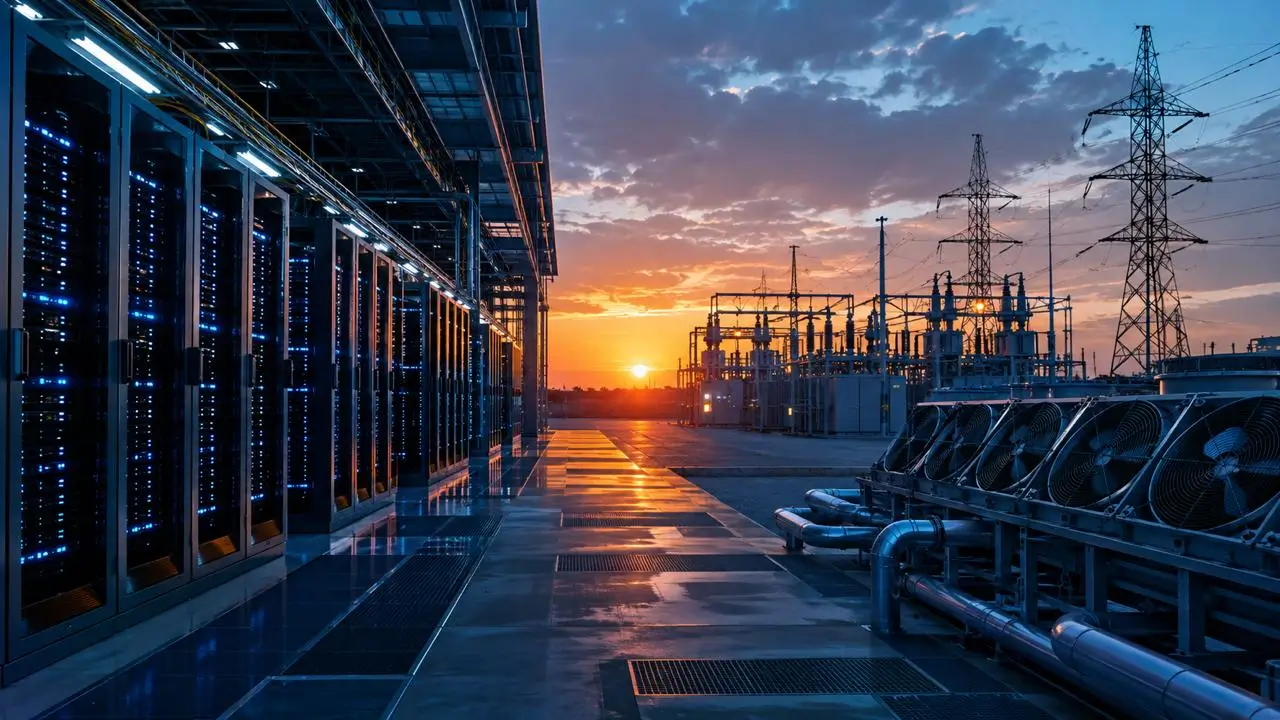
When Computing Starts to Test the Physical World
The most important changes in computing infrastructure are not always visible on a processor specification sheet, and some of the most consequential engineering decisions now happen far away from the software that ultimately runs on the machine. A modern AI system depends on a chain that extends from processors and memory to networking, electrical distribution, thermal management, and the systems that remove heat from the building. The performance of that chain depends on how effectively its individual parts work together rather than on the capability of any single component in isolation. AI has made those relationships more visible because many modern workloads place demanding requirements on infrastructure, with accelerated computing systems moving substantial volumes of data between processors, memory, storage, and networking layers during computation.

The future of AI infrastructure requires a broader perspective in which the data center is not simply a place where computing equipment operates, but an integrated environment where energy, thermal management, and workload behavior must be considered together. Understanding that shift requires looking beyond individual accelerators and examining how the entire architecture changes when computation becomes denser, more interconnected, and more power intensive. Conventional data centers generally evolved around established relationships between compute capacity and the infrastructure required to support it. Servers commonly occupied standardized racks, while power distribution followed established electrical architectures and cooling systems often relied on airflow management alongside chilled-water, refrigerant-based, or other heat-rejection approaches. AI changes that relationship because many AI systems use accelerated computing architectures that concentrate substantial processing capability into tightly connected systems, increasing the importance of electrical delivery, networking, and thermal management.
Higher compute density creates a corresponding concentration of electrical demand and heat generation, which encourages engineers to reconsider how power reaches the rack, how cooling reaches the hardware, and how quickly heat can move away from the components that produce it. The challenge does not exist independently at each layer because changes in one part of the system can create constraints elsewhere, such as higher-density computing potentially requiring different cooling approaches that can affect water systems, pumping requirements, electrical loads, and building design. AI infrastructure evolution can therefore be understood as a progression toward greater coordination among data-center components and the physical systems that support them. Traditional scaling often involved adding servers, racks, or buildings within established infrastructure patterns, whereas many AI workloads increasingly depend on connecting specialized processors into tightly coordinated systems.
The performance of such systems depends not only on the raw capability of each processor but also on how efficiently data moves between processors and how reliably the surrounding infrastructure maintains operating conditions. A cluster can contain powerful compute hardware and still underperform if its network fabric introduces excessive latency, its memory hierarchy limits data movement, or its cooling system cannot sustain the required operating profile. The physical infrastructure must therefore support computational coordination as much as computational capacity, particularly when workloads distribute computation across large numbers of accelerators. As AI systems continue to expand, the boundary between computing architecture and data-center architecture can become less distinct because the performance of computing systems increasingly depends on the design of power, cooling, networking, and other supporting infrastructure. The result is a shift toward an infrastructure model in which the physical environment becomes an increasingly important part of the computing architecture itself.

From General-Purpose Data Centers to AI-Centric Infrastructure
Accelerated computing changes infrastructure requirements. Specialized processors execute parallel workloads more efficiently than conventional CPU architectures for many AI tasks. The resulting systems often combine CPUs with GPUs or other accelerators, high-bandwidth memory, specialized networking, and software stacks that coordinate computation across multiple devices. This arrangement increases the importance of physical density for many AI systems because performance can benefit from bringing substantial processing capability into tightly connected clusters rather than relying exclusively on loosely coupled servers. Engineers must account for the electrical characteristics of the complete system, including power conversion, voltage regulation, transient behavior, and the distribution of energy across densely populated racks. Thermal design also becomes more closely connected to compute architecture because concentrated processing creates localized heat loads that traditional airflow-based cooling may struggle to manage efficiently.
The infrastructure challenge is therefore not simply to provide more electricity or install more cooling capacity, but to create an environment in which high-density computing can operate reliably without allowing electrical or thermal constraints to reduce system performance. A conventional server rack can contain independent systems that perform different tasks, while some AI-oriented rack architectures function as tightly integrated computational units in which multiple accelerators cooperate on the same workload. Power distribution must account for concentrated loads, cooling must remove heat from specific components, and networking must connect the rack to the broader computational fabric. The rack itself is increasingly treated in some AI infrastructure designs as an integrated engineering unit that brings computation, networking, power delivery, and thermal management into closer coordination.
That approach changes the physical meaning of the rack because engineers must consider not only how much equipment fits inside it but also how the equipment receives power, exchanges data, and transfers heat. The practical capacity of the rack therefore depends on the interaction between several infrastructure layers rather than on the number of servers that can physically occupy the available space. This systems-level view is becoming increasingly relevant as accelerated computing architectures place greater demands on the infrastructure surrounding individual processors. When more processing capability occupies the same physical area, electrical distribution becomes more complex because power delivery must support higher localized demand and maintain stable operation across the system. Thermal systems face a similar challenge because the amount of heat generated within a localized area can exceed the practical capacity of conventional room-level air management.
Direct-to-Chip Liquid Cooling
Liquid cooling has therefore gained importance in discussions of AI infrastructure because liquids can transfer heat more efficiently than air in many engineered systems and can bring heat removal closer to the components that generate it. The adoption of liquid systems does not eliminate the need for air cooling because many infrastructure elements and components can continue to rely on air-based thermal management. AI infrastructure evolution is therefore encouraging cooling design to move beyond room-level airflow considerations toward integrated thermal engineering that considers heat removal from the processor through to the external heat-rejection environment. That change places thermal design closer to the center of infrastructure planning because cooling architecture can influence rack configuration, power density, mechanical systems, maintenance procedures, and building requirements.
From Rack Density to System Density
The distinction between rack density and system density becomes important when evaluating how AI infrastructure scales. A rack can hold a particular quantity of hardware, but the computational system may extend across several racks connected through high-performance networking and shared infrastructure. The resulting architecture depends on more than the physical density of individual servers because processors, memory, networking, power systems, and cooling equipment all contribute to the performance of the complete system. AI workloads can require frequent communication between accelerators, which makes the arrangement of those components and the performance of the interconnect fabric relevant to the efficiency of the workload. A system that places substantial compute capacity into a tightly coordinated environment may therefore require infrastructure that can deliver power and remove heat with similar precision.
The engineering challenge shifts from maximizing the number of machines in a room toward balancing computational density with the electrical, thermal, and networking conditions required for useful performance. The physical layout of an AI system can influence how efficiently data travels, how cables are routed, and how cooling systems interact with the hardware. Network topology can affect the distance between communicating components, while rack placement can influence the design of power distribution and liquid-cooling infrastructure. These relationships become more significant when systems operate as coordinated clusters rather than as collections of independent servers. A data center designed around conventional server patterns may require architectural changes when it is adapted to support tightly interconnected, high-density AI clusters, depending on its existing power, cooling, and networking capabilities.
The extent of those changes will vary according to the original design of the facility, the density of the new computing equipment, and the type of cooling and power systems available. AI infrastructure consequently creates a stronger connection between computational topology and physical infrastructure planning than many conventional workloads require. This relationship also changes how infrastructure engineers think about capacity because computational performance can depend on whether supporting systems can sustain the conditions required by the workload. A processor can deliver substantial theoretical performance, but the system may fail to realize that capability if data cannot reach the processor at the required rate or if power and thermal constraints limit sustained operation. This can create a relationship between network performance and energy efficiency because underutilized accelerators continue to consume energy while delivering less useful computational output.
The same principle applies to cooling because insufficient thermal capacity can constrain the operating conditions of high-performance systems even when computational hardware remains available. AI infrastructure evolution increasingly emphasizes systems-level engineering, where performance gains can come from improving interactions between subsystems rather than optimizing individual components independently. The result is an infrastructure model in which useful computational capacity depends on the quality of the complete system rather than the specification of any isolated component.
Power Becomes a Primary Design Constraint
Power has always mattered to data-center engineering, but the expansion of accelerated computing places greater attention on how electricity enters the facility, moves through distribution systems, reaches high-density equipment, and ultimately becomes useful computation. AI infrastructure can concentrate significant electrical demand into relatively compact computing systems, increasing the importance of electrical design at rack, room, building, and grid levels. The engineering problem extends beyond the total amount of electricity available because power quality, conversion efficiency, distribution architecture, redundancy, and transient behavior all influence system performance. Power conversion introduces electrical losses that ultimately become heat, connecting electrical efficiency directly with thermal management requirements. The infrastructure therefore needs to manage electricity as both a computational input and a source of thermal load. This relationship becomes particularly important when accelerated computing systems operate at high utilization for extended periods.
Power Distribution Beyond Rack-Level Design
Power distribution must also account for the behavior of modern computing equipment rather than treating every electrical load as constant and interchangeable. Accelerated systems can produce demanding electrical profiles that require careful coordination across power supplies, distribution equipment, backup systems, and facility-level infrastructure. Engineers must consider how power reaches the rack, how conversion stages affect efficiency, and how electrical infrastructure responds when equipment changes operating conditions. Every conversion stage introduces some level of electrical loss, although the number and nature of those stages vary across architectures. Those losses ultimately contribute to heat and therefore influence the thermal burden that the facility must manage. Power architecture and cooling architecture consequently need to be considered together when infrastructure designers evaluate the practical capacity of high-density AI environments.
Reliability introduces another dimension because computing systems depend on stable electrical supply and carefully designed backup arrangements. UPS systems, batteries, generators, electrical distribution equipment, and control systems can all contribute to maintaining continuity when the primary supply changes or becomes unavailable. The importance of each layer depends on the workload, service requirements, and architecture of the data center. Interruptions can also affect distributed AI workloads differently depending on how applications handle checkpointing, restart behavior, and state recovery. A system that must repeat computational work after an interruption can experience additional resource consumption, while a system with effective checkpointing may recover with less repeated computation. Power infrastructure therefore becomes part of the performance and resilience architecture rather than remaining a separate utility layer.
Grid Capacity and the Geography of Computing
The growth of AI computing connects data-center development more directly with electricity infrastructure because large computing sites require reliable access to substantial power. The International Energy Agency identifies data centers as an increasingly important source of electricity demand and highlights the potential for grid constraints to influence the pace and location of future development. The issue is not limited to the quantity of generation available because transmission capacity, distribution infrastructure, interconnection processes, and local grid conditions can all influence whether a proposed site can support additional demand. A data center may therefore have sufficient physical space and cooling potential while still facing limitations related to electricity availability. These constraints can influence site selection and the timing of infrastructure development.
The geography of AI infrastructure consequently depends not only on connectivity and land but also on the characteristics of the energy systems that serve each location. The relationship between computing and electricity availability also creates potential opportunities for workload flexibility, although the practicality depends heavily on the characteristics of individual workloads. Some computational tasks can tolerate changes in timing, location, or processing speed, while latency-sensitive workloads may require immediate access to computing resources. Workload orchestration could increasingly incorporate physical infrastructure conditions, potentially directing computational activity toward systems with available power, sufficient cooling capacity, or favorable operating conditions where workloads permit such flexibility.
Such approaches require software systems to understand infrastructure conditions and to make decisions without compromising application requirements. They also depend on sufficient visibility into power and thermal systems, as well as control mechanisms that can respond safely to changing conditions. The concept therefore represents an emerging area of infrastructure optimization rather than a universal operating model for AI computing. Organizations developing large computing capacity may examine combinations of grid supply, renewable generation, energy storage, and other power arrangements where these options align with their operational, regulatory, and technical requirements. The value of these approaches depends on the local electricity system, the availability of generation, the characteristics of the workload, and the design of the facility itself. Energy storage can support resilience and, in some architectures, provide additional flexibility in how electricity is supplied to computing systems.
Renewable generation can contribute to electricity supply but does not automatically remove the need for reliable grid connections or other forms of balancing capacity. The resulting infrastructure strategy therefore needs to account for both the technical behavior of computing workloads and the physical characteristics of the energy system. AI infrastructure is consequently becoming more closely connected to energy planning, although the specific combination of power resources will vary significantly by location and project design.
Cooling Moves Closer to the Compute
Cooling becomes more important as computing systems concentrate greater processing capability into smaller physical areas because the electrical energy consumed by computing ultimately produces heat that must be removed. Traditional air cooling can remain effective for many systems, but higher-density computing can create thermal conditions that require additional approaches. The challenge is not simply to reduce the temperature of a room because heat must move from individual components through cooling interfaces and eventually into an external heat-rejection system. The distance between the source of heat and the mechanism that removes it can therefore influence the effectiveness of the thermal architecture. AI infrastructure increasingly brings cooling considerations closer to the hardware because high-density accelerators can generate concentrated thermal loads. This shift has contributed to growing attention to direct-to-chip and other liquid-cooling approaches for high-performance computing environments.
Liquid cooling can take several forms, including direct-to-chip systems that use cold plates, immersion approaches that place equipment in a thermally conductive liquid, and hybrid architectures that combine liquid and air cooling. Each approach creates different requirements for pumps, heat exchangers, manifolds, fluid management, monitoring, and maintenance. The selection depends on the equipment, rack configuration, required thermal performance, operational model, and facility design. Liquids can transfer heat more effectively than air in many engineered applications, which makes them useful when thermal loads become concentrated. However, liquid cooling introduces its own engineering requirements because fluid circulation, leak detection, filtration, water quality, and service procedures become part of the infrastructure architecture. Cooling therefore moves closer to the compute without becoming a simple replacement of one technology with another.
The thermal path of a high-performance computing system extends from the processor to the cooling interface, through the fluid or air system, into heat exchangers and ultimately toward an external heat-rejection mechanism. Each stage affects the efficiency and reliability of the complete cooling chain. A failure or limitation at one point can influence the operating conditions of the equipment upstream because heat cannot remain indefinitely within the system. Engineers therefore need to consider thermal performance across the complete path rather than focusing exclusively on the processor or cooling plate. This approach also affects maintenance because liquid systems introduce components that require monitoring and servicing alongside the computing hardware. AI infrastructure consequently encourages a closer relationship between computational design and thermal engineering, particularly when the system operates at high density.
Water, Heat Rejection, and Thermal Resilience
The movement toward advanced cooling creates new questions about how heat ultimately leaves the data center. Cooling systems can rely on different combinations of air, water, refrigerants, evaporative processes, dry cooling, or hybrid approaches depending on the location and design. Water availability can therefore become an important consideration, particularly where cooling architectures use substantial water flows or depend on local environmental conditions. The relationship between water and computing is not uniform because different cooling technologies have different water requirements. Engineers must consider local climate, water availability, treatment requirements, discharge conditions, and the operational characteristics of the chosen system. AI infrastructure can therefore increase the importance of evaluating thermal architecture alongside local environmental and resource conditions.
Environmental conditions can also influence the performance of heat-rejection systems because outdoor temperature and humidity affect how efficiently certain cooling architectures operate. A facility located in a hot environment may face different thermal conditions from one operating in a cooler climate, even when both facilities use similar computing equipment. Seasonal changes can also influence cooling requirements and the amount of energy required to reject heat. AI infrastructure can increasingly benefit from active thermal management that considers computing behavior alongside installed cooling capacity. If workloads change substantially over time, the cooling system may experience corresponding changes in thermal demand, creating opportunities for control systems to adjust operation where the architecture supports such coordination. The resulting design challenge involves balancing thermal performance, energy consumption, water requirements, and operational reliability.
Thermal resilience depends on more than installing sufficient cooling capacity because the cooling system itself requires redundancy, monitoring, maintenance, and recovery mechanisms. High-density AI systems can make thermal failures more consequential because localized heat loads can be substantial and may become difficult to manage if cooling performance declines. Engineers can reduce these risks through redundant equipment, isolated cooling loops, monitoring systems, and operating procedures designed to respond to abnormal conditions. The appropriate level of redundancy depends on the architecture and reliability requirements of the computing environment. Thermal resilience therefore becomes a systems problem involving mechanical infrastructure, controls, sensors, operations, and workload behavior. As AI infrastructure becomes denser, the ability to detect and respond to thermal conditions becomes increasingly relevant to sustained system performance.
The Data Center Becomes a Tightly Integrated System
The increasing density of AI computing makes it harder to treat power, cooling, networking, and computing as completely independent infrastructure layers. A change in processor architecture can influence electrical demand, which can affect power distribution and increase thermal loads. Change in cooling architecture can affect rack design, mechanical systems, water requirements, and maintenance procedures. A change in networking topology can influence rack arrangement, cable pathways, and the physical relationship between computing systems. The data center is therefore increasingly designed and operated as an integrated system whose performance depends on the quality of these interactions. This systems approach does not eliminate the need for specialized engineering disciplines but requires those disciplines to coordinate more closely.
The physical arrangement of equipment becomes particularly important when infrastructure must support high-density accelerated computing. Rack layout affects power distribution, cable management, cooling connections, and service access. Liquid cooling can introduce manifolds and distribution systems that require space and maintenance pathways beyond those needed for conventional air-cooled servers. Networking systems can also influence rack placement because tightly connected clusters may require specific cabling and interconnect arrangements. These factors mean that infrastructure planning must consider the complete system rather than treating each rack as an isolated unit. The practical result is a stronger connection between the computational architecture and the physical environment in which it operates.
AI infrastructure can increasingly benefit from sophisticated control architectures that account for relationships between workload behavior and infrastructure conditions alongside the underlying physical capacity. Sensors can provide information about temperature, power consumption, flow rates, equipment status, and other operating conditions. Software systems can then use this information to improve monitoring, detect abnormal behavior, and support operational decisions. The level of automation depends on the capabilities of the infrastructure and the degree to which different systems expose usable telemetry and control interfaces. Such approaches do not replace physical infrastructure because software cannot overcome fundamental limitations in power or cooling capacity. They can, however, improve the ability to understand how infrastructure behaves under changing computational conditions. U.S. Department of Energy — Data Centers
Hyperscale Changes the Meaning of Infrastructure Expansion
Hyperscale AI infrastructure can benefit from standardization, modular design, and careful coordination between physical and computational systems. Standardized designs can simplify deployment and maintenance by reducing unnecessary variation across repeated infrastructure components. Modular approaches can also allow capacity to be added in stages rather than requiring every part of a site to be built simultaneously. The usefulness of these strategies depends on the specific architecture, because some systems require specialized designs that cannot be easily standardized across all environments. AI infrastructure nevertheless creates strong incentives to repeat successful engineering patterns when large numbers of similar systems need to operate together. The challenge lies in maintaining consistency without preventing the architecture from adapting to changes in processors, cooling technologies, networking systems, and power requirements.
Modular infrastructure becomes particularly valuable when computing technology changes faster than the physical building that supports it. A data center may operate for many years while processors, networking technologies, and cooling requirements evolve within that period. Engineers therefore need to consider whether power distribution, cooling systems, floor layouts, and service pathways can accommodate future equipment. AI infrastructure can benefit from this approach because accelerated computing systems often use consistent configurations across large clusters to support predictable performance. Modular design can also reduce the complexity of deploying additional capacity when the underlying infrastructure has already been engineered for repetition. The effectiveness of modularity, however, depends on the degree to which future technologies remain compatible with the original design assumptions.
Future data centers will increasingly benefit from flexible architectures capable of supporting multiple generations of computing technology while maintaining predictable operational behavior. This flexibility can involve physical systems, power distribution, cooling infrastructure, networking, and software controls rather than any single component. Engineers must consider how new hardware can enter an existing environment without creating unacceptable electrical or thermal constraints. They must also account for the possibility that newer processors may change the density and shape of infrastructure requirements. A facility designed around one generation of computing equipment may therefore require adaptation as new architectures emerge. Hyperscale infrastructure increasingly needs to balance standardization with the ability to accommodate technological change.
Scaling Across Multiple Data Halls and Sites
AI systems can scale across multiple data halls or locations when the computational architecture and networking infrastructure support such arrangements. Within a single site, multiple halls can host different portions of a broader computing environment while sharing power, cooling, and operational systems. Across locations, networking becomes more important because data must travel between environments when workloads require distributed computation or shared resources. Where workloads require coordination across locations, the infrastructure must combine local computing capacity with networks capable of moving data between environments as required. The practical requirements depend heavily on latency, bandwidth, data locality, workload design, and the degree of synchronization required by the application. Multi-site infrastructure therefore introduces additional engineering considerations beyond simply adding more physical computing capacity.
AI infrastructure can become more dynamic at both the software and physical-resource levels as workload management becomes more closely connected with available computing, power, and cooling capacity. This approach requires orchestration systems capable of understanding resource availability while maintaining application requirements and performance objectives. A workload that can tolerate location changes or timing flexibility may have more opportunities for dynamic placement than a tightly synchronized training workload. The infrastructure must therefore distinguish between workloads according to their technical characteristics rather than assuming that all computational tasks can move freely. Such flexibility can create opportunities to use available capacity more efficiently, but it also increases the complexity of orchestration and monitoring. The broader direction points toward greater coordination between software scheduling and physical infrastructure conditions, although the extent of adoption will vary by architecture.
Future hyperscale data centers are likely to use common engineering frameworks while adapting individual implementations to the physical realities of each location. A site with strong grid connectivity may have different power options from a site where transmission capacity is constrained. A location with different climate conditions may require another approach to heat rejection, while water availability can influence cooling decisions. Network connectivity can also affect whether a location is suitable for particular AI workloads. The result is not a single universal hyperscale blueprint but a family of architectures that share common principles while adapting to local conditions. This infrastructure therefore needs repeatable engineering methods that remain flexible enough to accommodate differences in energy, climate, connectivity, and regulatory environments.
Efficiency Shifts From Component Optimization to System Optimization
Efficiency in AI infrastructure cannot be evaluated solely by examining the energy consumption of individual processors because the complete system includes memory, networking, power conversion, cooling, storage, and other supporting equipment. A highly efficient accelerator can still operate within a system that consumes substantial additional energy through supporting infrastructure. The useful measure therefore depends on the relationship between the energy consumed and the computational work delivered. This does not make component efficiency irrelevant because processors remain a major part of the energy profile. It does, however, highlight why system-level optimization becomes increasingly important as infrastructure grows in scale. The engineering challenge is to reduce unnecessary energy use across the complete path from electricity input to useful computational output.
Training and inference can also create different infrastructure requirements because their computational patterns and operating profiles are not identical. Training workloads can involve sustained, highly coordinated computation across large numbers of accelerators, while inference workloads can vary according to user demand, application design, and latency requirements. Some inference systems may experience predictable demand, while others can fluctuate significantly over time. The infrastructure must therefore consider workload behavior when evaluating capacity, utilization, and efficiency. A system optimized for one workload profile may not deliver the same efficiency under another profile. AI infrastructure planning consequently benefits from understanding the specific computational behavior of the workloads it is intended to support.
Data movement represents another important part of system efficiency because processors often depend on continuous access to data from memory and other computing resources. Moving data consumes energy and can introduce latency, particularly when information travels across increasingly complex system architectures. The location of data relative to the processor can therefore influence both performance and energy behavior. High-performance networking can reduce communication bottlenecks, but it also introduces additional equipment and energy requirements that must be considered at system level. The goal is not necessarily to minimize networking infrastructure but to ensure that the computational value delivered by the network justifies its energy and operational cost. These systems therefore requires a balanced approach in which computation, data movement, memory, networking, power, and cooling are optimized together.
Workload-Aware Infrastructure
Workload-aware infrastructure begins with the recognition that not every computational task places the same demands on physical systems. Training, inference, data processing, storage, and supporting services can have different requirements for compute, memory, networking, power, and latency. Infrastructure management can use this information to allocate resources according to the needs of each workload. This approach can improve utilization by reducing situations in which high-capacity resources remain allocated to tasks that do not require them. It can also help operators understand how demand changes over time and where infrastructure capacity may become constrained. The value of workload awareness therefore comes from connecting computational requirements with the physical resources available to satisfy them.
Thermal-aware workload management represents one emerging extension of this model. If certain systems approach thermal limits while others retain available cooling capacity, software could potentially influence workload placement in architectures that expose sufficient thermal telemetry and control capability. Such a system would need accurate information about temperatures, cooling conditions, workload requirements, and available computational capacity. It would also need to avoid creating new bottlenecks by moving workloads too aggressively or placing them in locations that introduce networking constraints. Thermal-aware scheduling therefore requires coordination between infrastructure telemetry and workload orchestration rather than a simple software rule. The approach remains an emerging area, but it illustrates how physical infrastructure conditions could become more relevant to computational scheduling. U.S. Department of Energy — Data Centers
As AI infrastructure grows in scale and complexity, cross-layer visibility can become increasingly important because manual interpretation of isolated infrastructure signals becomes more difficult. Operators may need to understand how processor utilization relates to power consumption, how power affects thermal conditions, and how thermal conditions influence workload performance. This requires data from multiple systems to be collected and interpreted within a common operational context. Monitoring tools can provide the visibility needed to identify relationships that would remain hidden when each infrastructure component is examined separately. The challenge is to create useful information without overwhelming operators with disconnected measurements. The AI infrastructure increasingly benefits from observability that connects computational behavior with the physical systems supporting it. U.S. Department of Energy — Data Centers
The Next Infrastructure Boundary Is the Energy System
The data center is increasingly connected to a larger energy and computing ecosystem in which electricity supply, grid capacity, and computational demand can influence one another. AI growth can increase electricity requirements, while limitations in grid infrastructure can affect the timing and location of data-center development. The relationship operates in both directions because large computing sites can also introduce new demand patterns into local energy systems. The resulting infrastructure challenge extends beyond the boundaries of the data-center building. Engineers and planners must consider how the site connects to the wider electrical network and whether that network can support the intended computing capacity. AI infrastructure increasingly intersects with energy-system planning as computing demand grows.
Some data-center workloads may be flexible enough to adjust their timing or processing location in response to power conditions, provided that application requirements permit such changes. This possibility creates a potential connection between workload orchestration and energy management. Flexible workloads could, in suitable architectures, be scheduled during periods when power availability is more favorable or moved between locations with sufficient capacity. Such strategies require careful consideration of latency, data movement, application deadlines, and operational reliability. They therefore cannot apply equally to every AI workload or every computing environment. The concept remains technically relevant because the growth of AI computing creates greater interest in how computational demand interacts with electricity systems.
Energy storage can also interact with backup power architecture, creating opportunities to coordinate resilience and energy management where system design and operating requirements allow. Storage can provide backup capability while also supporting other electrical functions depending on the configuration and control strategy. The value of such systems depends on the duration of support required, the characteristics of the electrical load, and the relationship between the storage system and other power infrastructure. Storage does not eliminate the need for reliable grid connections or other backup mechanisms in every environment. Its role instead depends on how the data center integrates batteries, UPS systems, generators, renewable generation, and grid supply. The broader direction is toward greater coordination between computing infrastructure and the energy systems that support it. U.S. Department of Energy — Energy Storage Grand Challenge
Energy Flexibility as an Infrastructure Capability
AI infrastructure may therefore evolve toward more sophisticated coordination between workload scheduling and energy management in applications where workloads offer sufficient flexibility. Such coordination could involve shifting computational timing, selecting among available locations, or adjusting resource allocation according to energy conditions. The practicality of these approaches depends on the ability of software systems to understand both application requirements and infrastructure availability. A workload that requires strict latency or continuous execution may have limited flexibility, while a batch-oriented task may provide more opportunities for scheduling changes. The infrastructure must therefore classify and manage workloads according to their technical characteristics. Energy flexibility is consequently better understood as a capability that applies to suitable workloads rather than as a universal property of AI computing.
Energy flexibility can allow infrastructure to respond to changes in supply and demand while maintaining essential computing operations, provided that flexible workloads and appropriate control mechanisms are available. Storage can provide another layer of flexibility by supporting electrical continuity or helping manage changes in supply. Grid interaction can also influence the design of large computing sites because electricity availability and network constraints may vary over time and by location. These capabilities require careful coordination because the priority remains maintaining the required level of service for critical workloads. Energy management therefore needs to operate within the boundaries established by computational requirements rather than overriding them. The objective is to create additional operating options without compromising the reliability or performance of essential systems. U.S. Department of Energy — Energy Storage Grand Challenge
A potential goal is to create infrastructure that can operate intelligently within the constraints of the energy system without making critical computing services dependent on variable energy conditions. This approach recognizes that AI infrastructure requires reliable electricity while also acknowledging that some computational demand may offer flexibility. The distinction between flexible and non-flexible workloads becomes important because not every task can respond to changes in power availability. Infrastructure operators therefore need to understand which workloads can move, pause, or change timing and which workloads require continuous availability. The resulting architecture can combine reliable baseline capacity with flexibility where the workload permits it. Such a model represents an emerging direction in the relationship between computing infrastructure and energy systems rather than an established standard across all AI facilities.
Cooling and Power Will Shape the Physical Limits of AI Scale
The physical architecture is likely to evolve as the relationship between computing, power, cooling, networking, and space changes with increasing system density and interconnection. Higher-density computing can place greater demands on electrical distribution while creating more concentrated thermal loads. Networking requirements can also affect physical layouts because tightly coordinated systems may require specific interconnect arrangements. These factors influence the practical capacity of a data center even when sufficient physical floor space remains available. A building may have room for additional equipment but lack the power or cooling systems required to operate that equipment effectively. AI infrastructure therefore makes the relationship between physical space and usable capacity more complex.
The practical limits of AI infrastructure depend on how effectively electricity can reach computing equipment and how efficiently heat can leave the system. Cooling capacity cannot be evaluated independently from power because most electrical energy consumed by computing ultimately becomes heat that must be managed. Power availability cannot be evaluated independently from cooling because additional electrical capacity may create additional thermal requirements. Networking cannot be evaluated independently from physical layout because high-performance communication systems require appropriate interconnects and pathways. The result is a network of constraints in which increasing one form of capacity may expose limitations elsewhere. As a result AI infrastructure requires engineers to evaluate capacity as a multidimensional property rather than as a single measure of installed computing hardware.
Software can contribute to this infrastructure model by helping operators understand changing workload requirements and infrastructure conditions. Monitoring systems can identify changes in power consumption, temperature, cooling performance, or equipment utilization. Orchestration systems can potentially respond to those conditions when workloads and infrastructure architectures support dynamic management. Such capabilities cannot replace physical capacity, but they can improve the way available resources are used. AI infrastructure can increasingly benefit from control architectures that account for relationships between workload behavior and infrastructure conditions alongside the underlying physical capacity. The result is a more integrated operating model in which software becomes an additional mechanism for managing physical constraints. U.S. Department of Energy — Data Centers
Thermal Architecture as a Scaling Factor
Future data-center design is likely to treat thermal architecture as an increasingly important determinant of practical computational capacity. The reason is straightforward: computing equipment can only operate within specified thermal conditions, and the infrastructure must continuously remove the heat generated during operation. As compute density increases, thermal management can become more challenging because heat becomes concentrated in smaller areas. Liquid cooling can address some of these challenges by bringing heat transfer closer to the source. The adoption of such systems, however, also changes the mechanical infrastructure required to circulate fluids and reject heat. Thermal architecture therefore becomes part of the capacity equation rather than a secondary consideration added after computing systems are selected.
The increasing integration of AI computing, power, cooling, and physical infrastructure can encourage closer collaboration among computational, electrical, mechanical, and architectural disciplines during early design. Decisions about processors can influence power requirements, while power decisions can influence cooling requirements. Cooling decisions can affect building systems, water infrastructure, maintenance access, and equipment layout. Networking decisions can influence rack arrangement and physical pathways. These relationships mean that design choices made early in a project can influence constraints encountered later during deployment. The engineering process therefore benefits when infrastructure disciplines consider these dependencies before the physical environment becomes difficult to change.
The physical limits of cooling also influence how infrastructure can scale over time. Adding more computing equipment may require additional cooling capacity, but adding cooling equipment can itself require more power and physical space. A new cooling architecture may also require changes to piping, pumps, heat exchangers, or heat-rejection systems. These dependencies make thermal planning a long-term infrastructure concern rather than a one-time equipment decision. AI infrastructure can increasingly benefit from control architectures that account for relationships between workload behavior and infrastructure conditions alongside the underlying physical capacity. The result is an engineering environment where computational growth must remain aligned with the thermal systems capable of supporting it.
Power Architecture as a Scaling Factor
Power architecture is a genuine scaling constraint because computing systems cannot operate beyond the electrical capacity available to them. The challenge becomes more complex when systems concentrate large amounts of computational capacity into smaller physical areas. Electrical distribution equipment must deliver power reliably while managing conversion losses, redundancy, protection, and maintenance requirements. These requirements influence the physical design of racks, rooms, electrical pathways, and building systems. AI infrastructure places greater emphasis on the relationship between computational capacity and electrical architecture. The practical limit of a computing environment depends partly on whether its power systems can sustain the equipment it is intended to operate.
Electrical efficiency also affects thermal requirements because energy lost during power conversion ultimately becomes heat. Improving electrical efficiency can therefore reduce the amount of heat that cooling systems must remove, although the relationship depends on the specific architecture. Power systems must also accommodate the operating characteristics of computing equipment rather than assuming that every load behaves identically. UPS systems, power supplies, distribution equipment, and backup systems all contribute to the overall electrical architecture. These components require careful coordination when computing density increases. Power architecture consequently becomes part of the thermal and operational design of AI infrastructure. U.S. Department of Energy — Data Centers
The relationship between AI computing and electricity infrastructure extends beyond the data center itself. The International Energy Agency’s analysis identifies data-center growth as an emerging source of electricity demand and examines the implications for grids, generation, and infrastructure planning. This means that AI infrastructure expansion can encounter constraints outside the physical boundaries of the computing facility. Transmission capacity, distribution infrastructure, interconnection timelines, and local electricity availability can all influence the feasibility of new capacity. Large AI facilities therefore need to consider both internal electrical architecture and external grid conditions. Power becomes a scaling factor at multiple levels, from the processor to the rack, the building, the site, and the wider energy system.
The Future Data Center Will Be Designed Around Constraints
The future of AI infrastructure is unlikely to be shaped simply by adding more computational hardware to existing data centers. Physical infrastructure imposes constraints that cannot always be solved by purchasing additional servers or accelerators. Power systems must have sufficient capacity, cooling systems must remove the resulting heat, and networks must connect the equipment at the required performance levels. Space must also support maintenance, service access, cable routing, and mechanical infrastructure. These requirements mean that computational capacity is increasingly tied to the physical systems surrounding it. The infrastructure challenge therefore involves understanding which constraint limits useful capacity first and designing the system accordingly.
Capacity is therefore multidimensional because a facility can have available floor space without having sufficient electrical capacity or cooling capability. It can have electrical capacity without sufficient grid connectivity, or cooling infrastructure without the networking required by the workload. The same principle applies at smaller scales because a rack can physically accommodate equipment that its power or cooling systems cannot safely support. AI infrastructure requires capacity planning that considers these relationships simultaneously. Engineers must understand not only how much hardware can be installed but also how much useful computation the complete system can sustain. This distinction between installed hardware and usable capacity becomes increasingly important as systems become denser.
Future data centers will increasingly benefit from flexible platforms capable of supporting multiple generations of computing technology while maintaining predictable operational behavior. Such flexibility can involve modular power systems, adaptable cooling infrastructure, standardized networking, and software-defined management. The objective is not to predict every future technology but to create infrastructure that can accommodate reasonable changes without requiring complete reconstruction. This approach can reduce the risk that a facility becomes constrained by assumptions made during its original design. The effectiveness of flexibility depends on how well the architecture anticipates changes in power density, thermal requirements, networking, and equipment dimensions. AI infrastructure increasingly needs to balance present performance with the possibility of future technological change.
Building Infrastructure That Can Adapt
Standardization can make infrastructure easier to deploy, operate, and maintain, but excessive standardization can also create limitations when technology changes. Engineers therefore need to identify which interfaces and design principles should remain consistent and which components require flexibility. Power connections, cooling interfaces, network architectures, and physical dimensions can all influence the ability to replace or upgrade equipment. Modular systems can simplify this process when they provide clear boundaries between components. The challenge is to create enough standardization to support repeatability while preserving the flexibility required by evolving computing systems. This balance becomes more important when facilities operate for many years across multiple generations of technology.
As infrastructure becomes more complex, maintaining visibility into relationships between systems can become increasingly important compared with monitoring each component in isolation. A rise in processor utilization may influence power demand, which can increase heat generation and affect cooling requirements. Changes in network traffic can also influence equipment utilization and energy consumption. Operators therefore benefit from understanding these relationships rather than examining each metric independently. Predictive maintenance can add another layer by using historical and real-time information to identify potential equipment issues before they become operational problems. The effectiveness of such approaches depends on the quality of available telemetry and the ability of monitoring systems to interpret it correctly. U.S. Department of Energy — Data Centers
Adaptability also depends on the ability to replace individual infrastructure components without disrupting the entire computing environment. This requires thoughtful design of electrical systems, cooling loops, networking connections, and service pathways. A modular approach can help isolate changes, but the effectiveness depends on the boundaries established by the original architecture. The infrastructure must also support maintenance activities without compromising the operation of other systems. These requirements become more challenging as computing density increases because equipment may have greater dependencies on shared power, cooling, and networking resources. Future infrastructure design therefore needs to consider not only how systems operate at full capacity but also how they can be maintained and modified over their operational life.
The Path From Hyperscale Data Centers to AI Infrastructure Ecosystems
AI infrastructure is increasingly being developed within a broader computational and energy ecosystem in which the data center interacts with power systems, networks, cooling resources, and software orchestration. The data center remains the physical location where computing equipment operates, but its performance depends on external systems that provide electricity, connectivity, and other essential resources. Grid conditions can influence where facilities are developed, while networking can influence how computing resources are connected across locations. Cooling architecture can also depend on local climate and resource availability. AI infrastructure increasingly requires engineers to consider the relationship between the data center and the wider systems that support it.
The growing scale of AI computing also creates a stronger relationship between software orchestration and physical infrastructure. Workload scheduling systems traditionally focused on allocating computing resources according to software requirements and available hardware. More complex environments can potentially incorporate information about power, cooling, network conditions, and physical location. Workloads can, in some architectures, move between locations based on available capacity, while energy-management systems can coordinate power use with computational demand where the workload and infrastructure support such coordination. These capabilities require careful integration because moving a workload can introduce data-transfer costs, latency, or operational complexity. The result is an emerging model in which physical infrastructure conditions may become additional inputs to computational scheduling.
The infrastructure ecosystem therefore extends from processors to energy systems and from individual racks to geographically distributed computing environments. Each layer introduces different constraints that can influence the performance of the others. The challenge is not simply to make every component more powerful but to ensure that the complete system can operate efficiently under real workload conditions. This requires coordination across computational architecture, networking, electrical systems, cooling, physical design, and software management. The result is an infrastructure model that increasingly resembles a connected engineering system rather than a collection of independent equipment categories. AI is not creating every element of this model from scratch, but it is making the relationships between them more difficult to ignore.
The Next Phase of Infrastructure Engineering
The technical challenge is increasingly shifting from building infrastructure optimized for current workloads toward architectures that can adapt as workloads and computing technologies evolve. Processor generations can change power requirements, memory architectures can alter data movement patterns, and networking technologies can change how systems communicate. Cooling systems may also need to evolve as thermal densities change. These developments create a need for infrastructure that can absorb technological changes without losing operational stability. The objective is not to design for every possible future scenario but to reduce the number of assumptions that could become constraints as technology advances. AI infrastructure increasingly rewards architectures that combine repeatability with adaptability.
AI infrastructure evolution is likely to depend increasingly on architectural discipline alongside advances in processors, cooling technologies, power systems, and networking. Better processors can improve computational performance, but their value depends on whether the surrounding infrastructure can deliver sufficient power, cooling, memory access, and network connectivity. Advanced cooling can support higher densities, but it introduces additional mechanical and operational requirements. Power systems can provide greater capacity, but they must remain connected to an energy system capable of supplying that capacity. Infrastructure engineering therefore becomes a coordination problem in which each technology must operate within the constraints created by the others. The future of AI infrastructure will consequently depend not only on individual technological advances but also on how effectively those advances are integrated into complete systems.
Future infrastructure designs are likely to place greater emphasis on treating electricity, heat, computation, and data movement as interconnected engineering considerations. This perspective does not mean that every data center will adopt identical architectures or that every workload will require the same level of integration. It means that the practical limits of AI computing increasingly emerge from interactions between systems that were once evaluated more independently. As AI systems continue to scale, an increasingly important question will be how effectively the surrounding infrastructure can evolve alongside the computing capacity being deployed. The answer will depend on the ability to coordinate power availability, thermal management, networking, physical design, and workload behaviorwithout losing reliability. The infrastructure that supports the next phase of AI will therefore be shaped as much by systems engineering as by the continued development of computing hardware.











