 Skip to content
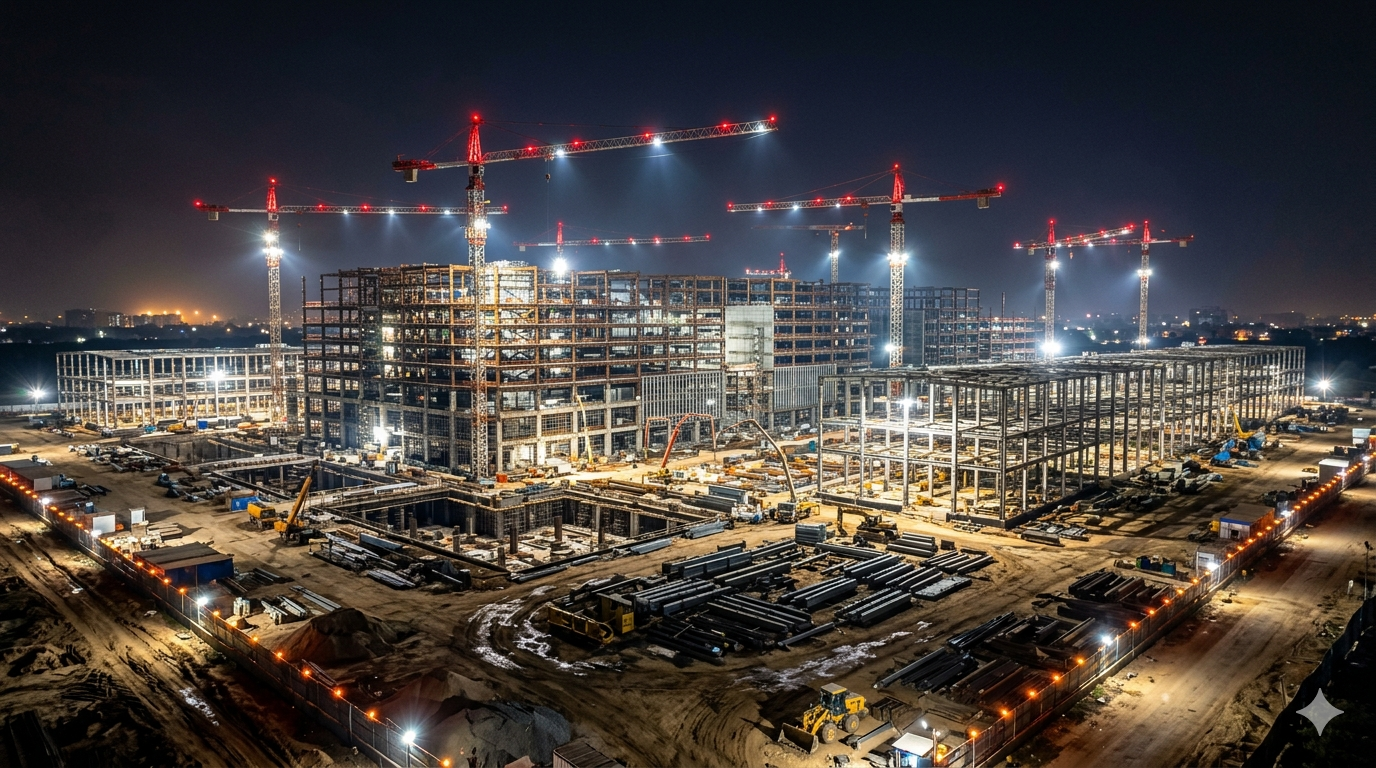
The numbers are so large they have become almost abstract. Amazon plans to spend $200 billion in capital expenditure in 2026. Alphabet is targeting $175 to $185 billion. Microsoft is on course for $120 billion or more. Meta has guided toward $115 to $135 billion. Oracle is pushing toward $50 billion. The five largest US technology companies will collectively deploy somewhere between $660 and $700 billion in infrastructure spending in 2026 alone, the majority of it directed at AI compute, data centres, and the equipment that powers them. Goldman Sachs projects that total hyperscaler capital expenditure from 2025 to 2027 will reach $1.15 trillion, more than double everything spent in the preceding three years.

The question this level of spending raises is not whether it is real. It is. The question is whether the returns that justify it will materialize on the timeline the investment requires and at the scale the capital deployment demands. The answer matters not only to the shareholders of the companies making these investments, but also to the broader ecosystem of infrastructure operators, equipment suppliers, colocation providers, and enterprise technology buyers. Their business models increasingly assume that this spending cycle reflects durable demand, not competitive fear expressed as strategic conviction.
The Revenue Gap That Nobody Is Ignoring
The revenue side of the AI infrastructure equation is real, growing, and still substantially smaller than the capital being deployed to serve it. AWS reached an annualised revenue run rate exceeding $140 billion and is growing at around 20 percent year on year, with a rising share of that growth attributable to AI workloads. Microsoft is targeting $25 billion in AI-related revenue by the end of fiscal 2026, driven by Copilot adoption, Azure AI services, and its partnership with OpenAI. Google Cloud is growing at comparable rates, with AI services becoming a meaningful and expanding share of that growth.
The aggregate AI-related services revenue across all of these platforms, however, remains a fraction of the capital being deployed to generate it. Estimates suggest that AI-related services delivered roughly $25 billion in revenue in 2025, against infrastructure spending that was already running in the hundreds of billions. Only about 25 percent of enterprise AI initiatives have delivered their expected return on investment to date. Fewer than 20 percent have scaled across entire enterprises. Companies are building infrastructure well ahead of the enterprise adoption curve that will ultimately fill it, and the gap between capital deployment and revenue generation is not a temporary anomaly. It is the defining financial characteristic of the current AI infrastructure cycle.
Why the Gap Does Not Mean the Investment Is Wrong
That gap does not mean the investment is wrong. Infrastructure investment by definition precedes the revenue it enables. AWS itself was deeply unprofitable for years before cloud computing adoption reached the scale required to justify the infrastructure AWS had built ahead of it. The question is not whether AI revenue will eventually reach the scale that justifies current infrastructure investment. It probably will. The question is how long it will take, what happens in the interim to companies and markets that have priced in rapid payback, and whether builders are designing today’s infrastructure for the market that will actually materialize rather than the one that looks most plausible from the vantage point of 2026.
The Competitive Compulsion Problem
Understanding why hyperscalers are spending at a pace that exceeds their ability to generate returns requires understanding the strategic dynamic that makes slowing down more dangerous than continuing. Each major hyperscaler’s AI infrastructure position is simultaneously a competitive asset and a competitive necessity. The companies that built the largest, most capable AI compute infrastructure earliest have secured the first-mover advantages that define market leadership in platform technology cycles: priority access to the latest hardware from Nvidia, faster model iteration cycles, exclusive enterprise relationships, and the ability to set pricing from a position of capacity abundance rather than scarcity.

Companies that fell behind in cloud infrastructure in the previous cycle spent years trying to close capacity gaps against Amazon Web Services and never fully succeeded. Every hyperscaler executive making capital allocation decisions in 2026 understands that lesson clearly. If they pause AI infrastructure investment now, even temporarily, they hand competitive positioning to rivals who keep building. They fall behind in hardware procurement queues where lead times stretch into years. They also arrive late to enterprise relationships that will form with providers who had capacity when demand materialised. This logic is compelling and individually rational. The collective result is an industry-wide surge in capital deployment that has outrun the revenue base it is meant to support.
Why Slowing Down Is the Riskier Choice
Strategic capital is now the primary determinant of competitive position in AI infrastructure in ways that make the spending decisions of individual companies difficult to evaluate in isolation. When Microsoft spends $37.5 billion in a single quarter on capital expenditure, it is not simply buying capacity. It is buying competitive positioning, strategic optionality, and a place in the queue for the hardware and talent that will determine who leads the next phase of AI platform development. The financial logic is secondary to the strategic logic, and the strategic logic is, at its core, about not being the company that ran out of compute when the market needed it.
The Enterprise Adoption Lag
The revenue gap between hyperscaler AI infrastructure investment and AI service revenue reflects an enterprise adoption dynamic that the infrastructure buildout has consistently outpaced. Enterprises are deploying AI, but the pace of deployment has been slower, more complex, and more expensive than the most optimistic projections assumed. The technical challenges of integrating AI into existing enterprise workflows, the compliance and governance requirements that regulated industries impose on AI deployment, the shortage of internal talent to manage AI implementations, and the genuine uncertainty about which AI applications deliver sufficient productivity gains to justify their cost have all contributed to an enterprise adoption curve that is real but gradual.
The critical distinction for infrastructure economics is between enterprise experimentation and enterprise production deployment. Experimentation generates AI service revenue, but it generates it sporadically, at relatively small volumes, with limited long-term contractual commitment. Production deployment, where enterprises integrate AI into core workflows and commit to sustained high-volume inference at scale, generates the steady, contracted, high-margin revenue that justifies infrastructure investment at the scale hyperscalers are currently committing. The transition from experimentation to production is underway but is not yet complete across most enterprise verticals, and the pace of that transition will determine how quickly the revenue gap narrows.
How Agentic Deployment Changes the Economics
GenAI’s double role as load creator and load orchestrator makes this dynamic complex. On one side, generative AI creates demand for infrastructure by generating inference workloads at a scale that previous AI applications never achieved. On the other side, the cost of serving generative AI inference at enterprise scale has created monthly cloud bills that enterprise technology executives are discovering are economically unsustainable, which in turn is creating pressure to move some workloads to on-premises or colocation infrastructure rather than continuing to consume them as cloud services. That demand shift changes the revenue picture for hyperscalers while adding to the demand signal for the broader infrastructure market.
The Infrastructure as Platform Argument
The strongest argument for the current level of AI infrastructure investment is the infrastructure as platform thesis. In this framing, the data centres, GPU clusters, networking fabric, and software stacks that hyperscalers are building are not simply capacity for current AI workloads. They are the platform layer on which the AI economy will operate for the next decade, in the same way that the cloud infrastructure built in the 2010s became the operational substrate for the software-as-a-service economy that generated trillions in value during that decade.
The platform argument has historical precedent that is genuinely compelling. The economics of cloud computing looked questionable at various points during AWS’s early years. The capital intensity was high, the revenue growth was impressive but the profitability was elusive, and the gap between the scale of investment and the immediate return was a persistent source of investor concern. AWS eventually generated economics that made the early investment look prescient by any reasonable measure. The argument that AI infrastructure will follow a similar trajectory is not unreasonable, and the hyperscalers making it are not simply rationalising reckless spending.
The important caveat is that the platform argument works best when the infrastructure being built becomes genuinely indispensable to the economy that grows on top of it. Cloud infrastructure became indispensable because the economics of operating software on cloud infrastructure were sufficiently superior to on-premises alternatives that the market converged on cloud as the dominant deployment model for most enterprise software. AI infrastructure will follow the same path if, and only if, AI capabilities become sufficiently integrated into enterprise operations that the compute required to run them becomes a non-discretionary cost rather than a discretionary investment.
The Lessons from Previous Infrastructure Overcycles
The historical record of infrastructure investment cycles offers both encouragement and caution for the current AI buildout. The telecommunications infrastructure investment cycle of the late 1990s, in which fibre optic networks and internet backbone capacity were built at a pace that massively exceeded near-term demand, ended badly for the companies that over-invested and the investors who funded them. It also created the physical infrastructure of the modern internet at a cost basis that made the subsequent information economy possible. The distinction between the infrastructure that survived the cycle and created lasting value, and the infrastructure that became stranded assets, came down largely to whether the physical assets retained their value even as the business models built around them failed.
AI infrastructure has some characteristics that compare favourably to the telecom overcycle. The equipment at the centre of AI infrastructure investment, specifically high-end GPU clusters, depreciates rapidly and has a useful life of three to five years rather than the decades-long useful life of fibre optic cables. That shorter depreciation cycle means the overcapacity risk is more self-limiting. Excess capacity that is economically stranded becomes physically obsolete on a timeline that prevents the most severe versions of the stranded asset problem that afflicted telecom infrastructure. The business models built around AI infrastructure also differ from telecom in that the hyperscalers spending on AI infrastructure are also the primary consumers of it, rather than building infrastructure to lease to third parties whose business models they could not control.
Why the Telecom Comparison Has Limits
The time-to-power crisis that constrains new AI infrastructure capacity coming online acts as a natural regulator on the pace of oversupply. If the primary constraint on the AI infrastructure buildout is the availability of grid power and electrical equipment rather than capital, then the infrastructure cycle cannot accelerate faster than the power infrastructure pipeline allows, which means the overcapacity risk is bounded by physical rather than purely financial constraints.
The Inference Revenue Case
The most credible near-term revenue justification for AI infrastructure investment is the inference workload. Inference, running trained AI models to serve predictions, generate content, and support automated decision-making at scale, now accounts for an estimated 60 to 70 percent of total AI compute demand at major hyperscalers. That share is growing as enterprise AI applications move from development to production and as the volume of AI-powered interactions at consumer scale continues to increase.
The inference revenue case is stronger than the training revenue case for several reasons. Inference workloads are continuous, predictable, and contracted in ways that training workloads are not. An enterprise that has deployed AI agents across its customer service operations needs continuous inference capacity to run those agents, generating predictable revenue that the infrastructure operator can plan around. Training workloads are sporadic and project-driven, generating revenue bursts that are harder to underwrite long-term infrastructure investment around.
The transition from training-dominated to inference-dominated AI workloads is therefore positive for the infrastructure revenue picture, even as it creates engineering challenges for facilities designed with training requirements as the primary specification. Inference at the scale that enterprise agentic AI deployment will generate is a large, durable, and growing revenue opportunity. The infrastructure being built today is well-positioned to serve that demand, and the economics of inference at scale, with high utilisation rates, long-term enterprise contracts, and growing workload volumes, are more attractive than the training-heavy early AI infrastructure economics that preceded them.
The Concentration Risk That Amplifies Everything
One of the most significant characteristics of the current AI infrastructure spending cycle is the concentration of investment in a small number of very large companies. The top five hyperscalers account for the overwhelming majority of AI infrastructure capital expenditure. Their financial health, their competitive positions, and their strategic decisions about AI investment pace are therefore the primary determinants of whether the infrastructure market continues at its current pace or decelerates.
That concentration creates a risk amplification dynamic. If any of the top five hyperscalers experiences a material change in its AI revenue trajectory, its access to capital markets, or its strategic assessment of AI infrastructure returns, the effect on the overall market is disproportionate. Oracle’s situation illustrates the risk: the company’s aggressive AI infrastructure commitment, combined with concentrated customer exposure through its partnership with OpenAI, has produced credit default swap spread widening and investor concern that a more diversified revenue base would absorb more easily.
The broader infrastructure ecosystem, including colocation operators, equipment suppliers, and the companies that provide the power and cooling infrastructure that AI data centres require, has built its business models around the assumption that hyperscaler spending will continue at or near current levels. Any material deceleration in that spending would cascade through the ecosystem in ways that would be felt well beyond the balance sheets of the hyperscalers themselves.
The Verdict the Market Has Not Yet Reached
The $700 billion question does not have a clean answer in April 2026. The spending is real. The infrastructure being built is genuine. The demand that will eventually fill it is coming, driven by enterprise adoption that is slower than the most optimistic projections but real and growing. The revenue gap between current infrastructure investment and current AI service revenue will narrow, and the infrastructure platform argument has historical precedent that gives it credibility.
What the market has not yet reached a verdict on is the timeline. If AI revenue reaches the scale required to justify current infrastructure investment within three to five years, the spending will look prescient and the financial structures built around it will prove sound. If the timeline extends to seven to ten years, the economics of the current investment cycle become substantially more challenging, the debt structures built to fund it will face refinancing conditions that may be materially different from today’s, and the companies that spent most aggressively will have carried the cost of that ambition for longer than their investors priced in.
What Enterprise AI Revenue Actually Looks Like at Scale
The revenue picture for AI infrastructure investment looks different depending on which enterprise segment you examine. The early adopters of AI at scale, large technology companies using AI to power consumer-facing products, search, recommendations, content moderation, and advertising optimisation, have been generating AI compute revenue for years. The infrastructure investment supporting those workloads has already demonstrated its returns, and the economics are well understood. The open question is about the next wave of enterprise adoption: the financial services firms, healthcare operators, manufacturers, and government agencies that are in the process of deploying AI across their core operations.
That second-wave enterprise segment is large enough to justify the current infrastructure buildout if it deploys AI at the depth that the first wave has. The aggregate IT spend of global financial services alone exceeds $600 billion annually. Healthcare technology spend runs in the hundreds of billions. Manufacturing digitisation is generating capital investment at comparable scale. If AI captures a meaningful fraction of that existing technology budget by delivering productivity improvements that justify the cost, the revenue opportunity is sufficient to absorb the infrastructure being built. The question is not whether the opportunity exists but whether the conversion from technology budget to AI workload will happen at the pace and depth that current infrastructure investment assumes.
Why Agentic AI Changes the Revenue Calculus
The agentic AI wave is the most significant near-term catalyst for the second-wave enterprise revenue case. Enterprises that deploy AI agents across their operations are not just experimenting with AI at the margin. They are integrating continuous inference workloads into core operational processes in ways that create durable, contracted, high-volume demand for AI compute. The economics of agentic deployment, once an enterprise has made the workflow integration investment, are very different from the economics of experimental API consumption. The infrastructure cost becomes operational rather than discretionary, and the revenue it generates becomes predictable rather than sporadic.
The Supply Side Constraints That Change the Risk Profile
Analysts focus more on the revenue risk in AI infrastructure investment than on the supply-side constraints that actually limit how much infrastructure companies can build and, in turn, how severe any overcapacity scenario can become. The time-to-power crisis that makes new AI infrastructure capacity difficult to bring online on compressed timelines is, paradoxically, one of the most important risk mitigants in the current investment cycle. A market that cannot build faster than the power supply chain allows cannot overshoot the demand curve by as much as a market with no physical constraints.
Grid connection delays in major markets now stretch three to five years. Transformer and switchgear supply chains face lead times of two to three years in some component categories. Permitting processes add further delays. The physical infrastructure required to power new AI data centers has become a binding constraint on how quickly companies can build. These limits mean that physical bottlenecks, not just capital, regulate how much new capacity can come online. Companies cannot easily accelerate past them. That natural cap on the pace of supply expansion reduces, though it does not eliminate, the risk of the severe overcapacity that defined the worst phases of earlier infrastructure cycles.
What Determines Whether the Investment Cycle Ends Well
The AI infrastructure investment cycle from 2024 to 2028 will ultimately be judged by three questions. First, does enterprise AI adoption reach the scale needed to fill the capacity being built? The evidence suggests it will, but on a timeline of five to seven years rather than two to three. Second, does the revenue generated by that adoption justify the cost structures of the infrastructure, including the debt servicing costs on the financing vehicles used to fund it? That depends heavily on the interest rate environment and the speed of adoption convergence. Third, does the infrastructure built today remain competitive long enough to generate the returns its economics require, or does hardware obsolescence create stranded asset risk before the investment cycle completes?
The hardware obsolescence question is the most specific to AI infrastructure and the least well understood by the financial community evaluating the investment cycle. GPU generations are cycling every 18 to 24 months. Facilities built around Blackwell hardware will need significant capital investment to accommodate Vera Rubin, and facilities built around Vera Rubin will need adaptation for whatever follows. Depreciation schedules for AI compute infrastructure must reflect rapid hardware cycles. Revenue models tied to specific infrastructure investments also need to account for the possibility that the hardware generating those revenues is replaced before the underlying facilities are fully amortized.
The Competitive Dynamics That Outlast the Cycle
Even in scenarios where the revenue timeline extends beyond current investment assumptions, the infrastructure built in this cycle will create competitive structures that outlast the immediate financial returns. The hyperscalers that build the largest, most capable AI infrastructure positions are simultaneously building barriers to entry that make it progressively harder for competitors to challenge them on cost, latency, or capability. A hyperscaler that has built a 10-gigawatt AI compute footprint and signed 15-year anchor tenant agreements across major markets has created a competitive moat that its capital structure needs to sustain until the revenue base grows into it, but the moat itself is real regardless of the timing of the revenue.
The Cost of Sitting the Cycle Out
That competitive dynamic is part of why the spending continues even as the revenue gap remains visible. The infrastructure leaders of the AI era are being determined now, and the companies committing capital to secure that position are buying strategic positioning that carries value independent of the near-term financial returns it generates. The companies that chose not to make that commitment during the current cycle will find themselves trying to build comparable positions against competitors who have a several-year head start, established hardware procurement relationships, and deeply embedded enterprise customer relationships. The cost of that disadvantage, over a decade, likely exceeds the cost of the current investment even under the less optimistic revenue timing scenarios.
The $700 billion question is not a single question. It is a compound one about revenue timing, the pace of enterprise adoption, hardware depreciation cycles, debt sustainability, and competitive positioning. Companies will see this infrastructure justify itself on some of those dimensions before others, and the final verdict on this investment cycle will depend on how these risks interact over the next five to seven years. What is clear is this. Companies are building the physical foundation of the AI economy right now. They understand the risks they are taking. The sheer scale of their investment reflects real conviction that the AI platform cycle will follow the precedent set by the cloud platform cycle, generating returns that will make today’s spending look, in hindsight, not just justified, but conservative.












