
For most of the past two decades, sovereign wealth funds occupied a predictable position in the global infrastructure investment landscape. They provided patient capital for airports, toll roads, ports, and utility networks. Co-investing with private equity firms in regulated assets that generated steady yields over long time horizons was standard practice. Diversifying national wealth away from commodity dependence, without taking on the operational risk of running complex businesses, defined their approach. Their investment philosophy was conservative by design. The asset class that attracted their attention was infrastructure in the conventional sense, physical networks whose value derived from the essential services they delivered and the regulatory frameworks that protected their economics.
That positioning has changed fundamentally over the past three years. Sovereign wealth funds are now among the most active and consequential investors in AI infrastructure, committing capital at scales that rival and in some cases exceed the investment programs of the hyperscalers whose compute demand is driving the buildout. Their motivations extend well beyond financial return. They are deploying capital as instruments of national economic strategy, as tools for geopolitical positioning, and as mechanisms for securing access to the technologies and infrastructure their governments have concluded are critical to national competitiveness. The distinction between sovereign investment and sovereign policy has collapsed in the AI infrastructure context. They are, increasingly, the same activity.
Why AI Infrastructure Attracted Sovereign Capital
The characteristics that make AI infrastructure attractive to sovereign wealth funds differ from those that attracted their predecessors to conventional infrastructure assets. Traditional infrastructure investments offered regulated revenues, predictable cash flows, and long asset lives whose stability matched the long-dated liabilities or generational savings mandates of sovereign funds. AI data centers share some of these characteristics. They generate contracted revenues from hyperscaler tenants. They have long operational lives. Their capital-intensive construction creates barriers to entry that protect incumbent operators from competition.
However, the strategic logic of sovereign AI infrastructure investment extends beyond these financial characteristics. Data centers are no longer purely commercial assets in the eyes of the governments that own the world’s largest sovereign wealth funds. They are the physical layer of the digital economy. They determine where AI workloads run, where data is processed and stored, and by extension which legal and regulatory frameworks govern that data. A government that controls or influences the data center infrastructure on which AI services operate exercises a form of sovereignty over the digital economy. Governments have concluded this is as important as sovereignty over physical territory, energy production, or financial systems.
This reframing of data centers as strategic national infrastructure has driven the deployment of sovereign capital into AI infrastructure at speeds that conventional investment processes were not designed to accommodate. The AI Infrastructure Partnership, formed by BlackRock, Global Infrastructure Partners, Abu Dhabi’s MGX, Microsoft, and Nvidia, committed $30 billion in initial equity and completed a $40 billion acquisition of Aligned Data Centers. Kuwait’s KIA and Singapore’s Temasek joined the transaction. This was not a conventional infrastructure deal assembled through a patient competitive process. It was a strategic commitment made at speed by institutions that concluded securing positions in AI infrastructure was a national priority that could not wait.
The Gulf Model: From Capital Allocators to AI Stack Builders
No group of sovereign wealth funds has moved more decisively into AI infrastructure than those of the Gulf Cooperation Council states. The five largest Gulf sovereign wealth funds collectively managed approximately $4 trillion in assets as of 2025. Projections suggest this figure could double to $8 trillion by 2030 on the strength of continued hydrocarbon revenues and investment returns. That capital base provides the Gulf states with investment capacity that few private sector actors can match. Furthermore, they have deployed a significant portion of it toward a single strategic objective: building sovereign AI infrastructure stacks that reduce dependence on foreign technology platforms and position the Gulf as a global hub for AI development.
Abu Dhabi has pursued this objective most systematically. The UAE established MGX in 2024 as a dedicated technology investment vehicle, with Mubadala and G42 as founding partners. MGX targets up to $100 billion in AI infrastructure, semiconductor, and core technology investments. Its mandate explicitly encompasses the physical layer of the AI stack, including data centers, connectivity, and energy infrastructure, as well as the software layers above it.
Abu Dhabi and Saudi Arabia: Two Models of Sovereign AI
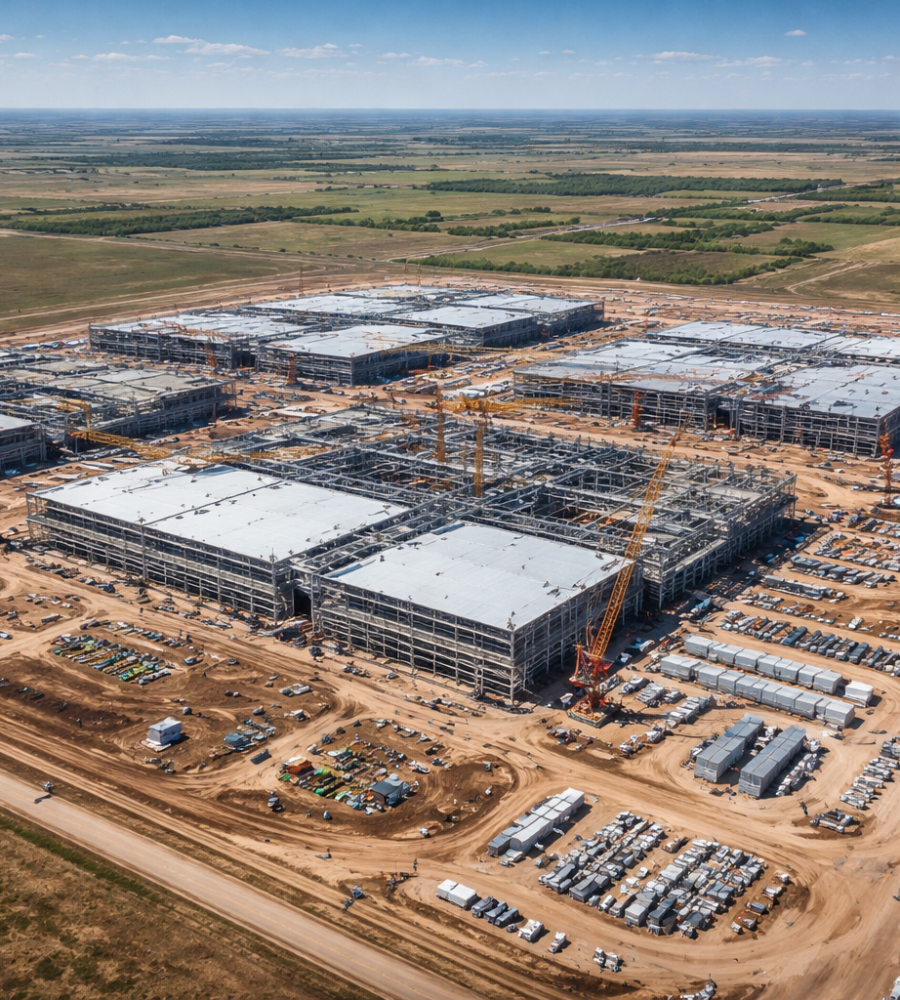
The UAE’s AI campus in Abu Dhabi, developed by G42 with support from OpenAI, Nvidia, and U.S. government approval to access hundreds of thousands of advanced semiconductors, is planned at a scale of 26 square kilometers and 5 gigawatts of capacity. That would make it the largest AI campus outside the United States. Saudi Arabia’s approach through the Public Investment Fund and its subsidiary HUMAIN follows a similar logic with a different organizational structure. PIF announced a $40 billion fund for AI technology investment. Its subsidiary Alat committed $100 billion to enhance Saudi Arabia’s technological capabilities by 2030. HUMAIN executed partnerships with Google Cloud for a $10 billion AI hub and with Qualcomm for AI data centers across the kingdom.
Qatar’s QIA closed a $20 billion AI infrastructure joint venture with Brookfield in late 2025, building on earlier positions in Anthropic and Databricks. Kuwait’s KIA joined the AI Infrastructure Partnership. The Gulf sovereign wealth funds are not merely allocating capital to AI infrastructure as a financial investment. Instead, they are building AI infrastructure as a sovereign project, using financial returns as a secondary objective to the primary goal of establishing national AI capabilities.
The Singapore Model: Strategic Patience and Portfolio Integration
Singapore’s sovereign wealth funds, GIC and Temasek, have approached AI infrastructure investment with a different philosophy that reflects Singapore’s distinct strategic context. Singapore does not have the hydrocarbon revenues of the Gulf states and cannot deploy capital at comparable scale. As a result, its sovereign wealth funds have pursued more selective positions that prioritize strategic access and portfolio integration over comprehensive stack ownership.
GIC and Temasek participated in the AI Infrastructure Partnership alongside Gulf counterparts, taking positions in the Aligned Data Centers transaction that provided exposure to the largest AI data center operator globally. Temasek has also invested in battery technology companies and other AI-adjacent infrastructure that complements data center positions. The Singapore model reflects a strategic calculus that differs from the Gulf’s full-stack ambition but serves a consistent objective: ensuring that Singapore maintains meaningful positions in the infrastructure that will determine the competitive landscape of the digital economy.
Singapore is a small city-state whose economic strategy has always depended on positioning itself at the intersection of major capital and trade flows. Its sovereign wealth funds extend that positioning into the AI infrastructure era by securing stakes in the physical infrastructure and the companies building it. At the same time, they manage the geopolitical complexity of maintaining relationships with both the United States and China that Singapore’s economic position requires.
Regulatory Friction and the Limits of Sovereign Capital
The acceleration of sovereign wealth fund investment in AI infrastructure has generated regulatory scrutiny in recipient countries. This scrutiny reflects governments’ growing concern about the strategic implications of foreign state-owned capital owning critical digital infrastructure. The United Kingdom’s National Security and Investment Act, Australia’s Foreign Investment Review Board, Canada’s Investment Canada Act, and equivalent frameworks in other jurisdictions have established mandatory review regimes for acquisitions of digital infrastructure by foreign state-linked investors. These regimes do not prohibit sovereign investment in AI infrastructure. They subject it to scrutiny whose intensity reflects both the strategic sensitivity of the asset and the geopolitical positioning of the investing state.
The legal distinction between a sovereign wealth fund pursuing purely commercial objectives and one maintaining close ties to state policy is a threshold issue in these review processes. A transaction by Norway’s Government Pension Fund Global, which operates with substantial independence from Norwegian government policy, faces a different regulatory profile than one by a fund whose investment decisions coordinate closely with national AI strategy. The Gulf funds occupy ambiguous positions in this analysis. They pursue commercial returns and employ sophisticated investment professionals who evaluate deals on financial criteria. They also operate within governance frameworks that reflect the strategic priorities of the states that own them.
Consequently, this regulatory complexity has shaped the structures through which sovereign funds deploy capital into AI infrastructure. Joint ventures with established private sector partners, minority stakes with defined governance rights rather than control, and investments through portfolio companies operating under domestic governance frameworks are all structures that sovereign investors have used to achieve strategic access while managing the regulatory profile of their investments. The $40 billion Aligned Data Centers transaction, structured as a consortium with BlackRock, GIP, Microsoft, and Nvidia alongside Gulf and Asian sovereign investors, reflects exactly this approach.
The National Security Dimension
The involvement of sovereign wealth funds in AI infrastructure has surfaced a tension that conventional infrastructure investment rarely encountered with comparable intensity. AI infrastructure is not just commercial real estate that happens to be occupied by servers. It is infrastructure that processes data, trains models, and delivers AI services whose capabilities are increasingly relevant to national security, economic competitiveness, and social stability. Moreover, the governments that own sovereign wealth funds are, in some cases, the same governments that other nations’ security agencies regard as potential adversaries.
The U.S. government’s approval process for the UAE’s access to hundreds of thousands of advanced Nvidia semiconductors for the Abu Dhabi AI campus reflects this tension directly. The approval was part of a bilateral agreement called the U.S.-UAE AI Acceleration Partnership and included conditions relating to data governance, security controls, and alignment with U.S. policy frameworks. It was not a purely commercial transaction. It was a diplomatic negotiation that determined the conditions under which a sovereign wealth fund could deploy capital toward AI infrastructure at a scale that would otherwise have triggered technology export restrictions.
The China dimension adds further complexity. Chinese sovereign capital, including the national AI fund launched in early 2025 with a primary focus on AI hardware and embodied AI, operates in a regulatory environment that increasingly segregates it from the U.S.-aligned AI infrastructure ecosystem. As a result, Western jurisdictions that welcome Gulf sovereign wealth fund investment while applying stringent scrutiny to Chinese state capital reflect a geopolitical positioning that mirrors the broader decoupling of U.S. and Chinese technology ecosystems. Consequently, sovereign wealth funds navigating this environment must manage investment portfolios that reflect geopolitical alignment as much as financial optimization.
The Financial Return Question
Behind the strategic logic of sovereign AI infrastructure investment lies a financial return question that deserves direct analysis. AI infrastructure investment is not obviously attractive on conventional infrastructure financial metrics. For instance, data centers require substantial capital investment, face technology obsolescence as GPU generations cycle, and carry tenant concentration risk when their revenues depend primarily on a small number of hyperscaler customers.
Sovereign wealth funds are nevertheless better positioned than most investors to manage this uncertainty. Their long investment horizons differ significantly from private equity funds facing defined exit timelines. Additionally, they can hold investments through technology cycles and deploy additional capital into facility upgrades as cooling and power infrastructure evolves. They also treat the strategic value of their infrastructure positions as a component of total return rather than purely financial yield. As a result, this changes the investment calculus in ways that make AI infrastructure more attractive to sovereign capital than to time-constrained private funds.
What Sovereign Investment Means for AI Infrastructure Geography
The most significant implication of sovereign wealth fund involvement in AI infrastructure is its effect on where AI infrastructure gets built and on what terms. Sovereign capital is not geographically neutral. It carries national objectives that shape its deployment toward markets and projects that serve those objectives, sometimes independently of where financial returns would direct purely commercial capital. Abu Dhabi’s commitment to building the world’s largest AI campus outside the United States reflects a sovereign investment decision. Its primary driver is the UAE’s ambition to establish itself as a global AI hub, not a calculation that Abu Dhabi offers superior risk-adjusted returns relative to competing markets.
This strategic geography is reshaping the global distribution of AI infrastructure in ways that hyperscaler capital deployment alone would not produce. Gulf sovereign investment is creating AI infrastructure capacity in markets that commercial capital previously underserved. As colocation infrastructure evolves to meet AI workload requirements, sovereign investment is determining which markets gain the infrastructure that hyperscale AI customers need and which are left behind.
The behind-the-meter power strategies that Gulf sovereign AI campuses are adopting reflect the energy advantages that Gulf states can deploy in AI infrastructure development. Abundant energy resources, high renewable energy potential, and the capital to build co-located generation infrastructure create operating economics that commercially developed facilities in energy-constrained markets struggle to match. The grid interconnection challenges that constrain AI infrastructure development in North America and Europe do not apply in the same way to sovereign AI campuses built on greenfield sites with dedicated power infrastructure in the Gulf.
The Partnership Model and Its Strategic Logic
The investment structures that sovereign wealth funds have developed for AI infrastructure reflect a sophisticated understanding of how to achieve strategic objectives while managing political and regulatory constraints. The consortium model, exemplified by the AI Infrastructure Partnership, bundles sovereign capital with private sector partners whose commercial credibility and governance frameworks reduce the regulatory friction that purely sovereign-led transactions would encounter. This structure is not simply a regulatory workaround. It creates genuine strategic value by combining the patient capital and long-term orientation of sovereign funds with the operational capability and market relationships of commercial infrastructure operators and technology companies.
The MGX and BlackRock AI Infrastructure Partnership demonstrates how this model works in practice. MGX brings sovereign capital, strategic intent aligned with Abu Dhabi’s AI ambitions, and relationships with Gulf region counterparts. BlackRock and Global Infrastructure Partners bring deal structuring expertise, operational infrastructure management capability, and U.S. institutional credibility that facilitates regulatory navigation in American markets. Microsoft and Nvidia bring technology relationships and customer pipelines that create demand visibility for the infrastructure the consortium develops. Together, these partners create a consortium whose capabilities exceed what any of them could achieve independently. The $40 billion Aligned Data Centers acquisition created the world’s largest commercially managed AI data center platform, with approximately 5 gigawatts of current and planned capacity.
The Singapore sovereign funds’ approach to consortium participation reflects a different but complementary logic. GIC and Temasek are not building sovereign AI stacks in the way Gulf funds are pursuing. Instead, they are securing strategic positions within the AI infrastructure ecosystem by joining consortia that provide exposure to large-scale AI infrastructure assets. Their participation in the Aligned Data Centers consortium alongside Gulf sovereign capital and U.S. institutional investors reflects a portfolio construction approach that builds AI infrastructure exposure through relationships rather than control.
Measuring the Sovereign AI Infrastructure Premium
The entry of sovereign wealth funds into AI infrastructure has created pricing dynamics that affect the entire market for AI infrastructure assets. Sovereign capital that treats strategic access as a component of investment return will pay premiums that purely commercial capital cannot justify on financial metrics alone. Those premiums change the clearing price for AI infrastructure assets in ways that affect every market participant, from developers seeking to monetize infrastructure positions to hyperscalers negotiating capacity agreements with operators whose cost of capital reflects sovereign as well as commercial return requirements.
The $40 billion valuation of Aligned Data Centers represented a premium over comparable commercial data center transactions. That premium reflected the strategic dimensions of sovereign participation in the consortium. Sovereign investors who acquire positions in AI infrastructure as national strategic assets price those assets on a basis that includes strategic optionality, geopolitical access, and national capability development value that do not appear in conventional discounted cash flow models. That pricing behavior sets market benchmarks that affect comparable transactions regardless of whether sovereign capital participates.
Risks of the Sovereign Premium Model
This sovereign premium dynamic creates both opportunities and risks for the AI infrastructure market. Developers and operators who understand sovereign capital’s strategic motivations can structure transactions that offer sovereign value alongside financial return. The resulting lower cost of capital improves development economics and accelerates the pace at which new AI infrastructure capacity reaches the market. However, it also introduces risk that asset values reflect sovereign strategic premiums rather than fundamental cash flow value.
The stranded power assets that sovereign infrastructure development is activating in new markets create competitive dynamics for existing operators in those markets. Meanwhile, the scale of sovereign AI campus development is changing the economics of power efficiency at the facility level as operators with sovereign capital backing invest in infrastructure whose performance characteristics set new benchmarks. Consequently, both commercial and sovereign infrastructure operators must now plan around a market where strategic capital and financial capital compete for the same assets on fundamentally different terms.
The Long-Term Structural Shift
Sovereign wealth fund involvement in AI infrastructure is not a transitional phenomenon driven by the current intensity of AI investment enthusiasm. It reflects a structural shift in how governments understand the relationship between capital, technology, and national competitiveness. That shift will persist regardless of how AI market valuations evolve in the near term. Governments have concluded, with varying degrees of explicitness, that the physical infrastructure on which AI runs is a strategic national asset that cannot be left entirely to commercial markets to develop and allocate. That conclusion drives sovereign investment in AI infrastructure as a policy instrument rather than merely a financial allocation.
The Scale of Capital Already Committed
Sovereign wealth funds invested $46 billion in AI ventures in the first eight months of 2025 alone. That figure does not include infrastructure-level commitments like the Aligned Data Centers transaction or the Gulf states’ domestic AI campus development programs, whose scale dwarfs the venture investment numbers. The total sovereign capital committed to AI infrastructure across the Gulf, Asia, and Europe runs into the hundreds of billions, deployed across time horizons that extend well beyond the current AI investment cycle.
These funds are not making bets on short-term AI market conditions. They are making structural commitments to the infrastructure that they have concluded the digital economy of the next generation will run on. That is a different kind of investment decision, made by institutions whose mandates and time horizons are unlike those of any other market participant.
The sovereign wealth funds that have moved most decisively into AI infrastructure are establishing positions that will compound in strategic value as AI capabilities become more central to economic and political power. The funds that have hesitated are watching the most strategically significant positions fill. In the AI infrastructure era, as in the hydrocarbon era that funded the Gulf sovereign wealth funds in the first place, the most important question is not what the asset is worth today. It is who controls the resource that the future runs on.