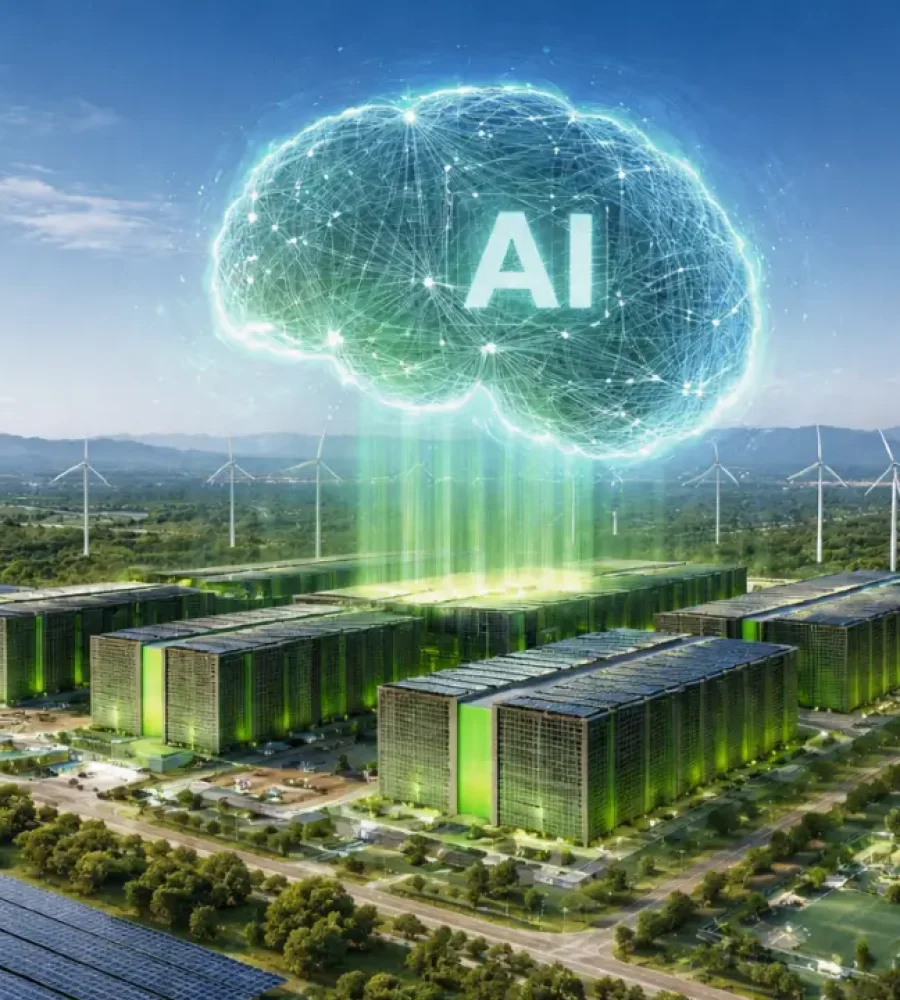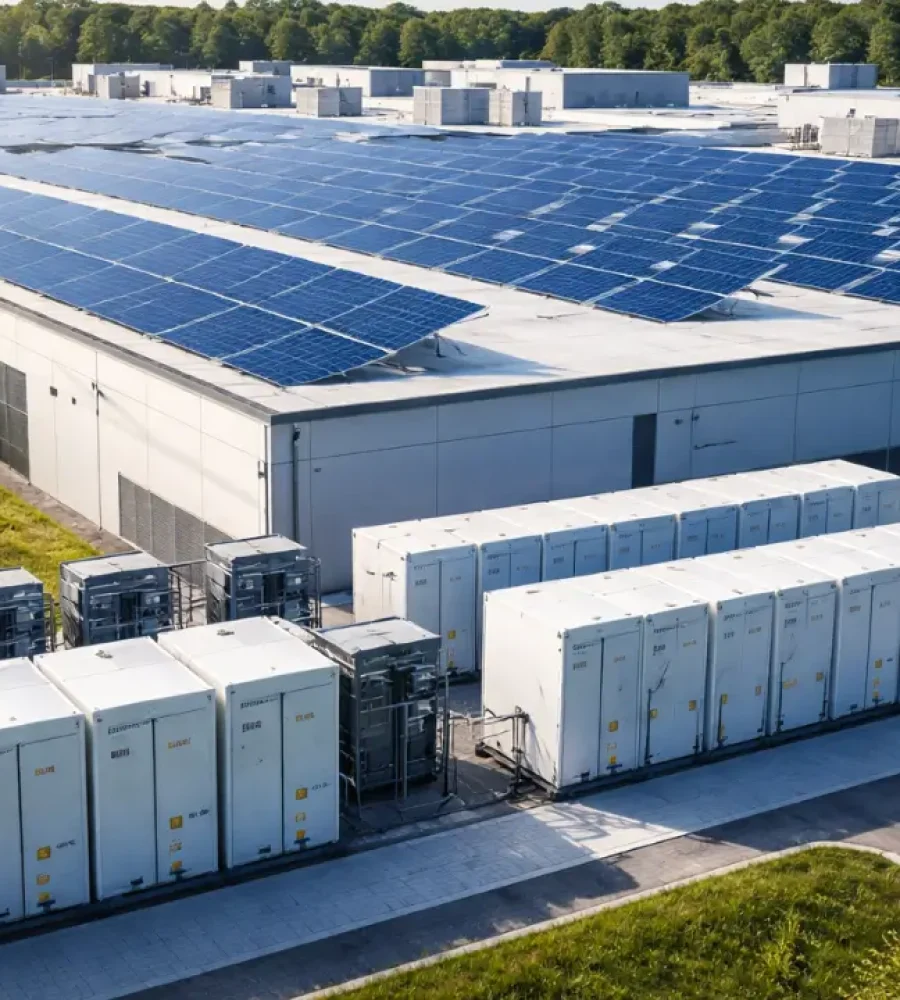
AI is driving unprecedented demand for compute, and data centers are struggling to keep pace without straining power grids and water resources. Advances in SiC and GaN technology for AI data centers promise a path toward greater efficiency and sustainability. By enabling faster switching, lower energy losses, and reduced cooling requirements, these wide-bandgap semiconductors could transform the environmental footprint of AI infrastructure. Yet, powering greener AI centers requires more than smarter chips- it demands holistic planning across energy, water, cooling, and material supply chains.
Over the past decade, the largest AI models have required increasingly specialized silicon. As a result, data centers hosting these chips consume power at rates rarely imagined a generation ago. Global data center electricity use has grown roughly 12% per year in recent years, according to international energy monitors. If this trend continues, total power draw could more than double by 2030.
Why does this matter? Scale creates system-level stress. In the United States, data centers already consume about 4-5% of national electricity. Some analyses project this share could exceed 10% by 2030 as AI workloads expand. In the European Union, data center energy needs may climb from around 70 TWh in 2024 to roughly 115 TWh by 2030. The load is shifting from a niche infrastructure item to a major grid actor. Consequently, utilities and regulators face new planning and reliability challenges.
Location choices amplify impacts. Hyperscale campuses and cloud providers often cluster in regions with cheap land or favorable power markets. However, interconnection queues and transmission limits often constrain them. Some operators respond by building the power plants they need adjacent to compute halls. For example, one high-profile Texas campus plans nearly 1.2 GW of on-site generation combining turbines, renewables, and battery systems. This vertical integration reduces delays and gives operators direct control over supply but it also shifts environmental and grid responsibility from utilities to private operators.
Expanding compute capacity forces a broader conversation. Optimizing servers alone no longer suffices. Energy systems, cooling strategies, water stewardship, and material supply chains must be managed together.
The energy and water nexus
AI places simultaneous pressure on electricity and cooling resources. Experts call this the “AI–energy nexus” because compute demand cascades across systems. As models scale, electricity use rises and so does heat. Cooling systems then draw additional power and, often, water.
For perspective, one industry estimate found a 100-word AI query can require roughly 0.5 liters of water for chip cooling. Multiply that by billions of daily queries, and the water footprint becomes staggering. Some forecasts predict AI data center water consumption could reach about 450 million gallons per day globally by 2030. Individual large facilities have reportedly used up to five million gallons daily, comparable to the municipal needs of small cities.
Water stress varies geographically. Around two-thirds of US data centers sit in areas with high water stress. Cooling technology and water sourcing thus become questions of local stewardship. Operators increasingly rely on reclaimed water, closed-loop systems, or dry-cooling, though these approaches may raise costs or reduce thermal performance in hot climates.
Water ties directly to electricity. Thermal power plants require large water flows for cooling, and chip manufacturing uses water for wafer processing. Data center growth affects water needs across the entire energy-production chain. Regulators now require water-use reporting and set water-efficiency benchmarks in several jurisdictions.
Finally, a feedback loop connects this to climate. If data centers source electricity from fossil fuels, water-intensive cooling indirectly contributes to greenhouse gas emissions. Coordinated action on energy sources and water use is essential.
Innovations in power infrastructure and electronics
Meeting rising demand efficiently requires upgrades across the electrical stack. At the component level, operators increasingly use wide-bandgap semiconductors. Silicon carbide (SiC) and gallium nitride (GaN) devices switch faster and lose less energy than traditional silicon. Power supplies, uninterruptible power systems (UPS), and converters built with SiC or GaN cut conduction and switching losses. Some new UPS converters with SiC reach conversion efficiencies above 99%, reducing waste heat and cooling requirements.
Beyond semiconductors, operators rethink power sourcing and management. Microgrids and on-site generation allow data centers to operate independently from external constraints. These systems let operators assemble tailored portfolios of renewables, batteries, and fast-start generators such as bridge turbines or fuel cells. Batteries now often replace older lead-acid UPS systems, carrying a facility through brief outages and providing rapid grid services.
Some operators adopt vertically integrated models, developing both compute buildings and adjacent power infrastructure. These campuses operate almost like utilities: they produce most of their electricity and, when possible, sell excess back to the grid. This setup shortens interconnection times and allows operators to design systems tailored to latency, resilience, and emissions goals.
Control systems are evolving, too. Intelligent energy management platforms coordinate on-site generation, batteries, and grid purchases. They charge batteries during low-cost, high-renewable hours and discharge when marginal grid carbon intensity rises. In this way, data centers shift loads in time and reduce emissions without cutting compute output.
However, private generation raises governance concerns. Operators managing electricity at scale must be monitored for air emissions, water use, and local grid impacts. Regulators and utilities must adapt rules to prevent private power from undermining broader decarbonization goals.
Thermal management and cooling advances
Efficient thermal design remains central. Cooling choices determine a facility’s energy and water use over its lifetime. Several strategies prevail, each with trade-offs.
Free or ambient cooling offers high energy efficiency. In cold climates, outside air or cold water can replace mechanical chillers. Nordic and high-altitude facilities have reached near 1.2 PUE numbers using lake or groundwater. Free cooling drastically reduces chiller electricity use.
Airflow management through hot-aisle and cold-aisle containment reduces mixing of intake and exhaust air. Containing hot exhaust lowers required supply air temperatures and improves chiller efficiency. Retrofitting aisle containment often saves 30–40% of cooling energy without new refrigeration equipment.
Liquid cooling is gaining for high-density racks. Direct-to-chip cold plates, pumped two-phase coolant loops, and immersion systems remove heat more efficiently than air. These solutions enable racks consuming 100+ kW each and allow waste heat reuse in district heating or industrial processes.
Adiabatic or evaporative pre-cooling suits drier climates. Spraying small amounts of water pre-cools intake air, reducing chiller load. Though water use is lower than large-scale once-through systems, scarcity can make this approach impractical.
Waste-heat reuse is emerging. Facilities can use captured heat to warm nearby buildings, drive absorption chillers, or support greenhouses. For example, one European center sends 30–40°C waste heat to a district network via heat pumps. Reusing heat reduces net emissions and enhances local integration.
AI-driven controls further improve efficiency. Predictive algorithms adjust fan speeds, pump flows, and setpoints based on workload and weather. Trials show AI can cut cooling energy by 5–10% compared with static schedules, ironically, using AI to manage AI’s energy appetite.
Renewables, carbon footprints, and emissions
Electricity sources matter. Carbon-intensive power increases emissions as compute demand grows. Currently, data centers and telecom networks contribute roughly 0.6–1% of global CO₂ emissions. Without change, that share will rise with AI workloads.
Industry responses vary. Many cloud providers commit to 100% renewable electricity via power purchase agreements, direct investments, and renewable certificates. Increasingly, firms aim for hourly matching, powering operations with low-carbon electricity in real time instead of averaging over a year.
Battery storage bridges renewable intermittency. Large arrays store solar or wind energy when abundant and discharge when unavailable. Some operators site data centers near renewable farms to secure cleaner power.
Challenges remain. Regions with fossil-heavy grids may continue to produce significant carbon despite offsets. Studies warn that expanding AI compute could add tens of millions of metric tons of CO₂ annually by 2030 in major markets.
Lifecycle emissions extend beyond operations. Server, chip, and cooling equipment manufacturing consumes energy. Semiconductor fabrication is particularly energy-intensive. Servers typically retire after three to five years. Embodied carbon, logistics, and disposal add to emissions. Efforts now focus on extending hardware life, refurbishing components, and recycling rare metals. Some initiatives aim to reuse 100% of decommissioned servers.
Policy is responding. The EU pushes binding reporting and energy labeling, including tracking water use and introducing a data center “energy label.” China requires new data centers in key regions to procure at least 80% green electricity and meet PUE targets. Voluntary pacts, such as the European Climate Neutral Data Centre Pact, set interim goals like PUE below 1.3 and renewable matching by 2025.
Ultimately, greening data centers depends on grid decarbonization. Efficiency gains, storage deployment, and renewable siting help, but low-carbon generation underpins long-term reductions.
Materials, supply chains, and electronic waste
Compute’s physical footprint extends beyond land and megawatts. Servers, cables, cooling units, batteries, and semiconductors consume materials and energy at scale. Rising AI demand intensifies pressure on inputs.
Critical minerals- cobalt, lithium, copper, and rare earths- are vital for chips and batteries. Mining concentrates in few regions, e.g., roughly 70% of cobalt comes from one African country. Mining and processing have large local environmental impacts and create geopolitical bottlenecks.
Semiconductor fabrication is energy intensive. Scaling production for AI-grade chips demands time and capital. Governments and operators pursue onshoring or diversification to reduce risk.
Rapid growth also generates e-waste. Servers retire every three to five years, and improper disposal creates toxic streams. While some providers refurbish hardware, much e-waste ends up in informal recycling.
Circular economy strategies help. These include longer-lived equipment, modular upgrades, refurbishment, improved recycling logistics, and extended producer responsibility. For example, Europe now demands better tracking of decommissioned servers and incentives for reuse.
Sustainable AI requires not only power and cooling efficiency but also smarter supply chains and end-of-life practices.
Policy, standards, and industry collaboration
Technology alone cannot solve the challenge. Policy and industry coordination set metrics, ensure transparency, and align incentives.
In the EU, regulators mandate energy and water reporting and design labeling similar to appliance energy ratings. Voluntary agreements like the Climate Neutral Data Centre Pact rally operators around efficiency and renewable targets.
Outside Europe, policies vary. China enforces high green electricity shares and PUE thresholds. India, Japan, Singapore, and parts of the US are drafting or implementing efficiency standards and water incentives. Industry groups, standards bodies, and certifications—like The Green Grid, 80Plus, and ISO 50001—offer frameworks to describe performance consistently.
Transparency is crucial. The EU plans a public data center energy database. Investors increasingly reward low-carbon operations, and collaboration with utilities accelerates renewable build-out and grid balancing.
Policy fragmentation remains a challenge. Harmonized standards would simplify global operations and direct capital to sustainable facilities.
Operational trade-offs
Designing sustainable data centers requires balancing energy efficiency, water stewardship, cost, reliability, and regulatory compliance.
Siting trade-offs: Cool, windy regions reduce cooling energy and carbon intensity, but land, latency, and workforce needs may force alternative locations. Water-stressed areas may favor air-cooling despite modest efficiency penalties. Hydropower proximity lowers carbon but introduces seasonal water risk.
Density trade-offs: Liquid cooling supports higher rack densities, reducing footprint but increasing costs and requiring specialized maintenance. Hybrid approaches balance liquid and air cooling.
Reliability trade-offs: Enterprises needing five-nines availability may favor redundant on-site generation and batteries, increasing uptime but also embodied carbon if fossil fuels power them. Operators must weigh resilience against emissions and cost.
Financial incentives: PPAs, tax credits, and carbon pricing influence decisions, making low-carbon technologies more attractive.
Future challenges and opportunities
Several trends will shape the industry:
- Grid capacity and transmission require upgrades to support tens of gigawatts of new load. Data centers could provide demand response and battery services to integrate renewables.
- Water scarcity will drive innovation in cooling, including adsorption chillers, alternative refrigerants, and dry-cooling. Desalination and deep groundwater bring energy costs and trade-offs.
- Material supply chains need resilience. Onshoring, diversification, modular design, and urban mining can limit virgin material use.
- Thermal limits challenge denser racks. Advanced cooling, edge computing, and efficient AI models can reduce central demand.
- Governance shapes outcomes. Coordinated policy, reporting standards, and aligned finance accelerate transitions.
Paths to alignment
To scale responsibly, operators should:
- Invest in efficiency at every layer- SiC/GaN electronics, UPS, airflow containment, liquid cooling.
- Pair facilities with low-carbon generation and storage, pursuing hourly renewable matching.
- Improve water stewardship via reclaimed water, closed loops, and dry systems.
- Embrace circularity through longer equipment life, refurbishment, and recycling.
- Strengthen policy for transparent reporting and aligned incentives.
Operational flexibility should be a feature, not a cost. Batteries, demand response, and smart scheduling let data centers support grids and gain cleaner power and revenue.
Collaboration is essential. Governments set rules and invest, utilities plan transmission, tech firms standardize reporting, researchers innovate, and investors reward sustainability.
The AI revolution is reshaping infrastructure. Data centers are moving from backroom operations to pivotal energy system components. Carefully designed and operated, they can complement decarbonization by providing flexible demand, reusing heat, and sitting alongside renewable projects. Left unchecked, they risk increasing carbon emissions, stressing water basins, and straining material supply chains.
Technical innovation, policy clarity, and corporate accountability are critical. Efficiency gains help but cannot replace cleaner grids and smarter resource management. AI’s promise depends on the choices architects, operators, and policymakers make today. With coordinated action, AI can scale while protecting climate, water, and materials, but the challenge is urgent, and the will to act must match the technology.