
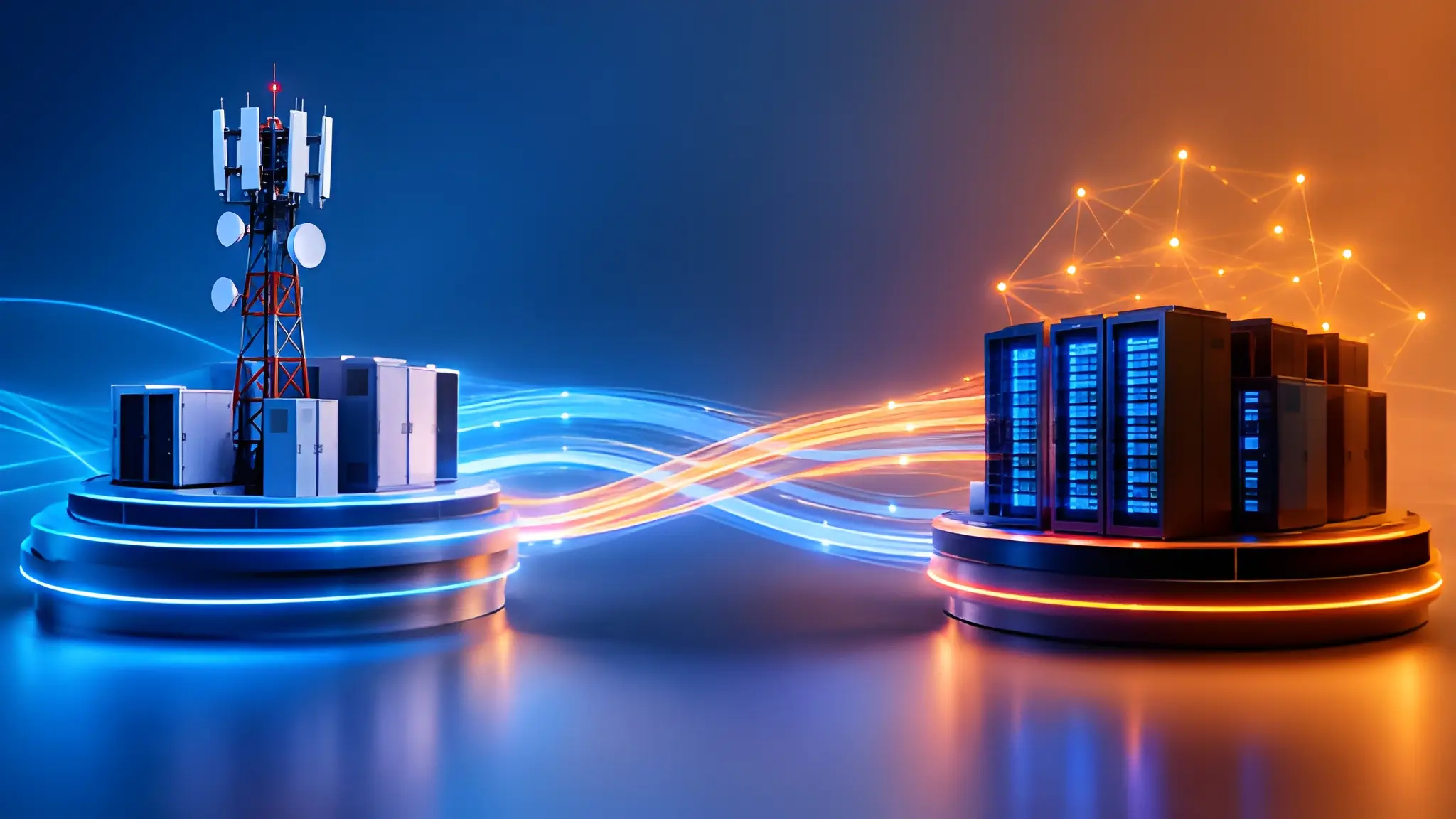
The most important change inside a telecom building may be the one that no longer looks like a telecom project. A room once organized around purpose-built switching equipment can now support general-purpose servers, virtualized network functions, storage, acceleration resources, and the network fabric required to connect those workloads. That shift changes the engineering problem because the building no longer exists only to move traffic between subscribers, aggregation points, and the wider network, but increasingly provides the compute environment in which parts of that network actually run. The distinction matters to an end user because the location of a workload can influence how far traffic travels before processing begins, how many network dependencies sit between an application and its user, and how much operational coordination is required when compute and connectivity share the same physical footprint.

Current technical work on software-defined and virtualized central-office services explicitly treats the monitoring of physical and virtual resources as part of maintaining service stability, reliability, and availability, showing that the central office has become a more integrated compute-and-network system rather than a collection of isolated appliances. The result is not simply a smaller version of a conventional data center, because the same location must satisfy network timing, service continuity, traffic engineering, and compute requirements while remaining closely coupled to access and transport infrastructure.
Virtualized network functions change what the building must provide
Once network functions move from dedicated appliances into software, the building starts carrying responsibilities that used to sit almost entirely inside the network equipment itself. A virtualized broadband gateway, virtualized customer-premises function, virtualized optical termination function, user-plane workload, or other software-based network function still needs dependable power, thermal management, physical security, networking, and operational visibility even though its behavior now depends on software running across shared infrastructure. That creates a different relationship between the rack and the network because the physical server becomes part of the service path, while the underlying network must provide predictable connectivity between workloads that may span several locations. Modern telco-cloud architecture explicitly treats infrastructure as a distributed environment extending across access locations, edge environments, and central cloud regions, with physical, virtualized, and container infrastructure operating as parts of the same broader platform.
The quiet conversion therefore changes the meaning of telecom infrastructure without requiring a dramatic architectural handover. A central office can retain its familiar role as an access and aggregation point while simultaneously becoming a distributed compute location whose workloads require data-center-style operating discipline. Power engineers now need to understand how clustered compute loads behave, cooling teams need to account for changing rack profiles, and network teams need to understand how physical infrastructure constraints can affect virtual service placement. The operational boundary becomes especially important when failures cross layers, because a network problem can originate in a physical resource while a physical intervention can affect software workloads that were previously treated as independent services. Edge computing reinforces this convergence by placing processing near users when applications require short response paths or local processing, while technical definitions increasingly recognize edge locations as computing environments that can coexist with telecom equipment.

Why Your Colocation Hall Now Feels Like a Carrier Core
Walk into a modern colocation hall and the first difference is not always visible in the cabinets themselves, but in the number of decisions happening around them. A tenant no longer approaches the building simply as a secure place to install equipment and order a cross-connect when required. The building increasingly acts as a point where carriers, internet exchanges, cloud connections, private networks, dark fiber routes, and customer networks converge, making the operator’s connectivity architecture part of the service experience. That change gives the colocation provider responsibilities that once sat primarily with network operators, because the provider must understand how traffic enters, exits, crosses, and fails across the surrounding network. Carrier-neutral facilities already market dense connectivity ecosystems, diverse fiber entrances, meet-me rooms, direct interconnection, and access to multiple network providers as core parts of the customer proposition rather than incidental building features.
The Meet-Me Room is Becoming an Operating System for Connectivity
The shift becomes clearer when the operator starts controlling connectivity beyond the walls of a single building. A colocation provider that develops metro fiber links can influence which sites connect directly, which routes remain diverse, where traffic can exchange, and how customers reach other locations without relying entirely on an outside carrier for every physical path. Dark fiber changes the commercial relationship because the customer can obtain the physical optical path and determine how it is used, while the provider can package connectivity between its own locations as an infrastructure product rather than treating each connection as an isolated building-to-building request. That model brings route engineering into the same operational conversation as power, cooling, security, and space because a damaged fiber route can affect service just as decisively as a physical problem inside the building.
A network operations center makes the role reversal even more visible because the provider begins watching connectivity as an operating environment rather than simply maintaining the physical room. Monitoring links, responding to faults, coordinating field work, observing network conditions, and supporting customer connectivity require a different operational mindset from maintaining racks and environmental systems alone. The customer consequently encounters a colocation provider that can behave like a network operator at the point where physical infrastructure and traffic paths meet, even when the provider does not operate a traditional access or telecommunications network. This matters during an incident because the useful question is no longer only whether the customer’s equipment remains powered, but whether the intended path between that equipment and another location remains available, diverse, and operational.
Route Visibility is Becoming Part of the Colocation Product
Once a colocation provider starts publishing network information, offering interconnection across multiple sites, or exposing route and peering information, the customer begins evaluating the building differently. The question changes from “Who can I connect to here?” to “How does my traffic actually move from here?” A network page that exposes topology, peering policy, looking-glass information, or route relationships gives customers visibility into the network behavior surrounding their workloads rather than leaving connectivity as an opaque service behind a support ticket. That level of transparency resembles the working model of a network operator because the customer can reason about paths, interconnection points, and network relationships instead of treating the data center as an isolated endpoint. Emerging carrier-neutral platforms already present multi-site fabrics, peering information, route servers, and dark-fiber access as interconnected parts of a network proposition, demonstrating how the language of colocation increasingly overlaps with the language of network operations.
The operational consequence is that interconnection decisions increasingly belong to the infrastructure layer immediately around the customer’s equipment. A tenant may have an optimized server, carefully designed application stack, and properly engineered internal network, yet still experience inconsistent performance because the path beyond the cage depends on a poorly chosen handoff or an insufficiently diverse external route. The meet-me room becomes important because it concentrates the physical interfaces through which those decisions become real, including carrier handoffs, private connections, peering links, and connections between buildings. Once multiple paths converge there, the physical arrangement of fiber and the logical arrangement of network relationships become closely connected, even though they remain different engineering domains. The customer therefore experiences the colocation building less like passive real estate and more like a controlled interconnection environment in which the operator can materially shape how traffic reaches the rest of the network.
The Corridor That Quietly Started Routing Your Traffic
The most consequential piece of infrastructure in a data center may sit outside the customer’s cage and receive almost no attention from the application team. The meet-me room determines where external connectivity enters the building, where carriers establish physical presence, and where customers can create direct relationships with networks that sit beyond their own equipment. Once those connections multiply, the room becomes a concentrated control point for the physical topology surrounding the customer, even though the routing decisions themselves may occur elsewhere in the network. A cross-connect therefore represents more than a short physical connection because it determines which external network relationship a customer can activate from a particular location. The distinction becomes increasingly important as applications depend on multiple clouds, private networks, content platforms, exchanges, and geographically separated compute locations that all require different traffic paths.
Physical Handoffs Increasingly Shape Logical Network Behavior
A network diagram can make connectivity appear abstract, but every logical relationship eventually reaches a physical interface somewhere. Fiber enters through a defined route, terminates on equipment, crosses a patching environment, reaches an optical or electrical interface, and then becomes part of a larger routing domain. That sequence means the physical architecture around a customer’s rack can influence which logical paths are available, how quickly a second path can be provisioned, and whether two connections that appear diverse actually leave the building through different infrastructure. The growing use of dedicated dark fiber between data center locations reinforces this relationship because the operator can extend connectivity beyond a single building while retaining control over the physical route connecting the sites.
The result is a subtle reversal in infrastructure priorities because the customer’s most important network decision may occur before a packet reaches the customer’s own router. Selecting a carrier handoff, choosing an exchange connection, determining whether a building-to-building link uses a genuinely separate route, or deciding where an external network enters the site can all affect the traffic path that follows. The data center operator consequently becomes part of the network architecture even when the customer retains control of its own routing policy and equipment. That does not mean the building operator becomes the customer’s carrier in every case, but it does mean that the operator increasingly controls the physical conditions under which carrier behavior occurs.
Telcos Didn’t Build Data Centers. They Inherited Them
The modern telco data center did not emerge because telecommunications operators suddenly decided to compete with conventional colocation providers, but because the network itself stopped fitting neatly inside dedicated appliances. Network functions increasingly moved into software, allowing routing, packet processing, security, traffic management, and other services to run on shared compute infrastructure rather than remaining permanently tied to specialized hardware. That change altered the physical role of locations that had historically existed primarily to aggregate access networks, terminate connections, house switching systems, and maintain proximity to subscribers. Once those locations began hosting virtualized or cloud-native network functions, the building had to support the operational requirements of servers, storage, high-speed switching, software-defined infrastructure, and distributed orchestration alongside the legacy network equipment that still carried production traffic.
That inheritance matters because telcos already possessed something new data center developers had to establish from scratch: strategically positioned buildings connected directly to the access and transport network. A central office could already sit close to customers, aggregation points, fiber routes, and network handoffs, so moving compute into that environment created an architectural shortcut for workloads that benefit from network proximity. The software-defined network made that shortcut increasingly useful because a function no longer needed to live beside a particular proprietary appliance to remain part of the service chain. Instead, operators could distribute functions across central, regional, and edge locations while connecting them through programmable network infrastructure and common compute environments. This makes the resulting site fundamentally different from a conventional server room because the location remains part of a live communications path while also becoming a place where software executes, state is processed, and traffic can be handled locally.
The Building Became Part of the Network Architecture
Once computing became part of the service path, building engineering stopped being a background concern for telecommunications teams. A server running a network function cannot be treated like another passive piece of equipment because its placement, connectivity, power path, thermal environment, maintenance window, and failure domain can influence the behavior of the service that depends on it. The engineering problem consequently expands from keeping network hardware operational to coordinating physical infrastructure with workload placement, network topology, software orchestration, and service continuity. An edge location may need to accommodate conventional telecommunications equipment alongside servers and switching infrastructure, while the operator must also understand how those resources interact when capacity is moved, software is upgraded, or a physical component fails. The result is a facility that behaves more like a distributed computing node inside a communications network than like the traditional central office of the hardware era.
The deeper shift is that telcos now inherit both the advantages and constraints of data center architecture without abandoning the responsibilities of network operators. They have proximity to users, established fiber routes, network control, and existing sites, but they also inherit the complexity of supporting compute workloads inside environments whose original design assumptions came from telecommunications rather than modern distributed computing. That creates a different optimization problem from simply constructing new server space because every additional workload must coexist with network functions that still require predictable connectivity and operational continuity. The physical site consequently becomes another layer in the network architecture, while the network becomes another dependency in the compute architecture. This convergence explains why the distinction between a central office, edge site, and data center increasingly depends on what the location does rather than what the operator historically called it.
When Building Engineers Started Talking Like Network Engineers
A data center can remain physically stable while its operational priorities change underneath the racks. When network behavior becomes inseparable from compute placement, building teams need to understand why a network path matters, while network teams need to understand why a physical constraint can alter that path. A cooling problem can force equipment out of service, a power maintenance event can remove a network function from its intended location, and a fiber fault can isolate otherwise healthy compute resources from the services they depend on. That creates an operating environment where infrastructure teams cannot treat power, cooling, cabling, network topology, and workload placement as separate checklists because each layer can influence the behavior of another. Modern edge and telco cloud architectures reinforce that relationship by combining physical resources, virtualized functions, networking, compute, and distributed locations within one service environment.
The Operating Language Inside the Building is Changing
Network engineers entering a data center environment encounter a different set of constraints from those found in a purely logical network design. Rack placement determines cable distance and physical access, equipment density influences thermal conditions, power distribution affects where devices can operate, and maintenance procedures can determine whether a supposedly redundant path can actually remain available during work. The network diagram may show two paths, yet those paths can still converge physically through the same room, tray, entrance, or other shared dependency. That is why physical route diversity has become an important part of network resilience rather than a concern that can be handed entirely to the building team. Colocation operators increasingly expose carrier connections, meet-me rooms, cloud interconnection, and diverse fiber pathways as parts of their connectivity offering, making the physical environment directly relevant to the network service customers consume.
That crossover changes incident response because the first useful question becomes less obvious than it used to be. A network alarm may originate from a fiber problem, but the corrective action can involve physical access, cabling records, route separation, or work in a controlled interconnection area. A facility alarm may appear unrelated to networking, yet the affected equipment could host a network function that sits directly inside a service chain. Teams therefore need a shared operational vocabulary around dependencies rather than separate vocabularies for “the building” and “the network.” This does not require every engineer to become a specialist in every discipline, but it does require each team to understand enough of the adjacent layer to recognize when an ordinary maintenance decision can become a service event. The result is a new kind of infrastructure operator who thinks simultaneously about equipment health, physical pathways, traffic behavior, and customer impact.
Network Teams are Learning the Physics of the Rack
The reverse transition is happening inside network organizations as well, because modern network equipment increasingly lives inside environments governed by data center constraints. A network architect can no longer treat the physical location of a switch, router, optical system, or network function as an implementation detail when the equipment shares power, cooling, containment, and access dependencies with compute systems. Higher equipment density can alter thermal behavior around a rack, changes in cabling can affect serviceability, and maintenance work can require coordination with systems that have nothing to do with routing but still share the same physical dependency. Distributed network functions create another layer because moving a workload to a different location changes more than its logical address; it can also change the physical network path, available resources, operational ownership, and failure domain surrounding that workload.
The same lesson applies to colocation operators that increasingly provide connectivity beyond simple cross-connects. Once an operator connects separate buildings through its own fiber infrastructure, manages interconnection points, or operates a network monitoring function, it inherits responsibilities that require network operational discipline. Route changes need documentation, fiber paths need traceability, maintenance needs coordination, and failures need to be isolated without assuming that a healthy rack means a healthy service. The operator also has to distinguish physical diversity from apparent diversity because two circuits can arrive through separate carriers while still sharing a building entrance or internal pathway. That makes network engineering knowledge valuable to the facility team, particularly when customers depend on the site as an interconnection point rather than merely as a secure location for servers.
Dark Fiber Is Becoming the New Cross-Connect
The traditional cross-connect solved a very specific problem: it gave one customer a direct physical connection to another network or service inside the same interconnection environment. That remains valuable, but the boundary of what customers need from connectivity has moved outward as workloads spread across multiple locations and applications depend on consistent communication between separate compute environments. A connection that ends at the customer’s rack may no longer be enough when the next critical dependency sits in another building, another edge location, or another part of the metropolitan network. Dark fiber becomes relevant in that environment because it extends the customer’s physical connectivity model beyond the immediate data center while allowing the connected parties to determine how the optical path is used. In effect, the fiber corridor becomes an extension of the interconnection environment, moving the boundary of the data center network into the streets and buildings surrounding it.
The Important Connection May Begin Outside the Building
That changes the way customers should think about redundancy because a second connection is useful only when it avoids the dependency that caused the first one to fail. Two cross-connects inside one building can provide different equipment paths while still sharing the same entrance, room, external duct, or metropolitan route. A provider-controlled fiber network can instead create a physical connection between separate locations, giving the customer another architectural option when designing connectivity across a broader footprint. The engineering question therefore becomes less about how many connections exist and more about where those connections physically travel before they reach the destination. This is particularly important for workloads that cannot treat network interruption as an ordinary application event because their compute resources, storage systems, network services, or traffic paths depend on continuous communication between locations.
The shift also explains why metropolitan fiber is becoming strategically important to colocation operators. A provider with several connected sites can make the relationship between those sites part of its product, allowing customers to treat geographically separated locations as components of one interconnection environment. That model changes the role of the data center because the building is no longer the complete unit of connectivity; the connected cluster of buildings and routes becomes the more useful architectural object. Customers can then evaluate where workloads should sit based not only on the equipment environment inside each site but also on the physical paths available between those sites. The provider, meanwhile, has to think about route construction, fiber maintenance, physical diversity, demarcation, restoration procedures, and operational visibility beyond the property boundary.
Owning the Route Changes What the Operator Controls
The strongest reason to treat dark fiber as strategically different from a conventional cross-connect is control. With a cross-connect, the customer establishes a local physical relationship, but the wider route can remain the responsibility of another network provider. With a dedicated fiber path, the connected parties can control the equipment placed on that fiber and determine how the underlying optical resource supports their network architecture. That creates greater responsibility as well because the physical cable becomes an infrastructure dependency that has to be monitored, maintained, documented, and protected. A provider offering inter-building fiber therefore starts taking on work that looks increasingly familiar to telecommunications operations, including route management and physical-path coordination. The customer sees the benefit as a more direct connection between infrastructure locations, but the operator absorbs the operational burden of making that connection predictable.
The broader implication is that network reach can become as important as rack availability when customers select infrastructure locations. A technically strong building can still be a poor choice if it sits outside the connectivity paths that a workload actually needs, while a well-connected cluster of sites can create flexibility that an isolated facility cannot easily reproduce. This is why the role of the colocation operator is moving toward something closer to network infrastructure management without eliminating its original responsibility for the physical data center. The provider must understand the building, the interconnection room, the external fiber path, and the relationship between those layers as one operating system. Customers, in turn, increasingly need to evaluate a site by asking where its connections go, how those routes are separated, who operates them, and what remains available when one physical path fails.
The Network Inside the Data Center Is Now Bigger Than the Network Outside
The network inside a modern data center is no longer simply the plumbing that connects servers to the outside world, because compute itself increasingly depends on a fabric that must move information rapidly between machines. AI workloads make this particularly visible because large groups of accelerators operate as coordinated systems, requiring high-speed communication between compute nodes rather than relying primarily on north-south traffic toward external networks. A spine-leaf architecture creates multiple paths through the facility, allowing workloads to communicate across a structured switching fabric while separating access from aggregation and providing predictable paths through the environment. That architecture turns the data center into a networked system whose internal behavior can determine application performance even when every external connection remains healthy.
The physical implications are equally important because the internal network has to coexist with the compute systems that generate the traffic. Switches, optical connections, server interfaces, accelerator interconnects, and cabling all occupy physical space while sharing the same power and thermal environment as the computing equipment they connect. Network topology therefore begins to influence rack placement, cable pathways, equipment density, maintenance access, and the physical separation of systems that need to remain resilient. A failure in an internal fabric can isolate healthy compute resources from one another even when those resources retain power and remain fully operational, making network availability a prerequisite for useful compute availability. That changes how operators think about capacity because adding servers without providing the corresponding network capability can create an infrastructure that appears larger on paper while delivering less usable performance to workloads that depend on coordinated communication.
Carrier-grade thinking is moving inward
Traditional telecommunications architectures centered on network functions and transport, while modern data-center architectures increasingly make the internal network fabric a critical part of distributed computing. Network operators entering these environments encounter familiar concerns around routing, path selection, redundancy, failure domains, telemetry, and traffic engineering, but those concerns now apply within a building or connected compute environment rather than only across a metropolitan or long-distance network. A packet moving between two servers can encounter multiple switching layers, physical links, interface dependencies, and policy decisions before reaching its destination, creating an internal path that can be operationally significant even though it never leaves the site. The distinction between internal and external networking becomes less decisive for workloads whose most important traffic remains within the compute environment.
That convergence also changes the meaning of resilience because external carrier diversity cannot compensate for an internal fabric that provides a single point of failure. A customer can connect to multiple outside networks and still encounter an outage if the compute workload depends on an internal switching layer, shared interface, or physical path that fails. Network design consequently has to consider the entire journey of traffic, beginning at the workload and continuing through the internal fabric before reaching another system, another location, or the public network. Telcos face the mirror image of that problem because their distributed network functions increasingly depend on compute environments whose internal networking can become just as important as the transport network connecting their sites.
One Hall, Two Playbooks, Same Customer
A customer entering an increasingly interconnected infrastructure environment may encounter far less operational separation between the telecommunications network and the data center than in earlier architectures. The application depends on compute, the compute depends on internal networking, the internal network depends on physical connectivity, and external connectivity ultimately depends on the building that contains the equipment. Each layer can therefore become the limiting factor even when every other layer remains healthy, making infrastructure performance a chain rather than a collection of independent services. Telcos have moved toward distributed compute as network functions increasingly run on software-based infrastructure, while many colocation providers have expanded their interconnection offerings to provide access to carriers, cloud networks, exchanges, and private fiber paths. The distinction between the two operating models is consequently becoming less useful for customers evaluating where workloads and network functions should live.
The convergence does not mean every telecommunications operator will become a conventional colocation provider or every data center operator will become a carrier. Their commercial models, regulatory responsibilities, network footprints, and investment priorities remain different, and those differences still matter when customers select infrastructure. What is changing is the set of capabilities each side must understand to deliver the service promised at the other end of the contract. A telco operating compute at the edge must understand power, cooling, rack constraints, physical access, and equipment lifecycle alongside network behavior, while a connectivity-focused data center operator increasingly has to understand route diversity, optical paths, interconnection dependencies, and network operations. The strongest infrastructure environments will therefore be those in which these disciplines cooperate at the architecture level rather than meeting only when something fails.
The Next Competitive Advantage is Knowing Where the Boundary Has Disappeared
For customers evaluating increasingly interconnected infrastructure, the practical question extends beyond whether a site is technically a data center or telecommunications location to what happens between the workload and the network destination it needs to reach. That means examining the internal switching fabric, cross-connect architecture, external fiber routes, carrier choices, physical separation, operational ownership, and the dependencies that connect them. A facility can offer strong compute capacity while retaining connectivity dependencies outside its direct operational scope, just as a network provider can offer transport while relying on physical infrastructure at the compute endpoint that it does not operate. Interconnection services increasingly expose these relationships because the connection may begin at a rack, pass through a meet-me room, leave the building over fiber, and terminate somewhere else without the customer seeing those physical boundaries.
That is why the role reversal matters beyond industry terminology. Telcos are discovering that compute cannot be separated from the physical environment supporting it, while data-center operators providing extensive interconnection services increasingly have to treat connectivity as more than a simple port at the edge of a building. The two playbooks increasingly overlap around requirements such as predictable performance, resilient physical paths, operational visibility, disciplined change management, and understanding dependencies across infrastructure layers. Customers ultimately benefit when an operator can reason across those boundaries because fewer problems disappear into the gap between network and building teams. The data center and the network are not becoming identical, but they are becoming increasingly interdependent, and that interdependence is changing what it means to operate either one well.











