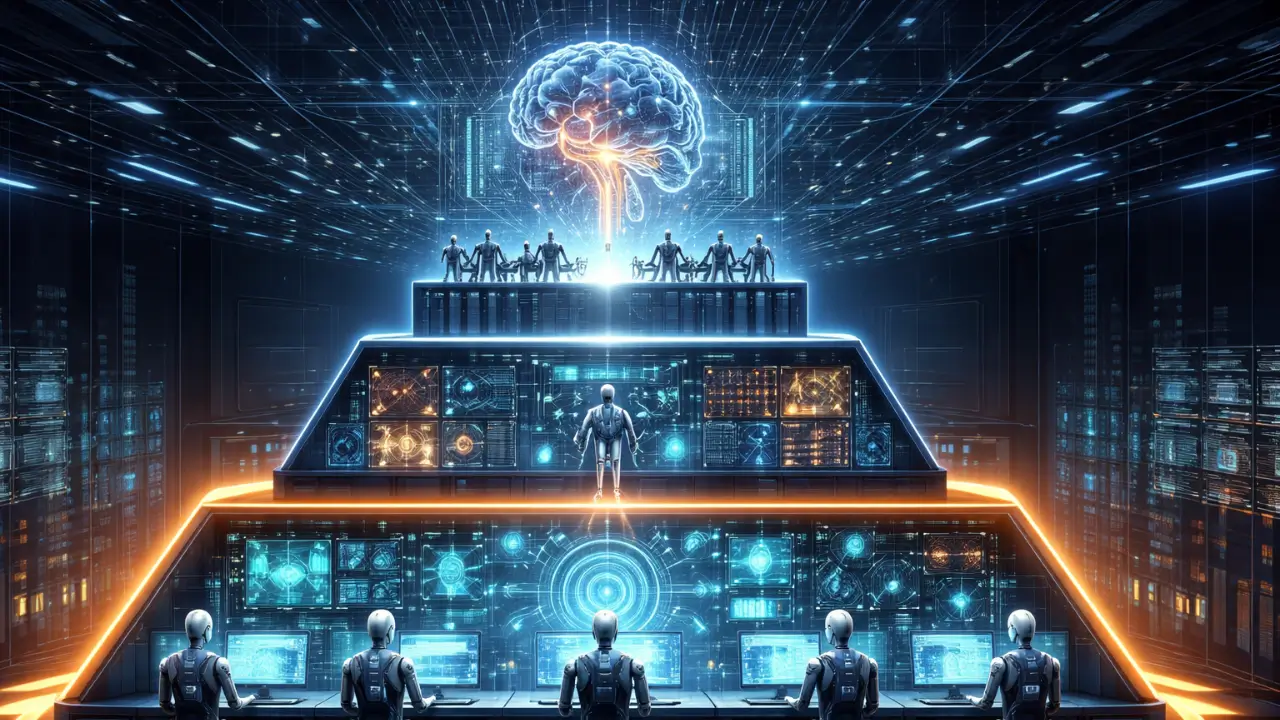
The advent of corporate hierarchy and AI marks a profound shift in how organizations conceive authority and operational control. Once confined to operational support, artificial intelligence increasingly assumes roles of execution and judgment across enterprises. This transition is reshaping managerial functions by placing autonomous systems at decision points traditionally reserved for senior human leaders. At the same time, human leadership is adapting by shifting emphasis from direct decision-making toward orchestration of hybrid teams composed of both human and machine agents. In this evolving context, corporate hierarchies are undergoing transformation from strictly human-centric structures to fluid, hybrid intelligence frameworks that distribute authority between humans and algorithms. Observers of this phenomenon emphasize that the transformation is philosophical and organizational, not merely technological, and reflects deeper questions about responsibility, oversight and strategic control.
Algorithms Ascending: From Execution to Judgment
In the industrial era, hierarchical structures were generally stable and rigid, with authority centralized at the top and execution relegated to the lower echelons of an organization. Routine tasks and operational decisions were executed by frontline staff, while thoughtful judgment remained the purview of senior managers and executives. Generative AI and autonomous systems have steadily diluted these clear delineations by taking on intricate and higher‑order tasks that require pattern recognition, risk assessment, and subtle judgement calls. As business operations incorporate agentic AI capable of conducting tasks from data synthesis to workflow management without continuous human intervention, the line between execution and judgment blurs, prompting organizations to reevaluate where responsibility resides within their structures.
This shift is evident in how AI tools are deployed across corporate functions. Intelligent systems now synthesize large data sets and propose strategic options that rival human analysis in speed and depth. In scenarios ranging from supply chain optimization to talent allocation, algorithms examine multifaceted variables to deliver recommendations that previously required hours of human deliberation. By integrating decision support tools that extend beyond mere automation, companies harness AI to evaluate evolving conditions and adjust operational priorities dynamically. The emergence of these capabilities prompts senior leadership to define new boundaries for AI involvement in judgment tasks, balancing technological acumen with human oversight to ensure alignment with corporate purpose and ethical frameworks.
Philosophical Questions of Authority and Agency
The transition of AI from execution support to judgment roles surfaces philosophical questions about the locus of authority. Algorithms do not possess intrinsic values or ethical preferences; instead, they reflect the data and objectives embedded within them by their human designers. This raises critical debates about whether AI can or should make decisions in areas affecting human careers, customer experiences and long‑term corporate trajectories. Human leaders, in turn, must grapple with balancing trust in AI judgement with protective oversight. They face the dual challenges of managing AI’s emergent autonomy while preserving human accountability. As executives consider these dynamics, corporate hierarchies are becoming hybridized, with AI acting as both a contributor to judgment and an influencer of strategic direction.
At the core of this evolution is the concept of agentic capability. Agentic AI systems perform tasks that encompass not only data processing but also autonomous orchestration of workflows and decision pathways. This evolution signifies a departure from traditional software that required human initiation at every step. Today’s agentic AI can execute tasks, monitor outcomes and trigger responses across integrated systems without constant human supervision. By doing so, AI expands its role from execution to judgment functionally and structurally, prompting organizations to rethink job descriptions and managerial responsibilities. Companies have begun to establish boundaries delineating where AI judgment can be trusted and where human intervention is mandatory, especially in sensitive areas like compliance and ethics.
Impact on Risk and Governance
This evolution also impacts corporate risk frameworks. As AI assumes responsibility for higher‑order decision processes, organizations must develop new governance mechanisms to monitor and evaluate algorithmic performance. Traditional audit structures are being redesigned to incorporate AI oversight, ensuring that algorithmic judgments align with strategic goals and legal requirements. Human judgment remains essential in interpreting the outcomes of AI systems, particularly when deviations from expected patterns occur. In practice, leaders build layered review systems where autonomous judgments are logged, vetted and accompanied by human reflection at predefined thresholds. This approach fosters a balance between efficient algorithmic decision-making and accountable human governance.
As algorithms gain prominence in corporate judgment tasks, corporate culture also evolves. Decision processes become more data driven and evidence centric, leading to broader organizational acceptance of AI judgments in areas like market strategy, customer engagement and resource allocation. This culture shift demands that human leaders cultivate new competencies, including fluency in interpreting model outputs, understanding algorithmic limitations and communicating AI‑derived insights across stakeholder groups. Hybrid intelligence structures thus emphasize collaborative interpretation of AI recommendations, where human leaders leverage AI precision and context awareness to make informed strategic choices that resonate with organizational values and long‑term objectives.
Redefining Managerial Roles in the Autonomous Enterprise
As autonomous systems become integral to operational execution, traditional managerial roles are under pressure to transform. Supervisory tasks that once involved routine oversight, such as allocating work, tracking performance and troubleshooting issues, are increasingly being delegated to intelligent systems that can handle them with higher efficiency. Managers are thus pivoting toward roles that emphasize orchestration, strategy and human‑centric leadership functions. In this new paradigm, managers spend less time on supervisory minutiae and more on facilitating collaboration between human teams and AI systems, optimizing workflows and addressing exceptions that autonomous systems cannot resolve.
For instance, autonomous AI agents are already being configured to assign tasks, monitor workflow performance and even evaluate outcomes against preset benchmarks without human prompt. This has led to a redefinition of supervision that emphasizes alerting human managers only when anomalies arise that algorithms are ill‑equipped to manage. In effect, human managers transition from task assigners to exception handlers and strategic facilitators. Such a shift requires managers to acquire new skills, including advanced AI literacy, cross‑disciplinary problem‑solving and enhanced interpersonal communication, all of which support effective collaboration within hybrid intelligence teams.
Ethical Judgment and Human Oversight
Leadership in an autonomous enterprise also demands a focus on ethical judgment. Autonomous systems operate based on patterns learned from data, yet they can inadvertently produce biased or unpredictable results if not properly governed. Human managers are tasked with ensuring that AI decision pathways reflect ethical considerations, regulatory compliance and corporate values. In practice, this involve roles such as AI ethics officers or compliance stewards who monitor autonomous systems’ decisions and intervene when values misalignment arises. This layer of leadership serves as a vital bridge between algorithmic efficiency and ethical stewardship.
The shift toward autonomous systems also affects talent strategy. Roles traditionally seen as support functions, such as schedulers, administrative assistants and junior project managers, are evolving into hybrid positions where oversight of AI and analysis of its outputs become central. These emerging roles focus on validating algorithmic outputs, ensuring data integrity and aligning system behavior with business goals. Human expertise now leans toward supervising agentic systems, curating data inputs and continually refining model behavior to adapt to dynamic business contexts. This reorientation underscores how managerial work is redefined from controlling tasks to shaping adaptive systems.
Redefining Managerial Evaluations
Moreover, managerial evaluations are shifting from individual task completion metrics to assessments of hybrid team performance, including how effectively managers guide AI systems, interpret insights and nurture human‑AI collaboration. Traditional performance indicators such as punctuality and task accuracy are giving way to complex success metrics that include innovation impact, system learning improvements and the agility of human‑AI teams. These changes force managers to redefine their value propositions within organizations, emphasizing integrative leadership over direct supervision.
In addition, autonomous systems are prompting a reevaluation of middle management altogether. Some organizations have found that AI tools enable highly efficient workflows that reduce or realign middle management layers. Whereas once multiple supervisory tiers were needed to manage information flow and execution, AI’s real‑time analytics and autonomous task assignment reduce the need for intermediate checkpoints. The result is often a leaner managerial hierarchy, where strategic orchestration roles sit above AI‑enabled operational layers.
Human leaders play an essential role in this redesign. Even as autonomous systems take on expansive operational responsibilities, human judgment remains crucial for interpreting ambiguous scenarios and setting priorities that align with corporate goals. Senior executives are redefining their roles to focus on long‑term strategic direction, vision articulation and cultural leadership rather than day‑to‑day task oversight. This realignment underscores the increasing emphasis on hybrid intelligence, wherein human leaders guide autonomous agents within a framework of organizational intent.
Shared Authority: Humans and Machines in Decision-Making
The increasing integration of AI in organizational hierarchies challenges traditional notions of authority. Rather than viewing humans as sole decision-makers, corporations are evolving toward models where authority is distributed between human leaders and autonomous systems. This hybrid distribution does not diminish human responsibility but reframes it within a collaborative ecosystem in which algorithms contribute recommendations, predictions, and real-time insights. Human leaders are now tasked with interpreting AI outputs, contextualizing them for business goals, and making final decisions when ambiguity arises. The partnership between humans and machines encourages a dynamic, iterative decision-making process that capitalizes on computational precision and human judgment. Organizations embracing this approach report that hybrid decision models enhance responsiveness while maintaining accountability.
Hybrid authority frameworks also require clear delineation of responsibility. Autonomous systems can execute tasks with precision and consistency, but they lack the ethical discernment and contextual understanding inherent to human cognition. As AI assumes greater operational authority, organizations have implemented protocols to ensure human oversight in critical decisions, particularly those involving legal compliance, strategic risk, or stakeholder impact. Leadership teams are establishing review gates and exception handling processes to prevent algorithmic misjudgments from escalating unchecked. This dual-layered governance fosters an environment where AI augments decision-making, yet humans remain the final arbiters of judgment in complex or sensitive situations.
Strategic Planning with Autonomous Systems
The influence of autonomous systems on authority extends beyond operations into strategic planning. Algorithms capable of predictive modeling and scenario simulation inform long-term business strategies, identifying patterns invisible to human analysts alone. By integrating these insights into corporate deliberations, executives can evaluate potential outcomes with greater granularity and confidence. The collaboration between human intuition and machine analysis allows organizations to navigate uncertainty while mitigating risk, creating a symbiotic relationship where authority is shared based on expertise and computational capability. The rebalancing of authority is not merely functional but also cultural, requiring organizational adaptation to embrace data-driven recommendations alongside human strategic foresight.
Human-machine collaboration also reshapes communication and reporting structures. Traditional hierarchical chains are being replaced with networked decision-making systems in which AI provides continuous updates, risk alerts, and scenario analyses to executives and managers. Information flows become multidirectional, enabling humans to respond proactively to insights while AI adapts workflows based on updated human inputs. This networked approach ensures that decisions are informed by both computational rigor and human judgment, reinforcing shared authority across organizational layers. Leaders must cultivate literacy in interpreting AI outputs and integrating them into human decision frameworks, emphasizing transparency and mutual trust between human and machine agents.
Accountability in Hybrid Decision Systems
Shared authority introduces new dimensions to accountability frameworks. Organizations have had to develop mechanisms to trace decisions, identify the contributions of both human and machine actors, and assess the quality of AI-generated recommendations. Documentation and logging systems now track algorithmic reasoning alongside human interventions, enabling retrospective review and performance evaluation. These practices ensure that authority, though distributed, remains transparent and auditable, aligning with corporate governance and regulatory expectations. In addition, hybrid accountability reinforces ethical responsibility, as humans remain responsible for guiding AI within the moral and strategic boundaries of the organization.
The human-AI partnership also transforms leadership expectations. Rather than simply supervising teams, leaders now orchestrate interactions among human staff and autonomous systems, ensuring alignment with organizational goals. Training programs increasingly emphasize hybrid intelligence skills, including interpreting AI analytics, managing algorithmic outputs, and resolving conflicts between automated recommendations and human judgment. This evolution highlights the necessity of adaptive leadership capable of managing technological complexity while sustaining human agency. Hybrid hierarchies reinforce the notion that authority is not a static possession but a fluid construct co-defined by humans and intelligent systems working in tandem.
Human Leadership as Orchestration
In hybrid intelligence structures, human leadership has shifted from direct decision-making toward orchestration. Leaders now manage complex interactions between autonomous systems and human teams, coordinating workflows, prioritizing objectives, and resolving conflicts that arise from divergent AI recommendations. The orchestration role requires an expanded skill set that blends strategic vision, technological literacy, and emotional intelligence. Executives guide algorithmic behavior while aligning AI outputs with corporate goals, ensuring that decisions reflect organizational values and long-term objectives. By focusing on orchestration, human leaders preserve agency while leveraging AI to enhance operational efficiency. This evolution represents a fundamental departure from traditional command-and-control management.
The orchestration model also emphasizes real-time decision synthesis. Leaders must integrate inputs from multiple autonomous systems, each operating within distinct operational parameters, and human teams, which contribute contextual insight and ethical judgment. This multidimensional oversight ensures coherence in strategy execution while mitigating risks of algorithmic bias or operational error. Orchestration relies on continuous monitoring, adaptive communication, and rapid problem-solving, requiring leaders to cultivate resilience and flexibility. The interplay between human judgment and AI analysis fosters a new form of managerial authority that privileges interpretation and coordination over direct control. In practice, orchestration enhances agility and enables organizations to respond effectively to dynamic market conditions.
Flattened Hierarchies through Orchestration
Orchestration reshapes traditional hierarchies by flattening layers of management. Autonomous systems assume operational oversight, freeing human leaders to focus on strategic alignment, cultural stewardship, and stakeholder engagement. Middle management layers, once responsible for monitoring routine processes, are now redefined to include roles that supervise AI decision-making and facilitate hybrid collaboration. This transition allows executives to focus on higher-order priorities, such as innovation, risk anticipation, and long-term visioning. The orchestration framework transforms authority into a networked and relational construct, where influence derives from coordination expertise rather than positional power. Leaders become facilitators of complex human-AI ecosystems rather than sole arbiters of decisions.
Communication dynamics under orchestration also evolve. Information is continuously shared between AI systems and human teams, requiring leaders to synthesize insights from multiple sources and translate them into actionable guidance. Orchestration demands that leaders maintain situational awareness, balancing AI-generated metrics with human intuition and contextual understanding. Decision-making is no longer linear; it emerges from iterative dialogue between intelligent systems and human judgment. Leaders must navigate ambiguity, evaluate AI recommendations critically, and guide teams toward coherent execution. This model fosters organizational adaptability, responsiveness, and the capacity to leverage AI for complex problem-solving.
Ethical Leadership within Orchestration
Ethical leadership gains renewed importance within orchestration. Autonomous systems execute decisions based on algorithmic logic, but moral and strategic alignment remains the responsibility of human leaders. Leaders intervene when AI outputs present ethical dilemmas, potential bias, or decisions that conflict with corporate values. Orchestration reinforces human accountability in hybrid hierarchies by embedding ethical evaluation at multiple stages of decision-making. Organizations that integrate ethical oversight into orchestration structures enhance trust among stakeholders, safeguard corporate reputation, and ensure regulatory compliance. By weaving ethics into the orchestration process, leadership reasserts the human dimension of authority even in highly autonomous environments.
The orchestration approach also enables a proactive culture of continuous learning. Leaders monitor AI performance and gather feedback from human teams to refine processes and improve outcomes iteratively. Training programs emphasize hybrid intelligence competencies, including data interpretation, algorithmic literacy, and collaborative problem-solving. Leaders act as enablers, empowering teams to exploit AI capabilities while preserving human judgment and creativity. This dynamic reinforces a learning organization model where adaptation, knowledge sharing, and hybrid decision-making define success. Orchestration thus transforms leadership from hierarchical control to agile, integrative governance.
Evolution of Corporate Hierarchies Toward Hybrid Intelligence
Corporate hierarchies are undergoing a structural transformation as AI and autonomous systems integrate into organizational frameworks. Traditional pyramidal models, where decision-making power flowed from executives down to operational staff, are giving way to fluid, hybrid intelligence structures. In these systems, authority is distributed based on competence, data access, and algorithmic insight rather than purely hierarchical rank. This redistribution allows organizations to leverage computational capabilities alongside human expertise, optimizing decision-making across multiple levels. As a result, power dynamics are no longer solely determined by formal titles but by the ability to orchestrate human and machine collaboration effectively. The shift signals a redefinition of leadership roles and corporate governance paradigms.
Hybrid hierarchies prioritize responsiveness and adaptability over rigid chains of command. Autonomous systems handle operational and analytical tasks, while human leaders focus on strategy, culture, and complex judgment. Information flows bidirectionally between humans and machines, enabling continuous refinement of processes and decisions. Organizations employing hybrid models report accelerated decision cycles and improved agility in responding to market fluctuations. Managers are now evaluated on their ability to integrate AI insights with human judgment, ensuring alignment with strategic objectives and ethical standards. This transition reflects a philosophical evolution, where hierarchical authority is no longer synonymous with control but with the capacity to orchestrate intelligent networks.
Accountability and Knowledge Management in Hybrid Structures
The integration of autonomous systems also influences corporate accountability mechanisms. Decision-making trails now include both human and algorithmic inputs, providing transparency and auditability for critical business operations. Organizations maintain rigorous documentation of algorithmic reasoning, human overrides, and hybrid team outcomes, ensuring compliance with regulatory standards. This structured accountability reinforces confidence in hybrid decision-making while distributing authority more equitably across human and AI actors. By embedding oversight mechanisms within hybrid hierarchies, companies achieve both efficiency and governance integrity, establishing a model where distributed authority enhances organizational resilience.
Hybrid intelligence structures also reshape knowledge management. Algorithms contribute to capturing, analyzing, and disseminating information rapidly, while human teams contextualize data within strategic and cultural frameworks. This synergy accelerates decision-making by providing real-time insights that inform operational adjustments, risk mitigation strategies, and market positioning. Human leaders act as integrators, aligning AI outputs with organizational objectives and stakeholder expectations. Teams become capable of making informed decisions at multiple levels without awaiting top-down directives, fostering a more agile and decentralized decision ecosystem. The result is a corporate architecture that leverages both the precision of AI and the judgment of humans to sustain competitive advantage.
Cultural Transformation in Hybrid Hierarchies
Cultural transformation accompanies the structural evolution of hierarchies. Organizations adopting hybrid intelligence frameworks foster environments that value data-driven insights while emphasizing human oversight. Employees are encouraged to interact with autonomous systems, interpret outputs critically, and provide contextual judgment. Leadership models shift from authority based on positional power to influence derived from coordination, knowledge synthesis, and ethical stewardship. These cultural adjustments ensure that AI integration enhances rather than diminishes human agency. As hybrid hierarchies mature, organizational norms, communication patterns, and performance evaluations evolve to reflect the interdependence of human and machine intelligence.
Training and development strategies also transform in hybrid hierarchies. Employees are equipped to interpret AI outputs, validate algorithmic decisions, and manage human-AI interactions effectively. Leadership development programs prioritize orchestration skills, systems thinking, and technological literacy. By fostering hybrid competencies, organizations ensure that authority is exercised with insight and precision, integrating human judgment with AI efficiency. The evolution emphasizes learning and adaptability as core components of hierarchical functionality, enabling organizations to respond to evolving markets while sustaining internal coherence. This approach reconceptualizes hierarchy as a dynamic system shaped by both computational intelligence and human stewardship.
Organizational Decision-Making in the Hybrid Era
The incorporation of AI into corporate decision-making has fundamentally altered how organizations approach strategy and operations. Autonomous systems analyze vast quantities of information and propose recommendations that would be infeasible for humans to produce alone. These insights provide leaders with a more granular understanding of operational performance, market trends, and risk exposures. However, human judgment remains essential for interpreting these outputs and integrating them with contextual knowledge, ethical considerations, and long-term strategic goals. Decision-making in hybrid environments is iterative and collaborative, requiring constant feedback between humans and AI systems to optimize outcomes. Organizations are thus redefining decision authority to encompass both computational intelligence and human oversight.
Hybrid decision-making models also affect operational governance. Leaders develop frameworks that designate specific responsibilities to AI systems, define exception-handling protocols, and ensure that human judgment remains central for high-stakes decisions. Continuous monitoring and adjustment of AI recommendations allow organizations to maintain strategic alignment while leveraging the speed and analytical depth of autonomous systems. These models emphasize risk mitigation, accountability, and transparency, ensuring that AI-generated insights enhance rather than replace human judgment. By formalizing the interaction between humans and algorithms, companies foster robust governance mechanisms that underpin ethical, efficient, and scalable decision-making structures.
Strategic Planning with AI Insights
The hybrid approach also transforms strategic planning. Autonomous systems generate predictive analyses and scenario simulations, allowing leadership teams to anticipate market shifts, supply chain disruptions, and emerging risks with enhanced precision. Human leaders contextualize these insights, weighing social, economic, and ethical implications alongside computational recommendations. This combination ensures that strategic decisions are both data-informed and aligned with organizational objectives. The iterative interaction between human judgment and algorithmic analysis fosters agility and foresight, enabling organizations to respond to uncertainty proactively rather than reactively. Consequently, decision-making hierarchies are evolving into interconnected networks that integrate multiple layers of intelligence.
In hybrid decision systems, performance evaluation metrics are also redefined. Traditional measures focused on task completion and efficiency are replaced by assessments that consider the quality of human-AI collaboration, adaptability of teams, and alignment with strategic objectives. Leaders are evaluated based on their ability to interpret AI outputs accurately, mediate between conflicting recommendations, and guide teams toward coherent execution. Similarly, algorithmic performance is monitored for accuracy, fairness, and reliability. These dual evaluation frameworks reinforce accountability and encourage continuous improvement, ensuring that decision-making remains robust, ethical, and responsive to changing operational conditions.
Resilience and Continuous Learning
Hybrid decision-making also promotes organizational resilience. By distributing analytical and operational authority across human and machine actors, companies reduce dependency on individual decision-makers. Algorithms provide predictive insights and perform rapid calculations, while human leaders maintain oversight, interpret complex scenarios, and make judgment calls in uncertain contexts. This division of labor allows organizations to adapt quickly to unforeseen challenges, maintain operational continuity, and optimize resource allocation. Resilience in hybrid hierarchies stems from the integration of AI precision with human adaptability, fostering robust systems capable of sustaining performance under volatile conditions.
Hybrid decision-making encourages a learning-oriented corporate culture. Continuous feedback from AI outputs allows teams to identify gaps, optimize processes, and refine decision protocols. Leaders act as facilitators, guiding teams to interpret AI insights while fostering human judgment, creativity, and ethical reasoning. Over time, the organization develops collective intelligence that integrates human experience and algorithmic analytics. This cultural evolution reinforces the value of hybrid hierarchies and ensures that authority, though shared, remains coherent, accountable, and strategically aligned. Hybrid decision-making thus represents not just a functional adjustment but a philosophical shift in how organizations conceive authority and intelligence.
As corporate hierarchies evolve to integrate AI, ethical governance becomes critical. Autonomous systems execute decisions at speed and scale. They operate without intrinsic ethical judgment. Human leaders remain responsible for ensuring that algorithmic outputs align with corporate values, regulatory frameworks, and societal expectations. Governance structures are redesigned to include review mechanisms, compliance checkpoints, and ethical oversight roles. These processes monitor AI decision-making closely. By embedding oversight, organizations maintain accountability while leveraging AI efficiencies. Hybrid hierarchies optimize operational performance while safeguarding ethical and legal integrity.
Multi-Layered Oversight and Transparency
AI governance frameworks involve multiple layers of oversight. Leaders implement approval gates, audit trails, and anomaly detection systems. These measures ensure AI recommendations meet ethical and strategic standards. Human review is required for high-risk decisions, especially those affecting employees, customers, or regulatory compliance. These structures prevent unintended consequences from AI errors or biases. Organizations maintain controlled environments where AI contributes to decision-making without replacing human responsibility. Ethical frameworks emphasize transparency. Organizations communicate decision logic and rationale to stakeholders to preserve trust.
Ethical considerations extend to algorithmic bias and fairness. Autonomous systems learn patterns from historical data, which may encode inequities or prejudices. Leaders in hybrid hierarchies detect and mitigate these biases. They ensure decisions do not disadvantage employees, customers, or stakeholders. AI ethics committees and cross-functional review teams provide oversight. These teams validate outcomes and recommend adjustments. Continuous monitoring and ethical evaluation preserve human values while leveraging computational power. Ethics becomes integral to operational and strategic decision-making. This ensures hybrid structures balance efficiency and integrity.
Accountability and Cultural Integration
Governance in hybrid hierarchies emphasizes accountability for both humans and AI. Organizations maintain detailed logs of AI outputs, human overrides, and final decisions. These logs provide a clear chain of responsibility. They facilitate auditing, regulatory compliance, and stakeholder communication. Leaders are trained to interpret logs, detect anomalies, and intervene when AI behavior diverges from objectives. Dual accountability strengthens trust in hybrid intelligence models. It ensures efficiency does not compromise ethical integrity or corporate reputation.
The ethical dimension reshapes corporate culture. Employees collaborate with AI, interpret outputs critically, and raise concerns when necessary. Organizations encourage combining ethical evaluation with technical assessment. Decision-making reflects both competence and integrity. This culture strengthens hybrid ecosystems and aligns AI efficiency with human values. Leaders act as custodians of ethics. They orchestrate workflows that balance automated execution with principled oversight. This approach reinforces organizational resilience and legitimacy.
Long-Term Strategic Responsibility
Governance extends to long-term strategic responsibility. Hybrid hierarchies integrate AI insights into planning while keeping human oversight for vision, risk management, and social impact. Leaders define principles for AI deployment and anticipate potential consequences. They design safeguards to align autonomous systems with corporate objectives. These steps ensure AI integration enhances competitiveness without eroding accountability or ethical standards. Hybrid hierarchies synthesize technological capability with moral stewardship. They establish a model where operational excellence and ethical integrity coexist.