
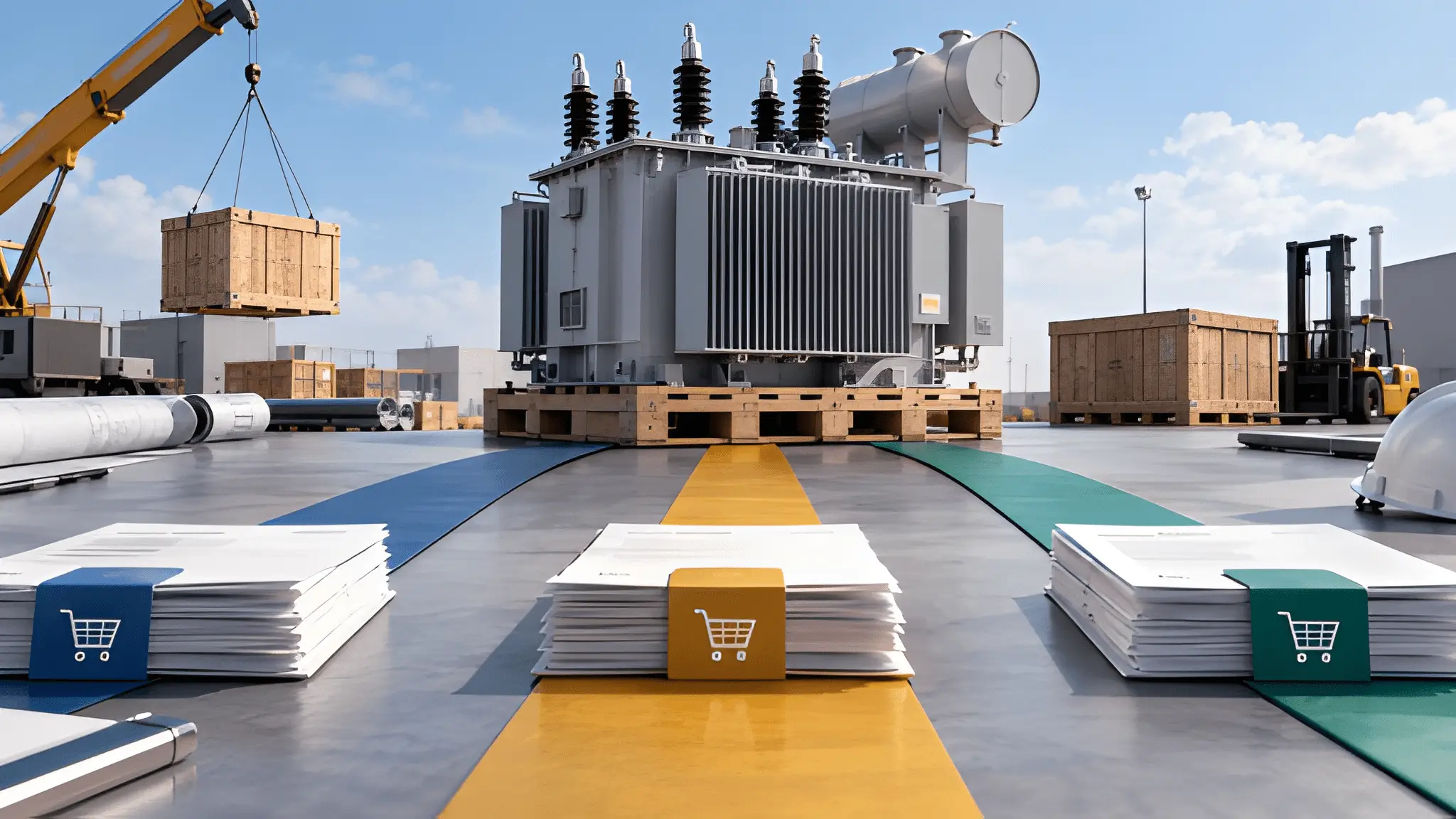
The first purchase order did not look unusual. A site operator needed a transformer for an electrical sequence already moving through design review, a contractor needed the same equipment to protect its construction schedule, and a manufacturing partner had separately reserved production capacity against its own interpretation of the same requirement. Each transaction carried a legitimate project reference, a technical specification, an internal approval trail and a commercial reason for moving quickly. Nothing in those individual records necessarily indicated that the three commitments pointed toward the same physical requirement. The supplier therefore saw several expressions of demand rather than one coordinated demand signal. By the time the discrepancy became visible, the procurement system had already converted uncertainty into commitments.

The order that looked like three different requirements
The problem begins when organizations treat the purchase order as the unit of truth rather than the physical component as the unit of truth. A transformer does not become three transformers because three commercial entities have created three records, yet separate systems can make that duplication look perfectly rational from inside each organization. The operator may regard its order as a protection against project delay, while the contractor regards its reservation as protection against an incomplete release package and the manufacturing partner treats its allocation as protection against uncertain production requirements. Those decisions can coexist without any participant deliberately creating artificial scarcity. The resulting demand signal, however, can reach the supply chain with more force than the underlying construction requirement justifies. Research on the bullwhip effect has long shown how order behavior can amplify upstream demand when participants react independently to uncertainty and long replenishment cycles.
A transformer reservation can therefore become a kind of shadow requirement. It occupies a production conversation, consumes supplier attention, influences capacity planning and can shape how other buyers perceive what remains available. The physical equipment may still exist as one intended asset, but the commercial ecosystem can behave as though several assets require protection. That distinction matters because the transformer market already operates under genuine capacity constraints, with demand from electrification, grid investment and data center development competing for manufacturing capacity. Current market analysis describes transformer supply as a binding constraint in parts of the power infrastructure chain, while current data center research continues to identify electrical equipment procurement as a major scheduling concern. The presence of real scarcity makes duplicated demand especially difficult to identify because a legitimate shortage and an artificial demand signal can occupy the same procurement dashboard.
Phantom demand starts with reasonable decisions
No procurement team needs to behave irrationally for phantom demand to emerge. A plausible pattern involves rational decisions made against incomplete information, with each participant protecting its own project requirement without seeing the full set of related commitments. An operator worries about energization, a contractor worries about construction sequencing, and a manufacturer worries about securing the production inputs required to honor its commitments. Their internal incentives can therefore encourage early reservation even when the underlying requirement remains shared. The resulting duplication does not necessarily appear as an error in any individual ERP system because each record remains internally consistent. The error exists between the systems, where nobody owns the complete physical picture.

The consequence is not simply that someone buys too much equipment. The more important consequence is that every participant starts making subsequent decisions from a distorted picture of demand. A supplier may interpret multiple reservations as evidence that capacity needs to remain protected, while another buyer may interpret the same constrained availability as evidence that it must place its own order earlier. That second decision creates another signal, which can reinforce the first perception and move the market further away from the physical requirement. The process resembles a feedback loop in which defensive procurement becomes evidence for further defensive procurement. Once that loop starts, correcting it requires more than canceling a purchase order because the surrounding production, logistics and scheduling decisions may already depend on the original signal.
The missing ledger is the real problem
A useful coordination record would distinguish between an identified need, a forecast requirement, a commercial reservation, a released purchase order, a manufacturing slot, a finished unit and an allocated unit awaiting delivery. Those states are materially different even though procurement dashboards can collapse them into a single label such as committed or ordered. A project leader looking at the latter may assume that the physical equipment exists somewhere in the chain when the supplier has only acknowledged a reservation or placed the requirement into a production queue. Conversely, a supplier may see several committed orders that represent different commercial stages of the same physical requirement. Inventory visibility systems already recognize the importance of separating available, reserved and committed quantities rather than treating every transaction as immediately equivalent to physical stock.
Coordination debt can accumulate precisely in that space, where every unresolved identifier, reservation or status difference creates another item that must later be reconciled. Every unresolved identifier, duplicated reservation, unconfirmed allocation and unexplained change in requirement adds another layer of interpretation that someone must eventually reconcile. The longer that reconciliation waits, the more downstream decisions can attach themselves to an assumption that nobody has formally validated. A transformer can then become the visible symbol of a much broader coordination problem involving engineering, procurement, manufacturing, logistics and site delivery. The market may still have a genuine shortage, while fragmented procurement information can make the underlying demand picture harder to interpret.
The Spreadsheet That Hid The Real Shortage
The spreadsheet usually looks reassuring until someone asks a question the spreadsheet was never designed to answer. Procurement may show a transformer as ordered, the contractor may show it as allocated, the manufacturer may show it as scheduled, and the site team may still have no confirmed delivery path. Every column can contain technically correct information while the project remains exposed. The difficulty comes from the difference between transaction status and physical status. A purchase order records an agreement, while a site needs an identifiable piece of equipment moving through a sequence that ends with installation and energization.
When procurement truth separates from site truth
That distinction becomes important when long-lead equipment moves through several procurement, engineering and delivery stages before reaching the site. A transformer can move from technical approval to supplier acknowledgment, from supplier acknowledgment to production planning, from production planning to manufacturing, and from manufacturing to logistics without any single dashboard carrying the complete chain. Each organization can report progress based on the milestone it controls. The site team, however, needs to know whether the physical item is still available for its requirement and whether every dependency around its arrival remains intact. Current supply-chain research emphasizes that visibility becomes progressively harder as information moves beyond direct suppliers and into deeper tiers, where the original buyer often lacks reliable status information.
The result can be an uncomfortable moment during a site review. The procurement team points to the order confirmation, the contractor points to the allocation notice, and the logistics team points to an expected movement window. The site engineer then asks for the serial reference, manufacturing status, inspection release, shipping readiness and confirmed destination, and the apparent certainty begins to dissolve. None of those questions necessarily indicates that a supplier has failed. They reveal that the project has several versions of the same truth, each optimized for a different operational purpose. A site can therefore appear fully procured on paper while remaining materially exposed to delay.
The field eventually exposes every assumption
The site has a different relationship with truth because physical work cannot proceed from a procurement status alone. Installation crews need equipment that arrives in the correct sequence, matches the approved design and can move through the available access route without creating another scheduling conflict. Commissioning teams need the equipment to be installed, tested and connected in a sequence that respects upstream and downstream dependencies. A delayed transformer can therefore remain invisible inside procurement reporting until another activity reaches the point where the missing equipment becomes unavoidable. At that moment, a procurement uncertainty becomes a construction problem.
This explains why procurement dashboards can remain green while a project schedule begins to move. The dashboard may reflect commitments rather than dependencies, while the schedule reflects the actual sequence required to complete the work. A transformer that arrives after its planned installation window can force crews to resequence work, change storage arrangements, adjust testing plans and revisit handover dates even if the purchase order itself remains fully compliant. The disruption can spread because physical work has less flexibility than transactional systems imply. Research on supply-chain coordination shows that mismatches between procurement behavior and operational requirements can create inefficiencies even when aggregate demand appears consistent with the original plan.
When Lead Times Lie To Everyone Equally
A lead-time quote begins as an estimate of when a supplier expects to deliver a defined piece of equipment under a defined set of commercial and technical conditions. It becomes something else when every buyer treats the estimate as a reason to secure capacity earlier than the underlying project actually requires. A manufacturer then sees stronger forward demand, procurement teams see tighter availability, and project developers receive fewer reasons to wait. The transformer market can genuinely be constrained at the same time, which makes it difficult to separate the physical shortage from the additional pressure created by defensive procurement. Current reporting on electrical equipment supply shows that high-voltage transformer availability remains under significant pressure as data center, grid, industrial and electrification demand compete for manufacturing capacity.
The quote becomes a market signal
The buyer who orders early is not necessarily causing the shortage, because securing a production position can be a rational response when manufacturing capacity is limited and project schedules depend on equipment arrival. The problem emerges when several parties protect the same underlying requirement without recognizing one another’s commitments. An operator can reserve equipment against a target energization date while a contractor reserves equivalent capacity against its construction sequence, leaving the supplier with more apparent demand than the physical project requires. Another buyer watching the same market may interpret that capacity pressure as evidence that it must also reserve equipment immediately. The process can create an amplification effect in which precautionary purchasing reinforces the conditions that made precaution necessary in the first place. Supply-chain research has long documented how decentralized ordering decisions can amplify demand signals as information moves upstream through a network.
The resulting lead time can therefore reflect several layers of demand and production uncertainty rather than a single physical manufacturing constraint. One layer represents the manufacturer’s actual production capacity, another reflects the existing queue, another reflects committed reservations, and another reflects buyers attempting to protect themselves from future queue expansion. Those layers can become difficult to distinguish when suppliers communicate availability through commercial quotes rather than through a shared view of final physical demand. A procurement team may receive a longer delivery estimate even though no new project has physically consumed the equivalent amount of equipment. The supplier is responding to the commitments visible in its own order book, while the buyer is responding to the supplier’s revised estimate. The feedback loop becomes self-reinforcing because each side makes the next decision using information generated by the previous defensive decision.
Safety ordering can manufacture its own pressure
Safety ordering becomes particularly complicated when the same requirement passes through several contractual layers. A site owner may authorize early procurement to protect an energization window, while an engineering contractor separately seeks supplier confirmation so it can protect its construction schedule. A manufacturing partner may then secure upstream materials or production capacity against the contractor’s requirement without knowing that the owner has already reserved the equipment directly. Each action protects a legitimate dependency. The network nevertheless begins carrying multiple commercial signals around one physical asset. The result resembles inventory inflation even when no participant intends to accumulate excess equipment.
A procurement environment built around individual protection therefore rewards ownership of capacity rather than efficient movement of capacity. The organization that releases a reservation first assumes that someone else will retain enough supply to cover the requirement if circumstances change. The organization that keeps its reservation preserves optionality but also prevents that capacity from being cleanly reallocated. When every participant makes the same calculation, optionality becomes collective congestion. The market does not need fraudulent orders or speculative trading for this to happen. It only needs several rational participants to value protection more highly than coordinated release.
The lead-time number becomes less useful
A lead-time estimate is most useful when the buyer understands the assumptions behind the supplier’s delivery position. Without that context, the number can become a blunt indicator of market anxiety rather than a reliable planning input. A buyer that receives a long estimate may react by moving procurement forward, while another buyer may respond by accepting a substitute specification or pursuing another supplier. Those responses alter the supplier’s planning environment and can change the next lead-time estimate.The number therefore does not necessarily describe a single market condition, because supplier capacity, demand commitments and project requirements can all influence the quoted position.
That dynamic matters for AI infrastructure because electrical equipment sits inside a tightly sequenced chain of design, manufacturing, transport, installation and commissioning. A transformer arriving early does not automatically create useful schedule protection if the associated switchgear, protection equipment, cabling, foundations or site readiness cannot support installation. Conversely, a late transformer can disrupt activities that appear unrelated to procurement because downstream work depends on its physical presence. The procurement team therefore needs more than a supplier’s estimated delivery date. It needs to understand the relationship between the equipment’s production state and the site’s actual sequence.
The Domino No One Was Tracking
A delayed transformer can extend beyond a transformer problem when installation, testing, commissioning or energization activities depend on its arrival.Once the equipment misses the point at which the site expected to receive it, the project team must decide what work can move forward and what work must wait. That decision can affect electrical installation, testing sequences, temporary power arrangements, crane planning, material staging and contractor mobilization. A schedule that looked like a collection of independent activities suddenly reveals a chain of dependencies. Coordination debt can become visible through schedule dependencies that no single procurement dashboard is designed to own.
The missing transformer moves more than the schedule
The physical movement of a large electrical component creates another layer of dependencies outside the factory. Transport equipment must be available, access routes must accommodate the load, staging areas must be prepared and site personnel must be available when the shipment arrives. If the delivery window changes, those resources may need to move as well. A revised arrival can therefore create conflicts with another project’s logistics slot or with another construction activity occupying the same site resources. Supply-chain planning becomes inseparable from construction sequencing once equipment is large, specialized and difficult to move.
This is why a duplicated reservation can create consequences far beyond the original purchase decision. If one project secures a manufacturing slot it does not yet need, another project may accept a later slot and then move its logistics planning around that later date. When the first project eventually changes its requirement, the original slot may no longer fit neatly into the second project’s schedule. The physical equipment can exist, the supplier can remain contractually compliant and the overall ecosystem can still lose time because the allocation was never coordinated around actual site requirements. Current analysis of data center electrical procurement describes equipment availability as a direct schedule constraint rather than a conventional back-office purchasing issue.
Logistics inherits procurement’s uncertainty
A logistics team cannot plan from the word ordered. It needs a credible physical status, an expected release point, a transportation requirement and a receiving condition. The further a component moves through procurement without those details becoming stable, the more difficult it becomes to reserve the right logistics resources at the right time. A transformer can therefore be commercially committed while remaining operationally unready for movement. That difference creates idle planning effort on one side and avoidable uncertainty on the other. The project eventually pays for both through schedule adjustments rather than through a single identifiable procurement charge.
Staging yards experience the same problem because space becomes a coordination resource when equipment cannot move directly from production to final installation. If several projects advance equipment orders defensively, logistics providers may have to accommodate components arriving before their intended installation windows. Equipment then remains in intermediate locations while the site catches up. That creates additional handling requirements and introduces another point at which identification, preservation, inspection and release status must remain accurate. The longer a component stays outside its intended installation sequence, the more important accurate ownership and status information becomes.
Handover windows expose the hidden dependencies
Handover is where fragmented planning becomes particularly visible because several previously independent workstreams must converge. The electrical equipment must be physically present, installed, inspected and ready for the next stage of testing. Documentation must align with the equipment that actually arrived, and the responsible teams must have enough certainty to schedule the work around it. A procurement record cannot complete that handover by itself. The project needs synchronized physical, technical and commercial information.
A duplicated transformer reservation can interfere with that synchronization even if the duplicate never reaches the site. The reservation can influence production sequencing, supplier communication and delivery assumptions, while another project reorganizes its own schedule around a different availability position. When one reservation is later released or changed, the consequences can appear as a logistics adjustment somewhere else. The people dealing with the resulting delay may never know that the original trigger was a duplicate commitment created months earlier. Coordination debt is difficult to remove after the fact because the visible problem appears far away from its original cause.
Buffer Stock Became The Bottleneck
Buffer stock can improve resilience when additional inventory supports the requirement and timing the organization needs to protect. The logic changes when several participants create buffers against the same constrained component. Each organization may believe that its reserve protects its own schedule, yet the combined reserves can remove equipment from circulation even when the projects do not need simultaneous delivery. The system then contains more protected inventory without gaining equivalent operational resilience. The buffer becomes a blockage because its value depends on coordination that the procurement model does not provide.
Transformers create a particularly difficult case because they are not interchangeable pieces of generic warehouse stock. Their electrical characteristics, physical configuration, protection requirements and intended application can constrain where they can be used. A unit assigned to one project may not provide a straightforward substitute for another project’s requirement. That reduces the value of fragmented inventory because the ecosystem cannot assume that every stored transformer represents immediately usable supply. Procurement therefore needs to distinguish between physical possession and usable flexibility.
A buffer becomes useful when someone can deploy it at the moment of need. Fragmented buffers often lack that quality because individual contracts still control ownership, specifications and release conditions. One project can hold equipment that another project urgently needs, yet transferring the equipment may require commercial renegotiation, technical validation and approval from several parties. The physical item exists, but the operational option does not. That difference matters when procurement teams judge resilience by what has been purchased rather than by what they can actually redeploy.
Fragmented buffers lock up optionality
The problem can become harder when each participant values certainty differently and protects its own position accordingly. The operator wants certainty around energization, the contractor wants protection against installation disruption and the supplier wants confidence that production capacity remains monetized. None of those priorities is unreasonable. Their combination can create a market in which every participant holds optionality while the system itself loses flexibility. A component can be physically available and still function as unavailable supply because nobody has established the conditions under which it can move.
This is one reason shared visibility can be more valuable than simply increasing inventory. A coordinated view can identify which equipment is genuinely assigned, which reservation protects an active requirement, which allocation has become redundant and which unit could be released without threatening another site’s schedule. That information allows the ecosystem to use existing capacity more efficiently before adding another layer of purchasing. The approach does not remove the need for safety stock or early procurement where genuine risk exists. It makes those protections more selective by connecting them to actual requirements rather than allowing every participant to independently insure against the same uncertainty.
The better buffer is synchronized capacity
The strongest form of protection is not always physical inventory. In a constrained transformer market, it can be a clearly defined manufacturing position connected to a validated requirement, supported by an agreed specification and linked to a credible delivery sequence. Such an arrangement can preserve access to production capacity while avoiding unnecessary duplication of commitments. It also gives the supplier better information about which requirements are firm and which remain conditional. That clarity can improve production planning even when the underlying manufacturing constraint remains unchanged.
Synchronized capacity also changes the conversation between the site, contractor and manufacturer. Instead of asking each party whether it has secured a transformer, the project can ask whether one physical requirement has one accountable allocation and whether every other reservation connected to that requirement remains necessary. That question reveals duplication without requiring every organization to expose commercially sensitive information. It creates a shared control point around the physical asset rather than around the individual contract. The result can be a procurement structure that protects genuine requirements without treating every overlapping reservation as independent demand.
The transition requires discipline because releasing unnecessary protection can feel dangerous in a constrained market. The organization that gives up a duplicate reservation must trust that the shared record accurately identifies the underlying requirement and that the remaining allocation will remain protected. That trust comes from clear ownership, defined release rules and regular reconciliation between procurement, engineering, manufacturing and site teams. Without those mechanisms, fragmented buffers will continue to look safer than coordinated capacity. With them, the ecosystem can begin converting coordination debt into usable flexibility rather than accumulating more equipment as insurance.
What Shared Visibility Actually Fixes
Shared visibility does not mean putting every commercial record into one universal procurement system. The more useful change is to establish a common physical reference that lets different participants recognize when several commercial actions point toward the same site requirement. That reference can connect the technical specification, site requirement, responsible party, manufacturing position, delivery sequence and current disposition without exposing information that each organization has a legitimate reason to keep private. The objective is to replace fragmented assumptions with a controlled view of what equipment the physical project actually requires. That becomes increasingly important while transformer demand remains elevated and manufacturers continue expanding capacity in response to pressure across power infrastructure markets.
From transactional buying to coordinated demand
A shared demand signal also changes the meaning of an early procurement decision. Instead of treating every reservation as an independent requirement, the participants can classify it according to the physical requirement it protects and the condition that would make another reservation unnecessary. An operator might retain the primary allocation while a contractor maintains only a conditional reservation that automatically comes under review when the manufacturing position becomes firm. A manufacturing partner can then plan against a requirement whose status reflects the actual project rather than against several disconnected commercial instructions. The resulting process does not eliminate uncertainty, but it prevents uncertainty from being multiplied through independent purchasing actions. Current supply-chain analysis increasingly places procurement coordination alongside manufacturing investment and supply-chain monitoring when addressing shortages in grid-supporting equipment.
The most important change occurs when procurement status and project status begin using the same underlying reference. A transformer should not appear as available in one system, allocated in another and physically committed to a third site without someone being able to reconcile those states. The shared record can show whether the equipment represents an active requirement, a duplicate protection, a conditional reservation or an asset that can be reassigned. That creates a clearer basis for supplier conversations because the supplier can distinguish firm demand from overlapping demand without needing to interpret every project independently. The result is a more credible demand picture, which can improve the quality of production planning even when the market itself remains constrained.
The early contractor-manufacturer huddle
The most effective coordination often begins before the purchase order becomes the dominant source of information. Engineering, procurement, the contractor and the manufacturer can review the requirement while the specification is still being finalized, identifying which decisions could affect manufacturing capacity and which elements remain flexible. That conversation gives the manufacturer a clearer view of what the project actually intends to build rather than forcing the supplier to infer demand from separate commercial interactions. It also gives the project a clearer understanding of which design decisions have consequences for production, testing and delivery. The conversation becomes a planning mechanism rather than a status meeting.
This approach matters because technical changes can create new procurement signals even when the underlying requirement has not changed. A revised rating, connection arrangement, enclosure requirement or protection configuration can cause a new quotation or production review that appears separate from the original requirement. Without coordination, the earlier position may remain active while the revised position enters the system as another demand signal. A structured technical review can determine whether the change modifies the existing allocation or creates a genuinely new requirement. That decision prevents engineering evolution from quietly becoming procurement duplication.
Paying Down Debt Before It Compounds
Coordination debt does not necessarily become visible when a project is first approved, because unresolved gaps can remain within separate procurement, engineering and delivery processes. It accumulates through small unresolved gaps between teams, suppliers and schedules, with each gap appearing too minor to justify immediate intervention. One identifier does not match another, one reservation remains unexplained, one supplier status has not been reconciled and one delivery assumption sits outside the current construction schedule. None of those conditions necessarily threatens the project by itself. Together, they create an information structure that becomes increasingly expensive to untangle as the equipment moves closer to installation.
Coordination becomes an operating discipline
The cost of that debt can be reflected less in procurement administration than in the schedule flexibility available when equipment or delivery conditions change. A project with clean coordination can respond to a supplier change because it knows which requirement is affected, which activities depend on it and which alternatives remain available. A project carrying coordination debt must first determine what the supplier change actually means before deciding what to do about it. That delay can consume the same schedule flexibility that procurement teams originally tried to protect through early ordering. The irony is that a process designed to reduce delivery risk can create another form of risk when its protective actions remain disconnected.
Transformer procurement makes that problem particularly visible because the equipment sits at the intersection of electrical design, manufacturing, logistics, construction and energization. A decision made during procurement can therefore influence activities that sit several organizational boundaries away from the person who made the decision. Current market research continues to describe electrical equipment availability as a development constraint for data center projects, while manufacturers are responding through capacity expansion and longer-term production commitments.











