 Skip to content
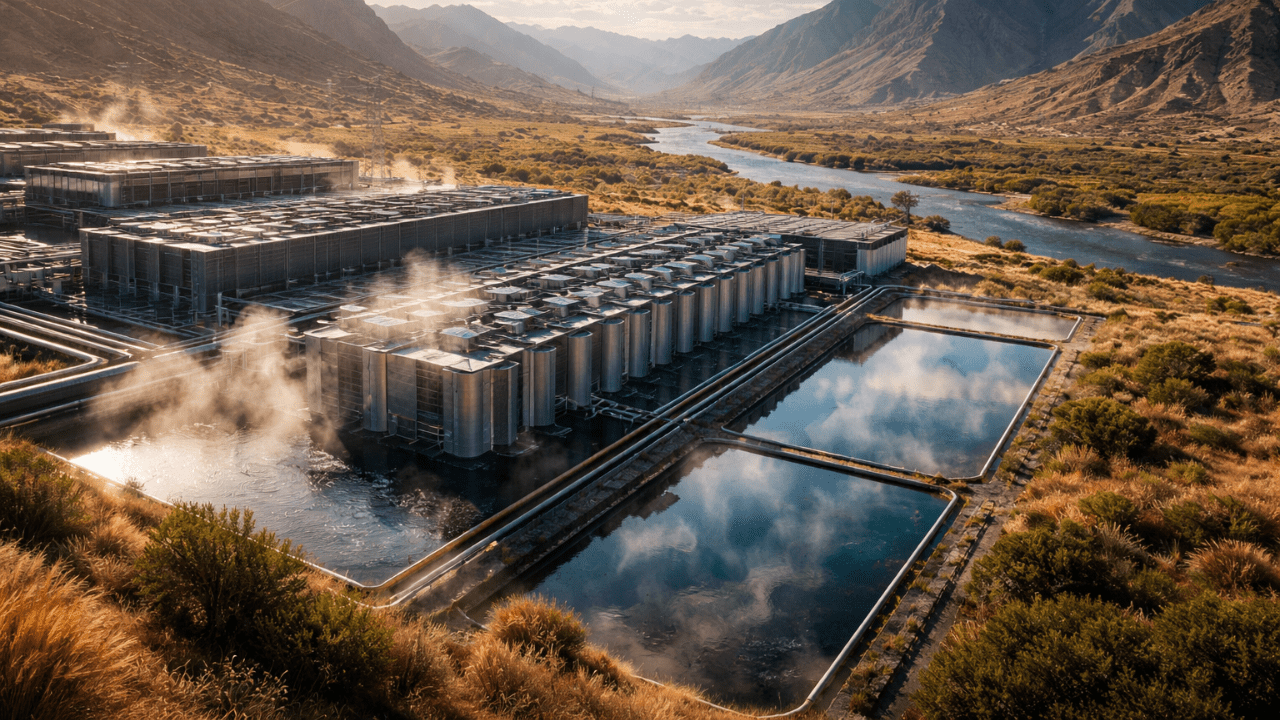
The rise of digital infrastructure, especially hyperscale and AI-intensive data centers, has coincided with an increasingly acute global water crisis, creating an intersection where the thirst for data meets the scarcity of water in many watersheds. Data centers use significant amounts of freshwater to manage the heat produced by densely packed computing equipment, often relying on evaporative cooling systems that draw water from local supplies and discharge it after heat rejection, which can exacerbate water scarcity in stressed regions.

With rapid growth driven by artificial intelligence workloads, both direct water use for cooling and indirect water use through power production are expanding, intensifying competition for freshwater between industry, agriculture, municipalities, and ecosystems. In dry regions where water stress is already high, such as parts of the American Southwest, South Asia, and southern Europe, the placement of large data centers has drawn public scrutiny and environmental concern due to potential impacts on local water supplies. These dynamics make water stress an essential lens for assessing data center sustainability and operational resilience in the digital era, requiring planners and policymakers to revisit traditional assumptions about infrastructure siting and resource dependence.
Regional Water Stress Fundamentals
Water stress refers to the situation in which demand for freshwater outstrips the available supply within a region, often due to climatic conditions, population growth, or competing economic uses, creating a resource squeeze that raises costs and risks for all users. In the context of data centers, water stress becomes particularly relevant because many cooling technologies depend on large volumes of freshwater, placing pressure on aquifers, rivers, and municipal systems in areas already grappling with scarcity.
For example, industry analyses highlight that many new data center developments are occurring in regions classified as water stressed, where baseline demand already competes with agriculture, industry, and residential use, increasing the risk of local shortages and reputational vulnerabilities for operators. Public studies show that in parts of India, an estimated 60–80 % of data centers may face high water stress this decade, given rapid expansion in urban centers with limited renewable water availability.

Baseline Water Availability and Competitive Allocation Pressures
The consequences of placing water-intensive infrastructure in such contexts extend beyond operational logistics; they can influence local governance, community relations, and environmental sustainability objectives, pushing data center designers to adopt a more nuanced understanding of hydrological risk in their planning decisions. As a result, the geography of data centers is no longer solely determined by access to cheap power and network connectivity but must also account for long-term water availability and equitable resource sharing with surrounding communities.
Mapping water risk has become an increasingly important component of data center site evaluation, particularly in regions facing long-term hydrological pressure. While electricity access and network connectivity remain primary siting criteria, operators now incorporate water stress indicators into feasibility assessments during early planning stages. These assessments evaluate baseline water demand, seasonal variability, drought probability, and projected climate shifts before committing capital. However, integration of formal water risk modeling varies across companies, and no standardized industry protocol governs hydrological due diligence. In water-stressed jurisdictions, developers often conduct detailed watershed impact analyses as part of environmental permitting processes. As a result, water risk mapping represents a growing strategic discipline rather than a universally embedded industry norm.
Competing Demands and Local Water Balances
When data centers draw water from local supplies, whether through municipal connections, groundwater wells, or surface sources they enter a complex web of competing demands that may include agriculture, industry, residential use, and ecosystem requirements. Water risk maps help visualize these interactions, showing where data center cooling demands intersect with critical ecological flows or peak agricultural irrigation seasons, allowing planners to anticipate stress points and design mitigation strategies. In many regions, such as parts of India and the southwestern United States, drought conditions and increasing temperatures have already elevated baseline water stress, tightening the balance between existing users and new industrial demands.
Environmental NGOs, water utilities, and community groups often engage with data center projects during planning stages, seeking assurances that water allocations do not compromise local access or long-term resilience in the face of climate variability. For instance, developers who integrate alternative water sources, such as treated wastewater or rainwater harvesting, can reduce reliance on freshwater withdrawals and demonstrate a commitment to regional water equilibrium. In sum, water risk mapping does more than chart stress zones; it becomes a decision support tool guiding equitable and sustainable infrastructure investment in the face of competing regional water balances.
Cooling Architecture in Water-Constrained Zones
Cooling design sits at the center of the water stress debate because thermal management strategies directly determine how much freshwater a facility consumes across seasons and load profiles. Traditional evaporative cooling systems, including cooling towers paired with chillers, dissipate heat efficiently but consume significant volumes of water through evaporation and blowdown cycles, especially during high-temperature periods. Industry assessments indicate that evaporative systems can achieve strong energy efficiency performance compared with fully air-cooled alternatives, yet they create measurable water intensity that becomes problematic in arid climates.
Consequently, operators in water-constrained zones increasingly evaluate air-cooled chillers, dry coolers, and hybrid systems that reduce or eliminate evaporative losses while balancing energy performance. These alternatives typically require higher electrical input during peak heat because they rely more heavily on ambient air rather than phase-change evaporation to reject heat, thereby increasing indirect water use at the power generation level. This trade-off forces designers to evaluate total water footprint, including both direct cooling water and embedded water in electricity production, rather than focusing solely on on-site withdrawals.
Air-Cooled and Hybrid Trade-Offs
Air-cooled systems eliminate most on-site water consumption because they circulate refrigerant through coils that reject heat directly to ambient air, reducing freshwater dependency in drought-prone regions. However, air cooling often results in higher power usage effectiveness during hot weather because compressors and fans must work harder to maintain safe inlet temperatures for servers. Research from infrastructure analysts shows that shifting from evaporative to dry cooling can increase electricity consumption by several percentage points, especially in climates with prolonged heatwaves.
This incremental energy demand indirectly influences water consumption at thermal power plants, where electricity generation itself often depends on water for steam cycles and cooling. Hybrid systems attempt to balance these pressures by operating in dry mode during cooler months and activating evaporative assistance only during peak summer conditions, thereby limiting annual water withdrawals while preserving energy efficiency. Therefore, architects in water-stressed geographies treat cooling design as a multidimensional optimization problem that weighs local hydrology, climate patterns, electricity carbon intensity, and regulatory exposure before finalizing system architecture.
Direct Liquid Cooling and Containment Evolution
Beyond traditional air and tower systems, high-density computing clusters increasingly rely on direct liquid cooling solutions that circulate coolant directly to server components, reducing the need for large evaporative infrastructure. Direct-to-chip cooling loops transfer heat more efficiently than air, which enables higher rack densities while lowering overall cooling overhead in many deployments. Although these systems still use liquid, they often operate in closed loops that require minimal makeup water compared with open evaporative towers, which can significantly reduce freshwater withdrawals.
Containment strategies, including hot aisle and cold aisle containment, further enhance cooling precision by preventing air mixing and lowering the total thermal load that cooling equipment must handle. Operators who integrate containment with liquid cooling often achieve improved energy performance while simultaneously reducing dependency on large cooling towers, thereby shrinking on-site water footprints. Consequently, cooling architecture decisions increasingly shape not only operational costs but also the long-term geographic viability of data centers in regions facing tightening water constraints.
Governments in several drought-affected regions have increased scrutiny of industrial water withdrawals, including those associated with large data centers. In the United States, permitting processes in water-stressed states often require environmental impact disclosures detailing projected withdrawals and mitigation plans. However, regulatory oversight varies significantly by jurisdiction, and no unified global framework specifically governs data center water consumption. In Europe, sustainability reporting directives require broader environmental disclosure, but they do not mandate standardized water usage caps for digital infrastructure. Most reporting obligations remain tied to general environmental permitting laws rather than sector-specific regulation. Consequently, regulatory exposure depends heavily on local water conditions and regional environmental policy rather than on a globally harmonized compliance regime.
Environmental Reporting and Compliance Risk
Transparency increasingly defines the relationship between digital infrastructure operators and the communities that host large-scale facilities, particularly in regions where water scarcity influences public policy. Investors evaluate environmental disclosures to understand how companies manage operational water risk across diverse geographies and climate zones. Corporate sustainability reporting now frequently includes detailed breakdowns of total water withdrawals, recycling rates, and water intensity metrics that reflect facility-level performance. Stakeholders seek clarity not only on global aggregates but also on how individual sites interact with local hydrological conditions. Disclosure practices continue to evolve as capital markets demand clearer visibility into environmental risk exposure. Consequently, environmental accountability shapes investment confidence and long-term strategic positioning within the digital infrastructure sector.
Seasonal variability complicates water planning because water availability and cooling demand often peak at opposite times of the year, creating operational tension in water-dependent systems. During summer months, data center cooling loads rise due to higher ambient temperatures, yet drought conditions frequently reduce surface water availability and lower reservoir levels. Climate models project that many regions will experience more intense heatwaves and prolonged dry periods, which amplify both cooling demand and hydrological stress simultaneously. Operators must therefore design infrastructure that can withstand periods when water restrictions tighten or when municipal allocations fluctuate in response to drought emergencies. Adaptive strategies include diversifying water sources, securing recycled wastewater agreements, and designing systems capable of shifting between dry and evaporative modes depending on seasonal constraints. By integrating climate variability projections into engineering decisions, data center planners strengthen operational resilience while reducing vulnerability to short-term hydrological shocks.
Heatwaves and Operational Stress
Extreme heat events strain both cooling systems and regional water supplies, forcing operators to manage peak thermal loads while communities implement conservation measures. Heatwaves increase evaporation rates in cooling towers, which raises water consumption precisely when water availability may decline due to drought. At the same time, electricity grids experience higher demand for air conditioning, which can elevate energy prices and indirectly influence water usage at power generation facilities. Infrastructure resilience therefore depends on maintaining thermal stability without exacerbating local water scarcity during critical climate events. Engineers increasingly simulate worst-case climate scenarios to test how facilities perform under combined heat and drought conditions, adjusting redundancy and backup strategies accordingly. Such forward-looking modeling aligns data center design with broader climate adaptation planning, ensuring that digital infrastructure remains reliable even as seasonal extremes intensify.
Water–Energy Nexus Considerations
Electricity production from thermoelectric power plants typically requires substantial water withdrawals for steam cycles and cooling, which links digital infrastructure growth to regional hydrology even when facilities minimize on-site consumption. As data center electricity demand increases to support artificial intelligence and cloud workloads, upstream water use associated with power generation becomes more relevant. Regions that rely heavily on fossil-fuel or nuclear generation generally exhibit higher operational water intensity compared with areas powered by wind and solar resources.
Consequently, the water footprint of a data center extends beyond its physical boundary and reflects the composition of the local energy grid. Renewable energy procurement strategies can therefore reduce both carbon emissions and indirect water exposure. Evaluating embedded water within electricity supply enables a more comprehensive understanding of total resource intensity across the infrastructure lifecycle.
Embedded Water and Grid Composition Dynamics
Electricity production from coal, natural gas, and nuclear plants typically requires significant water withdrawals for cooling and steam cycles, which links digital infrastructure growth to regional hydrology even when facilities adopt air-based cooling. The United States Geological Survey reports that thermoelectric power accounts for a large share of freshwater withdrawals in several countries, highlighting how electricity demand shapes water use patterns. As data center electricity consumption grows to support artificial intelligence and cloud workloads, planners must evaluate the water intensity of local grids when selecting sites.
Regions powered primarily by renewable energy sources such as wind and solar generally demonstrate lower operational water intensity compared with thermal generation, which can mitigate indirect water impacts. Consequently, companies that procure renewable power not only reduce carbon emissions but also moderate water stress associated with upstream energy production. This integrated assessment reinforces the need to evaluate water and energy as a coupled system rather than independent sustainability metrics.
Optimizing Both Resources Simultaneously
Design teams increasingly pursue strategies that optimize water and energy simultaneously through advanced cooling controls, load management, and renewable integration. For example, artificial intelligence-driven thermal management systems can adjust airflow, coolant circulation, and set points dynamically, reducing unnecessary energy and water consumption during partial load conditions. Operators also colocate facilities in regions with abundant renewable energy and relatively stable water supplies to balance both constraints at once. Energy storage and demand response participation further enable facilities to smooth peak electricity loads, which indirectly reduces stress on water-intensive power plants during high-demand periods. As sustainability frameworks mature, companies track metrics such as water usage effectiveness and power usage effectiveness together to capture holistic performance. These combined optimization efforts strengthen the long-term resilience of data centers in a climate-constrained world where water and energy pressures increasingly converge.
Site Selection Beyond Power and Connectivity
For decades, developers have prioritized electricity pricing, grid reliability, tax incentives, fiber connectivity, and land costs when selecting data center locations. Water availability has historically functioned as an engineering consideration rather than a primary strategic driver. However, in regions experiencing sustained drought or aquifer depletion, water constraints increasingly influence feasibility assessments during early planning stages. Some hyperscale operators now incorporate water stress indicators alongside energy and network evaluations, particularly when expanding in arid climates. Nevertheless, power availability and latency considerations remain dominant siting factors in most global markets. Water availability is therefore becoming more prominent in certain geographies, but it has not universally surpassed traditional infrastructure priorities.
Comprehensive hydrological due diligence evaluates groundwater recharge rates, watershed sustainability, seasonal precipitation patterns, and competing industrial demand before approving major infrastructure investments. Environmental impact assessments increasingly require developers to disclose projected annual water withdrawals and demonstrate that proposed usage will not exceed sustainable yield thresholds. In some regions, authorities impose caps or mandate alternative water sourcing strategies to protect aquifers and surface ecosystems. Developers respond by negotiating access to treated municipal wastewater or by investing in on-site recycling systems that reduce freshwater dependence. These proactive approaches can accelerate permitting processes while strengthening community trust in long-term operations. As water risk becomes a board-level issue, hydrological analysis now influences corporate expansion roadmaps as decisively as electricity pricing or tax incentives once did.
Designing Resilient Water Management Systems
Resilient water management requires more than efficient cooling hardware; it demands integrated systems that incorporate redundancy, recycling, and diversified sourcing to maintain continuity under variable conditions. Closed-loop water systems reduce evaporation losses and minimize blowdown discharge, preserving freshwater supplies while sustaining cooling performance. Rainwater harvesting infrastructure captures precipitation from rooftops and paved surfaces, storing it for supplemental use during dry periods and reducing reliance on municipal networks.
Advanced filtration and treatment technologies allow operators to reuse process water multiple times before discharge, thereby lowering net withdrawals per unit of compute. Redundant supply connections, including dual municipal feeds or backup groundwater wells, provide operational continuity during infrastructure disruptions or drought restrictions. Through layered design strategies, operators can maintain uptime commitments while aligning with regional water conservation priorities.
Recycling and Circular Water Strategies
Circular water strategies aim to treat wastewater as a resource rather than a liability, converting municipal effluent into a cooling supply that offsets freshwater extraction. Several data center operators partner with local utilities to secure reclaimed water agreements, which reduce pressure on potable water systems while supporting municipal reuse goals. These partnerships often include investment in advanced treatment infrastructure that improves water quality for industrial cooling applications. Continuous monitoring systems track water chemistry, flow rates, and evaporation losses in real time, enabling proactive maintenance and efficiency improvements. By implementing circular models, facilities can significantly decrease their freshwater intensity even in moderately stressed regions. Such innovation demonstrates how engineering solutions can align digital growth with responsible water stewardship across entire
Environmental Accountability and Reporting
Environmental reporting expectations for water use have increased, particularly among publicly traded technology companies that publish annual sustainability disclosures. Major operators voluntarily report metrics such as total water withdrawals, recycled water usage, and water intensity ratios within broader ESG frameworks. Regulatory requirements for environmental disclosure vary by jurisdiction and typically apply across industries rather than targeting data centers specifically. While European sustainability directives and U.S. securities guidance expand transparency requirements, they do not establish sector-specific water performance thresholds. Investors and community stakeholders increasingly evaluate water stewardship narratives as part of broader ESG assessments. As a result, water reporting is expanding through market pressure and disclosure frameworks rather than through uniform, binding global mandates.
Water Usage Effectiveness, often abbreviated as WUE, has emerged as a key metric that measures the volume of water used per unit of IT energy consumption, enabling benchmarking across facilities. Data center operators calculate WUE by dividing annual site water usage by the total energy delivered to computing equipment, providing a normalized measure of cooling water intensity. Industry groups promote WUE reporting to encourage transparency and to stimulate innovation in low-water cooling architectures.
Public disclosure of WUE values allows regulators, investors, and researchers to assess whether facilities in water-stressed regions demonstrate proportionate efficiency relative to climate conditions. Operators who achieve lower WUE values through hybrid systems, reclaimed water sourcing, or liquid cooling demonstrate tangible progress toward minimizing local hydrological impacts. As performance metrics mature, WUE increasingly complements Power Usage Effectiveness in sustainability reporting frameworks that evaluate digital infrastructure holistically.
Emerging Technologies in Low-Water Cooling
Technological innovation continues to reshape how data centers manage heat in water-constrained environments, reducing dependence on freshwater-intensive systems without sacrificing compute density. Immersion cooling, which submerges servers in thermally conductive dielectric fluids, eliminates traditional air handling and significantly reduces evaporative water needs. This approach enhances heat transfer efficiency because liquid mediums remove thermal energy more effectively than air, enabling higher rack densities with lower cooling overhead. Although immersion systems require specialized infrastructure and capital investment, they demonstrate strong potential for deployment in regions where water scarcity constrains conventional cooling. Passive cooling strategies, including free air cooling in colder climates and geothermal-assisted systems, further diversify the technological toolkit available to designers. As artificial intelligence workloads increase thermal density, these low-water innovations offer pathways to sustain performance while aligning infrastructure growth with hydrological limits.
Free cooling leverages ambient environmental conditions, such as cool outside air or naturally low groundwater temperatures, to dissipate heat without relying heavily on mechanical refrigeration or evaporative towers. Facilities located in northern Europe and other temperate regions often exploit cooler climates to reduce both water and electricity consumption. By aligning site selection with favorable climatic conditions, operators reduce the frequency and intensity of active cooling cycles. Climate-aligned design integrates building orientation, advanced insulation, and optimized airflow pathways to maximize passive heat rejection. Such strategies decrease reliance on water-intensive infrastructure while supporting long-term operational efficiency. Over time, climate-aligned architectures may shift the global distribution of data centers toward regions that naturally support low-water cooling strategies.
Cross-Sector Collaboration for Water Security
Some data center operators collaborate with municipal utilities and local water authorities to secure reclaimed wastewater supplies and coordinate conservation planning. These partnerships are more common in water-stressed regions where industrial water demand faces heightened public scrutiny. In several documented cases, operators have invested in treatment infrastructure upgrades to enable reuse of municipal effluent for cooling purposes. However, such collaboration is not yet standardized across the global data center industry and remains dependent on local regulatory frameworks and utility capacity. Environmental organizations occasionally engage in watershed restoration partnerships with large technology firms, though participation varies by company and geography. Therefore, cross-sector water collaboration represents a growing practice rather than a universal operating model.
Public acceptance of data center expansion increasingly depends on credible water stewardship commitments backed by measurable action. Community engagement processes allow residents to understand projected water usage, mitigation strategies, and long-term sustainability goals before construction begins. Transparent communication reduces misinformation and fosters collaborative problem-solving when concerns arise regarding aquifer depletion or drought resilience. Operators who demonstrate consistent investment in local water infrastructure, such as treatment upgrades or recycling systems, often strengthen their social license to operate. This social capital can accelerate permitting processes and reduce the likelihood of legal challenges or public opposition campaigns. Ultimately, long-term viability in water-stressed regions hinges not only on engineering excellence but also on sustained trust between digital infrastructure providers and host communities.
Strategic Relocation and Expansion Planning
Water scarcity has begun influencing expansion planning decisions in select drought-prone regions where permitting conditions tighten and community scrutiny intensifies. Rather than relocating operational facilities, companies more commonly adjust future development pipelines by diversifying geographic portfolios. Advances in cloud architecture enable flexible capacity distribution, reducing exposure to localized environmental constraints. In highly stressed watersheds, developers may delay or modify proposed projects if long-term supply assessments indicate structural limitations. However, water availability remains one of several risk variables considered alongside electricity access, latency requirements, land pricing, and fiscal incentives. Consequently, water stress shapes expansion strategies in specific contexts without yet redefining global data center geography in isolation.
Regional diversification mitigates operational risk by spreading infrastructure across varied climatic and hydrological zones, reducing exposure to localized drought events. Distributed data center networks allow operators to balance workloads dynamically, maintaining service continuity even if water restrictions constrain a particular site. Geographic flexibility also strengthens negotiating leverage with utilities and regulators, as companies avoid overreliance on a single watershed. In practice, diversification strategies integrate predictive climate modeling to anticipate long-term shifts in precipitation and temperature patterns.
By incorporating water stress projections into multi-decade planning horizons, executives protect shareholder value while aligning infrastructure growth with sustainability imperatives. Over time, this geographic redistribution may redefine global digital corridors, favoring regions that combine renewable energy abundance with stable freshwater availability.
Navigating Water Scarcity in Future Data Infrastructure
The global expansion of digital services, artificial intelligence workloads, and hyperscale cloud infrastructure has permanently altered the resource profile of modern data centers, placing water stress at the center of strategic decision-making. Water no longer functions as an invisible operational input because communities, regulators, and investors now scrutinize industrial consumption with heightened sensitivity in drought-prone regions. Across continents, planners confront a dual imperative: sustain exponential compute growth while safeguarding freshwater systems that support agriculture, biodiversity, and human health. This tension forces infrastructure leaders to transition from reactive compliance to proactive stewardship grounded in hydrological intelligence and engineering innovation. Companies that once optimized solely for latency and electricity pricing now integrate watershed stability, seasonal variability, and long-term climate projections into their capital allocation models. Consequently, the future geography of digital infrastructure increasingly reflects hydrological resilience as much as technological capability.
Integrating Water Risk into Core Strategy
Forward-looking operators embed water risk assessments into board-level governance structures, ensuring that expansion proposals undergo the same scrutiny as financial and cybersecurity evaluations. Strategic planning teams use advanced hydrological modeling tools, such as watershed stress indices and aquifer recharge simulations, to test site viability under projected climate scenarios. By aligning facility growth with regions that demonstrate renewable water stability, companies reduce exposure to regulatory disruption and community backlash.
Integrated reporting frameworks further connect water performance to executive accountability, reinforcing the importance of responsible resource management across the enterprise. This systemic integration transforms water from an operational afterthought into a central pillar of corporate resilience. Over time, organizations that internalize water stewardship into strategy gain a competitive advantage in markets where sustainability credibility influences investor confidence and regulatory approvals.
Engineering for a Water-Constrained Future
Engineering solutions must evolve alongside strategic frameworks to ensure that technical systems reflect water-conscious design principles. Closed-loop liquid cooling, immersion systems, hybrid air-evaporative architectures, and advanced containment strategies illustrate how thermal management innovation can decouple compute density from freshwater intensity. Renewable energy procurement further reduces indirect water impacts associated with thermoelectric generation, reinforcing the water–energy nexus approach discussed earlier.
Facilities that incorporate rainwater harvesting, reclaimed wastewater agreements, and real-time monitoring systems build operational redundancy while reducing dependency on potable supplies. Climate-responsive design, including modular expansion and adaptive cooling configurations, enhances resilience against heatwaves and drought cycles. These engineering pathways demonstrate that sustainable digital growth does not require compromise in performance when water stewardship guides design from inception.
Aligning Digital Growth with Environmental Stewardship
Digital transformation will continue accelerating across industries, yet the ecological boundaries that govern freshwater systems demand disciplined infrastructure planning. Regional water stress maps, transparent disclosure metrics such as Water Usage Effectiveness, and cross-sector partnerships establish guardrails that balance economic growth with environmental responsibility. Operators who engage communities transparently and invest in local water replenishment projects cultivate trust that strengthens long-term operating stability.
Regulatory scrutiny will likely intensify as climate volatility amplifies scarcity, making early adaptation more cost-effective than reactive compliance. Strategic relocation, diversification, and climate-aligned site selection will redefine the spatial logic of global data center networks over the coming decades. Ultimately, the future geography of data centers will favor regions where hydrological resilience, renewable energy availability, and technological innovation converge to support sustainable digital infrastructure.












