ABB and VoltaGrid have extended their collaboration to accelerate deployment of high-performance power infrastructure tailored for AI-driven data centers, signaling a shift toward vertically integrated energy strategies inside hyperscale environments.
Meanwhile, the agreement, signed on March 25, 2026, at CERAWeek 2026 in Houston, It expands prior engagements between the two firms. It also reinforces a growing industry focus on behind-the-meter power resilience. ABB will book the orders in the second quarter of 2026. The companies did not disclose financial details.
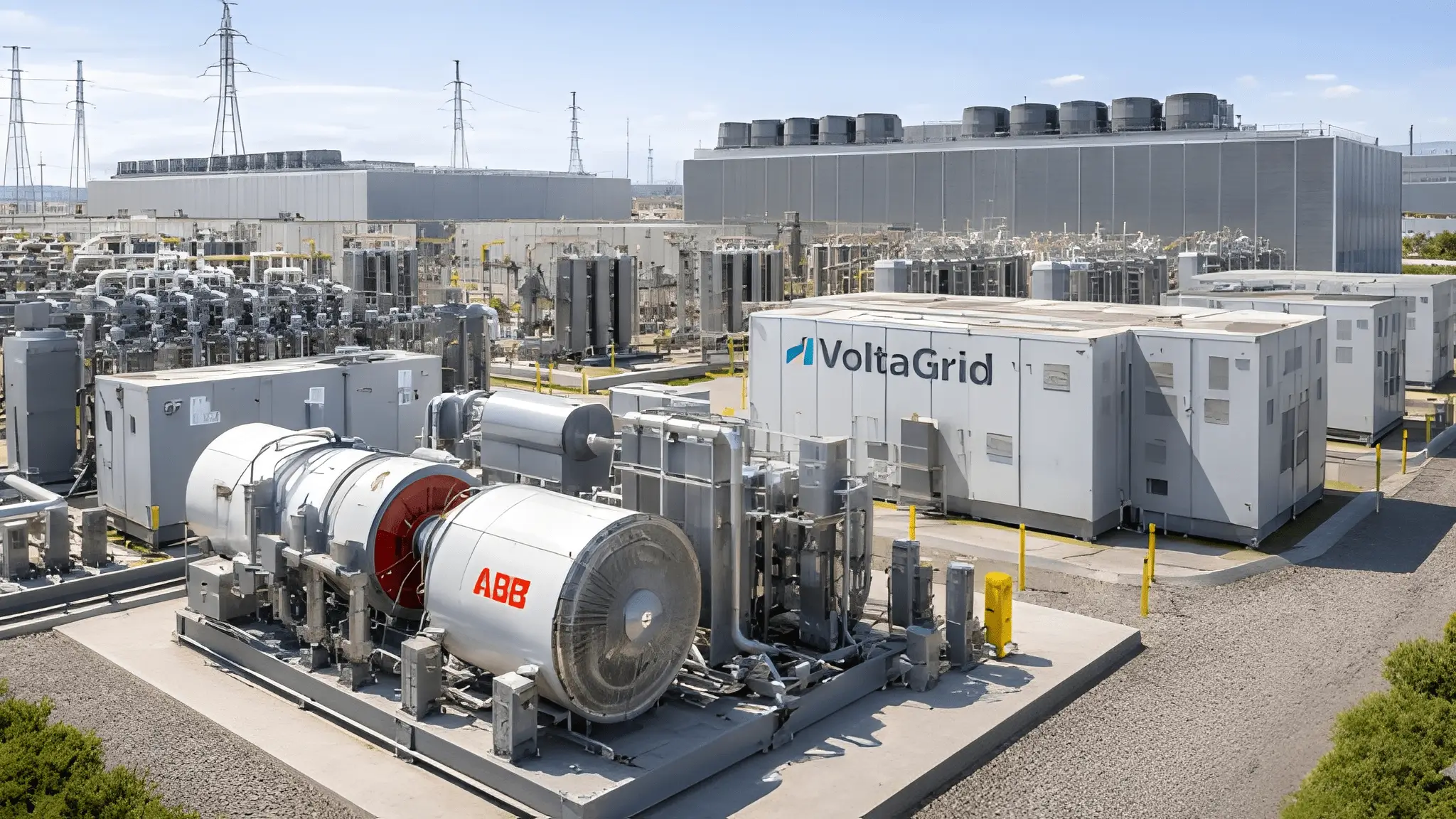
At the center of this expansion, ABB is supplying 35 synchronous condensers equipped with flywheel technology, alongside prefabricated eHouse units. These assets are designed to stabilize voltage fluctuations and maintain grid integrity critical requirements as AI workloads push infrastructure toward higher density and volatility.
Stabilization technologies emerge as core AI infrastructure layer
The deployment reflects a deeper architectural shift in how data center operators approach power reliability. Synchronous condensers, often compared to mechanical stabilizers, provide instantaneous inertia and reactive power support capabilities that are increasingly essential as traditional grid buffers struggle to keep pace with AI-induced load variability.
ABB’s contribution extends beyond stabilization. The company will also provide medium- and low-voltage distribution systems and excitation technologies aimed at maximizing uptime and operational continuity. This integrated approach combines capabilities from ABB’s automation, electrification, and motion portfolios into a unified infrastructure stack.
“VoltaGrid’s power platform is purpose-built to deliver large-scale power with exceptional dynamic performance and reliability for next-generation digital infrastructure,” said Nathan Ough, CEO of VoltaGrid. “By integrating ABB’s advanced grid stabilization technologies with our AI-optimized power systems, we are able to meet increasingly stringent transient performance requirements while accelerating deployment at gigawatt scale.”
VoltaGrid’s systems prioritize not only performance but also deployment efficiency, offering compact, low-noise solutions that align with the spatial and environmental constraints of modern data center campuses.
Power architecture becomes strategic differentiator in AI era
Initially, the partnership underscores a broader industry realization: power delivery is no longer a background utility but a defining factor in compute scalability. As AI clusters grow in size and intensity, maintaining voltage stability and system resilience has become as critical as cooling and networking.
ABB continues to position itself as a key enabler in this transition, leveraging digitalization and automation technologies to enhance grid responsiveness and operational efficiency. The collaboration with VoltaGrid illustrates how distributed power models are gaining traction as hyperscalers seek faster, more controllable deployment pathways.
“Extending our collaboration with VoltaGrid demonstrates the strength of ABB’s businesses working together combining automation, electrification and motion expertise and technologies with innovative distributed power systems to create greater value for customers,” said Per Erik Holsten, President of ABB’s Energy Industries division. “Together, we are enabling reliable, resilient and scalable power infrastructure for data centers serving the rapidly growing AI economy.”
Rising energy demand reshapes global data center strategies
Data centers consumed roughly 1.5 percent of global electricity in 2024, with the United States accounting for nearly 45 percent of that demand. However, the rapid acceleration of AI workloads is expected to push these figures significantly higher, intensifying pressure on both centralized grids and localized power systems.
Consequently, partnerships like ABB and VoltaGrid’s highlight a transition toward hybridized energy architectures that blend grid support with on-site generation and stabilization. This evolution is likely to redefine how operators design, finance, and deploy next-generation compute infrastructure.