Corning has unveiled a new suite of optical technologies designed to reshape how AI infrastructure scales, positioning itself at the center of a rapidly evolving connectivity layer for next-generation data centers. The announcements, timed ahead of the Optical Fiber Communication (OFC) Conference in Los Angeles, signal a deeper industry shift toward density-first network architectures as AI workloads intensify.
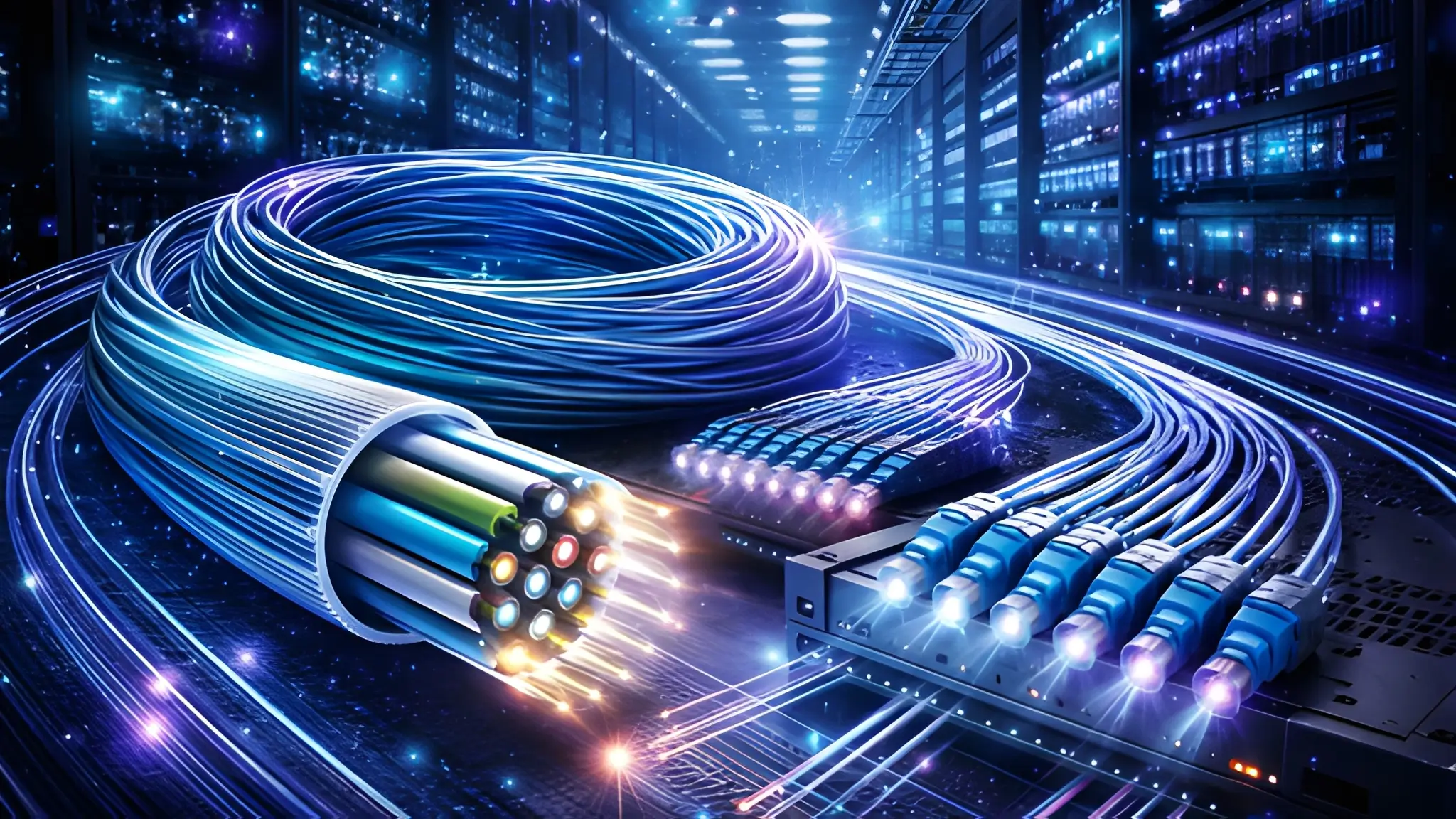
At the core of the launch is Corning’s multicore fiber solution, an integrated cable architecture that embeds multiple cores within a single strand. The company claims this design delivers four times the capacity per fiber, a significant leap for operators grappling with exponential traffic growth driven by large-scale AI models and distributed training clusters.
The move aligns with broader industry coordination. Corning recently joined a multi-vendor initiative to standardize multicore deployments under the SDM4 MCF multi-source agreement (MSA), alongside America Fujikura, Sumitomo, and TeraHop. The specification targets intra-campus and high-capacity interconnect environments, where physical infrastructure constraints increasingly limit scaling. Although the standard remains under development, Corning’s early showcase suggests vendors are racing to operationalize density gains ahead of formal ratification.
Density, Efficiency, and the Economics of Scale
Corning’s multicore approach does more than increase throughput. It directly addresses installation complexity and operational cost. By consolidating capacity into fewer fibers, the company says operators can reduce connector counts by up to 75% and cut cable mass by as much as 70%. Consequently, this translates into faster deployments and lower physical strain on data center pathways, two factors becoming critical as AI clusters expand across campuses.
In parallel, Corning introduced Contour Flow, a high-density micro cable engineered to maximize duct utilization. Built on the company’s SMF-28 all-glass optical fiber platform, the cable delivers extended reach while halving the diameter of traditional ribbon cables. It also doubles fiber count within the same footprint, scaling up to 1,728 fibers. Moreover, this design directly targets campus-scale interconnects, where space constraints increasingly dictate network topology decisions.
The company also expanded its connector portfolio with a 32-fiber Miniature Multi-Fiber (MMC) connector. Extending beyond its existing 12-, 16-, and 24-fiber configurations, the new connector pushes density further at the interface level. As a result, operators can support higher port counts and more compact switching environments without sacrificing performance.
Co-Packaged Optics Signals Next Phase of AI Networking
Beyond fiber and cabling, Corning used OFC to highlight its advances in co-packaged optics (CPO), a technology widely viewed as critical for the next phase of AI infrastructure. The company demonstrated an end-to-end connectivity system developed in collaboration with leading CPO system integrators and AI switch providers.
This system aims to enable faster data transmission, higher bandwidth density, and lower energy consumption three pillars that define the future economics of AI data centers. Unlike traditional pluggable optics, CPO integrates optical components directly with switching silicon, reducing latency and power overhead. Therefore, Corning’s positioning in this space underscores its intent to move beyond passive infrastructure into tightly integrated optical ecosystems.
“As AI capabilities continue to grow at an unprecedented rate, operators must build networks for today while planning for future demands,” said Michael O’Day, SVP and GM of Corning Optical Communications. “Across every segment of the network from silicon and subsea to rural broadband and data centers, Corning’s innovations are shaping the future of connectivity.”
Strategic Implications for AI Infrastructure
Corning’s latest portfolio reflects a broader recalibration across the data center industry. AI workloads are not only increasing bandwidth requirements but also compressing tolerance for latency, energy inefficiency, and physical sprawl. However, traditional scaling approaches adding more fibers, more cables, and more layers are proving unsustainable at hyperscale.
Instead, the industry is shifting toward integrated density strategies, where capacity, efficiency, and form factor converge. Corning’s multicore fiber, high-density cabling, and CPO initiatives collectively point to a future where fewer physical components deliver exponentially greater performance.
For operators, this transition carries both opportunity and urgency. As AI clusters grow more complex, infrastructure decisions made today will define scalability ceilings for years to come. Corning’s latest announcements suggest that the race to optimize AI data networks is no longer incremental; it is architectural.