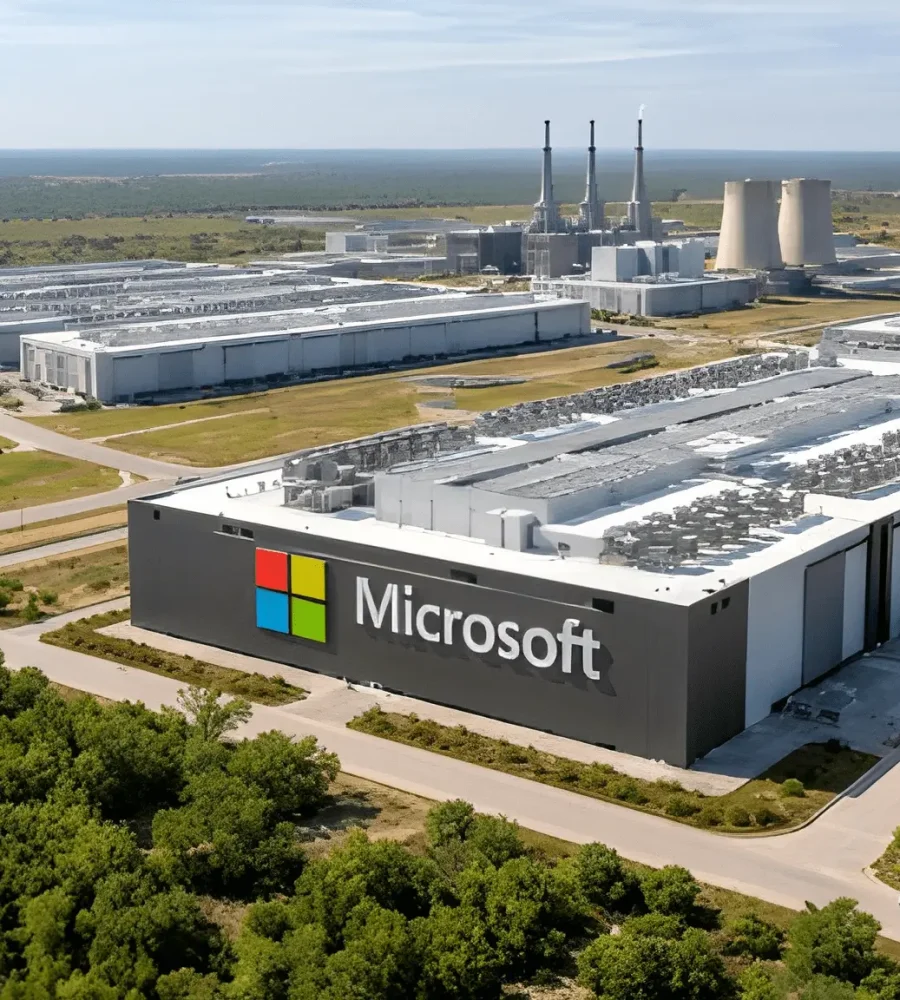
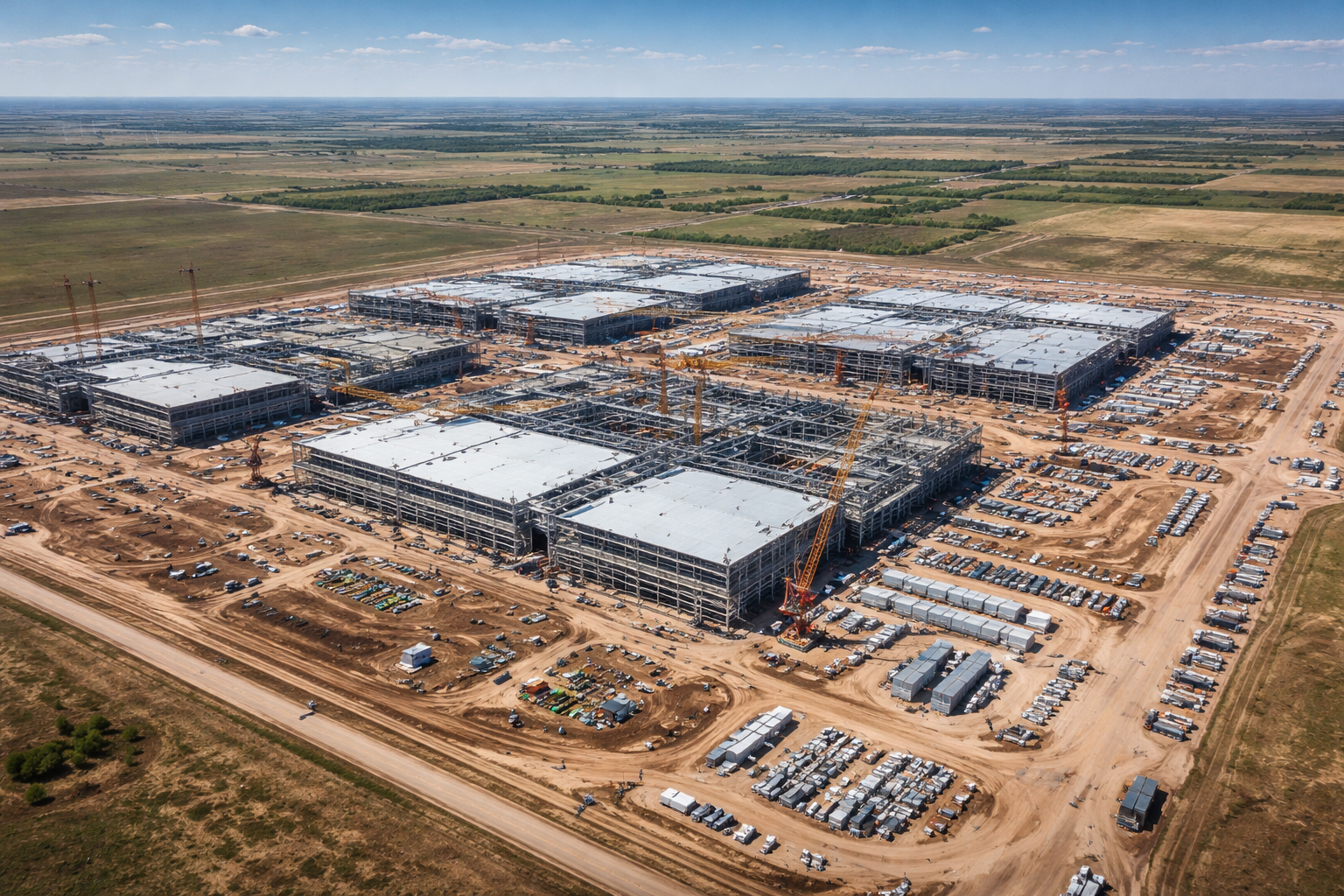
Crusoe, the AI factory company, has announced a new 900 megawatt (MW) AI factory campus in Abilene, Texas. The facility is purpose-built to support Microsoft‘s expanding AI infrastructure requirements. This development marks a major expansion of Crusoe’s Abilene footprint and positions the company as a primary infrastructure partner for one of the world’s largest AI compute consumers.
Behind-the-Meter Power at Industrial Scale
The new campus sits adjacent to Crusoe’s existing 1.2 gigawatt (GW) facility in Abilene. That facility is already under construction as part of OpenAI and Oracle‘s Stargate initiative. Unlike conventional data center leasing arrangements, the expansion features an on-site power plant delivering energy directly to the facility. This design bypasses grid interconnection constraints that have increasingly delayed AI infrastructure deployment across North America.
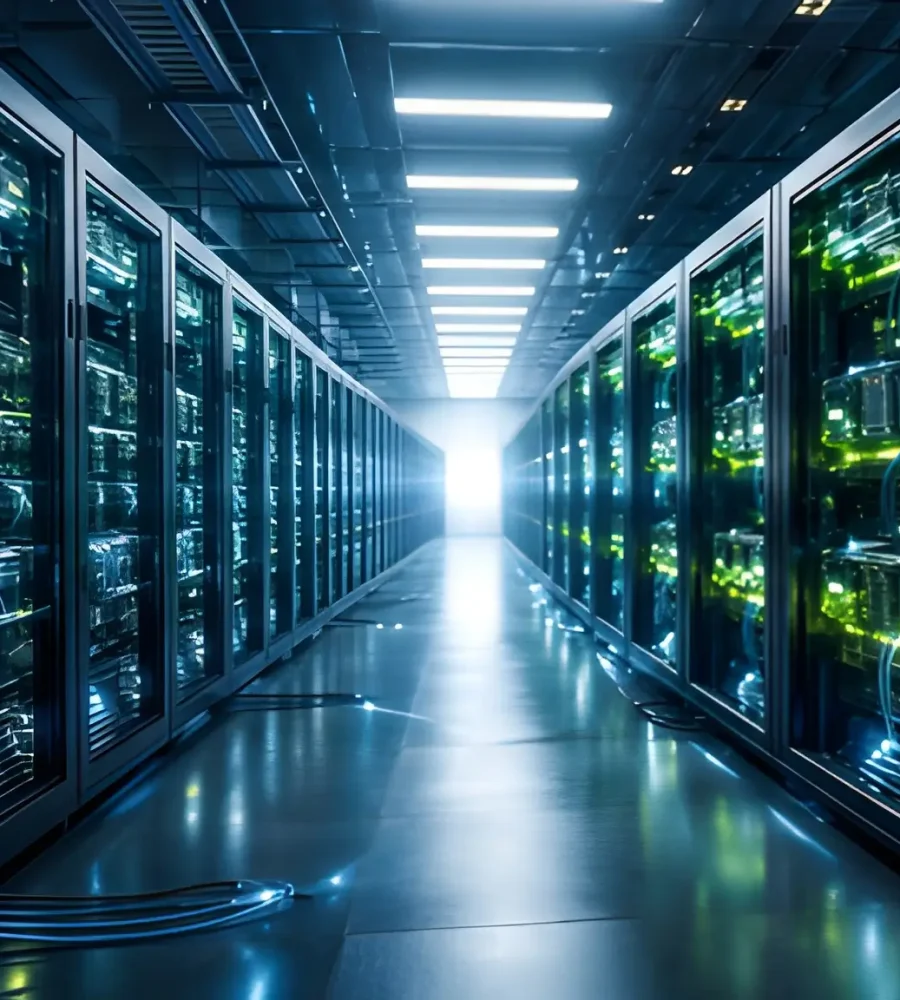
The two new data halls are built to support high-density AI workloads. Their design reflects the evolving requirements of frontier model training and inference. Construction is currently in the land-clearing and site preparation phase. Capacity is expected to come online progressively through 2026 and into 2027.
Microsoft Anchors the Abilene Expansion
Microsoft’s move to anchor this expansion follows Oracle and OpenAI’s earlier commitment to the adjacent campus. Together, these decisions reinforce Abilene’s emergence as a concentrated node of AI compute capacity. The choice also reflects Microsoft’s broader strategy of securing frontier-scale compute through vertically integrated infrastructure partners.
Microsoft has been expanding physical infrastructure across multiple U.S. states. Recent campus activations in Wisconsin and Texas demonstrate the scale of its domestic compute buildout. Choosing Crusoe gives Microsoft access to a developer with proven execution at gigawatt scale, alongside the energy independence that behind-the-meter generation provides.
Crusoe’s Bring Your Own Capacity Model
Crusoe built its infrastructure model around what the company calls Bring Your Own Capacity (BYOC). This approach co-locates power generation with compute rather than depending on grid availability. It allows Crusoe to move faster than traditional data center developers in regions where grid interconnection queues stretch for years.
At CERAWeek 2026 in Houston, Crusoe co-founder and Chief Strategy Officer Cully Cavness addressed the growing constraints facing AI infrastructure developers. “We take a view of trying to bring computing to where the energy is available or abundant and in many cases, building our own power generation,” Cavness said. He noted that opportunities to co-locate with surplus grid power have diminished significantly. “Today, these kinds of opportunities are fewer and farther between, and we see more and more situations where we actually have to bring more or all of the power to the campus.”
Long-Duration Storage Backs the Energy Strategy
To reinforce energy independence, Crusoe secured long-duration storage through a strategic agreement with Form Energy, also announced at CERAWeek 2026. Under the deal, Crusoe will receive 12 gigawatt-hours (GWh) of iron-air battery storage. This provides multi-day backup and capacity buffer for AI data centers starting in 2027. Form Energy manufactures all battery systems at its facility in Weirton, West Virginia.
“Powering the AI economy requires reliable, scalable, and cost-effective energy solutions,” said Mateo Jaramillo, Co-founder and CEO of Form Energy. “This partnership with Crusoe, a market leader in energy-first AI infrastructure, demonstrates how multi-day energy storage can unlock new capacity for data centers while strengthening domestic manufacturing and delivering the firm, reliable power needed to support the next generation of AI infrastructure.”
“The future of AI depends on access to abundant, reliable power delivered at speed,” said Cully Cavness, Co-founder, President, and Chief Strategy Officer at Crusoe. “This agreement with Form Energy reinforces Crusoe’s commitment to energy innovation and establishes a new model for securing energy infrastructure at scale, enabling us to meet growing demand while building a more resilient and sustainable system.”
Crusoe also expanded its partnership with Redwood Materials to scale second-life battery deployments at its Nevada facilities. This move further reduces operational dependence on grid stability.
Abilene Cements Its Place on the AI Infrastructure Map
The concentration of AI compute capacity in Abilene reflects deliberate site selection. The region offers available land, access to renewable and gas-based power, and proximity to Texas grid infrastructure. These conditions remain structurally advantageous compared to constrained coastal markets.
With the new 900 MW campus, Abilene now hosts both the original Stargate facility and a separate Microsoft-aligned AI factory within a single geographic corridor. This pattern signals a shift in AI infrastructure development. Single locations now serve multiple anchor tenants at a scale that would have seemed extraordinary just two years ago.
Crusoe also earned recognition on Fast Company’s Most Innovative Companies list for 2026, reflecting broader industry acknowledgment of its energy-first approach.
For the wider AI infrastructure market, the Crusoe-Microsoft development makes one structural reality clear. The race for compute cannot be separated from the race for power. Developers that control both variables are setting the pace of AI infrastructure deployment. As grid constraints tighten across North America, the behind-the-meter model Crusoe pioneered is shifting from a competitive edge to a baseline requirement for large-scale AI build-outs.