Skip to content
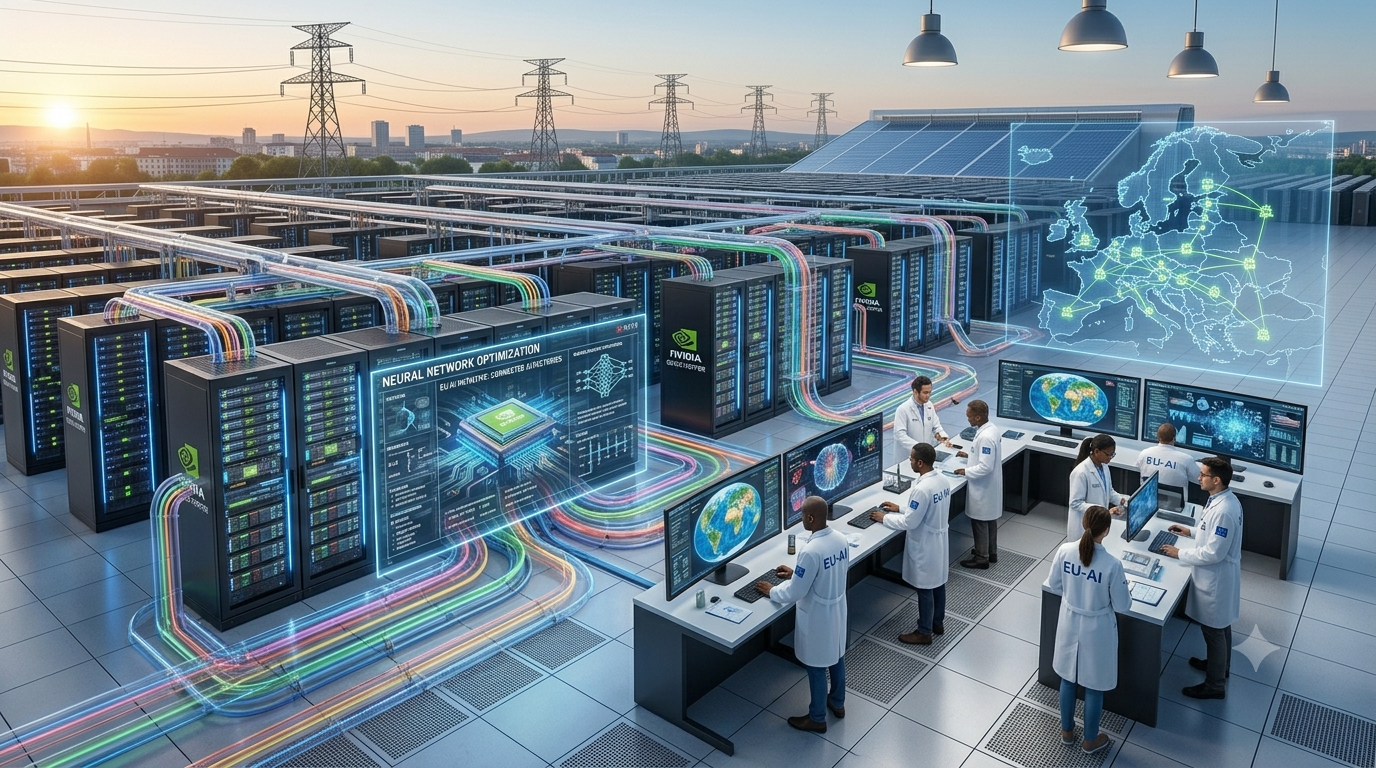
Europe has launched its largest AI supercomputing expansion to date. The continent is developing 35 new NVIDIA-powered AI and high-performance computing (HPC) systems across 23 countries. The initiative will support more than three million researchers. It also strengthens Europe’s technological sovereignty, scientific leadership, and industrial competitiveness. NVIDIA announced the expansion during ISC High Performance 2026. The new systems will accelerate research across climate science, healthcare, clean energy, quantum computing, manufacturing, and fundamental science. Additionally, the company revealed that more than 90% of Europe’s AI Factory deployments now rely on NVIDIA infrastructure. Since 2025, Europe has deployed or announced nearly 800 AI exaflops of computing capacity.

Europe Expands Sovereign AI Infrastructure
Europe continues to accelerate investments in sovereign AI infrastructure. The latest expansion reflects growing demand for domestic computing capacity across public and private sectors. The 35 systems span national supercomputing centers, EuroHPC AI Factories, universities, and leading research institutions. Together, these deployments represent Europe’s largest annual supercomputing rollout. Most facilities will use NVIDIA Blackwell and Hopper platforms. Meanwhile, NVIDIA Quantum InfiniBand networking will connect the systems. Developers will also deploy CUDA-X libraries, NIM microservices, and NVIDIA AI Enterprise software. As a result, researchers can train AI models, run simulations, perform inference, and develop agentic AI applications.
NVIDIA Founder and CEO Jensen Huang emphasized AI’s growing scientific importance.
“AI is the new instrument of science, and Europe is building the infrastructure to put it in the hands of millions of researchers.”
AI Factories Lead the Rollout
Europe’s AI Factory initiative drives much of this expansion. Several flagship projects will deliver next-generation AI infrastructure across the continent. These facilities will provide researchers with significantly greater computing power. Moreover, they will strengthen Europe’s long-term AI capabilities. Each deployment targets different scientific and industrial priorities. However, every project supports Europe’s broader strategy for sovereign AI development.

MareNostrum5 Receives Major AI Upgrade
The Barcelona Supercomputing Center will significantly expand MareNostrum5 through the EuroHPC AI Factory initiative. Engineers will install NVIDIA GB300 NVL72 and NVIDIA GB200 NVL4 systems. They will connect the infrastructure through NVIDIA Quantum-X800 InfiniBand networking. The upgraded platform will deliver nearly 20 AI exaflops for training workloads. Furthermore, it will provide approximately 33 AI exaflops for inference applications. Researchers will use the system for generative AI, climate science, biotechnology, healthcare, agriculture, energy research, and government services. Barcelona Supercomputing Center Director Mateo Valero Cortés said the upgrade will equip European scientists with advanced computing tools. He added that researchers can tackle increasingly complex scientific challenges through the expanded platform.
BavariaAI Develops Blue Swan
Germany’s BavariaAI initiative continues expanding its AI capabilities through the Blue Swan platform. The project spans Friedrich-Alexander University Erlangen and the Leibniz Supercomputing Centre. Developers will deploy 1,000 GPUs using NVIDIA GB200 NVL4 systems. Additionally, Quantum-2 InfiniBand networking will connect the infrastructure. Once operational, Blue Swan will deliver nearly 11 AI exaflops for training. It will also provide around 22 AI exaflops for inference workloads. Researchers will develop multimodal foundation models for healthcare, robotics, public administration, perception systems, and scientific research.
IT4LIA Becomes One of Europe’s Largest AI Projects
Italy’s IT4LIA initiative ranks among Europe’s largest announced AI Factory deployments. The project will install more than 8,000 GPUs using NVIDIA GB200 NVL4 systems. Meanwhile, NVIDIA Quantum-X800 networking will connect the entire infrastructure. According to NVIDIA, IT4LIA will deliver approximately 82 AI exaflops for training. In addition, the platform will provide nearly 164 AI exaflops for inference. Researchers will apply the system across cybersecurity, meteorology, manufacturing, agriculture, and climate science. Consequently, the project will strengthen Italy’s AI ecosystem while supporting Europe’s broader AI ambitions.
HammerHAI Strengthens Germany’s AI Capacity
Germany is also expanding its sovereign AI infrastructure through the HammerHAI project. The country’s first AI Factory will deploy more than 850 NVIDIA GPUs. Moreover, NVIDIA Quantum-X800 InfiniBand networking will connect the entire system. HammerHAI will deliver nearly 8 AI exaflops for training workloads. It will also provide around 15 AI exaflops for AI inference. Researchers will use the platform for engineering simulations and scientific computing. Additionally, enterprises will run large language models and advanced AI applications. The project strengthens Germany’s ability to support industrial innovation and cutting-edge research.
Sweden Builds the Mimer AI Factory
Sweden continues expanding its AI ecosystem through the Mimer AI Factory. Linköping University will host the facility under the ownership of the EuroHPC Joint Undertaking. The deployment includes 100 NVIDIA GB200 NVL4 systems. Together, these systems contain 400 GPUs. The platform will generate nearly 4 AI exaflops for training tasks. Furthermore, it will deliver about 7 AI exaflops for inference workloads. Researchers will advance projects in life sciences, autonomous systems, materials research, and trustworthy AI. The facility will also support data-driven innovation across multiple industries.
AI Accelerates Climate and Energy Research
Europe is also using AI infrastructure to solve major climate and energy challenges. Researchers now apply advanced computing to improve Earth system modeling and environmental simulations. They also accelerate biomedical discoveries and carbon capture research. Meanwhile, scientists continue developing hydrogen technologies and fusion energy systems. These applications require enormous computing resources and highly accurate simulations. Consequently, AI supercomputers have become essential research tools.
Europe Strengthens Its AI Leadership
Europe’s latest supercomputing expansion marks a major milestone in its AI strategy. The initiative combines sovereign compute, AI factories, advanced networking, and quantum research under one vision. Moreover, the investment strengthens Europe’s ability to compete in the global AI race. It also gives millions of researchers access to next-generation computing resources. At the same time, the new infrastructure will accelerate breakthroughs across healthcare, climate science, manufacturing, and clean energy. These capabilities will help researchers solve increasingly complex challenges. With nearly 800 AI exaflops deployed or announced since 2025, Europe continues to scale its AI ecosystem. Consequently, the continent is positioning itself as a global leader in AI-driven innovation and scientific discovery.