
.Nscale Locks $3.5 Billion Figure Robotics Compute Deal  ·Qatar’s Meeza Lands Major Hyperscaler Deal for 8MW ·Qualcomm Strikes Amazon AI Chip Deal, Opens Door to $4 Billion Stock ·Hitachi Energy Bets $300M on China Grid Manufacturing Corvex Builds Toward 8MW Cloud Infrastructure Footprint LITEON Bets $176 Million on DCX Liquid Cooling EdgeConneX Backs Singapore’s AI-Ready Tropical Data Center Testbed

Meta’s Orbital Solar Bet Reshapes AI Infrastructure Power

Meta Platforms is moving beyond terrestrial energy constraints, securing a landmark partnership to source solar power from space for its

Share
Meta Overview

Meta Platforms is moving beyond terrestrial energy constraints, securing a landmark partnership to source solar power from space for its expanding AI data centre footprint. The agreement signals a structural shift in how hyperscalers approach energy reliability as compute demand accelerates.

Service Public Policy Newsletter Leaderboard 970x118 1

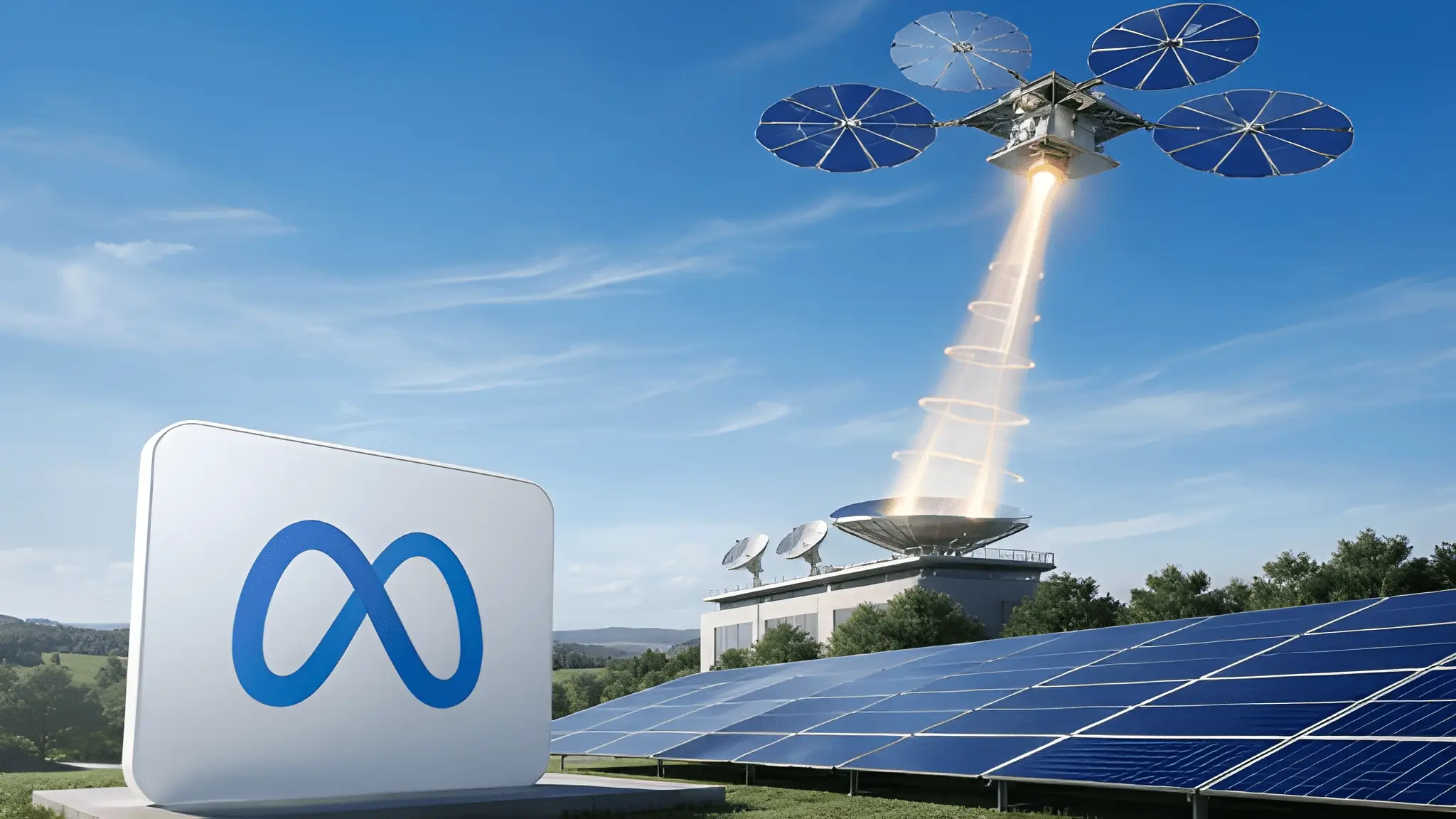
Meta confirmed it has struck a deal with Overview Energy for up to 1 gigawatt of space-derived solar capacity. The reservation places Meta among the earliest technology companies to lock in orbital energy supply, effectively treating space as the next frontier of infrastructure.

Overview Energy continues to develop and validate its core systems, targeting an initial orbital demonstration in 2028. Meta expects access to the energy by the end of the decade, aligning with projected surges in AI-driven workloads.

Unlocking the Limits of Terrestrial Solar

Meta framed the partnership as a response to a fundamental limitation: Earth-based solar generation remains intermittent. Solar farms operate only during daylight hours, leaving capacity underutilised for significant portions of the day.

Service Advisory Services Leaderboard 970x118 1

Overview Energy is attempting to “unlock these idle hours” through a radically different architecture. Its satellites operate in geosynchronous orbit, approximately 22,000 miles above the equator, where sunlight remains constant. From this vantage point, energy is captured continuously and transmitted to Earth as low-intensity, near-infrared light.

This model allows existing solar facilities to extend production cycles. As a result, infrastructure that would otherwise remain inactive overnight can generate electricity around the clock, improving output efficiency and grid contribution.

Meta emphasised that these ground facilities convert the transmitted energy into electricity without requiring additional land or new grid infrastructure. “Because the technology will build on solar infrastructure that’s already in place rather than requiring new facilities, it can come online faster at scale than traditional buildouts,” Meta stated.

Infrastructure Without Footprint Expansion

The appeal of orbital solar lies not just in continuity but in deployment speed. Traditional energy projects often face land acquisition challenges, permitting delays, and grid integration bottlenecks. By contrast, Meta’s approach leverages existing solar assets as receiving nodes, effectively bypassing these constraints.

This positions space solar as a modular overlay rather than a ground-up buildout. It also aligns with hyperscaler priorities: rapid scaling, predictable output, and minimal friction with local infrastructure ecosystems.

Long-Duration Storage Completes the Stack

However, generation alone does not solve the intermittency challenge at grid scale. Meta is pairing its orbital solar strategy with energy storage to stabilise supply across extended periods.

The company has partnered with Noon Energy to deploy up to 1GWh of long-duration energy storage capacity. The system aims to deliver consistent, clean power to next-generation AI data centres, even when supply fluctuations occur.

Meta noted that grids require storage capable of holding energy not just for hours, but for multiple days. This capability becomes critical as renewable penetration increases and workloads demand uninterrupted uptime.

The agreement includes a reserved capacity allocation, alongside a 2.5GWh pilot demonstration project expected to complete in 2028. The timeline mirrors the orbital solar rollout, suggesting a coordinated infrastructure stack that integrates generation and storage simultaneously.

A New Energy Layer for AI Scale

Meta’s dual investment in space-based generation and long-duration storage reflects a deeper recalibration of energy strategy in the AI era. Data centres are no longer passive consumers of grid power; they are becoming active participants in shaping energy ecosystems.

By securing early access to orbital solar capacity, Meta is effectively hedging against terrestrial constraints while positioning itself for sustained compute expansion. The approach also signals a broader industry shift, where energy innovation becomes inseparable from infrastructure design.

Meanwhile, the convergence of orbital generation and advanced storage introduces a new operational paradigm: always-on renewable energy tailored for high-density compute environments. For AI infrastructure, where downtime translates directly into lost value, that reliability could become a defining competitive edge.

Service Podcast Leaderboard 970x118 1
[simple-author-box]

More from AI Infrastructure

Meta Launches Muse Spark Open to Challenge China’s AI Models

Meta Platforms Inc. has introduced Muse Spark Open, a new open-weight artificial intelligence model

CapitaLand Bets $203 Million on Chennai Data Center Expansion

CapitaLand India Trust (CLINT) has launched a US$203.2 million data center development in Chennai,

AirTrunk Listing Delay Exposes AI Infrastructure Financing Risks

AI Infrastructure Financing Faces a Cost-of-Capital Test The global artificial intelligence infrastructure boom is

COMPUTE WEEKLY

The briefing that 40,000+ tech leaders read every Monday. Sharp, fast, essential.

Building an AI Startup Without Owning GPUs

Not owning GPUs has become the default, deliberate strategy for building an AI company — not a compromise founders accept reluctantly. H100 rental rates fell 64-75% in fifteen months, a dense ecosystem of neoclouds and inference-as-a-service providers now lets startups skip infrastructure entirely, and credit programs can fund a company’s first year before a founder writes a check
Most Read

A migration spreadsheet can show a workload leaving the cloud, arriving at a private

A data center can satisfy its engineering requirements, secure its power supply, and demonstrate

Gigawatt-scale AI infrastructure changes the fundamental question facing construction leaders: how can complex facilities

A superintendent reviewing a data center site should not have to reconcile three different

The Data Hall Is Only One Part of Deployment A data center can have

Disruptor Spotlight

Cerebras Systems

The chip that makes Nvidia nervous. Cerebras’ Wafer Scale Engine is rewriting the rules of AI inference at scale.
Faster
0 x
YoY Revenue
0 x
Transistors
0 T
Market Pulse
MSFT
+1.02%
NVDA
+0.66%
AMZN
-0.078%
AMD
-6.95%
TSMC
-2.98%
Indicative only · Not financial advice
Upcoming Events

TBC

The AI Infrastructure Race

WEBINAR · ONLINE
The AI Infrastructure Race: Won on Power, Land and Trust — Not Capital
MAY
0
AI Infrastructure Summit
DUBAI · IN PERSON
MEA’s premier AI infrastructure event.
JUN
0 0
Compute Forecast Summit
SINGAPORE · IN PERSON
Our flagship APAC event. Early bird open.
Latest Moves
Live
Ecolab
Ecolab Deepens Cooling Strategy With $4.75B CoolIT Acquisition
Ecolab is making one of its biggest moves yet into AI infrastructure after completing its $4.75 billion acquisition of liquid cooling specialist CoolIT Systems
Gemini Generated Image 5gy41q5gy41q5gy4
Pure DC and AVK Deploy Europe’s First 110 MW Data Center Microgrid in Dublin
The Pure DC Dublin microgrid has made history as Europe’s first large-scale on-site data center microgrid, launched in partnership with power solutions provider AVK at Pure DC’s campus in Ireland.
Clipboard Image 1784558387
Pace Digitek Partners With MEGMEET to Expand AI Data Center Power Business
India’s AI infrastructure ecosystem continues to mature as domestic technology manufacturers move beyond traditional telecommunications and industrial markets toward high-growth digital infrastructure opportunities
Follow Compute Forecast
11K followers
1200 followers
Companies to Watch
CW
CoreWeave
Neo Cloud · $19B · IPO Watch
CB
Cerebras Systems
AI Hardware · $4.25B · Pre-IPO
G42
G42
Sovereign AI · Abu Dhabi
H
Humain
Saudi AI · $40B Fund
Latest Podcast
AI Capex, Cloud Margins & the Nuclear Bet
48 MIN · 25 APR 2026
document.addEventListener("DOMContentLoaded", function() { var el = document.querySelector('a[href="https://www.s-sols.com/products/wordpress/accelerator?utm_source=usersite&utm_medium=banner&utm_campaign=free_lim_ver&utm_term=accel"]'); if (el) { el.style.setProperty("display", "none", "important"); } }); document.addEventListener("DOMContentLoaded", function() { var el = document.querySelector('a[href="https://www.s-sols.com/products/wordpress/accelerator?utm_source=usersite&utm_medium=banner&utm_campaign=free_lim_ver&utm_term=accel"]'); if (el) { el.remove(); } });
Scroll to Top







