The announcement of an exclusive global partnership between ServerDomes and Global Green Generation is, in our view, one of the most significant signal, recently, that the traditional data center model has failed the demands of the AI era. This alliance is focused on designing and building a new class of ultra-efficient, AI-ready data centers engineered specifically to overcome the existential constraints of power scarcity, water usage, and glacial deployment timelines that are currently throttling global AI growth.
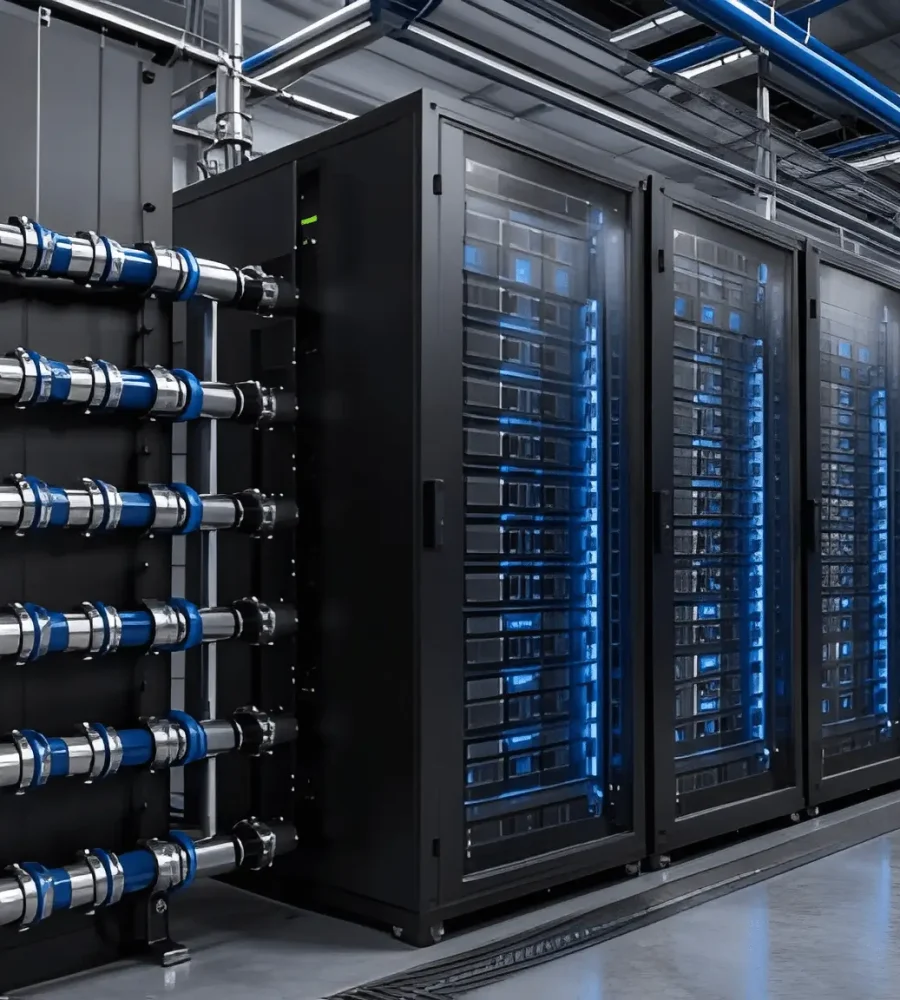
The data presented by both CEOs, David Keegan (Global Green Generation) and David Jackson (ServerDomes), underscores a reality we have been stressing: traditional infrastructure cannot withstand the explosive surge in AI compute demand. With AI workloads predicted to double every seven months, chip manufacturers are already talking about 1–2 megawatt racks, densities that, as Keegan rightly notes, “break traditional infrastructure” because “you physically cannot move enough air to cool that.”
We notice that ServerDomes’ nature-inspired architecture and hybrid cooling approach directly address these physics-based limitations, validated by operational data showing:
- Water Efficiency: 93% less water used (0.14 L/kWh vs. 3–5 L/kWh typical).
- Power Reduction: 27% less power consumed overall.
- Density: The ability to fit 5 to 25 megawatts on a single acre.
- Speed: A fully commissioned facility delivered within 12 months, compared to the 18 to 30 months required for conventional construction.
Through this exclusive agreement, Global Green Generation will assume the global design and build responsibility for the full suite of ServerDome facilities, starting with urgent deployments across North America and Europe. We believe this standardization and scalability are vital to addressing the global infrastructure bottleneck.
Both CEOs highlighted that the most critical barrier is the grid constraint. Jackson pointed out that utilities are quoting three to five years just to deliver modest power allocations (20–50MW), forcing developers to seek alternatives. Our conclusion is that the move to modular configurations (5MW–50MW) and the option for behind-the-meter, off-grid power solutions is no longer a luxury, it’s now a mandatory response to an incapacitated utility infrastructure.
Beyond raw performance, the geodesic design of the ServerDome is inherently strategic. We recognize that the unique dome shape, which leverages natural physics for heat evacuation, is also key to solving the community acceptance problem that has plagued conventional hyperscale “big sheds.” As Jackson emphasized, the smaller, quieter, and environmentally responsible nature of the building, combined with near-zero community water usage, removes the biggest sources of resistance. This partnership, therefore, aligns with our view that ESG and sustainability must now be the primary design drivers.