
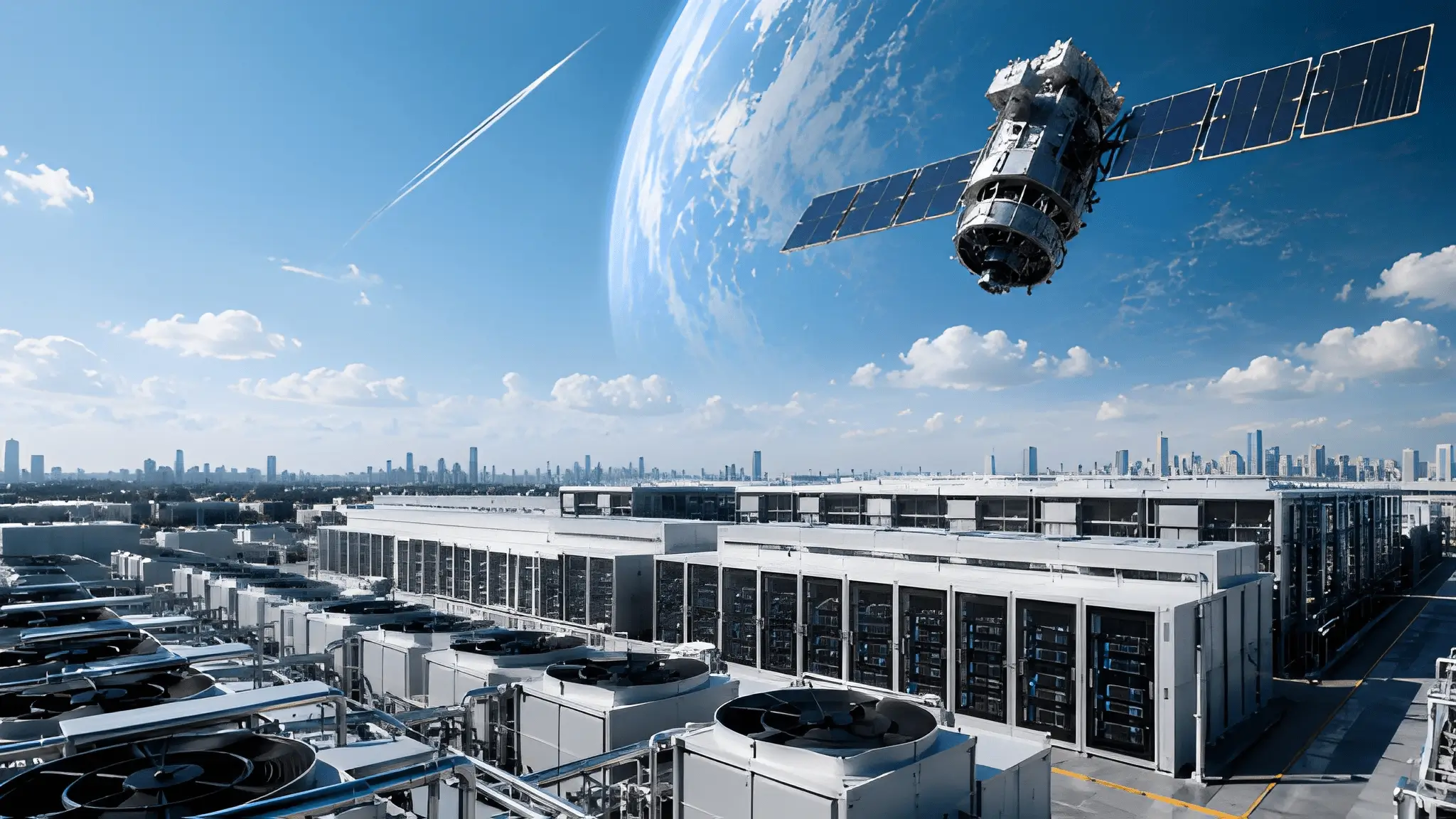
The debate over where future AI infrastructure should reside gained a new dimension this week after SoftBank founder Masayoshi Son publicly dismissed the idea of building data centers in space. While several space companies are exploring orbital computing platforms, Son argued that the decisive phase of the artificial intelligence race will be won through terrestrial infrastructure, not off-planet experiments.

Speaking during the annual shareholder meeting of SoftBank’s mobile unit, Son questioned the economic rationale behind orbital data centers. His comments arrive at a time when technology companies are searching for solutions to growing power constraints, land shortages, and escalating demand for AI compute capacity. As investments pour into next-generation infrastructure, the discussion increasingly centers on where the world’s future computing resources should be deployed. For SoftBank, the answer remains firmly grounded on Earth. The company is already committing enormous capital toward AI ecosystems, including major backing for OpenAI and a broader infrastructure expansion strategy spanning multiple regions.
Why SoftBank Sees Limited Value in Space-Based Compute
Son outlined a practical assessment of orbital data centers, focusing on economics rather than technological ambition. According to him, the primary benefit of locating data centers in space would be lower electricity expenses. However, he argued that power costs represent only a relatively small portion of total operating expenditures compared with the cost of advanced AI hardware. Modern AI facilities increasingly spend billions on graphics processing units, networking systems, storage architecture, and specialized cooling technologies.
Against that backdrop, Son suggested that savings from solar-powered orbital facilities may not meaningfully alter the economics of large-scale AI deployment. He also highlighted several operational tradeoffs. Launching infrastructure into orbit introduces transportation costs, ongoing maintenance challenges, and communication latency concerns. These factors, he indicated, could outweigh any potential benefits generated by reduced energy expenses. The remarks directly contrast with growing enthusiasm among some aerospace and technology firms pursuing space-based computing concepts as a long-term solution to terrestrial infrastructure bottlenecks.

“He Who Strikes First Wins”
A shareholder asked whether SoftBank would pursue initiatives similar to those proposed by SpaceX chief Elon Musk. Son used the opportunity to reinforce his belief that the near-term AI race will be decided through rapid infrastructure deployment on Earth rather than speculative future projects. “In the battle for AI, the next few years will be far more important than what might happen a decade or so from now,” he said after a SoftBank Corp. shareholder asked if the Japanese company planned anything similar to the SpaceX chief’s grandiose plans.
Although Son expressed admiration for Musk’s impact on technology and industry transformation, he made it clear that SoftBank’s priorities lie elsewhere. While calling Musk a “remarkable agent of change,” Son said that SoftBank will focus on building “formidable” data center capacity on Earth. “He who strikes first wins,” he said. The statement reflects an increasingly common view among infrastructure investors who believe that immediate access to compute capacity could become a decisive competitive advantage as AI adoption accelerates across industries.
SoftBank’s Massive AI Infrastructure Bet Continues
Son’s comments carry weight because SoftBank has emerged as one of the world’s most aggressive AI investors. The Japanese conglomerate has committed approximately $65 billion to OpenAI while also signaling plans to direct hundreds of billions of dollars toward data centers and supporting infrastructure globally. That strategy places SoftBank among a growing group of investors attempting to build the physical foundations of the AI economy. Data centers, power systems, networking infrastructure, and advanced semiconductor supply chains have become critical assets in the race to support increasingly demanding AI workloads.
Moreover, the company’s investment thesis appears centered on scaling compute availability as quickly as possible. Son’s emphasis on timing suggests that infrastructure readiness may matter more than experimental breakthroughs over the next several years. The approach aligns with broader industry trends as hyperscalers, cloud providers, and AI developers rush to secure capacity before demand outpaces available supply.
SpaceX and Blue Origin Are Betting on a Different Future
Despite Son’s skepticism, interest in orbital data centers continues to grow. Both SpaceX and Blue Origin have announced plans involving space-based computing infrastructure designed to overcome energy and land constraints facing terrestrial facilities. Supporters of orbital data centers argue that abundant solar energy in space could eventually provide a cleaner and potentially more scalable power source for compute-intensive workloads. Some proponents also believe space-based facilities could help alleviate pressure on overloaded electrical grids and increasingly contested development sites. However, the concept remains largely unproven at commercial scale. Significant questions persist around deployment costs, reliability, maintenance logistics, hardware replacement cycles, and network performance. Therefore, Son’s comments highlight a widening divide between long-term experimental infrastructure strategies and the urgent demand for deployable AI capacity today.
The SoftBank founder also addressed the competitive landscape surrounding artificial intelligence. While acknowledging intensifying competition, he rejected the notion that the market is approaching a winner-takes-all outcome. Son said there remains substantial growth potential for OpenAI as well as rivals including Anthropic and Google. According to him, artificial intelligence remains in an early stage of development with significant room for expansion. AI is still in its early stages with scope for “ten-fold, a hundred-fold” growth, he said. That perspective reinforces SoftBank’s willingness to continue investing heavily across the AI value chain despite increasing competition among model developers and infrastructure providers.
SoftBank Expands Into Neocloud and Energy Storage Markets
Beyond AI investments, SoftBank’s telecom division is preparing additional infrastructure-focused initiatives in the United States. Junichi Miyakawa, who leads the company’s wireless business, revealed plans to enter both the neocloud and data center storage battery markets. The move signals SoftBank’s intention to participate in multiple layers of the digital infrastructure stack rather than concentrating solely on AI model development or data center ownership. Energy storage systems are becoming increasingly important as operators seek to improve resilience, manage peak demand, and support power-intensive AI facilities. Meanwhile, the company’s Japanese neocloud business is scheduled to launch later this year. The expansion reflects a broader industry shift toward specialized cloud platforms optimized for AI workloads and high-performance computing environments.
The Strategic Reality Behind Son’s Position
Son’s rejection of orbital data centers is less about technological possibility and more about timing. While space-based compute may eventually become viable, SoftBank believes the decisive AI infrastructure battle is unfolding right now on Earth. The company’s investment strategy reflects that conviction. Rather than waiting for future breakthroughs in orbital infrastructure, SoftBank is directing capital toward assets capable of delivering compute capacity immediately. As AI demand continues to surge, the industry faces a defining question: whether the next generation of infrastructure should solve constraints by expanding beyond Earth or by scaling faster on it. For now, SoftBank has chosen its side.











