Space Data Centers Gain New Momentum as SpaceX Signals Public Offering
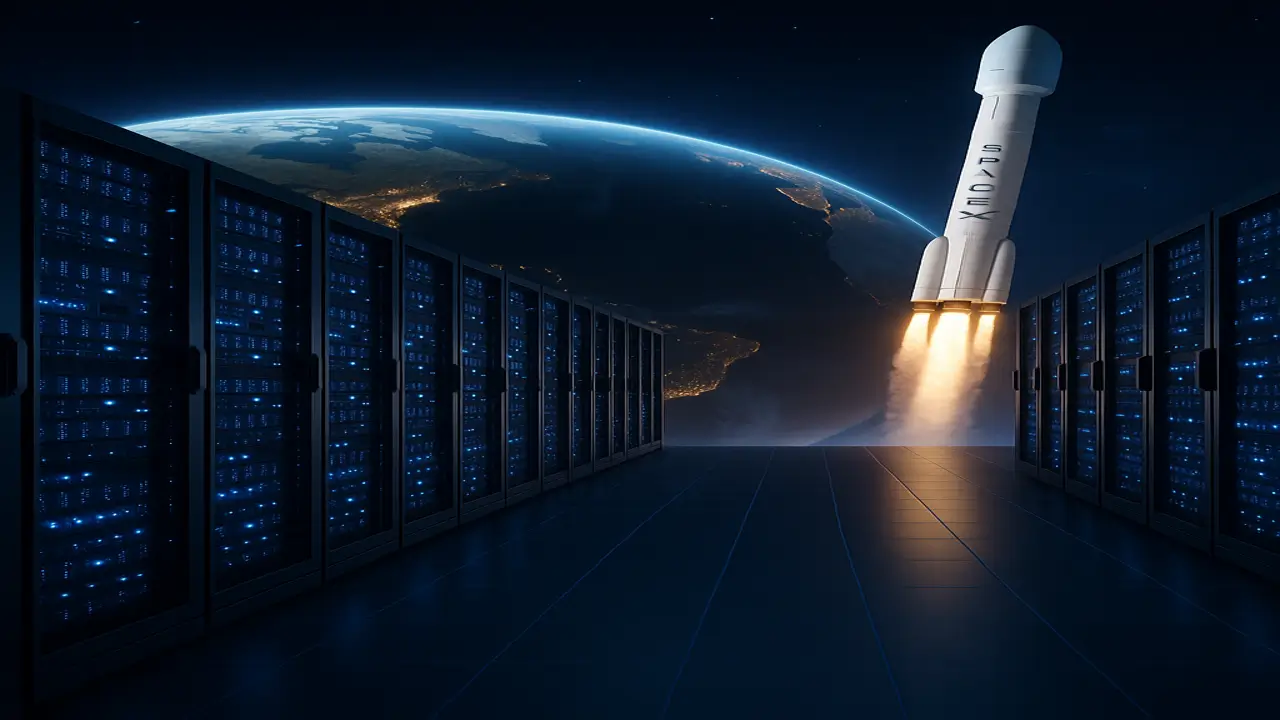
We are observing a pivotal shift in global digital infrastructure as space data centers move from conceptual ambition to tangible strategy. The latest indication arrives with SpaceX preparing for a potential initial public offering that could raise significantly more than $30 billion, marking what may become one of the largest listings in history. As reports across global financial outlets outline, this potential IPO aligns with expanding initiatives around off-planet compute capabilities, reinforcing the accelerating trajectory of space-based infrastructure.
Current private valuations place SpaceX at approximately $800 billion, with public estimates ranging between $1 trillion and $2 trillion. As noted, the company may be targeting around $1.5 trillion, a figure that underscores the heightened investor interest surrounding next-generation compute frameworks designed beyond Earth’s surface.
Historically, CEO and founder Elon Musk has advocated for keeping SpaceX private to maintain long-term mission continuity, particularly around multispecies habitation and interplanetary expansion. Yet the recent momentum around space data centers situates the IPO conversation within a new strategic layer.
Shifting Strategy Toward Off-Planet Compute Infrastructure
Industry observers highlight that Musk’s evolving stance may be connected to the company’s emerging system of deploying data centers in orbit. In a widely shared commentary, this perspective gained traction after Musk himself acknowledged reporting on the subject by stating that its analysis was accurate.
Momentum toward space data centers accelerated earlier when SpaceX confirmed that its Starlink constellation would expand into compute-enabled satellite platforms. This month, Musk further elaborated on a longer-horizon vision that includes constructing satellite factories on the Moon and using a mass-driver an electromagnetic railgun to launch AI-capable satellites into lunar escape velocity. He noted that such architectures could scale to over 100TW per year of AI compute, framing them as steps toward early markers of a Kardashev Type II civilization.
Although SpaceX already generates an estimated $22–24 billion in annual revenue, new capital from a public listing could support accelerated development of space-based compute systems. This expansion would also indirectly benefit xAI, another Musk-led enterprise that depends on high-density compute environments to support large-scale model training.
Rising Global Interest in Space Data Center Initiatives
We are witnessing a broader industry movement as multiple organizations explore the viability of orbit-based and lunar-based computing. Companies such as Axiom Space, NTT, Ramon Space, and Sophia Space are actively evaluating concepts for orbital compute nodes, advanced satellite processing units, and extraterrestrial data relay systems. Their initiatives highlight the growing conviction that Earth-bound infrastructure, limited by land, power, and cooling constraints, may soon require complementary capacity built beyond the planet.
Prominent technology leaders share similar expectations. Jeff Bezos, founder of Amazon and owner of Blue Origin, stated in October that gigawatt-scale data centers will exist in space within the next decade. Earlier this year, former Google CEO Eric Schmidt acquired rocket manufacturer Relativity Space with the intention of enabling orbital compute platforms. These signals collectively demonstrate a widening alignment around space-based infrastructure as a natural progression in the evolution of global computing.
In November, Google introduced Project Suncatcher, a long-term strategy to deploy terawatt-scale compute capabilities in space. This initiative further illustrates how hyperscale leaders are actively preparing for an era where data processing and storage transcend terrestrial limitations.
Why the World Is Watching the Next Phase of Compute Evolution
As we continue tracking the expansion of space data centers, it becomes increasingly clear that this emerging frontier is shaping the global conversation around digital infrastructure. From potential trillion-dollar market valuations to multinational participation and cross-industry collaboration, the momentum suggests that off-planet compute ecosystems may become a defining component of the next technological epoch.