Skip to content
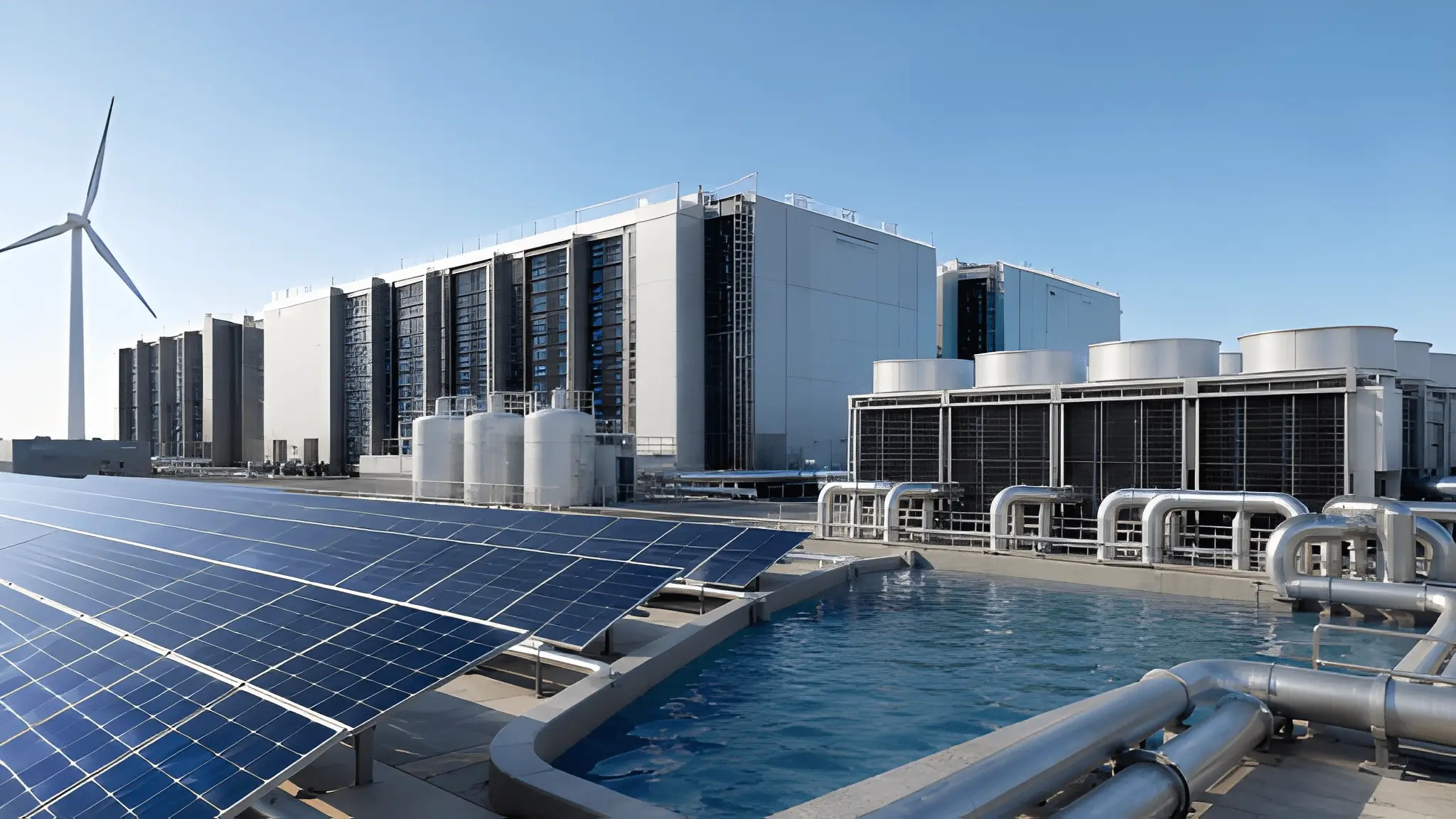
Sustainability now defines the next phase of data center development rather than serving only as an environmental commitment. As operators plan larger campuses and denser computing infrastructure, they are placing greater emphasis on power sourcing, water management, and long-term operational efficiency. Tata Projects says this shift is reshaping India’s digital infrastructure, making renewable energy and resource-conscious engineering central to future projects. The engineering, procurement, and construction (EPC) company views sustainability as a strategic requirement that influences project planning, technology decisions, and operational resilience as India prepares for rapid digital infrastructure expansion.

Renewable Energy Moves to the Center of India’s Data Center Expansion
Data center developers across India are accelerating their adoption of renewable energy as they expand digital infrastructure, according to Tata Projects. Operators increasingly favor solar and hydropower as they prepare for rising electricity demand from cloud computing, AI workloads, and hyperscale deployments. Through its Advanced Technology Facilities (ATF) business unit, Tata Projects supports both data center and semiconductor projects as an engineering, procurement, and construction (EPC) partner. That dual presence gives the company a strategic position across two industries expected to drive India’s next phase of digital manufacturing and infrastructure growth. “If you look at the companies developing data centers in India, they are looking at green power sources, such as solar and hydro. Renewable energy is a clear focus area for them,” Preiti Patel told ETDatacenters in an interview.
The industry’s growing preference for cleaner energy sources highlights a broader effort to align infrastructure expansion with sustainability goals while preparing facilities for decades of higher power demand. Power is not the only constraint shaping India’s data center future. Water management is rapidly becoming another critical consideration as operators evaluate long-term sustainability strategies. According to Tata Projects, companies are investigating alternative cooling technologies capable of reducing environmental impact while supporting larger computing facilities. Among the approaches under consideration is the use of desalinated seawater within closed-loop cooling systems, allowing operators to reduce freshwater dependence without compromising operational performance.
Patel said technologies supporting sustainable infrastructure are expected to evolve rapidly as every stakeholder across the ecosystem works toward improving efficiency and reducing environmental pressure. The growing focus on advanced cooling reflects an industry-wide recognition that infrastructure resilience will increasingly depend on both energy optimization and responsible water management.

Capacity Growth Will Intensify Resource Demands
Tata Projects embeds sustainability into every phase of data center development, from site selection and engineering design to construction, commissioning, handover, and long-term operations and maintenance. The company treats environmental performance as a core design principle, reflecting how hyperscale operators increasingly weigh lifecycle efficiency alongside construction quality when choosing infrastructure partners. Its growing portfolio reflects that strategy. Tata Projects secured contracts to build Microsoft’s data center campuses in Hyderabad and support Tata Electronics’ semiconductor fabrication facilities in Assam and Gujarat. These projects underscore how engineering firms now play a broader role in delivering the specialized infrastructure that supports India’s expanding digital economy.
Sustainability Shapes Every Stage of Project Delivery
Tata Projects integrates sustainability across every stage of modern data center development instead of limiting it to facility operations. The company considers environmental factors during site selection, engineering design, construction, commissioning, handover, and long-term operations and maintenance. This approach aligns with changing customer expectations as hyperscale operators increasingly prioritize lifecycle efficiency alongside construction quality when selecting infrastructure partners. The company has already secured several high-profile technology infrastructure projects. Tata Projects won contracts to build Microsoft’s data center facilities in Hyderabad and support Tata Electronics’ semiconductor fabrication plants in Assam and Gujarat. These assignments highlight how engineering firms are expanding their role beyond conventional construction to deliver the specialized infrastructure powering India’s digital economy.
Early Experience Positions Tata Projects in Strategic Markets
Beyond data centers, Tata Projects continues to strengthen its presence within India’s emerging semiconductor manufacturing ecosystem, giving the company exposure to two fast-growing infrastructure segments that demand advanced engineering capabilities. “We are now well in this journey, and we have successfully delivered certain data centers and are also actively working in the semiconductor space,” Patel said, adding that Tata Projects holds a first-mover advantage among a few other companies in India. The combination of hyperscale data center construction and semiconductor infrastructure provides the company with experience across complementary sectors that are expected to receive sustained investment over the coming decade.
India’s digital infrastructure story is no longer defined solely by the speed of capacity additions. The next phase will depend on how efficiently developers manage electricity, water, and construction practices while supporting exponential growth in computing demand. Moreover, renewable energy integration, water-efficient cooling technologies, and lifecycle sustainability are becoming competitive differentiators rather than optional initiatives. Consequently, engineering firms capable of delivering resource-efficient infrastructure at scale are likely to play a larger role as India’s data center industry expands toward multi-gigawatt capacity over the remainder of the decade.