
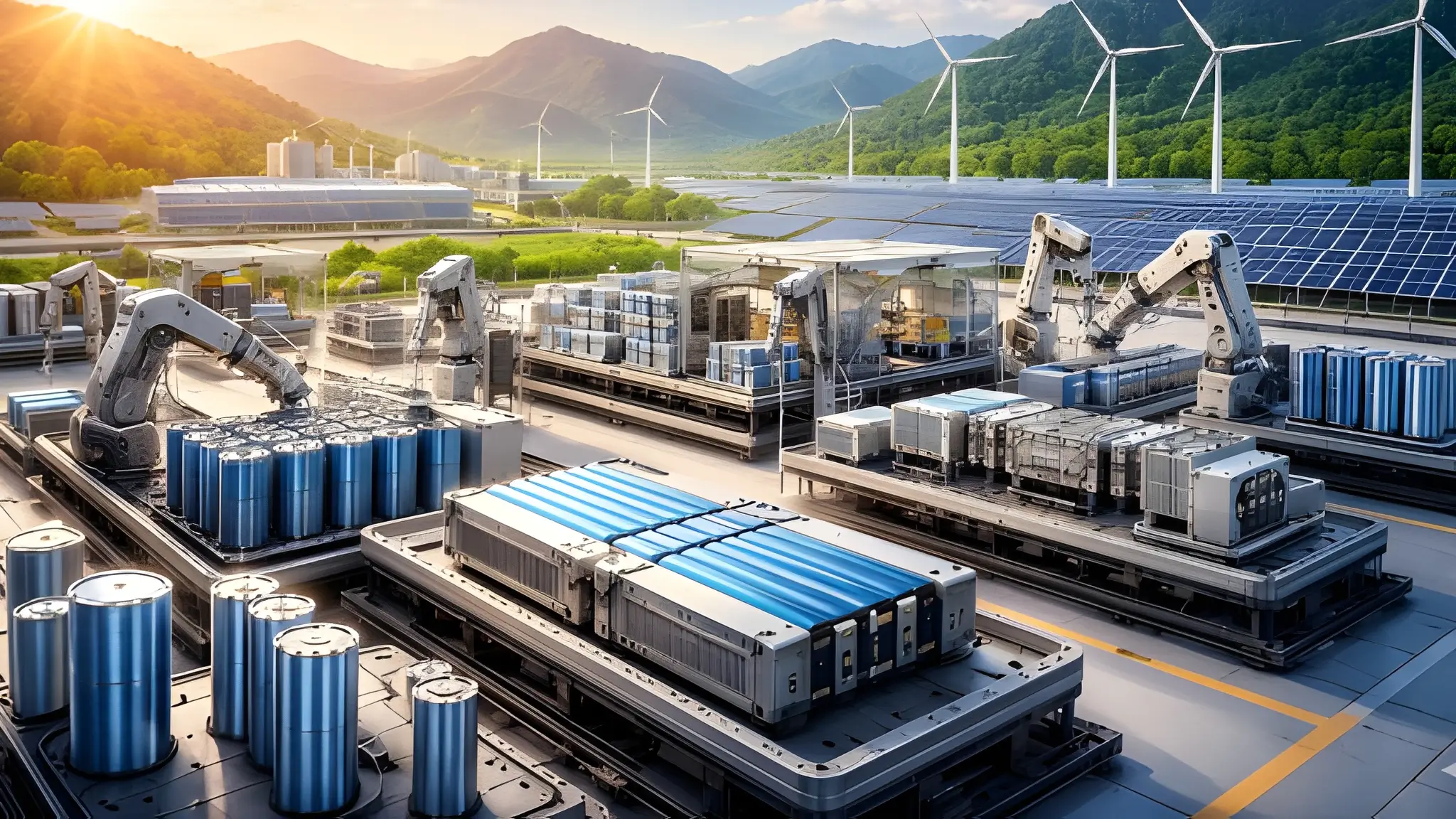
Vietnam has accelerated its push into grid-scale storage with the commissioning of a new battery manufacturing facility in Hung Yen province, positioning the country to capture more value from its fast-growing renewable energy sector.

GG Power’s newly inaugurated Battery Energy Storage System (BESS) factory, opened on April 11, introduces 5 GWh of annual production capacity into Vietnam’s emerging storage supply chain. The move strengthens Hanoi’s broader strategy to localize clean energy infrastructure while supporting grid stability as solar and wind deployments expand. The project reflects a deliberate pivot toward domestic capability building in a segment that remains heavily import-dependent across Southeast Asia.
Industrial-Scale Automation Signals Efficiency Push
The facility spans 1.2 hectares and integrates high levels of automation, with more than 90% of processes handled through advanced systems. This design reduces production cycle times and enhances output consistency critical factors as storage demand scales alongside intermittent renewable generation.
GG Power has allocated approximately $12 million (VND300 billion) to develop the site, embedding both manufacturing and innovation functions within a single footprint. A dedicated research and development center will focus on next-generation storage technologies, enabling product diversification across residential, commercial, industrial and utility-scale applications.

This vertically integrated approach allows the company to respond faster to market shifts while maintaining tighter control over product performance and lifecycle optimization.
Strategic Technology Transfer Partnership with Goldwind
A central component of the project is GG Power’s collaboration with Goldwind, structured through a technology transfer and licensing agreement. The partnership grants GG Power access to advanced engineering expertise while preserving autonomy over its research and development roadmap.
Goldwind will continue to provide technical support and training, ensuring alignment with global standards in system performance and maintenance practices. The arrangement is designed to accelerate capability building without constraining local innovation, a balance that remains critical for emerging manufacturing hubs.
Such cross-border collaborations increasingly define the competitive landscape in battery manufacturing, where speed to scale and technical reliability determine long-term viability.
Policy Alignment Reinforces Localization Goals
Vietnamese policymakers have framed the project as a milestone in the country’s clean energy industrialization strategy. During the inauguration, Nguyen Hoang Long highlighted the importance of developing locally manufactured clean energy equipment.
The government has begun advancing policy mechanisms aimed at reducing reliance on imported components while incentivizing domestic production. These efforts align with GG Power’s stated objective to localize more than 50% of its supply chain by 2026, a target that could catalyze upstream industries and deepen the country’s manufacturing base. Job creation and skills development are expected to follow, particularly in high-value engineering and technical roles tied to storage technologies.
Storage Capacity Targets Drive Market Urgency
Vietnam’s Power Development Plan 8 underscores the urgency behind such investments. The country aims to deploy between 10 GW and 16.3 GW of energy storage capacity by 2030, reflecting the operational challenges posed by rapid renewable energy expansion.
Grid congestion and intermittency have already emerged as constraints in key solar and wind corridors. Storage systems offer a pathway to balance supply variability, improve dispatch flexibility, and enhance overall grid resilience. Therefore, domestic manufacturing capacity becomes a strategic lever, not only for cost control but also for ensuring timely deployment of critical infrastructure.
Vietnam’s evolving policy framework and rising energy demand have begun attracting global battery and storage players. Companies such as Fluence and Gotion have already established a presence, signaling intensifying competition across the value chain.
GG Power’s entry into large-scale manufacturing adds momentum to this trend, reinforcing Vietnam’s position as a regional hub for energy storage production. However, sustained growth will depend on execution, particularly in scaling supply chains, maintaining quality standards, and aligning output with evolving grid requirements.
Outlook: From Assembly to Innovation Hub
The Hung Yen facility represents more than incremental capacity; it signals Vietnam’s ambition to transition from an assembly-based model to a technology-driven manufacturing ecosystem.
As renewable penetration deepens, storage will shift from a supporting role to a central pillar of energy system design. Companies that integrate manufacturing, innovation, and strategic partnerships will likely define the next phase of market leadership.
GG Power’s investment places it within that competitive cohort, at a time when Southeast Asia’s clean energy transition is entering a more complex, and opportunity-rich stage.











