
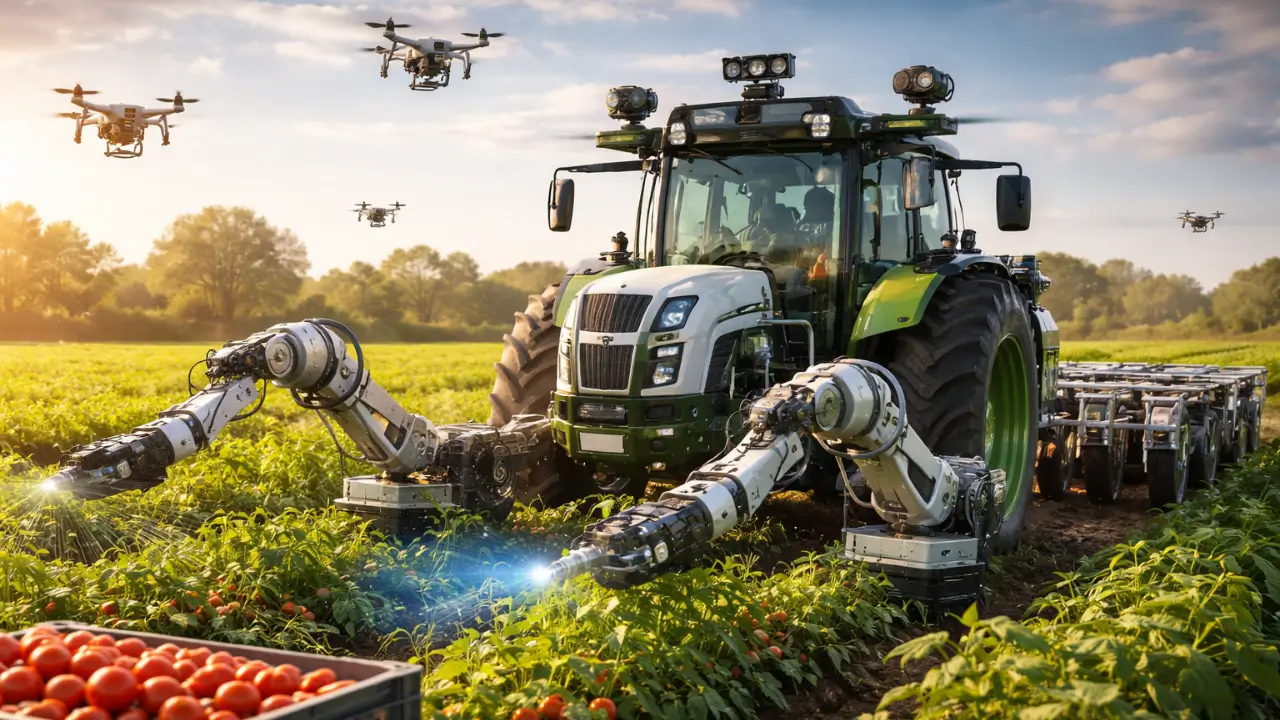
Autonomous farming is entering a phase defined more by perception capability than mechanical automation. Computer vision systems now interpret agricultural environments with increasing contextual awareness. These systems translate visual inputs into operational decisions across planting, maintenance, and harvesting workflows. As perception improves, machines interact more precisely with crops and terrain. Autonomy therefore extends beyond navigation into biological interpretation. This transition represents a structural shift in how agricultural automation is engineered.
Earlier agricultural machines followed preprogrammed rules with limited environmental feedback. Vision-driven systems replace those constraints with adaptive interpretation of real-world conditions. Cameras and imaging sensors capture unstructured field data continuously. Algorithms process this information to recognize patterns rather than execute static commands. Decision-making becomes responsive rather than prescriptive. This change enables autonomy under variable and unpredictable field conditions.
Object Recognition as a Foundational Capability
Visual object recognition underpins most autonomous agricultural operations, enabling systems to identify crops, weeds, soil features, and obstacles in real time. Modern neural architectures enhance classification accuracy even across inconsistent visual environments. Because recognition performance directly informs downstream mechanical actions, failures at this layer can compromise overall operational reliability. As a result, object recognition continues to receive sustained and focused engineering investment.
Agricultural fields present challenges that are largely absent in controlled industrial settings, as organic growth introduces significant variability in shape, color, and spacing. To function reliably, recognition models must generalize across these inconsistencies without requiring constant retraining. Large, geographically diverse datasets help meet this need by exposing models to a wide range of conditions. Domain adaptation techniques further stabilize performance, ensuring robustness. Ultimately, scalability depends on maintaining consistent perception across regions and seasons.
Visual Diagnostics for Plant Health Monitoring
Computer vision systems now assess plant health by continuously interpreting visual indicators such as color, texture, and growth patterns. These subtle variations reveal early signs of stress or disease, reducing reliance on periodic manual scouting. With continuous imaging, issues are identified sooner, allowing for targeted intervention instead of blanket treatment. As a result, precision increases without adding operational complexity, positioning visual diagnostics as a core autonomous capability in modern agricultural systems.
Advanced platforms integrate multispectral and hyperspectral imaging to capture wavelengths beyond human perception. This capability reveals physiological changes before external symptoms emerge. Vision algorithms then interpret these spectral signatures in combination with spatial data, creating a richer analytical context. By unifying multiple imaging layers, diagnostic confidence improves. The result is an extended form of perception that reaches directly into underlying biological processes.
Precision Intervention Through Visual Feedback
Visual perception directly informs autonomous intervention systems, allowing machines to adjust spraying, pruning, or irrigation in response to highly localized conditions. Actions are triggered only when visual indicators justify intervention, rather than being applied uniformly across an entire area. This targeted approach significantly reduces resource waste while lowering overall environmental impact. Continuous feedback loops connect perception with execution, enabling systems to refine decisions as conditions evolve. Precision, in this context, emerges from the tight coupling of real-time visual intelligence and responsive action.
As these systems mature, visual data becomes not just a trigger for action but a foundation for long-term optimization. Patterns observed over time help models anticipate stress, growth cycles, or inefficiencies before they become visible problems. This shifts autonomous intervention from reactive correction to proactive management. The result is an operational model where efficiency is sustained through foresight, not constant intervention.
Automated Harvesting Through Visual Dexterity
Harvesting automation relies on advanced visual interpretation to function effectively in real-world conditions. Machines must detect ripe produce despite occlusion, uneven positioning, and constantly changing lighting. Visual systems evaluate size, orientation, and accessibility simultaneously, translating these signals into actionable decisions. These assessments directly inform robotic manipulation in real time. As a result, effective dexterity depends less on mechanical strength and more on the precision of perception. Harvesting autonomy, therefore, is fundamentally anchored in visual competence.
As visual understanding improves, harvesting systems transition from rigid, rule-based actions to adaptive decision-making. Subtle differences between crops, foliage density, or environmental disturbances can be interpreted rather than ignored. This adaptability allows robots to operate with greater consistency across diverse fields and seasons. Over time, visual intelligence becomes the primary enabler of scalability in autonomous harvesting, determining not only accuracy but long-term operational viability.
Edge Processing Enables Real-Time Decisions
Harvesting automation relies on advanced visual interpretation to function effectively in real-world conditions. Machines must detect ripe produce despite occlusion, uneven positioning, and constantly changing lighting. Visual systems evaluate size, orientation, and accessibility simultaneously, translating these signals into actionable decisions. These assessments directly inform robotic manipulation in real time. As a result, effective dexterity depends less on mechanical strength and more on the precision of perception. Harvesting autonomy, therefore, is fundamentally anchored in visual competence.
As visual understanding improves, harvesting systems transition from rigid, rule-based actions to adaptive decision-making. Subtle differences between crops, foliage density, or environmental disturbances can be interpreted rather than ignored. This adaptability allows robots to operate with greater consistency across diverse fields and seasons. Over time, visual intelligence becomes the primary enabler of scalability in autonomous harvesting, determining not only accuracy but long-term operational viability.
Dataset Engineering as Core Infrastructure
System performance depends heavily on the quality and structure of the datasets it is trained on. In agricultural contexts, imagery must capture seasonal cycles, regional diversity, and biological variation to remain representative. Labeling accuracy directly shapes model behavior, influencing both reliability and edge-case performance. Synthetic data plays a complementary role by filling gaps where rare or extreme scenarios are underrepresented. As these datasets scale, governance evolves into an infrastructure discipline rather than a peripheral task. Long-term autonomy ultimately depends on sustained, disciplined data management.
This shift reframes data not as a static input, but as a living asset that requires continuous oversight and iteration. Drift in environmental conditions, crop genetics, or farming practices can quietly erode model relevance if datasets are not refreshed with intent. Operational maturity therefore lies in aligning data pipelines, validation processes, and domain expertise into a single feedback loop. When data stewardship is treated with the same rigor as compute or deployment, system performance remains resilient rather than brittle over time.
Model Generalization and Operational Stability
Generalization enables consistent performance across diverse environments, while continuous learning allows models to evolve without disrupting operations. Validation pipelines track accuracy drift over time, ensuring reliability as conditions change. In this context, stability remains as critical as adaptability. Effective deployment strategies therefore balance ongoing improvement with operational reliability. Through this lifecycle discipline, autonomous systems mature in a controlled and dependable manner.
Visual perception integrates seamlessly with navigation and control systems, forming the foundation for coordinated operation. Standardized interfaces support modular platform design while enabling interoperability across multi-vendor equipment environments. Perception outputs then guide motion planning and task execution, elevating perception from a discrete function to a system-wide capability. Ultimately, autonomy depends on the tight coordination of these intelligence layers working in unison.
Large-scale deployment depends on robust digital infrastructure that can support continuous operation. High-bandwidth sensor networks enable uninterrupted imaging, while onboard compute resources reliably handle inference workloads in real time. Connectivity plays a critical role by allowing ongoing updates and remote diagnostics. Together, these infrastructure choices directly influence system uptime and responsiveness. At scale, visual systems advance not through isolated components, but through coordinated investment across hardware layers.
Reliability and Field Validation
Field conditions continuously challenge perception systems, as dust, rain, and shifting lighting conditions degrade visual quality. To counter these disruptions, redundant sensing architectures are employed to maintain situational awareness. Validation protocols rigorously test system performance across operational extremes to expose edge-case failures. Safety mechanisms are designed to manage perception uncertainty when inputs degrade or conflict. Together, these measures ensure that reliability engineering remains the foundation for trust in autonomous systems.
Automation reshapes workforce roles without eliminating human oversight. Operators increasingly supervise systems through visual dashboards rather than direct intervention. Interpretation and judgment replace manual labor as the primary responsibility. Human expertise remains essential for calibration, anomaly detection, and exception handling. As a result, technical literacy becomes more critical across operational teams. This evolution of the workforce mirrors the rising complexity of the systems they manage.
Rather than reducing human relevance, automation elevates decision-making to a strategic layer. Teams are expected to understand system behavior, not just system operation. This shift rewards cross-disciplinary knowledge, blending infrastructure awareness with data interpretation and operational context. Over time, the operator’s role aligns more closely with stewardship than execution. Control moves from physical actions to informed oversight, reinforcing the human role as an integrator within increasingly autonomous environments.
Standardization and Interoperability Efforts
Standardization reduces deployment friction by establishing shared data formats that enable seamless equipment interoperability. Protocol alignment ensures perception outputs integrate cleanly with downstream control systems, minimizing translation overhead. Industry frameworks further support long-term maintainability by creating common reference points across vendors. This consistency improves multi-region scalability while stabilizing emerging autonomous ecosystems as they mature.
As autonomous systems scale, standards also act as a coordination layer between innovation and operational reliability. They allow new capabilities to be introduced without disrupting existing workflows or infrastructure assumptions. By constraining variability at the interface level, organizations can iterate faster within defined boundaries. The result is not reduced flexibility, but a more predictable path from experimentation to production.
Regulatory and Compliance Considerations
Autonomous systems operate within constantly evolving regulatory frameworks, where transparency in machine decision-making is essential for compliance. Strong data governance ensures alignment with regional requirements, while certification processes increasingly assess the reliability of perception systems. As regulatory expectations become clearer, organizations can scale these technologies more responsibly. Ultimately, compliance frameworks play a decisive role in shaping both deployment strategies and overall adoption pace.
Continuous imaging strengthens environmental observation by enabling visual tracking of soil conditions and water distribution over time. These visual records complement traditional sensors, adding contextual depth to collected data. When analyzed longitudinally, they reveal patterns and trends that would otherwise remain fragmented. This layered monitoring approach improves situational awareness. As a result, visual systems meaningfully extend operational oversight rather than merely supplement it.
Latency Management in Autonomous Operations
Low latency remains operationally critical because delayed perception directly affects navigation and physical manipulation. Deterministic processing enables systems to respond with predictable, repeatable behavior under time-sensitive conditions. Architectural choices therefore reflect strict timing constraints rather than abstract performance metrics. Effective latency management becomes a safety mechanism, not just an optimization. In this context, real-time vision establishes the foundation for operational confidence.
As workloads scale and environments grow more complex, maintaining this responsiveness becomes increasingly challenging. Variability introduced by network paths, shared compute resources, or inconsistent scheduling can erode the guarantees real-time systems depend on. Addressing these risks requires tighter integration between sensing, compute, and execution layers. When these elements remain synchronized, systems preserve reliability even under dynamic conditions. Operational trust ultimately emerges from this alignment, not from raw processing power alone.
Autonomous systems require structured, ongoing maintenance to remain reliable. Regular calibration preserves perception accuracy, while software updates address environmental drift over time. As a result, maintenance increasingly resembles IT operations rather than traditional mechanical servicing. Long-term stability depends on this planned evolution, enabling sustained and dependable deployment.
The Trajectory of Perception-Led Autonomy
Autonomous farming is advancing in step with improvements in perception capability, as gains in accuracy and system integration continue to accelerate adoption. Visual intelligence increasingly defines the practical ceiling of autonomy, shaping how far machines can operate without human intervention. As a result, equipment design is being recalibrated around perception constraints rather than raw mechanical capacity. Operational models are evolving in parallel, adapting workflows to what machines can reliably see, interpret, and act upon. At every layer of the stack, perception remains the central enabler of the next frontier in agricultural automation.
This shift reframes autonomy not as a question of motion or power, but of understanding. The future of autonomous farming will be determined less by how machines move through fields and more by how accurately they interpret complex, changing environments. As perception systems mature, they will dictate deployment strategies, economic viability, and trust at scale. In this context, progress will be measured not by novelty, but by consistency, resilience, and the ability to operate under real-world uncertainty.











