As power grids shift rapidly from fossil fuels to renewable energy, one stubborn challenge remains: how to store electricity reliably at scale for long periods. Solar panels generate power only when the sun shines. Wind turbines produce energy only when the wind blows. However, balancing supply and demand over several hours or even days requires storage systems that go far beyond what standard lithium-ion batteries were built to deliver.
Vanadium redox flow batteries, or VRFBs, have emerged as a strong contender for this role. Often described as a frontier technology in grid-scale storage, they combine distinctive chemistry with flexible design. Utilities across Asia, Europe, and North America are now testing and deploying these systems to smooth renewable output and strengthen grid reliability. As deployments expand, attention has shifted from curiosity to a more practical question: can VRFBs become a core component of future clean power systems?
How Vanadium Flow Batteries Work
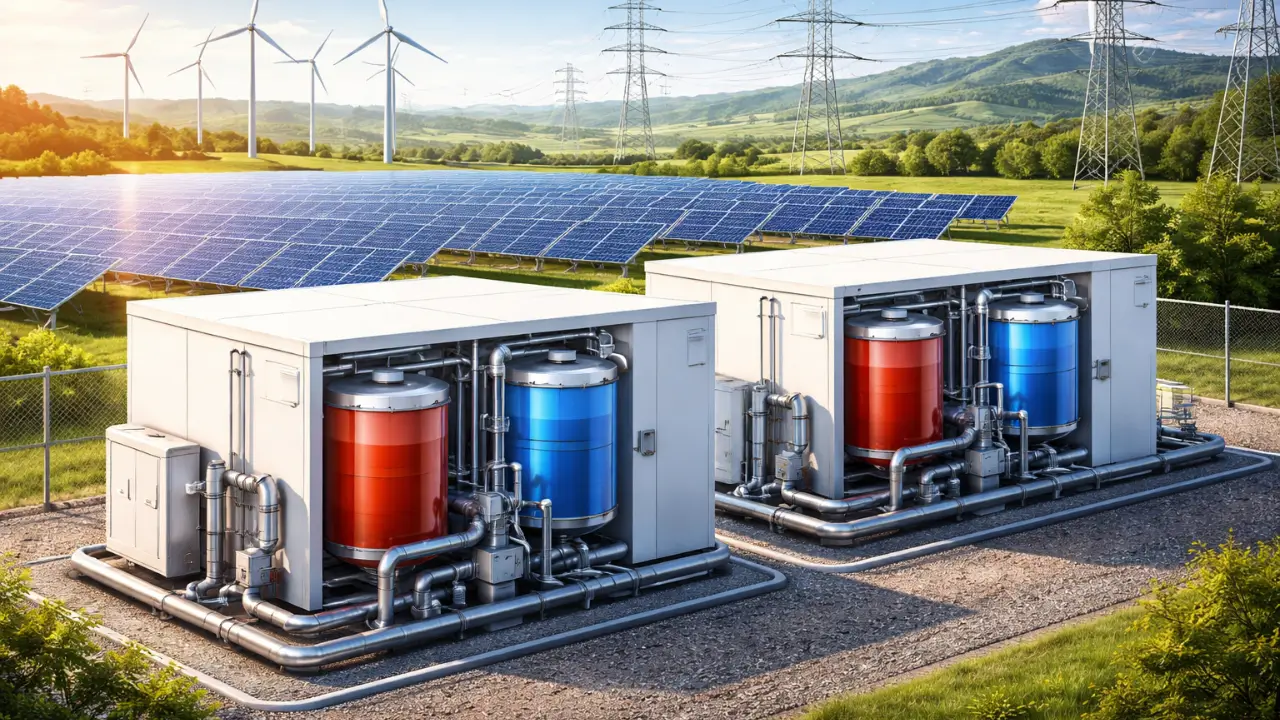
Vanadium flow batteries differ fundamentally from conventional batteries. Instead of storing energy in solid electrodes, they store it in liquid electrolytes kept in external tanks. These liquids contain vanadium ions in different oxidation states on each side of the system.
When operators charge or discharge the battery, pumps circulate the electrolyte through a cell stack. Electrochemical reactions then store or release energy. Because the electrolyte tanks determine energy capacity and the stack determines power output, engineers can scale each element independently. As a result, developers can tailor systems for applications that require several hours of storage rather than short bursts of power.
Safety provides another important advantage. VRFB electrolytes are water-based and non-flammable. This chemistry eliminates the risk of thermal runaway that concerns many lithium-ion installations. Consequently, utilities can site flow batteries near campuses, industrial parks, and community energy projects with fewer fire-related constraints.
Real-World Deployments and Case Studies
Vanadium flow batteries have moved beyond laboratory research and pilot demonstrations. Today, several countries operate large commercial projects that highlight their potential.
China’s Gigawatt-Hour Installations
China leads global deployment. In northwest China, Rongke Power Industries has scaled VRFB projects from 100 MW to 175 MW and then to a massive 200 MW and 1 GWh installation in Xinjiang. Commissioned in 2025, this project forms part of a broader renewable energy hub. It delivers multiple hours of discharge capacity, helping stabilize wind and solar generation while supporting regional grid reliability.
Utility-Scale and Community Projects Worldwide
Japan adopted flow batteries early. A 15 MW and 60 MWh system at Hokkaido Electric Power’s substation operates alongside wind and solar assets. The battery enables peak shifting and improves operational flexibility.
Australia has also begun integrating VRFBs. Near Hawker, a 2 MW and 8 MWh system connected to a solar PV array shifts midday generation to evening demand. Although smaller in scale, this project demonstrates the technology’s value for rural and regional grids.
Meanwhile, several European countries are connecting flow battery projects to national and cross-border grids. These efforts aim to enhance flexibility as renewable penetration increases. Together, these deployments show that VRFBs now play a meaningful role in long-duration storage planning.
Why VRFBs Appeal to Power Grids
Long Life and Reliability
Longevity stands out as one of the strongest advantages of VRFBs. Vanadium ions do not degrade in the same way as solid electrodes in lithium-ion batteries. As a result, flow batteries can cycle many thousands of times with minimal capacity loss. Manufacturers often design systems for 20 years of continuous operation.
In addition, operators can access and service individual components. Technicians can repair or replace pumps, stacks, or tanks without discarding the entire system. Utilities value this modularity because it aligns with long-term infrastructure planning and reduces lifetime costs.
Independent Scaling of Power and Energy
Flow batteries allow planners to size energy capacity and power output separately. If a project requires more hours of storage, engineers can expand the electrolyte tanks. If higher power output is necessary, they can increase stack capacity. This flexibility makes VRFBs well suited for multi-hour storage, particularly in grids with high renewable penetration.
Safety and Sustainability
Because VRFBs use water-based electrolytes, they present fewer fire risks than many alternatives. This feature simplifies permitting and community acceptance. Furthermore, vanadium retains value at the end of a project’s life. Operators can recycle and reuse the electrolyte, which strengthens lifecycle economics and supports sustainability goals.
Additional Benefits and Emerging Uses
Ancillary Grid Services
Beyond energy storage, VRFBs can provide valuable grid services. They support frequency regulation, voltage control, black start capability, and demand response. As renewable generation increases system variability, these services become more important. Flow batteries can respond quickly and operate for extended periods, making them well suited to this evolving role.
Microgrid and Behind-the-Meter Applications
Developers are also deploying VRFBs in microgrids and behind-the-meter installations. Industrial facilities, hospitals, campuses, and remote communities use them to reduce peak demand and improve resilience. During outages, these systems maintain critical loads. In regions with high electricity tariffs, they also lower operating costs by smoothing demand profiles.
Together, these applications expand the technology’s relevance beyond large transmission grids. VRFBs can support both centralized infrastructure and localized energy systems.
Challenges and Complexities
Despite their strengths, vanadium flow batteries face real obstacles.
High Upfront Costs and Supply Constraints
Capital cost remains the primary barrier. The vanadium electrolyte alone can account for up to half of total system costs. Consequently, initial investments often exceed those of lithium-ion systems.
Price volatility adds further uncertainty. Global vanadium production is concentrated in a limited number of countries, which exposes projects to supply risks. Although electrolyte leasing models reduce upfront expenses, developers still weigh market fluctuations carefully.
Energy Density and Physical Footprint
VRFBs have lower energy density than lithium-ion batteries. Therefore, they require more space for the same storage capacity. In dense urban environments or land-constrained areas, this larger footprint can limit deployment options. Developers must plan sites carefully to accommodate tanks, stacks, and supporting infrastructure.
Technical Maturity and Market Competition
While the technology has advanced significantly, engineers continue to improve membranes, cell efficiency, and electrolyte management. At the same time, competing storage solutions are evolving rapidly. Iron-based flow batteries and new long-duration lithium systems compete for investment.
Market structures also influence adoption. In some regions, electricity markets do not fully compensate long-duration storage. Without clear revenue streams, developers face additional financial complexity.
Innovation and Future Directions
Ongoing innovation could reshape the economics of vanadium flow batteries. Electrolyte leasing programs continue to lower entry barriers for utilities. Meanwhile, manufacturers are scaling production and integrating supply chains to reduce costs.
In North America, companies are forming joint ventures to localize vanadium processing and electrolyte manufacturing. These partnerships aim to reduce geopolitical risks and strengthen domestic supply. Researchers are also refining membrane materials and stack designs to improve efficiency and durability.
In parallel, advanced software and digital controls are enhancing system optimization. By integrating predictive analytics and grid modeling, operators can maximize performance and revenue streams.
A Strategic Role in Tomorrow’s Grid
Vanadium flow batteries occupy a distinctive position in the energy storage landscape. They do not suit every application, particularly where space constraints or very high power density dominate. However, they offer durable, safe, and flexible long-duration storage that aligns closely with the needs of renewable-heavy grids.
Large installations in China, steady adoption in Japan and Australia, and emerging projects in Europe demonstrate growing confidence in the technology. If supply chains stabilize and manufacturing costs decline, VRFBs could play a central role in balancing renewable generation and strengthening grid resilience.
As energy systems continue to evolve, vanadium flow batteries stand poised to support a cleaner and more reliable power future.