The shift toward liquid cooling inside data centers is no longer driven solely by thermal necessity. As rack densities climb and air-based approaches strain under power-hungry workloads, attention has moved beyond performance and efficiency toward a quieter but consequential question: how serviceability changes when liquid replaces air. Maintenance practices, repair timelines, workforce training, and operational risk profiles are being reshaped in subtle but material ways. For operators and designers alike, serviceability has emerged as a central economic variable rather than a secondary operational detail.
Liquid cooling introduces a fundamentally different physical environment into white space operations. Tubes, manifolds, quick-connects, fluids, and sealed enclosures redefine how technicians interact with equipment.
Tasks once defined by airflow management and component access now require fluid isolation, contamination control, and procedural precision. The economics of maintenance, often measured through mean time to repair, staffing intensity, and service predictability, are adjusting accordingly.
Serviceability as a Design Constraint
Historically, data center serviceability evolved alongside air cooling. Hot-swappable components, front-access servers, and standardized rack layouts were optimized for rapid human intervention. Liquid cooling alters that foundation. The presence of fluid paths introduces new servicing dependencies and failure considerations that must be addressed during system design rather than deferred to operational practice.
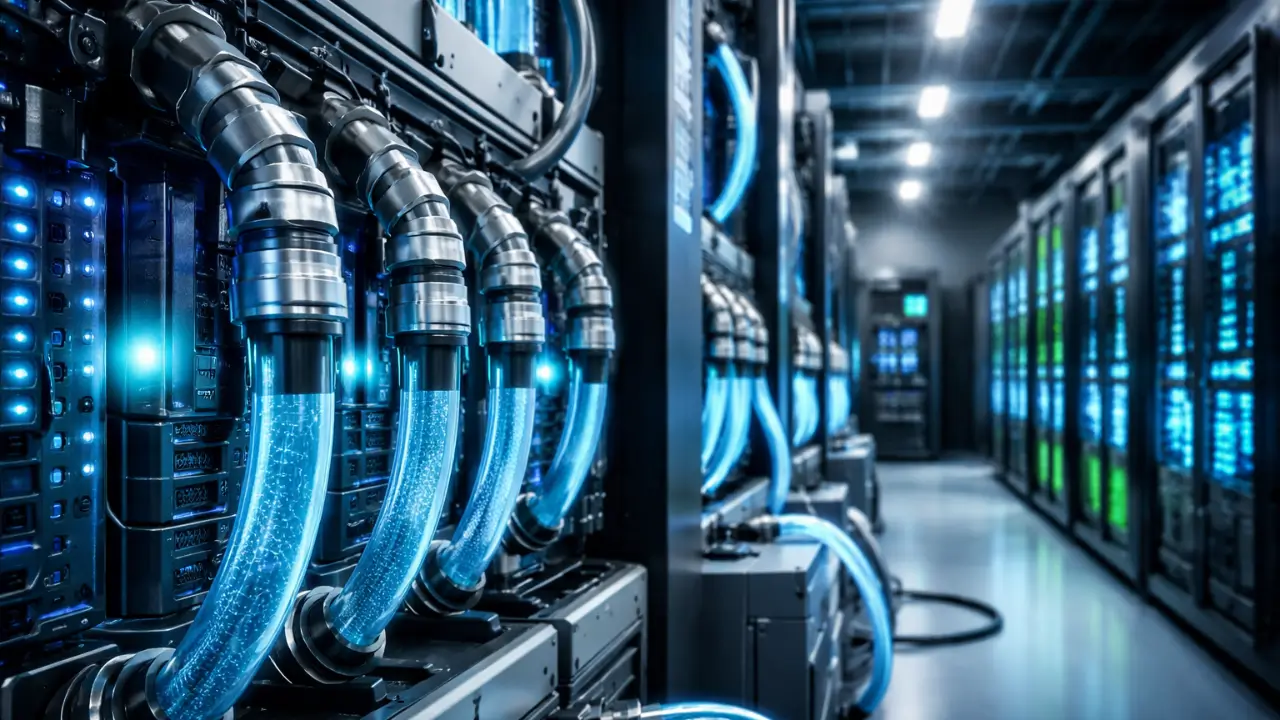
In many contemporary liquid-cooled architectures, serviceability is embedded into mechanical and plumbing layouts. Direct-to-chip cooling loops are often designed with server-level isolation valves and quick-disconnect fittings, allowing technicians to remove individual assemblies without draining entire loops, provided vendor-recommended procedures and hardware configurations are in place. Immersion cooling deployments increasingly account for physical handling through lift assistance, extraction trays, and drip-management controls, though the exact implementation varies by vendor and site design.
These features reflect an industry recognition that maintenance friction directly affects uptime economics. Where serviceability is not deliberately engineered, repair windows tend to lengthen and operational risk increases disproportionately.
Technician Workflows in Liquid-Cooled Environments
Liquid cooling changes the sequence and discipline of technician activity. In air-cooled facilities, many service tasks are performed live with minimal preparatory steps beyond electrical safety and electrostatic precautions. Liquid-cooled systems introduce additional procedural layers.
Technicians typically begin with fluid isolation, verifying loop pressure stability and valve integrity before accessing components. Disconnecting a server or cold plate assembly may require capturing residual fluid and confirming seal condition. Reassembly involves controlled reconnection, gradual re-pressurization, and post-service inspection to detect microleaks or connector misalignment.
These steps lengthen individual service events relative to basic air-cooled interventions, particularly during early operational phases. Over time, however, standardized workflows reduce variability and error rates. Maintenance increasingly resembles structured industrial servicing rather than ad hoc IT repair, reflecting the physical realities of fluid-based systems.
Mean Time to Repair Under Liquid Cooling
Mean time to repair has become a focal metric as liquid cooling adoption expands. Early assumptions held that liquid cooling would inherently extend repair times due to added mechanical complexity. Operational experience has shown a more conditional outcome.
In modular direct-to-chip deployments equipped with well-designed isolation points, quick-disconnects, and accessible layouts, repair times have in some cases approached those of comparable air-cooled systems once technicians become proficient with procedures. These outcomes depend heavily on system design, spare-part strategies, and training maturity rather than the presence of liquid alone.
Immersion cooling presents a different profile. Board-level interventions may take longer due to extraction, fluid management, and handling requirements. However, failure rates related to dust ingress, fan wear, and airflow imbalance are typically reduced. The net economic impact depends less on the duration of individual repairs than on repair frequency and predictability.
From an operational standpoint, reduced variance in repair timelines can be as valuable as shorter repairs. Predictable servicing windows allow operators to plan staffing, redundancy, and maintenance scheduling with greater confidence.
Component Swap Procedures and Physical Access
Component replacement under liquid cooling reflects a shift toward modular assemblies rather than in-place repairs. Cold plates, hose sets, and connector assemblies are commonly treated as replaceable units, enabling technicians to restore service quickly while deferring root-cause analysis to controlled environments.
This approach reduces on-site troubleshooting complexity and limits exposure to fluid pathways during extended diagnostics. While replacement assemblies may carry higher unit costs, reduced service time and lower risk of secondary damage alter the overall maintenance cost structure.
Physical access plays a critical role. Liquid-cooled racks require sufficient clearance for hose articulation, extraction paths, and ergonomic movement. Inadequate access can negate modularity benefits by turning routine swaps into labor-intensive procedures. As a result, access planning is now a core element of serviceability design.
Contamination Risks During Servicing
Contamination represents one of the most consequential serviceability risks in liquid-cooled systems. Unlike air-cooled environments, where dust accumulation is gradual and localized, fluid contamination can propagate rapidly through shared loops.
Servicing activities introduce exposure risks through open connectors, handling interfaces, and ambient particulates. Effective contamination control relies on disciplined procedures, capped connections, controlled service environments, and fluid-quality monitoring.
Dielectric immersion fluids largely isolate electronic components from airborne dust and debris, reducing the need for board-level cleaning. However, immersion does not eliminate maintenance requirements. Fluid aging, material compatibility, and particulate ingress remain operational considerations, necessitating periodic testing and management.
The economics of contamination control are preventive by design. The incremental cost of strict servicing protocols is modest compared with the potential consequences of fluid degradation or system-wide downtime.
Retraining Requirements and Workforce Evolution
Liquid cooling expands the skill set required of data center technicians. Familiarity with fluid handling, pressure systems, and materials compatibility supplements traditional IT and electrical expertise. This evolution has direct implications for workforce development.
Retraining programs typically combine theoretical instruction with supervised hands-on servicing. Technicians learn to recognize early indicators of seal degradation, interpret pressure and flow data, and execute controlled maintenance steps. Over time, proficiency reduces servicing errors and improves recovery confidence.
Retraining represents an upfront investment rather than an ongoing burden. Facilities with trained personnel report fewer service-induced incidents and more consistent maintenance outcomes, reinforcing the link between workforce specialization and operational stability.
Safety and Human Factors
Serviceability in liquid-cooled environments intersects closely with technician safety. Fluids introduce slip hazards, handling challenges, and exposure to pressurized systems. Even dielectric fluids require controlled handling due to stored energy and mechanical risk.
Design responses increasingly account for human factors. Non-slip flooring, clear service zones, pressure relief protocols, and tools designed for gloved operation contribute to safer maintenance conditions. These measures also support consistent execution of procedures under real-world conditions.
Human factors engineering recognizes that many service failures originate from fatigue, constrained access, or procedural ambiguity rather than technical complexity alone. Liquid-cooled systems that address these factors tend to achieve more reliable service outcomes.
Economic Implications of Service Design
The cumulative effect of redesigned workflows, training investments, and contamination control reshapes liquid cooling maintenance economics. Costs shift from reactive repair toward planned intervention and procedural discipline. Capital expenditures may rise due to specialized components and training, but operational volatility often declines.
Predictable maintenance cycles reduce emergency interventions, which typically carry the highest cost and risk. Facilities benefit from more stable staffing requirements and fewer cascading failures linked to rushed repairs.
As liquid cooling matures, lifecycle service costs are increasingly evaluated alongside energy efficiency. Designs that minimize service friction demonstrate more stable total cost profiles, particularly in high-density environments where air cooling maintenance becomes progressively disruptive.
Global Variations in Serviceability Practices
Serviceability approaches differ across regions, shaped by labor markets, regulatory environments, and operational maturity. In regions with specialized technical labor, liquid cooling deployments often feature advanced servicing protocols. Elsewhere, simplicity and modular replacement take precedence to align with broader skill distributions.
Global operators increasingly standardize design principles while allowing procedural adaptation at the regional level. This balance supports consistency without ignoring local operational realities.
The Role of Standards and Documentation
As liquid cooling adoption expands, industry standards and documentation are becoming more comprehensive. Maintenance guidance now extends beyond installation manuals to include servicing playbooks, contamination controls, and incident response procedures.
Standardized documentation reduces reliance on individual expertise and supports knowledge transfer across teams and sites. It also enables benchmarking, allowing operators to refine service models based on comparative performance.
Clear documentation reinforces a culture of deliberate maintenance aligned with system design and operational intent.
Looking Ahead
Serviceability considerations continue to influence the evolution of liquid-cooled infrastructure. Designers are prioritizing self-sealing interfaces, improved monitoring, and simplified access to reduce maintenance friction further.
While automation and assisted servicing may play a role in the future, human-centered design remains the primary determinant of maintenance effectiveness. In that context, liquid cooling maintenance economics are shaped less by the presence of liquid itself than by how thoughtfully systems are designed, documented, and serviced.
Serviceability is no longer peripheral to infrastructure planning. In high-density computing environments, it has become a defining factor in operational resilience and long-term sustainability.