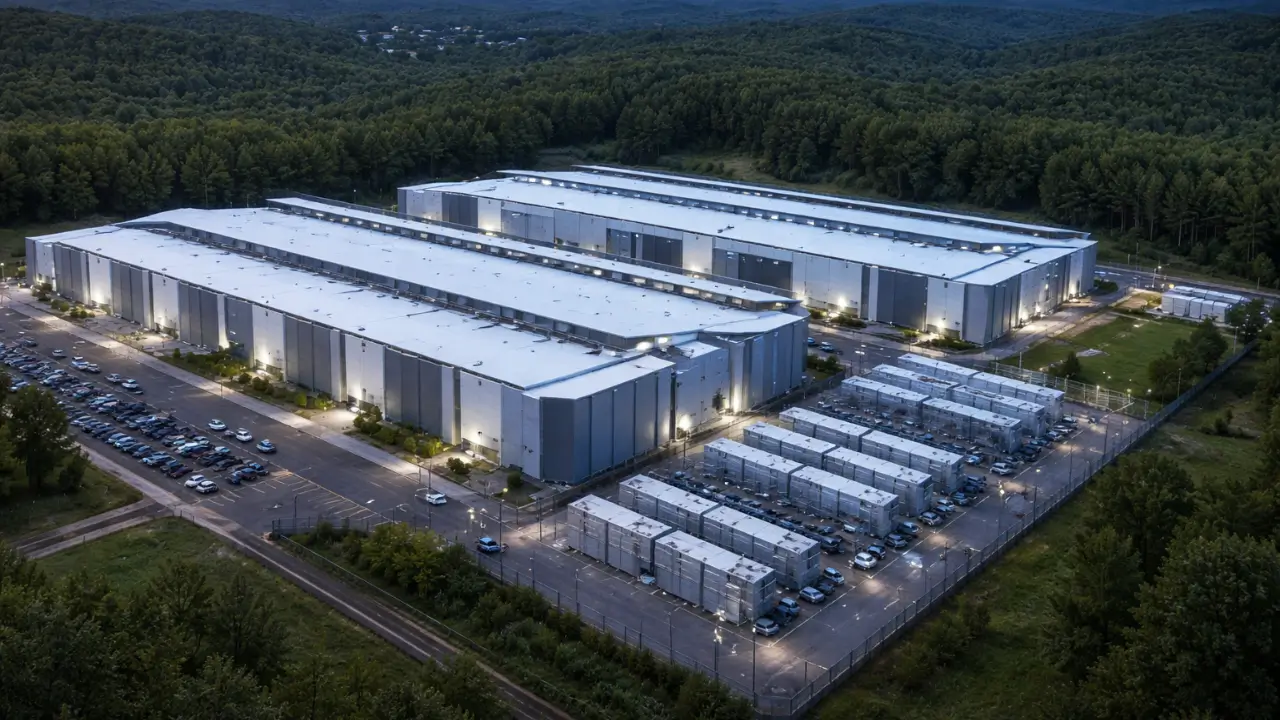
A long-term colocation agreement between Nscale and WhiteFiber is positioning North Carolina as an emerging node in the fast-evolving neo cloud and AI infrastructure landscape. The $865 million, ten-year deal secures 40MW of capacity for Nscale at WhiteFiber’s forthcoming NC-1 data center in Madison, North Carolina, with deployment beginning next year and scope for expansion thereafter.
The agreement reflects a broader recalibration underway in global digital infrastructure markets, where AI compute demand is reshaping how capacity is contracted, financed, and brought online. Rather than incremental leasing, multi-year, hyperscaler-aligned commitments are increasingly defining the economics of new data center builds, particularly in secondary U.S. markets with available land and power headroom.
NC-1 is being developed on a 96-acre site at 805 Island Drive in Rockingham County, acquired earlier this year from textiles manufacturer Unifi. The site carries industrial legacy significance: after more than three decades of operations, Unifi closed the 946,585-square-foot facility in February as part of a footprint reduction, resulting in 91 layoffs. The transition of the property from manufacturing to high-density digital infrastructure mirrors a wider structural shift in regional economies toward compute-led development.
WhiteFiber, the colocation and high-performance computing arm of Bit Digital, has outlined an initial capacity roadmap of 99MW for the site, with longer-term plans to scale to 200MW. The companies have disclosed $150 million in investment to date and ongoing discussions with lenders to finance the remainder of the buildout. The Nscale commitment provides early anchor tenancy that materially de-risks the project’s next phases.
“WhiteFiber has taken a prudent and cautious approach to client selection. We took our time, reviewing multiple offers before selecting Nscale, a partner with a proven track record of hyperscaler deployments,” said Sam Tabar, CEO of WhiteFiber.
“This agreement validates our strategy to engineer NC-1 to meet hyperscaler specifications and support the most advanced AI workloads. We look forward to working closely with Nscale as we plan for the potential expansion of this deployment toward double its initial size by the end of 2027.”
Under the agreement terms, Nscale will begin paying for 20MW of capacity in April 2026, followed by an additional 20MW in May. The structure staggers financial and operational ramp-up while aligning with anticipated AI workload demand. Nscale has also secured first notification rights for any future available capacity at the site, underscoring expectations that NC-1 could become a longer-term strategic footprint rather than a single-deployment location.
The deal further highlights the transformation of WhiteFiber itself. Bit Digital’s acquisition of Enovum in November 2024 established WhiteFiber as the group’s GPU cloud unit, operating from Enovum facilities. Founded in 2020, Enovum currently runs one site in Montreal, Canada, with additional developments underway in Québec City, extending WhiteFiber’s presence beyond the U.S. market.
For Nscale, the North Carolina agreement builds on a rapid expansion trajectory since the company’s formation in May 2024, when it was spun out of cryptomining firm Arkon Energy. Over the past year, Nscale has secured high-profile agreements with Microsoft and OpenAI to provide access to AI compute, positioning the firm as a key intermediary between infrastructure owners and large-scale AI customers.
Operationally, Nscale currently runs a 30MW data center at Glomfjord Industrial Park in Norway, with plans to double that capacity to 60MW. Additional developments are planned in Fauske and Narvik in Norway, as well as London in the UK. Alongside owned facilities, the company is leasing capacity from Verne in Iceland, Start Campus in Portugal, and Ionic Digital in Texas, with much of this capacity earmarked for Microsoft and OpenAI workloads.
Taken together, the WhiteFiber-Nscale agreement illustrates how neo cloud operators are blending owned assets with long-term colocation partnerships to assemble geographically diverse AI compute portfolios. North Carolina’s entry into this network reflects the growing importance of non-traditional data center markets as AI demand accelerates and competition for power and land intensifies in established hubs.