
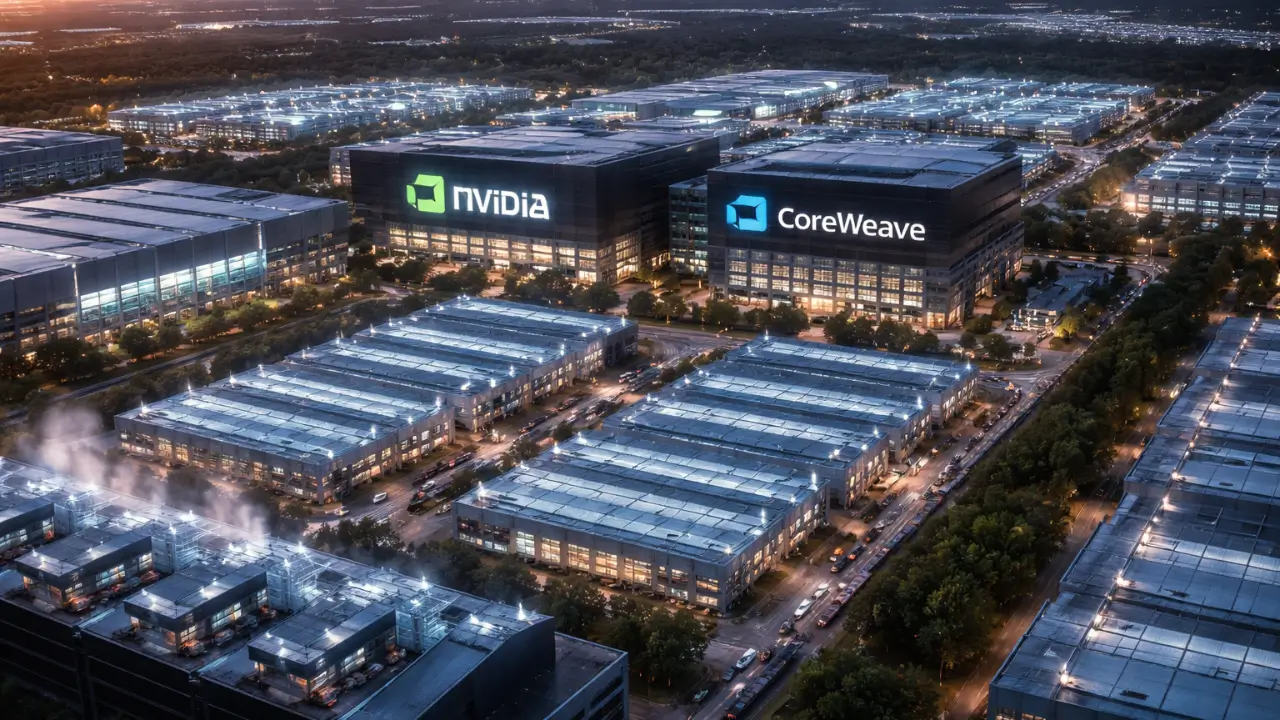
Nvidia has committed $2 billion to CoreWeave, deepening a partnership that both companies say will accelerate the global buildout of AI-focused data centers. The investment, made through the purchase of CoreWeave Class A shares at $87.20 per share, anchors a broader plan to construct more than 5 gigawatts of AI factory capacity by 2030.
The move signals Nvidia’s intent to push harder into the physical layer of AI computing as demand for GPU-intensive workloads continues to surge. Rather than relying solely on traditional cloud providers, Nvidia is strengthening ties with a specialist operator that designs, builds, and runs infrastructure purpose-built for artificial intelligence.
AI factories, as described by both companies, are large-scale data centers optimized for accelerated computing. They provide enterprises, model developers, and cloud customers with on-demand GPU power for training, fine-tuning, and inference. As AI workloads grow in scale and complexity, these facilities have become critical to keeping deployment timelines intact.
Importantly, the new capital gives CoreWeave greater financial flexibility. Nvidia’s balance sheet strength will help speed up the acquisition of land, power capacity, and physical facilities required to deliver new sites at scale. As a result, infrastructure expansion can proceed in parallel with rising customer demand, rather than lagging behind it.
AI Factories Become the Backbone of Industrial-Scale Computing
Nvidia framed the investment as part of a much larger shift in global infrastructure priorities. “AI is entering its next frontier and driving the largest infrastructure buildout in human history,” said Jensen Huang, CEO of Nvidia. “CoreWeave’s deep AI factory expertise, platform software, and unmatched execution velocity are recognized across the industry. Together, we’re racing to meet extraordinary demand for NVIDIA AI factories, the foundation of the AI industrial revolution.”
That framing reflects how Nvidia increasingly views AI infrastructure not as a support function, but as a new industrial category. Compute capacity now shapes how quickly organizations can innovate, deploy products, and compete. Consequently, access to reliable, high-density GPU environments has become a strategic differentiator.
CoreWeave has positioned itself squarely within that shift. The company focuses exclusively on AI infrastructure, tailoring its data centers, orchestration software, and operations to accelerated computing. Earlier this year, CoreWeave expanded beyond infrastructure operations by acquiring AI model development platform Weights & Biases, reinforcing its ambitions across the AI lifecycle.
The company has also drawn interest from major technology players. Cisco has been linked to CoreWeave in discussions that value the company at approximately $23 billion, underscoring how strategic AI infrastructure assets have become.
Deep Technical Integration Across Hardware and Software
Beyond capital, the expanded collaboration includes extensive technical integration. CoreWeave plans to deploy multiple generations of Nvidia’s accelerated computing platforms across its facilities. These include the Rubin platform, Vera CPUs, and Bluefield storage systems, which together form the backbone of Nvidia’s next wave of AI infrastructure.
At the same time, Nvidia will evaluate and validate CoreWeave’s AI-native software stack. Tools such as SUNK and CoreWeave Mission Control are designed to manage large-scale GPU clusters, optimize workload scheduling, and streamline operations. Nvidia aims to incorporate elements of this software into its own reference architectures for cloud partners and enterprise customers.
This two-way integration reflects a growing emphasis on co-design. Hardware, software, and operations increasingly evolve together, especially at the scale required for frontier AI models. As a result, partnerships that span all three layers are gaining importance.
Michael Intrator, Co-Founder, President, and CEO of CoreWeave, framed the collaboration around that principle. “AI succeeds when software, infrastructure and operations are designed together. Nvidia is the leading and most requested computing platform at every phase of AI – from pre-training to post-training – and Blackwell provides the lowest cost architecture for inference.”
His comments highlight why Nvidia remains central to AI infrastructure strategies. From training massive models to serving real-time inference, Nvidia’s platforms continue to dominate demand across workloads.
Strategic Implications for the AI Infrastructure Market
The Nvidia-CoreWeave deal arrives as competition intensifies around AI capacity. Hyperscale cloud providers, sovereign governments, and enterprises are all racing to secure compute resources. However, building AI factories requires more than capital. Power availability, grid access, cooling design, and operational expertise now shape project timelines.
By aligning closely with CoreWeave, Nvidia effectively secures a dedicated channel for deploying its latest platforms at scale. Meanwhile, CoreWeave gains preferred access to next-generation hardware and validation pathways that can attract customers seeking stability and performance.
Looking ahead, the planned 5-gigawatt expansion underscores how rapidly AI infrastructure expectations have grown. Just a few years ago, such figures would have seemed extreme. Today, they reflect a market where compute has become the limiting factor for innovation.
As AI adoption continues to accelerate, partnerships like this one suggest that the future of computing will be built as much in physical space as in code.











