
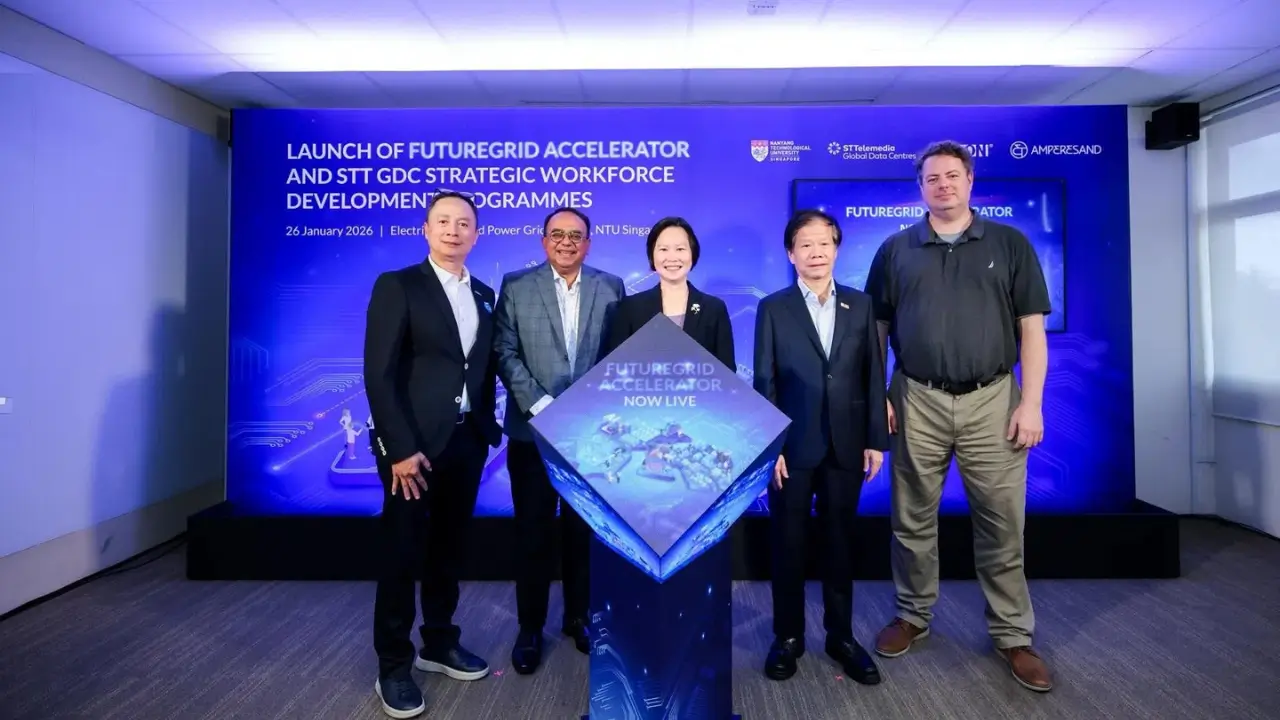
HVDC power for AI infrastructure is being tested in Southeast Asia as ST Telemedia Global Data Centres (STT GDC) announced the launch of a live High Voltage Direct Current testbed in Singapore. The initiative, called the FutureGrid Accelerator, was unveiled alongside new academic partnerships aimed at strengthening talent development for AI-driven data centers and advanced energy systems.

The announcement was officiated by Ms. Gan Siow Huang, Minister of State for Foreign Affairs and Trade & Industry. It comes as Singapore accelerates efforts to support AI-ready infrastructure while aligning digital growth with long-term energy transition goals.
FutureGrid Accelerator Brings HVDC Into Live AI Environments
The FutureGrid Accelerator has been established at Nanyang Technological University’s Electrification and Power Grids Centre on Jurong Island. It was jointly developed by STT GDC and LITEON, with support from the Energy Research Institute @ NTU and NTU spinoff Amperesand. According to the partners, this marks Southeast Asia’s first live testbed where HVDC systems are integrated directly with real AI workloads.
The facility has been designed to address rising rack densities and reliability requirements driven by large-scale AI computing. As GPU clusters expand, traditional alternating current architectures are increasingly strained. Consequently, HVDC is being evaluated as an alternative capable of supporting higher power loads with fewer losses.

Beyond data centers, HVDC is being positioned as a foundational technology for future power systems. Because direct current architectures reduce conversion steps, they are seen as better suited for low-carbon grids and renewable energy integration.
Why HVDC Is Being Considered
As AI and high-performance computing deployments grow, the limitations of AC-based power delivery have become more visible. HVDC systems are expected to deliver efficiency gains while simplifying infrastructure design.
STT GDC estimates that HVDC can enable overall energy savings of up to 30 percent compared with conventional approaches. Carbon emissions reductions of as much as 400 tonnes of CO₂ equivalent per megawatt per year have also been projected. In parallel, copper usage can be reduced by up to 45 percent, while the physical footprint of power infrastructure may shrink by 30 to 40 percent.
Support for ultra-high-density racks exceeding 1,000 kW has been cited as another advantage. In addition, renewable energy sources can feed directly into DC systems, avoiding multiple conversion stages that typically reduce efficiency.
Industry, Government, and Research Alignment
“The FutureGrid Accelerator is a strategic investment in Singapore’s long-term digital leadership,” said Bruno Lopez, President and Group Chief Executive Officer of ST Telemedia Global Data Centres. According to Lopez, the collaboration brings together multinational suppliers and local deep-tech firms to advance energy-efficient AI infrastructure.
Government leaders framed the initiative as part of a broader push to strengthen Singapore’s innovation ecosystem. Ms. Gan said the project demonstrates how industry and academia can collaborate to build advanced capabilities in emerging technologies.
Within the testbed, HVDC system performance will be validated at power loads of at least 325 kW using current-generation AI servers. The setup combines LITEON’s data center reference architecture with Amperesand’s solid-state transformer technology, which has been identified as a key enabler for future HVDC deployments.
STT GDC said the technology is expected to be deployed in upcoming data centers in Singapore. Over time, adoption is planned across its global portfolio.
Preparing the Workforce for Energy-Intensive AI
Alongside the technology launch, STT GDC confirmed the signing of MOUs with the Institute of Technical Education, Singapore Polytechnic, Nanyang Technological University, and the National University of Singapore. Over the next five years, more than 8,000 Singaporeans are expected to benefit from industry-aligned training programs focused on AI infrastructure and sustainable energy systems.
Internships will be offered across data center operations and corporate functions, including IT, sustainability, finance, and marketing. In addition, 100 sponsorships will be provided for the Data Centre Foundation Certificate, helping participants gain industry-recognized credentials.
ITE students will receive exposure to data center operations through curriculum development, immersive virtual training, and industry attachments. Singapore Polytechnic will focus on sustainability-focused programs tied to green data center practices. NTU’s partnership centers on joint research and workforce development for AI data centers powered by direct current systems. NUS graduates will gain access to internships and structured entry pathways into the digital infrastructure sector.
A Signal of Where AI Infrastructure Is Headed
Taken together, the launch of the FutureGrid Accelerator and the talent partnerships reflect a coordinated approach to infrastructure development. HVDC power for AI infrastructure is being evaluated as a scalable response to rising compute intensity and energy constraints.











