
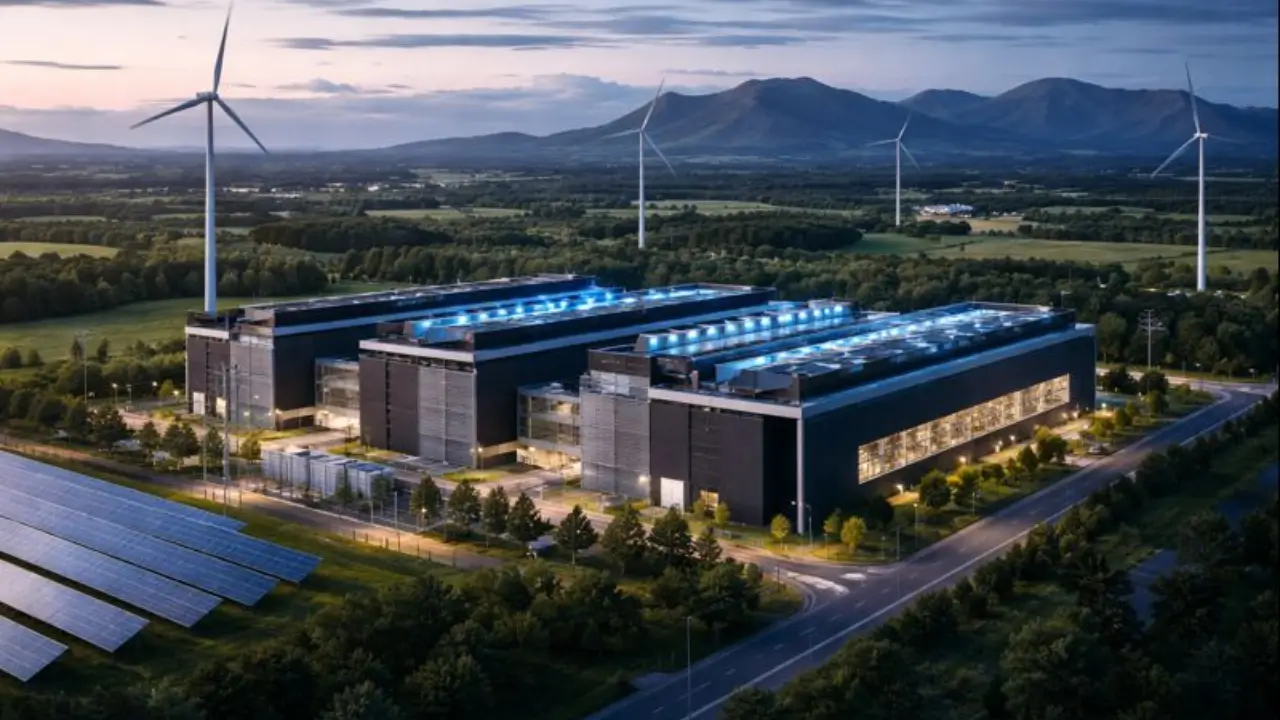
The North Lanarkshire AI Growth Zone marks a decisive shift in how the United Kingdom aligns artificial intelligence ambitions with infrastructure planning, capital flows and energy strategy. By designating North Lanarkshire as an AI Growth Zone, the UK government has created a framework that could unlock 500MW of data center capacity near Glasgow while mobilizing multibillion-pound private investment across digital and energy ecosystems.

The designation is expected to catalyze £8.2 billion ($11.3bn) in private-sector investment, according to Scottish operator DataVita. The figure includes data center development and 1GW of private-wire renewable energy projects designed to support high-density compute workloads. AI Growth Zones, introduced in January 2025, aim to accelerate data center development through financial incentives and prioritized access to power, reflecting growing pressure on the UK’s grid and land availability.
Alongside the designation, a £543 million ($748.8m) community fund will support projects in North Lanarkshire over 15 years. The initiative seeks to balance infrastructure expansion with local economic development, workforce growth and social investment.
DataVita outlines hyperscale ambitions and regional footprint
DataVita currently operates the 24MW Fortis DV1 facility in North Lanarkshire and plans to scale its footprint significantly. The company says it will eventually supply 500MW of hyperscale capacity in the AI Growth Zone, although it has not disclosed a timeline for the expansion.

Danny Quinn, Managing Director of DataVita, said: “Scotland has everything AI needs – the talent, the green energy, and now the infrastructure. But this goes beyond the physical build. We’re creating innovation parks, new energy infrastructure, and attracting inward investment from some of the world’s leading technology companies.
“This is a real opportunity for North Lanarkshire, and we want to make sure local people share in it.”
The AI Growth Zone website outlines a different capacity breakdown, listing a target of 250MW of hyperscale space, a 40MW data center for research and innovation organizations and 100MW for enterprise customers.
Built in 2021 by HFD Group, the Fortis DV1 facility has been operated by DataVita since 2016, when the company became the site’s first occupier. DataVita acquired ownership of the facility from a syndicate of private investors in a 2021 transaction that included ‘£45m ($63.1m) of support’ from its owner.
In January 2025, DataVita filed plans to expand the Fortis site with a new external plant building. In November, it applied for permission to develop another data center on the site, referred to as DV3. The company also operates a second facility, DV2, in central Glasgow at 177 Bothwell Street, which provides 130 racks across 1,000 square meters.
Last year, neocloud provider CoreWeave announced deployments of an unspecified number of Nvidia GPUs within DataVita facilities, signaling growing demand for AI-optimized infrastructure in Scotland.
Government positions AI zones as economic catalysts
North Lanarkshire becomes the fifth AI Growth Zone since the program launched. Two zones are located in Wales, one in Oxfordshire and another near Cobalt Park in Newcastle. The government positions the initiative as a mechanism to accelerate AI adoption while distributing economic benefits across regions.
UK Technology Secretary Liz Kendall said: “Today’s announcement is about creating good jobs, backing innovation and making sure the benefits AI will bring can be felt across the community – that’s how the UK government is delivering real change for the people of Scotland.
“From thousands of new jobs and billions in investment through to support for local people and their families, AI Growth Zones are bringing generation-defining opportunity to all corners of the country.”
The policy reflects broader shifts in national infrastructure strategy, where data centers increasingly influence regional planning, energy investments and industrial competitiveness. Analysts note that AI workloads are reshaping how governments prioritize grid expansion, renewable integration and digital infrastructure incentives.
Industry voices highlight energy constraints and opportunity
Industry leaders have welcomed the new designation while emphasizing structural challenges in the UK’s power ecosystem. Matthew Baynes, Vice President for secure power and data centers at Schneider Electric UK & Ireland, described the initiative as a positive signal for investment but underscored persistent barriers around renewable energy access.
Baynes said: “We believe there is a clear opportunity to catalyse both the AI and green transitions by turning data centers into the energy centres of the future – fast-tracking new developments with behind-the-meter power generation and microgrids.
“The AI Growth Zone announced today could not be more timely. We believe Scotland, with its cool temperate climate and rich conditions to generate renewable energy, provides a key opportunity to create secure, scalable, and sustainable infrastructure capable of galvanising the AI race. Now, the UK’s sustainability and AI ambitions must work together hand-in-glove, demonstrating that today’s technology can be a catalyst for a greener future, powered by AI.”
Industry observers say the convergence of hyperscale demand, renewable generation and policy-driven incentives could reposition Scotland within Europe’s AI infrastructure landscape. However, the pace of grid upgrades, permitting processes and capital deployment will determine whether projected capacity translates into operational reality.
As the UK expands its AI Growth Zone network, North Lanarkshire illustrates how government policy, private investment and energy strategy are becoming interdependent pillars of the AI economy.











