 Skip to content
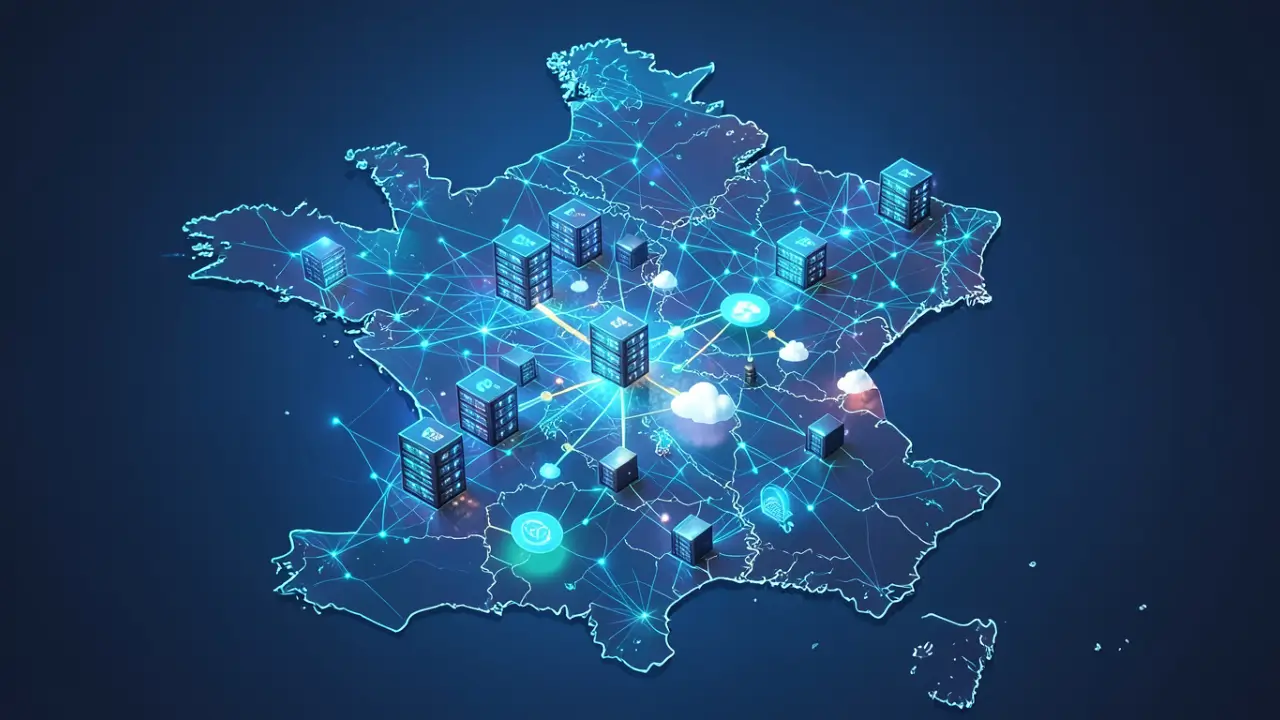
In 2026, France stands as Europe’s sovereign compute powerhouse, a title earned through a decade-long blueprint for a fully independent “AI Stack.”

This transformation did not happen by accident. It followed years of deliberate investment designed to keep data, models, and compute under national control. While many European neighbors struggled with energy constraints and growing dependence on U.S. cloud providers, France focused on self-reliance. The result is a system that treats compute as critical infrastructure, built to endure geopolitical and economic shocks.
Here is how France assembled that system, one pillar at a time.
France’s Nuclear Edge: Powering the AI Revolution
France entered the AI compute race with a decisive advantage. Its fleet of 56 nuclear reactors supplies more than 70 percent of national electricity, providing the kind of stable, low-carbon power hyperscalers require. As Germany faced setbacks in its energy transition and other countries absorbed the fallout from gas supply disruptions, France delivered predictable gigawatts at competitive prices.

In 2025, the government partnered with state-owned EDF to designate industrial zones with up to two gigawatts of pre-allocated capacity reserved for data centers. Many of these zones sit near existing reactors, including Gravelines and Penly, which allows operators to bypass the grid bottlenecks that continue to slow projects in the UK and the Netherlands. At the same time, EDF began scaling modular small nuclear reactors through its Nuward program, laying the groundwork for even denser future clusters.
The clearest signal of confidence arrived later that year. Fluidstack committed €10 billion to build a one-gigawatt decarbonized supercomputer campus in Normandy, matching the scale of the largest facilities in Nevada. The company projected annual carbon savings of 500,000 tons compared to gas-powered alternatives in the United States. By 2026, Meta and Google followed with pledges for secondary sites, bringing an additional €20 billion in planned investment. France’s energy sovereignty had become a durable competitive moat.
Birthing Euro-Native AI Giants
Energy alone does not create an AI ecosystem. France paired infrastructure with a deliberate effort to grow domestic champions rather than rely on imported platforms. Through the French Tech 2030 initiative, backed by Bpifrance, the state directed capital toward foundational layers of the stack, including chips, clouds, and models.
Mistral AI stands at the center of this push. Valued at €11.7 billion after its 2026 Series D, the Paris-based company competes directly with leading U.S. labs through open-weight models such as Mistral Large 2, built with European data privacy in mind. Its dedicated inference platform, Mistral Compute, runs entirely on French infrastructure, which allows enterprises to process sensitive data without exposure to the U.S. CLOUD Act. As a result, companies like Airbus and BNP Paribas now default to Mistral for high-risk workloads, keeping intellectual property within Europe.
Around Mistral, a broader ecosystem has taken shape. SiPearl’s Rhea processors power Europe’s first homegrown supercomputers, reducing dependence on constrained GPU supply chains. Scaleway and OVHcloud together control roughly 40 percent of Europe’s sovereign cloud market, while OVH’s Green Cloud clusters surpassed 100 megawatts in 2026. Through equity stakes, tax incentives, and guaranteed public procurement, Bpifrance has helped launch more than 200 AI startups and create 50,000 jobs. Sovereignty, in this model, scales commercially rather than remaining a purely political aspiration.
Democratizing Compute: Public Supercomputers as Utilities
France treats large-scale compute as a shared resource rather than a luxury reserved for the biggest firms. This mindset shaped the country’s public supercomputing strategy, which builds on the legacy of Jean Zay.
First launched in 2019, Jean Zay ranked among Europe’s top AI supercomputers for years. Upgrades completed in 2025 pushed its performance to 50 exaFLOPS, and further expansion in 2026 added more than 10,000 GPUs. Through GENCI, the national compute agency, researchers and small companies receive access at no cost. As a result, startups can train advanced models without absorbing the costs associated with large U.S. cloud providers.
That approach expanded further with Alice Recoque, Europe’s first exascale AI factory, unveiled in 2025 at a cost of €500 million. Located in Toulouse, the facility houses 20,000 GPUs and focuses on multimodal training for climate science and healthcare. Open access has already delivered tangible results, including a protein-folding model developed by a Grenoble biotech firm that rivals AlphaFold.
For defense and intelligence, France took a different route. In September 2025, a classified supercomputer operated by AMIAD came online in Brittany, delivering 100 petaFLOPS under full national control. Built without foreign chips or external access points, it supports military AI programs across Europe. Together, these public systems have trained the majority of Europe’s sovereign AI models, reinforcing independence at scale.
The Sovereignty Doctrine: Policy as Rocket Fuel
None of this progress would have materialized without sustained political commitment. President Macron’s AI for Humanity doctrine, embedded in the €100 billion France 2030 plan, hardwires sovereignty into national technology policy. More than €30 billion is earmarked specifically for AI, alongside procurement rules that prioritize European solutions.
The 2026 transition from Zoom and Microsoft Teams to Visio illustrates this stance. Built on OVH infrastructure and certified under SecNumCloud standards, Visio now supports government communications for five million users. Sensitive conversations run on French software hosted in France, reducing exposure to foreign surveillance regimes.
Talent policy reinforces the same goal. Since 2023, the French Tech Visa program has fast-tracked 10,000 AI specialists. Paris now hosts more research labs than Berlin and London combined, supported by generous research grants and Inria fellowships that attract senior researchers from institutions such as Stanford and DeepMind. On the regulatory front, France’s influence over the EU’s AI Act has helped shape rules that favor established European players, including Mistral.
Critics argue that subsidies distort the market. Investment figures tell a different story. In 2026, France captured 25 percent of Europe’s €50 billion in AI investment.
The 2026 Payoff: Sovereignty as a Strategic Asset
France’s approach has turned sovereign compute into a tangible strategic asset. Nuclear baseload power feeds ten gigawatts of active data centers, exascale systems train frontier models, and enterprises trust the integrity of the stack. While the United States dominates sheer scale and China advances through centralized state control, France offers Europe a distinct alternative: legally protected, carbon-neutral autonomy.
This strategy does not seek isolation. It prioritizes resilience. As geopolitical pressures intensify through data access disputes and technology bans, France’s compute hub safeguards nearly €1 trillion in European data value. Countries such as Italy and Sweden now explore partnerships anchored in French infrastructure. Sovereign compute has moved beyond rhetoric. It has become a resource with real weight, and France secured it first.












