 Skip to content
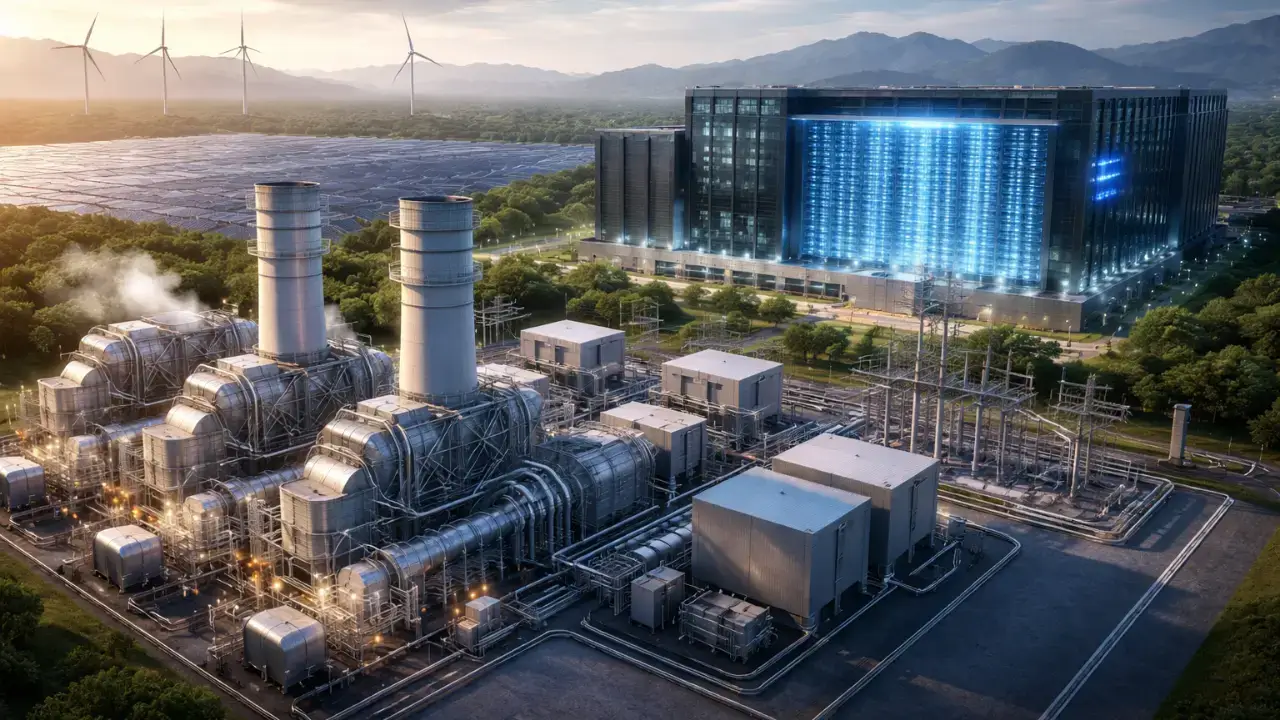
Artificial intelligence has transformed the data center from a digital facility into a high-demand energy node that requires sustained electrical precision at industrial scale. GPU-dense clusters now operate around the clock, pushing power consumption profiles to levels that challenge conventional grid assumptions. Infrastructure teams consequently reassess their approach to baseload supply as model training cycles stretch over weeks without interruption tolerance. Meanwhile, renewable integration and transmission congestion introduce variability that complicates long-term reliability planning. As energy systems evolve under electrification pressure, dispatchable generation regains strategic relevance in digital infrastructure development. Against this backdrop, gas turbines for AI data centers move back into focus as foundational assets designed to secure stable, continuous power delivery.

The Return of Baseload Thinking in a High-Performance World
For years, energy strategy in digital infrastructure prioritized efficiency, flexibility, and renewable procurement, yet the rapid rise of AI compute has revived a classical concept: baseload power. High-density GPU clusters consume steady and predictable loads that cannot tolerate extended frequency deviations or voltage instability. As a result, operators increasingly value dispatchable generation that delivers constant output independent of weather conditions. Renewable energy continues to expand rapidly worldwide; however, solar and wind output fluctuate according to environmental variables that infrastructure teams cannot control. Therefore, strategic planners now integrate firm generation sources to stabilize overall energy portfolios. Gas turbines for AI data centers fit this requirement because they can operate continuously while responding dynamically to demand shifts.
AI Compute Density Reshapes Reliability Priorities
AI-optimized data centers differ structurally from conventional enterprise facilities because they concentrate extreme processing capacity into compact footprints powered by advanced accelerators. The deployment of GPUs such as those produced by NVIDIA and AMD has significantly increased rack power densities, thereby intensifying the demand for stable upstream power infrastructure. Training workloads can run continuously for extended durations, which means even brief interruptions may disrupt computational cycles and incur significant operational costs. Moreover, hyperscale providers often co-locate multiple AI clusters within single campuses, amplifying aggregate load requirements. Grid operators must therefore accommodate concentrated industrial-scale consumption patterns that resemble manufacturing plants rather than traditional IT facilities. Consequently, baseload thinking returns not as nostalgia but as a practical response to the physics of high-performance compute.
Advanced AI workloads operate on tightly synchronized architectures that rely on stable frequency and voltage conditions to maintain computational integrity. Even minor power quality disturbances can trigger protective shutdowns, hardware resets, or data inconsistencies across distributed nodes. While uninterruptible power supplies and battery systems mitigate short-term disturbances, they cannot substitute for prolonged supply instability at the grid level. Furthermore, AI training models often depend on parallel processing across thousands of accelerators, which amplifies the impact of localized outages. Energy architects therefore prioritize systems that maintain predictable output under varying external conditions. Gas turbines for AI data centers offer consistent mechanical inertia and voltage support capabilities that contribute to grid stability in ways intermittent sources cannot replicate alone.

Stability-First Architecture in Modern Energy Planning
In contemporary infrastructure planning, flexibility alone no longer satisfies operational requirements because stability defines competitive advantage in AI deployment. Grid frequency must remain within narrow operational bands to prevent cascading disruptions across interconnected systems. As renewable penetration increases, system inertia declines because inverter-based resources do not inherently provide rotational mass. Gas turbines, by contrast, generate synchronous power that contributes directly to frequency control and grid balancing. Consequently, many regional planners evaluate firm generation assets to preserve reliability margins amid accelerating electrification. This shift reflects not resistance to renewables but recognition that AI compute clusters require uncompromising power quality standards.
Gas Turbines as Strategic Infrastructure, Not Transitional Assets
For much of the past decade, analysts described natural gas generation as a transitional bridge between coal-dominated systems and renewable-heavy grids. However, AI-driven energy intensity reframes turbines as long-term infrastructure components embedded within hybrid architectures. Modern aeroderivative and heavy-duty turbines offer rapid ramping capabilities, modular scalability, and improved thermal efficiency compared to earlier generations. Manufacturers such as GE Vernova and Siemens Energy now design systems that integrate seamlessly with renewable assets and storage technologies. Therefore, turbines increasingly function as reliability anchors within diversified energy stacks rather than placeholders awaiting obsolescence. Gas turbines for AI data centers thus become strategic enablers of digital expansion instead of residual legacy technologies.
As electrification accelerates across transportation, manufacturing, and residential sectors, competition for grid capacity intensifies in many regions. Transmission expansion often lags behind demand growth due to permitting complexity and investment constraints. Data center developers therefore seek on-site or near-site generation to mitigate exposure to transmission bottlenecks. Gas turbine installations provide localized generation that reduces dependency on distant grid resources while enhancing resilience against regional disturbances. Moreover, co-located generation supports predictable expansion planning aligned with phased campus development. In this environment, turbine technology strengthens energy sovereignty for operators building AI-dense infrastructure at scale.
Stability Over Variability: Why Grid Conditions Matter More Than Ever
Electric grids across advanced economies now operate under structural transformation as renewable generation captures a growing share of installed capacity, thereby altering traditional load-balancing dynamics. While wind and solar power contribute significantly to decarbonization targets, their intermittency introduces variability that system operators must continuously manage. Grid-scale batteries address short-duration fluctuations, yet they cannot always sustain prolonged deficits during extended low-generation periods. Therefore, dispatchable generation assets regain prominence in regions experiencing tight reserve margins and rapid electrification. AI clusters, which operate with minimal tolerance for sustained voltage or frequency drift, amplify the consequences of grid instability. Gas turbines for AI data centers contribute synchronous generation and controllable output that stabilize network conditions during variability events.
As inverter-based resources replace conventional rotating generators, overall grid inertia declines, which reduces the system’s natural resistance to frequency deviations. Lower inertia conditions can accelerate frequency drops during disturbances, increasing the likelihood of cascading outages. Operators therefore seek complementary technologies that restore rotational mass and frequency response capability. Gas turbines inherently provide mechanical inertia through synchronous operation, strengthening grid resilience in real time. Consequently, planners evaluating AI-intensive industrial corridors increasingly account for inertia contributions alongside pure energy metrics. This approach ensures that energy ecosystems maintain physical stability while supporting digital expansion.
Co-Location: Power Generation Moves Closer to Compute
As hyperscale developers expand AI campuses, many pursue co-location strategies that integrate on-site or adjacent generation infrastructure with compute facilities. Transmission congestion and interconnection delays have slowed grid access in several high-demand markets, prompting developers to explore direct generation solutions. Gas turbine installations positioned near data centers reduce dependency on distant transmission lines and mitigate exposure to regional outages. Furthermore, co-location enables operators to align energy supply expansion with phased data hall construction schedules. This spatial integration also supports microgrid architectures capable of islanding during grid disturbances. Gas turbines for AI data centers therefore anchor localized energy ecosystems designed around performance certainty.
Modern AI campuses increasingly incorporate microgrid frameworks that combine dispatchable generation, storage, and renewable assets under unified control systems. Microgrids enable facilities to disconnect from the broader grid during instability while maintaining operational continuity. Gas turbines function as central generation nodes within these architectures due to their rapid start capabilities and predictable output profiles. Control systems orchestrate turbine output alongside battery discharge and renewable inflows to maintain voltage stability across internal distribution networks. Consequently, microgrid-enabled campuses achieve higher resilience without sacrificing integration with regional markets. This model reflects a shift toward infrastructure autonomy in high-density compute environments.
Turbine Technology in the Age of Modular Infrastructure
Data center construction now follows modular expansion strategies that deploy capacity in phased increments aligned with customer demand. Similarly, turbine manufacturers have introduced modular configurations that scale output through incremental unit additions rather than single monolithic installations. Aeroderivative turbines, originally developed for aviation applications, offer compact footprints and rapid deployment timelines suited to fast-moving digital projects. These systems provide operational flexibility while maintaining high efficiency across varying load levels. Therefore, turbine technology aligns structurally with modular data center design philosophies. Gas turbines for AI data centers integrate into phased infrastructure roadmaps that accommodate growth without overbuilding capacity prematurely.
AI demand forecasting often evolves dynamically due to shifts in model training cycles, enterprise adoption, and cloud expansion. Infrastructure planners therefore value generation assets that can deploy quickly and scale responsively. Modular turbine systems reduce lead times compared to large centralized plants, enabling developers to synchronize power delivery with rack deployment schedules. Additionally, incremental capacity expansion limits stranded capital risk while preserving operational continuity. This alignment between energy infrastructure and compute scaling strategies strengthens financial discipline across AI investments. As a result, turbine modularity reinforces broader trends toward agile infrastructure management.
https://www.gevernova.com/gas-power/products/gas-turbines/aeroderivative
Beyond Backup: From Emergency Power to Primary Energy Source
Traditionally, data centers relied on diesel generators for emergency backup, reserving them for rare outage scenarios. However, AI-driven facilities increasingly evaluate turbines not merely as contingency resources but as active primary generation assets. Continuous-operation gas turbines deliver stable baseload output that supports day-to-day compute demand rather than remaining idle. This shift reflects the growing energy intensity of AI workloads, which transform data centers into critical industrial nodes. Operators seek generation technologies capable of sustained runtime without excessive emissions relative to legacy backup systems. Gas turbines for AI data centers thus transition from emergency insurance mechanisms to integral energy providers within operational ecosystems.
Modern gas turbines incorporate advanced combustion technologies that reduce nitrogen oxide emissions compared to older designs. Combined-cycle configurations further enhance efficiency by capturing waste heat to generate additional electricity. Operators therefore achieve higher output per unit of fuel consumed relative to simple-cycle systems. Although renewable integration remains central to decarbonization strategies, turbines provide firm support that stabilizes renewable variability. Consequently, energy planners increasingly evaluate lifecycle emissions intensity across hybrid portfolios rather than isolating single technologies. This systems-based perspective supports balanced infrastructure decisions in AI-centric markets.
Hybrid Architectures: Integrating Turbines with Renewables and Storage
Energy strategy for AI infrastructure no longer frames dispatchable generation and renewables as mutually exclusive pathways. Instead, hybrid architectures combine wind, solar, storage, and gas turbines within coordinated control frameworks. Turbines supply stable output during renewable shortfalls while batteries address transient fluctuations and peak smoothing. Advanced energy management systems orchestrate resource dispatch based on real-time demand, weather forecasts, and market signals. This integration preserves reliability without abandoning decarbonization objectives. Gas turbines for AI data centers therefore operate as balancing instruments within diversified energy ecosystems rather than standalone fossil assets.
Modern hybrid energy systems rely on sophisticated control algorithms that optimize dispatch decisions across multiple resource types. Supervisory control platforms analyze load curves, grid signals, and asset availability to maintain stable voltage and frequency conditions. Turbines respond to these signals with rapid ramping capability that complements inverter-based renewable systems. Consequently, digital orchestration transforms turbines into flexible reliability partners within integrated energy stacks. This technological convergence mirrors the computational sophistication inside AI clusters themselves. Together, these systems reflect an era where digital intelligence governs both compute and power infrastructure.
Thermal Efficiency and Waste Heat Synergies
Energy efficiency has become a defining variable in AI infrastructure economics because sustained high-density compute converts significant electrical input into thermal output. Gas turbines, particularly in combined-cycle configurations, achieve higher overall efficiency by capturing exhaust heat to generate additional electricity. This waste heat recovery process reduces fuel consumption per unit of delivered power, strengthening economic performance for continuous baseload applications. AI campuses increasingly explore opportunities to integrate turbine exhaust heat into district heating, absorption cooling, or industrial symbiosis arrangements. Such thermal integration strategies transform generation byproducts into secondary value streams rather than dissipating them unused. Gas turbines for AI data centers therefore contribute not only stable electricity but also strategic thermal resources within broader infrastructure ecosystems.
Combined heat and power systems, also known as cogeneration, deliver electricity and useful thermal energy from a single fuel source. This approach enhances overall energy utilization compared to separate heat and power generation pathways. In high-density data center environments, operators can repurpose turbine exhaust heat for liquid cooling loops or nearby industrial processes. Several regions encourage cogeneration because it improves system efficiency and reduces transmission losses associated with distant generation. Consequently, AI developers evaluating on-site turbines increasingly incorporate CHP feasibility into campus master planning. This integration aligns operational efficiency with evolving sustainability frameworks across global energy markets.
Policy Signals and Energy Sovereignty Considerations
Energy infrastructure decisions increasingly reflect geopolitical realities and industrial policy priorities rather than purely market-driven economics. Governments across North America, Europe, and Asia have introduced frameworks that emphasize domestic energy security and grid resilience. AI infrastructure, often viewed as strategic national capacity, now intersects directly with these policy discussions. Developers therefore assess generation technologies that reduce exposure to volatile cross-border supply chains and constrained transmission corridors. Gas turbines for AI data centers provide controllable generation capacity that strengthens regional energy sovereignty when deployed responsibly. This alignment between digital expansion and energy policy reshapes investment strategies across hyperscale markets.
Industrial policy initiatives frequently support infrastructure that enhances technological leadership and economic competitiveness. As AI capabilities become central to national strategies, governments scrutinize whether grid infrastructure can support sustained computational growth. Transmission expansion projects often face lengthy permitting timelines, which create uncertainty for large-scale data center investments. Therefore, policymakers increasingly recognize the value of localized dispatchable generation within industrial corridors. Gas turbines, when integrated into diversified portfolios, contribute firm capacity that complements renewable deployment objectives. This balanced approach enables AI ecosystem growth without compromising systemic reliability.
Fuel Evolution: From Conventional Gas to Hydrogen-Ready Systems
The future viability of gas turbines increasingly depends on their compatibility with lower-carbon fuels and evolving decarbonization mandates. Manufacturers have responded by developing hydrogen-capable combustion systems that blend natural gas with increasing proportions of hydrogen. Several modern turbine platforms can already operate with hydrogen blends, and research continues toward higher-percentage hydrogen operation. This technological evolution positions turbines within longer-term energy transition narratives rather than isolating them from climate policy trajectories. Gas turbines for AI data centers thus adapt to emerging fuel pathways while maintaining their core reliability function. By aligning performance stability with fuel flexibility, turbine technology extends its strategic relevance in decarbonizing grids.
Hydrogen-ready turbines incorporate advanced materials and combustion chamber designs that manage higher flame speeds and distinct thermal characteristics. Engineers continue refining systems to reduce nitrogen oxide emissions under hydrogen-enriched conditions. Infrastructure developers monitor these advancements closely because fuel adaptability influences long-term capital planning decisions. Meanwhile, pilot projects across Europe and North America demonstrate hydrogen blending feasibility in existing gas infrastructure. Consequently, AI campus planners evaluating on-site turbines consider fuel transition scenarios within multi-decade operational horizons. This forward-looking posture reinforces turbines as adaptable infrastructure rather than static assets.
The Future of Baseload in an AI-Dominated Grid
The resurgence of baseload thinking does not signal a retreat from renewable ambition but rather a recalibration of reliability strategy under AI-driven demand growth. Grid operators confront simultaneous pressures from electrification, decarbonization, and computational expansion, which collectively elevate the importance of system stability. AI clusters require uninterrupted power quality to sustain synchronized processing across thousands of accelerators. Consequently, energy architecture evolves toward hybrid configurations that combine renewables, storage, and dispatchable turbines under unified digital control. Gas turbines for AI data centers contribute synchronous generation, rapid ramping, and modular scalability within this integrated framework. This convergence defines a new equilibrium where stability and sustainability advance together rather than compete.
Future grids will likely operate as layered ecosystems where distributed generation, centralized plants, storage systems, and advanced controls function in coordinated balance. AI infrastructure will continue expanding across regions that can guarantee both energy availability and regulatory predictability. Turbine deployments will therefore coexist alongside renewable growth, not as opposition but as stabilizing complements. Digital orchestration platforms will optimize dispatch decisions across diverse asset classes, preserving reliability under fluctuating conditions. In this environment, baseload power regains relevance as a strategic design principle rather than a rigid legacy model. The AI era thus reframes turbine technology as an adaptive pillar within resilient, performance-driven energy systems.










