 Skip to content
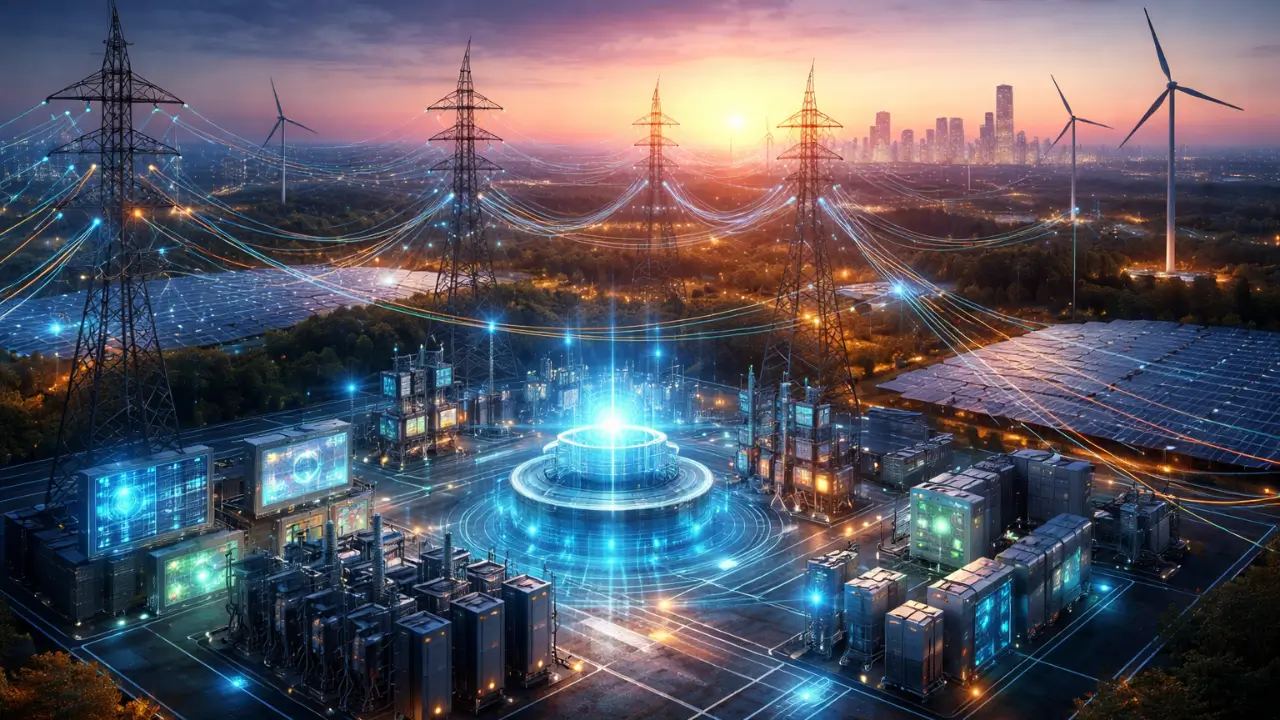
The era of passive power infrastructure is giving way to AI driven autonomous electrical grid decision making, a shift that is redefining how modern energy systems behave under pressure and opportunity alike. Electrical networks once reacted to faults only after thresholds were breached and operators intervened. Today, artificial intelligence enables grids to anticipate disruptions, interpret contextual signals, and coordinate generation, transmission, and demand with machine-speed precision. This evolution does not rely merely on faster computation, but on systems that continuously learn from operational data and refine their own strategies. As autonomy expands across substations, generators, and distributed assets, the grid transforms from mechanical infrastructure into an adaptive decision-making ecosystem.

From Reactive to Cognitive: The Grid’s Behavioral Shift
The earliest electrical grids depended heavily on human operators and rigid control logic. Operators monitored system measurements, addressed alarms, and enacted contingency plans when abnormal events occurred. The introduction of Supervisory Control and Data Acquisition (SCADA) systems in the latter 20th century improved visibility, but control decisions still rested on manual interpretation of data streams and pre‑defined rules. Today, AI augments these legacy layers with cognitive decision frameworks that perceive context, prioritize objectives, and anticipate disturbances before they manifest.
Cognitive grids combine machine learning, predictive analytics, and real‑time data ingestion into systems that “understand” broader conditions rather than merely reacting to sensor thresholds. AI‑infused energy management systems (EMS) operate as intelligent agents, continuously analyzing diverse datasets that include consumption patterns, weather forecasts, and operational telemetry. Instead of waiting for a frequency deviation to trigger a protective relay, AI models predict imbalance trends and orchestrate corrective measures proactively. In doing so, grid behavior transitions from passive response into continuous optimization with goals such as stability, flexibility, and resilience explicitly encoded in adaptive logic.
At its core, cognitive grid behavior reveals itself in three capabilities: contextual awareness, anticipatory action, and continual learning. Contextual awareness allows systems to interpret the significance of data beyond thresholds, relating fluctuating load to impending renewable generation shifts. Anticipatory action enables actions like pre‑emptive reserve dispatch or network reconfiguration before disturbances occur. Continuous learning, supported by reinforcement algorithms and feedback mechanisms, refines decision policies over time as the system experiences varied operational regimes.

Decision‑Making at the Edge: Intelligence Beyond Control Rooms
While centralized grid control rooms remain essential for strategic oversight and coordination, the advent of edge AI brings much of the decision process to the points where electricity flows substations, feeders, and distributed energy resources (DERs). Edge AI implies embedding localized intelligence directly into grid nodes so that decisions occur within milliseconds and adapt to local conditions without waiting for round‑trip signals to central servers.
Edge decision making radically changes operational dynamics. Instead of a centralized dispatch center issuing instructions that propagate outward, autonomous agents situated at the edge interpret local data (e.g., voltage, current, thermal conditions) and implement control actions when necessary. These actions include isolating a faulted segment, adjusting transformer taps, or rebalancing feeder loads in real time. Technologies like federated learning and decentralized architectures allow these agents to share insights and align policies without compromising privacy or latency.
Substations equipped with specialized processors now run inferencing tasks that historically required cloud compute resources, yielding decisions in microseconds. This localized decision autonomy not only reduces reaction times but also augments system resilience; when communications with a central controller degrade, edge agents still maintain grid stability through learned protocols.
Furthermore, edge AI supports “collaborative autonomy.” Multiple agents communicate and coordinate in real time, forming a mesh of decision nodes that collectively optimize operations. This structure mirrors human teams in which domain experts situated across departments coordinate to solve complex problems except in autonomous grids; these agents interact in algorithmic protocols guided by optimization objectives and safety constraints.
The Rise of Autonomous Generators
Traditional power generation scheduling was often driven by fixed dispatch plans that relied on historical load profiles and reserve margins. Automatic Generation Control (AGC) improved this by adjusting generator outputs to maintain frequency, but these adjustments were still reactive and largely centralized. Autonomous generators break from this paradigm by dynamically adjusting output via machine reasoning based on real‑time system conditions and predictive forecasts.
AI‑controlled generation assets interpret myriad signals from wind forecasting models to grid frequency fluctuations and adapt output without operator input. For inverter‑based resources (IBRs) such as solar and battery storage, control algorithms define virtually all operational behavior because these units lack mechanical inertia and rely on software logic to contribute to system stability.
Reinforcement learning frameworks have emerged as potent tools for generator autonomy because they allow control policies to evolve through iterative interaction with grid environments. These AI agents observe grid states, evaluate outcomes of previous actions, and refine their strategies to better support stability and efficiency. As a result, generation dispatch no longer depends solely on pre‑established schedules but becomes a continuously optimized function of real‑time grid conditions and learned anticipation.
Alongside conventional generation plants, distributed energy resources behave autonomously within a coordinated ecosystem. Microgrids powered by local renewables and storage routinely sense local demand and generation mismatches, shifting between grid‑connected and islanded modes based on learned decision thresholds. These autonomous generation behaviors enhance reliability and reduce transmission stress during peak loads or faults.
Transmission as a Living Network
Transmission networks have historically operated as fixed pathways for high‑voltage power delivery. Engineers designed lines, transformers, and protection schemes to transport energy with minimal human intervention, except when faults or overloads occurred. AI reimagines these transmission lines and substations as adaptive elements within a living network that reroutes flows, rebalances loads, and self‑corrects based on learned grid conditions.
AI‑enabled transmission optimization leverages dynamic state estimation, predictive analytics, and multi‑agent coordination to recognize subtle patterns that precede congestion or instability. For example, machine learning models can anticipate thermal stress on lines caused by high loads and temperature conditions and recommend pre‑emptive redispatch or alternate routing paths to prevent overheating.
More advanced decision frameworks extend beyond recommendations into autonomous execution. Transmission agents detect when certain corridors approach critical limits and autonomously reconfigure network topology through switches, circuit breakers, and flexible AC transmission system (FACTS) devices to balance flows across the network. These actions, learned through reinforcement strategies and historical simulations, ensure that power flows adapt to real‑time demands with minimal human intervention.
This living network concept also integrates with wide‑area damping control systems that manage oscillations and stabilize inter‑area dynamics by coordinating active and reactive power devices across large geographic spans. AI enhances these controls by continuously learning from grid behavior under varied disturbance scenarios and adjusting parameters to optimize performance.
Learning from Disturbance: Turning Instability into Insight
While traditional grid operations treat disturbances as events to be managed, modern AI‑driven systems interpret those same disturbances as valuable data that can refine future behavior. Instead of simply resetting a protection relay after an overcurrent event, AI systems analyze waveform signatures, network context, and environmental conditions to identify deeper causal relationships that inform future decision strategies. Machine learning models feed continuously on disturbance logs, adaptive thresholds, and post‑event diagnostics to construct more accurate predictive maps of vulnerability and optimal corrective action.
What once was a static fault log becomes a living dataset that informs control actions, reduces false positives, and tunes system responses to minimize unnecessary trips. This transformation means that disturbance does not only end operations for a period it becomes part of an ongoing experiential learning process that strengthens system behavior at scale and over time. By turning instability into insight, electrical networks begin to evolve more rapidly and resiliently than through traditional human‑centric incident analysis alone.
Predictive Coordination Between Generation and Demand
Traditional generation dispatch logic has relied on historical load forecasts, reserve margins, and pre‑scheduled ramping plans that assume relatively slow changes in demand and supply. In contrast, predictive coordination uses AI to synchronize supply and demand dynamically by analyzing real‑time measurement streams, weather forecasts, consumer behavior patterns, and macroeconomic signals. Neural networks and time‑series forecasting models continuously update predictions of load curves and renewable output variations so that autonomous dispatch agents adjust generation and storage assets in anticipation rather than in reaction.
This means battery assets can be pre‑charged before anticipated peaks, distributed solar inverters can delay export until optimal grid balance, and controllable thermal load devices can shift consumption automatically to flatten demand spikes. Such predictive coordination blurs traditional boundaries between market scheduling and grid operations because the system itself becomes an active participant in aligning generation behavior with consumption patterns. By enhancing contextual forecasting and embedding this intelligence into operational logic, the grid serves as a mediator between supply behavior and demand uncertainties rather than a system that reacts only after imbalance occurs.
Human Oversight in an Autonomous Grid
Even as AI systems take on greater autonomy, human operators remain vital in guiding overall system behavior, setting policy constraints, and ensuring ethical and safe outcomes. In an autonomous grid environment, operators shift from manual control actions toward strategic supervision, interpreting alerts, refining optimization goals, and resolving conflicts that exceed algorithmic boundaries. Operators no longer execute each switch action manually; instead, they oversee clusters of AI‑controlled agents that act according to defined policy frameworks, operating objectives, and risk tolerances.
Human oversight is especially important when systems encounter novel conditions or ambiguous patterns that lie outside the training datasets situations where contextual judgment and ethical deliberation become essential. Training programs for grid operators now emphasize interpretation of AI behavior, scenario planning with learned agents, and oversight of multi‑agent interactions rather than rote command execution. With human expertise recentered around supervision and policy design, the grid becomes a symbiotic arena where AI augments human capabilities and humans ensure AI remains aligned with public safety and regulatory standards.
Grid Self‑Healing: Automation in Moments of Crisis
Self‑healing grid concepts have existed for decades in theory, but grounded implementations only surfaced as distributed intelligence and high‑speed communications matured. Autonomous detection, isolation, and restoration (ADIR) systems interpret sensor data with millisecond accuracy to identify faults and enact corrective measures without explicit human direction. These systems leverage pattern recognition, topology analysis, and predictive fault detection to anticipate fault progression and minimize customer interruptions before significant outages occur.
Rather than waiting for a voltage sag to cascade into a widespread blackout, self‑healing architectures segment the grid into intelligent domains that contain and restore service locally, reducing the duration and scope of outages measurably. As each agent learns from the outcomes of isolation and restoration actions, future crisis responses become faster and more precise, enabling the grid to reconfigure dynamically under adverse conditions. The result is a fundamentally more resilient electrical network that not only withstands disturbances, but actively restructures itself to maintain continuity of service while preserving equipment integrity.
The Ethics of Machine‑Directed Infrastructure
When algorithms start making decisions that affect national‑scale energy delivery, ethical considerations move to the forefront of engineering discourse. Accountability becomes complex when autonomous agents act independently, raising questions such as who bears responsibility for a suboptimal machine decision or an unforeseen failure that impacts public safety. Transparency also becomes essential because stakeholders, regulators, operators, and the public must understand how AI decisions are made, what data they rely on, and what constraints guide their behavior.
Ensuring that automated decisions align with equity and fairness principles matters when algorithms prioritize load shedding, demand response events, or restoration sequences during constrained conditions. Privacy concerns also arise as AI agents analyze granular energy usage data to make predictions systems must protect consumer information while still leveraging demand patterns for optimization. Addressing these ethical dimensions requires binding frameworks, explainable AI methods, and multidisciplinary governance that aligns technological progress with societal values rather than leaving it solely to technical engineers.
Interoperability as Intelligence
AI’s potential is realized most fully when disparate grid hardware, software, and communication protocols can interoperate seamlessly at scale. Historically, grid systems suffered from fragmentation because each vendor’s equipment communicated through proprietary protocols with limited coordination. Modern interoperability frameworks strive for open standards that allow heterogeneous systems from smart inverters to legacy generators to advanced sensors to share context, command directives, and operational status that promote collective optimization. Interoperability itself becomes a form of collective cognition because the more systems can convey intent and state to one another, the more effectively autonomous agents learn and adapt.
Application programming interfaces (APIs), shared data schemas, and cross‑domain communication protocols help create a unified information substrate on which AI models operate cohesively instead of in silos. Artificial intelligence amplifies the value of interoperability by learning across systems and domains, discovering latent patterns and enabling coordinated behavior that transcends individual asset boundaries. In this way, interoperability becomes not just a technical objective but a source of systemic intelligence that enhances grid performance, resilience, and adaptability.
Cyber‑Resilience in an AI‑Driven Energy Network
As electrical grids embrace autonomy and AI, the surface area for cyber threats expands accordingly, not only because of increased connectivity but also because intelligent agents make decisions that could be manipulated if compromised. Cyber‑resilience in AI‑driven energy networks must go beyond perimeter defense toward embedded security awareness within operational logic. Autonomous systems need built‑in anomaly detection that recognizes not just physical electrical disturbances, but also patterns indicative of malicious intrusion, spoofed signals, or manipulated data feeds.
Security algorithms must integrate with machine learning models such that detected threats lead to adaptive reconfiguration of control policies, isolation of compromised segments, and safe fallback modes that preserve critical operations. System designers employ techniques such as secure enclaves, authenticated messaging, real‑time integrity verification, and behavior‑based intrusion detection to defend against sophisticated attacks targeting AI‑controlled infrastructure. These capabilities must co‑evolve with operational intelligence because the next generation of attackers will target not just communication protocols, but the behavioral models that make autonomous decisions.
When Infrastructure Becomes Intentional
Electric grids are no longer mere conduits that channel electrons from point A to point B; they are learning systems capable of interpreting conditions, anticipating challenges, and acting in ways that drive system goals with minimal human instruction. Through AI‑enabled cognition, edge decision making, autonomous generators, adaptive transmission, and self‑healing mechanisms, these networks are redefining the relationship between infrastructure and behavior. Operators are evolving into strategic supervisors, ethical frameworks are guiding intelligent decision boundaries, and interoperability is knitting disparate systems into a collective intelligence.
Cyber‑resilience becomes integral to every operational decision, ensuring that autonomy does not come at the expense of safety or trust. As that evolution continues, the grid of the future will not only deliver energy, but also understand it, balance it, and evolve in response to every fluctuation, disturbance, and opportunity. This transformation marks the dawn of infrastructure that behaves as a step change from reactive machines to intentional systems that shape the very future of energy delivery.












