
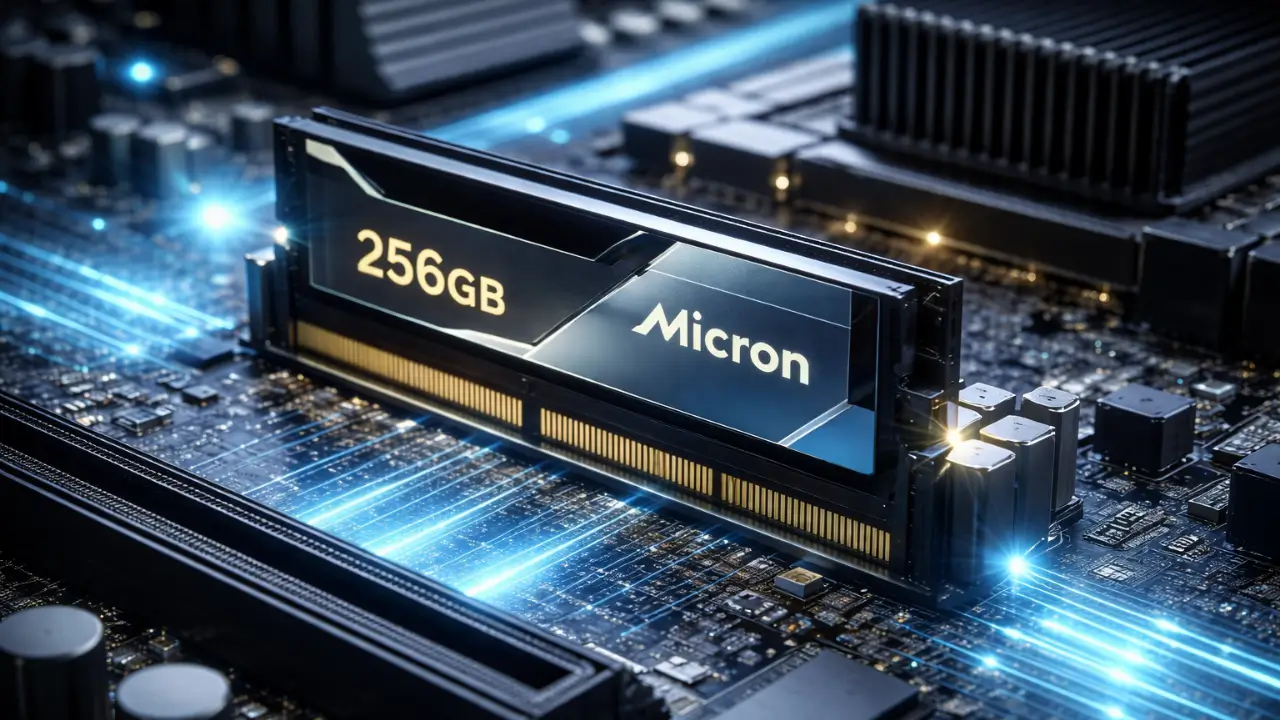
Micron Technology is pushing the boundaries of low-power server memory with the shipment of customer samples for its 256GB SOCAMM2 module, a high-capacity LPDRAM solution designed for next-generation AI and high-performance computing (HPC) servers.
The module relies on the industry’s first monolithic 32Gb LPDDR5X die, marking a significant engineering milestone for data center memory architecture. As AI workloads expand in size and complexity, memory capacity and power efficiency have emerged as critical constraints for hyperscale infrastructure operators. Micron’s new SOCAMM2 platform addresses both factors simultaneously, enabling higher-density memory footprints while reducing energy consumption.
The company positions the product as a key building block for modern AI systems where model training, inference workloads and persistent memory caches place unprecedented pressure on server memory subsystems.
AI workloads redefine server memory architecture
Data center architectures now face structural changes driven by rapidly evolving AI workloads. Large language models, agentic AI frameworks and inference pipelines require far larger context windows and significantly larger parameter footprints than traditional enterprise workloads.
Consequently, memory subsystems must support higher concurrency, faster data movement and efficient power usage. These demands push infrastructure operators toward memory technologies that combine bandwidth efficiency, latency improvements and reduced thermal output.
LPDRAM has increasingly gained attention in this context. Its low-power design and compact packaging allow system architects to rethink memory placement, rack density and overall power distribution within AI infrastructure.
Micron says the new SOCAMM2 module aligns with this shift. The company has also collaborated with NVIDIA to co-design memory architectures optimized for advanced AI computing platforms.
“Micron’s 256GB SOCAMM2 offering enables the most power-efficient CPU-attached memory solution for both AI and HPC. Today’s announcement highlights Micron’s technology and packaging advancements to deliver the highest-capacity, lowest-power modular memory solution with the smallest footprint in the industry,” said Rajendra Narasimhan, Senior Vice President and General Manager of Micron’s Cloud Memory Business Unit. “Our continued leadership in low-power memory solutions for data center applications has uniquely positioned us to be the first to deliver a 32Gb monolithic LPDRAM die, helping drive industry adoption of more power-efficient, high-capacity system architectures.”
Larger capacity and lower power reshape server economics
The new SOCAMM2 module introduces several architectural advantages for AI and general-purpose compute environments. With 256GB per module, the design delivers roughly one-third more capacity than the previously highest-capacity 192GB SOCAMM2 modules. In an 8-channel CPU configuration, this allows servers to support up to 2TB of LPDRAM, enabling larger context windows and more demanding inference workloads.
Power efficiency represents another critical improvement. SOCAMM2 modules consume roughly one-third the power of comparable RDIMM solutions while occupying only one-third of the physical footprint. This combination allows data center operators to increase rack density while lowering overall energy consumption and cooling overhead.
Performance improvements also extend to inference workloads and traditional compute applications. In unified memory architectures, Micron says the 256GB SOCAMM2 module can improve time-to-first-token by more than 2.3 times during long-context, real-time LLM inference when used for KV cache offloading compared with currently available solutions. For standalone CPU-based high-performance computing environments, LPDRAM delivers more than three times better performance per watt compared with mainstream memory modules.
Beyond raw performance, the modular SOCAMM2 architecture supports improved serviceability and system flexibility. The design integrates well with emerging liquid-cooled server platforms and allows infrastructure operators to expand memory capacity as AI workloads scale.
“Advanced AI infrastructure requires incredible optimization at every layer to maximize performance and efficiency for demanding AI reasoning workloads,” said Ian Finder, head of Product, Data Center CPUs at NVIDIA. “Micron’s achievements in delivering massive memory capacity and bandwidth using less power than traditional server memory with 256GB SOCAMM2 is enabling the next generation of AI CPUs.”
Industry collaboration shapes next-generation memory standards
Micron continues to contribute actively to the JEDEC SOCAMM2 specification, working alongside system designers and infrastructure vendors to refine the emerging standard for low-power server memory.
The company also maintains deep technical collaborations with hyperscale customers and semiconductor partners, aiming to improve both power efficiency and compute performance in next-generation AI data centers.
Customer samples of the 256GB SOCAMM2 module are now shipping. The product expands Micron’s broader LPDRAM portfolio, which spans component capacities from 8GB to 64GB and SOCAMM2 module configurations ranging from 48GB to 256GB.
As AI infrastructure scales globally, memory architectures such as SOCAMM2 may play a central role in balancing the industry’s competing priorities of performance growth, energy efficiency and system scalability.











