 Skip to content
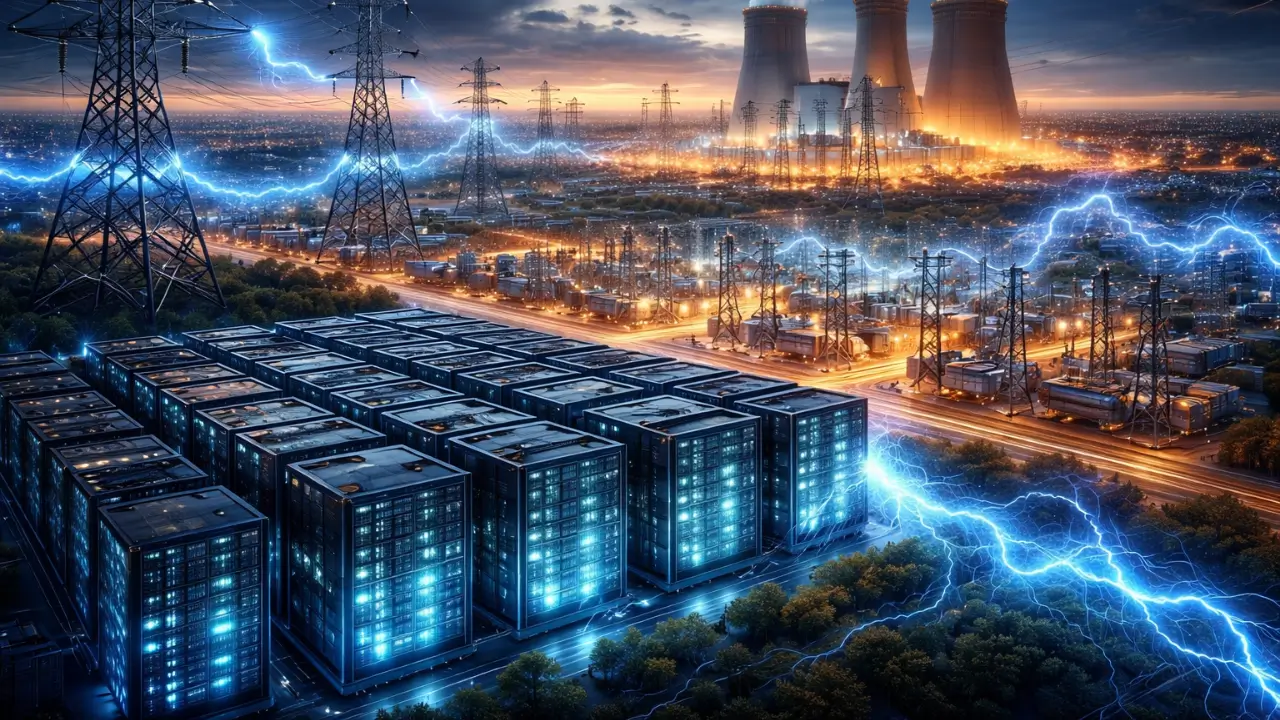
Artificial intelligence has become the defining infrastructure race of the decade, but it is also transforming the technology boom into an electricity story. Data centers supporting AI workloads already consume between 177 and 192 terawatt-hours of electricity annually in the United States, roughly 4% to 5% of national demand, according to recent industry analysis. Within a few years, that figure could climb dramatically, with projections indicating the share could reach 9% to 17% of total electricity demand by 2030.

That trajectory forces utilities, regulators, and communities to confront a difficult question: who pays for the power behind AI?
In early March, several of the world’s most powerful technology companies stepped forward with an answer. But the industry still faces debate over whether their solution can truly keep the lights on, or merely buy time in an increasingly strained system.
The Industry’s Attempt to Reassure Ratepayers
Amazon, Google, Meta, Microsoft, OpenAI, Oracle, and xAI recently agreed to the so-called Ratepayer Protection Pledge, committing to finance the electricity generation and grid upgrades required to power their growing data center footprints.
On the surface, the commitment appears straightforward. The companies pledge to fund the generation capacity and grid upgrades required to serve their facilities and ensure those costs do not appear on the electricity bills of households or businesses. They also commit to securing sufficient generation capacity and supporting grid operators with backup resources during emergencies.
For communities that already question hyperscale data center expansion, the message is simple: AI companies will pay their own way. Yet voluntary promises do not always align with infrastructure realities.

Governments heavily regulate electricity markets for good reason. Utilities and developers must navigate long planning cycles, regulatory approvals, and billions of dollars in capital investment to build power plants, substations, and transmission lines.
Against that backdrop, a non-binding pledge raises immediate questions. The agreement provides no explicit enforcement mechanism, no independent auditing framework, and no defined methodology to measure whether companies have fully covered the costs their facilities impose on the grid. In other words, the initiative signals intent rather than obligation.
That approach may serve a political purpose, particularly as governments attempt to accelerate AI development without triggering public backlash over electricity prices. However, it also leaves a significant gap between corporate assurances and operational guarantees.
Hyperscalers Are Already Acting Like Utilities
Still, dismissing the pledge as purely symbolic would overlook a deeper shift underway in the technology industry.
Major cloud and AI developers increasingly behave less like conventional corporate energy consumers and more like infrastructure operators. Microsoft has already contracted nearly 7.9 gigawatts of new electricity supply in the MISO region, more than double its current consumption there. Google has lined up more than 7,800 megawatts of new generation capacity in Texas alone. Meta continues to pursue large nuclear procurement agreements that it expects will reach 6.6 gigawatts by 2035.
These commitments are far from marginal purchases. Historically, large industrial utilities or national infrastructure projects made investments of this scale. Now companies building AI platforms drive those commitments instead of traditional electricity providers.
Grid Stress Is Becoming Geographic
The real pressure point for the grid may not lie in national electricity supply but in where demand concentrates.
In Virginia, already the world’s largest data center hub, data centers consume more than one-fifth of statewide electricity. Forecasts indicate that share could climb to between 39% and 57% by the end of the decade if current growth trajectories continue.
Other states could soon face similar dynamics. Indiana, Ohio, Pennsylvania, and Georgia rank among the regions projected to see data centers exceed 20% of local electricity demand under moderate growth scenarios.
These concentrations matter because utilities design transmission networks, substations, and generation capacity around geographic balance. When a single industry cluster begins consuming a disproportionate share of power, grid operators must adapt quickly or risk instability.
The Power Mix Behind AI Is Also Changing
Another underappreciated aspect of the AI power surge is the type of generation likely to meet new demand. Energy modeling suggests that natural gas capacity additions could average between 6.6 and 13.7 gigawatts annually between 2025 and 2030, significantly above historical levels. At the same time, renewable energy deployment could slow relative to earlier expectations due to changes in federal tax incentives.
For technology companies that have spent a decade promoting clean energy leadership, this reality introduces a tension between climate commitments and compute growth.
Advanced nuclear reactors, geothermal power, and long-duration energy storage are frequently cited as future solutions. But most of those technologies remain years away from large-scale deployment. For now, the AI economy may be built largely on natural gas.
Faced with slow interconnection queues and grid congestion, some companies are moving even further, developing their own power systems. Oracle, for example, has assembled a substantial portfolio of behind-the-meter generation, including fuel cells and modular gas plants. xAI has announced plans to develop 1.2 gigawatts of power capacity for its Colossus supercomputer facility while expanding massive battery storage systems.
These strategies reflect a growing belief within the tech sector that the traditional grid cannot expand fast enough to keep pace with AI infrastructure. If that assumption proves correct, the industry could gradually move toward hybrid power ecosystems data centers supplied partly by public utilities and partly by privately financed generation.
The Bigger Question Is Trust
Ultimately, the pledge is less about electricity procurement and more about public trust. Communities hosting large data centers are increasingly worried about rising electricity prices, water consumption, and land use. Regulators face the delicate task of enabling economic growth without shifting infrastructure costs onto residents. By publicly committing to cover their own power requirements, AI companies are attempting to address those concerns before they evolve into political resistance.
But trust is built not on announcements but on outcomes. If electricity prices rise, grid reliability falters, or promised generation capacity fails to materialize, voluntary pledges will quickly lose credibility.
AI’s Energy Future Will Test Infrastructure Governance
The Ratepayer Protection Pledge represents an important acknowledgment: AI expansion cannot proceed without parallel investment in energy infrastructure. Yet the pledge alone will not resolve the deeper structural challenge. Electricity planning cycles were designed around predictable industrial growth, not the sudden emergence of gigawatt-scale digital campuses.
Bridging that gap will require new regulatory frameworks, faster interconnection processes, and perhaps a rethinking of how large electricity consumers interact with the grid. Until then, the promise that hyperscalers will pay their own way remains encouraging, but incomplete.Because in the AI era, electricity is no longer just a utility input.
It is becoming the most important bottleneck in the digital economy.












