 Skip to content
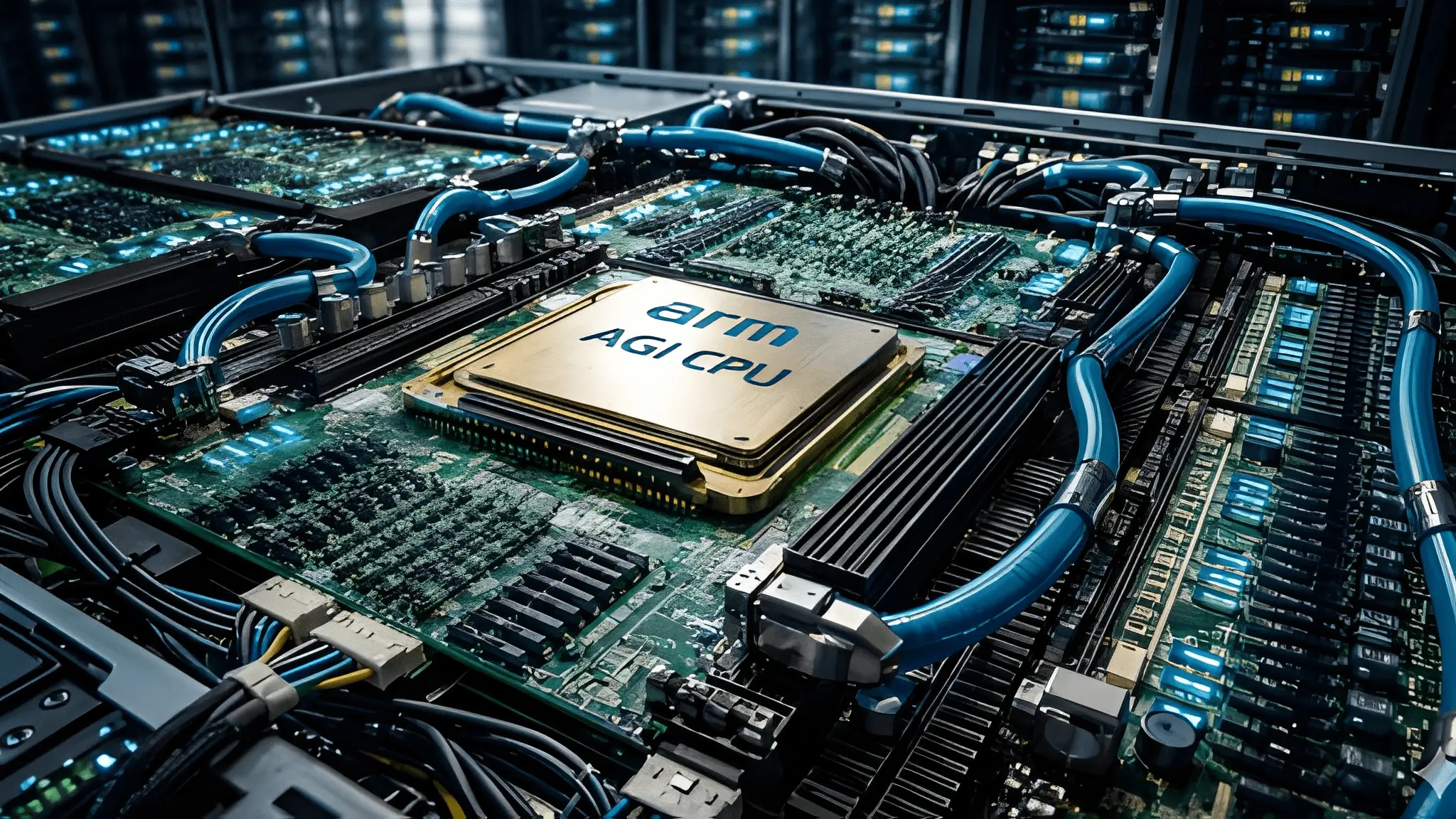
Arm has introduced its first in-house silicon for AI data centers, the Arm AGI CPU marking a structural shift in how compute is provisioned for agentic workloads. The processor targets environments where AI agents run continuously, reason, plan, and act in real time, pushing CPU demand beyond traditional orchestration roles.

As data centers evolve toward persistent inference and autonomous execution layers, CPU density is emerging as a primary constraint. Arm states that data centers will therefore need more than four times the current CPU capacity per gigawatt. This inflection point reframes CPUs as active participants in AI pipelines rather than passive schedulers.
Architecture Built for High-Density AI Execution
The Arm AGI CPU introduces up to 136 Neoverse V3 cores per processor, designed to sustain high-throughput, low-latency AI operations. Each core delivers 6 GB/s of memory bandwidth with latency below 100 nanoseconds, aligning with the requirements of real-time agentic systems.
The chip operates at a 300-watt TDP and runs on DDR5-8800 across twelve memory channels, alongside PCIe Gen6 connectivity. This configuration prioritizes both bandwidth and scalability, enabling dense compute clusters within constrained power envelopes.

The architecture’s rack-level scaling clearly demonstrates its intent. A single rack supports up to 8,160 cores with air cooling; however, liquid cooling pushes that figure beyond 45,000 cores. Arm claims more than twice the performance per rack compared to x86 CPUs, translating into potential capital expenditure savings of up to $10 billion per gigawatt of AI data center capacity.
Meta Anchors Deployment as Lead Partner
Meta is acting as the lead partner and co-developer and will deploy the Arm AGI CPU alongside its own MTIA silicon. Santosh Janardhan, head of infrastructure at Meta added, “We worked alongside Arm to develop the Arm AGI CPU to deploy an efficient compute platform that significantly improves our data center performance density,”
This collaboration signals a deeper convergence between hyperscale operators and silicon providers, where co-design becomes central to achieving performance-per-watt targets at scale.
In addition, OpenAI, Cloudflare, Cerebras, SAP, and SK Telecom have made commercial commitments. OEM partners such as Lenovo, Supermicro, and Quanta Computer are working on systems. Early systems are already available, and vendors will expand availability in the second half of 2026.
The breadth of ecosystem alignment suggests that Arm’s entry is not incremental, it is coordinated. As a result, the AGI CPU positions itself within a rapidly forming supply chain optimized for AI-native infrastructure.
Strategic Outlook: CPU Becomes the AI Control Plane
The Arm AGI CPU signals a broader transition in data center architecture, where CPUs reclaim strategic importance in AI execution layers. While GPUs remain dominant for model training and parallel computation, data centers increasingly rely on CPUs for orchestration, memory handling, and agent lifecycle management.
Consequently, the rise of agentic AI could redefine compute hierarchies, with CPUs scaling in tandem with accelerators rather than trailing them. Arm’s approach suggests that future competitiveness in AI infrastructure will depend not only on raw compute, but on how efficiently different silicon layers integrate within a unified system.












