 Skip to content
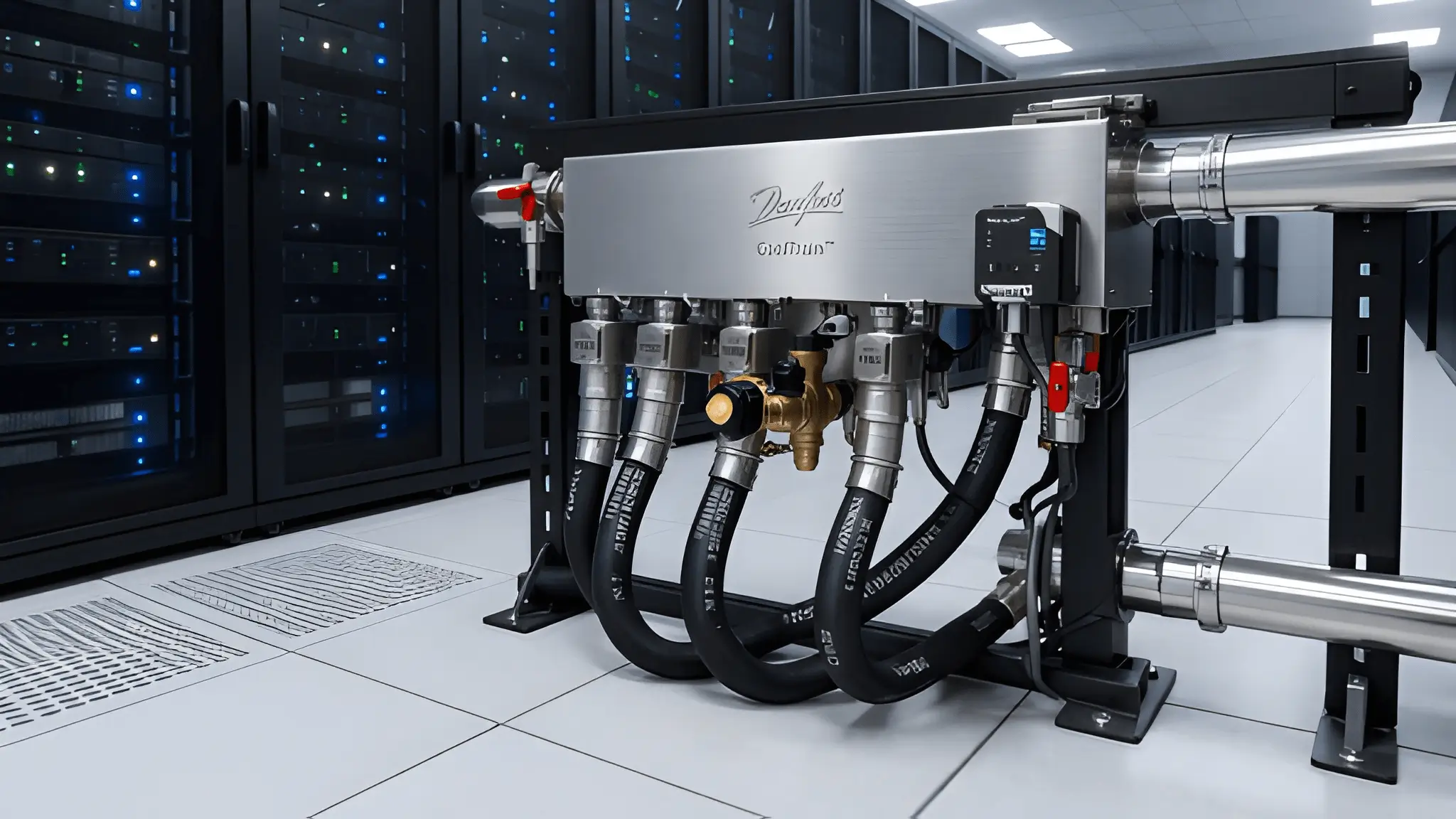
As AI infrastructure scales beyond conventional thermal limits, Danfoss has introduced a modular subsystem designed to remove one of liquid cooling’s most persistent bottlenecks: on-site assembly risk. The newly launched CoolTrain™ positions factory-integrated cooling as a deployment standard rather than an upgrade path.

The announcement reflects a broader shift across high-density environments, where liquid cooling has moved from optional to mandatory. However, while compute density has accelerated, deployment methodologies have lagged behind. CoolTrain™ directly addresses this mismatch by transforming cooling integration into a pre-engineered, plug-and-play process.
Factory-Engineered Cooling Replaces On-Site Complexity
The Danfoss CoolTrain™ is a modular, pre-tested valve train subsystem built to bridge facility-level TCS cooling loops and rack-level liquid cooling infrastructure. By relocating assembly from the data center floor to a controlled manufacturing environment, the system arrives pressure-tested, internally cleaned to ISO standards, pre-filled with coolant, and hermetically sealed.
This “sealed-for-site” model compresses installation timelines from hours per rack to minutes. It also eliminates key failure points associated with manual assembly, including leaks, contamination, and inconsistent hydronic balancing.
Traditional deployment models have long depended on field assembly, where variability introduces inefficiencies. Systems often lack dynamic balancing, forcing pumps to compensate for uneven flow distribution. That inefficiency translates directly into higher energy consumption and operational instability.
Eliminating Hydronic Imbalance at Scale
At the core of CoolTrain™ is a shift toward automated hydronic optimization. The integrated AB-QM Pressure Independent Control Valve (PICV) continuously adjusts coolant flow in real time, aligning it with rack-level demand.

This approach stabilizes flow conditions across high-density clusters while improving both Power Usage Effectiveness (PUE) and Water Usage Effectiveness (WUE). Instead of reactive tuning, operators gain a system that maintains equilibrium autonomously.
However, the impact extends beyond efficiency metrics. By removing manual balancing requirements, CoolTrain™ reduces commissioning complexity and minimizes human error during deployment.
Integrated Reliability and Leak Mitigation Architecture
Danfoss has consolidated multiple reliability-focused components into a single subsystem. The CoolTrain™ incorporates FD83 interlockable couplings and EHW194 Boston® hoses, both engineered to reduce leak probability under high-pressure conditions. Valve materials exposed to coolant are corrosion-resistant and validated through compatibility testing for long-term durability.
This integrated design shifts reliability from procedural to structural. Instead of relying on installation precision, the system embeds consistency within the product itself.
When paired with the optional NovoCon® S digital actuator, CoolTrain™ transitions from a passive subsystem into an active data source within DCIM environments. It streams real-time telemetry on flow rates and temperatures, enabling operators to align cooling performance with live IT loads.
This capability supports predictive maintenance strategies while improving uptime predictability. As a result, cooling infrastructure begins to function as an operational intelligence layer rather than a static utility.
Industry Pressure Driving Deployment Innovation
“We saw the immense pressure our customers are under. They need to deploy liquid cooling fast and at scale, but the traditional methods are holding them back with risks and inefficiency. The CoolTrain™ is our direct answer to this. It’s about replacing on-site variables with factory-guaranteed certainty. We want to empower engineers to go with the smart flow, confident that their system is efficient and leak-proof from the moment it’s connected.” said Moath Shanaah, Data Center Business Development Manager at Danfoss, Türkiye, Middle East and Africa
The launch of CoolTrain™ signals a deeper structural change in data center design priorities. Cooling is no longer a downstream consideration; it now defines deployment speed, risk exposure, and operational efficiency at scale.
Moreover, as AI workloads continue to push rack densities upward, infrastructure strategies must evolve toward pre-integration and modularity. Solutions like CoolTrain™ indicate that the next phase of data center scaling will depend less on component innovation and more on deployment architecture.












