 Skip to content
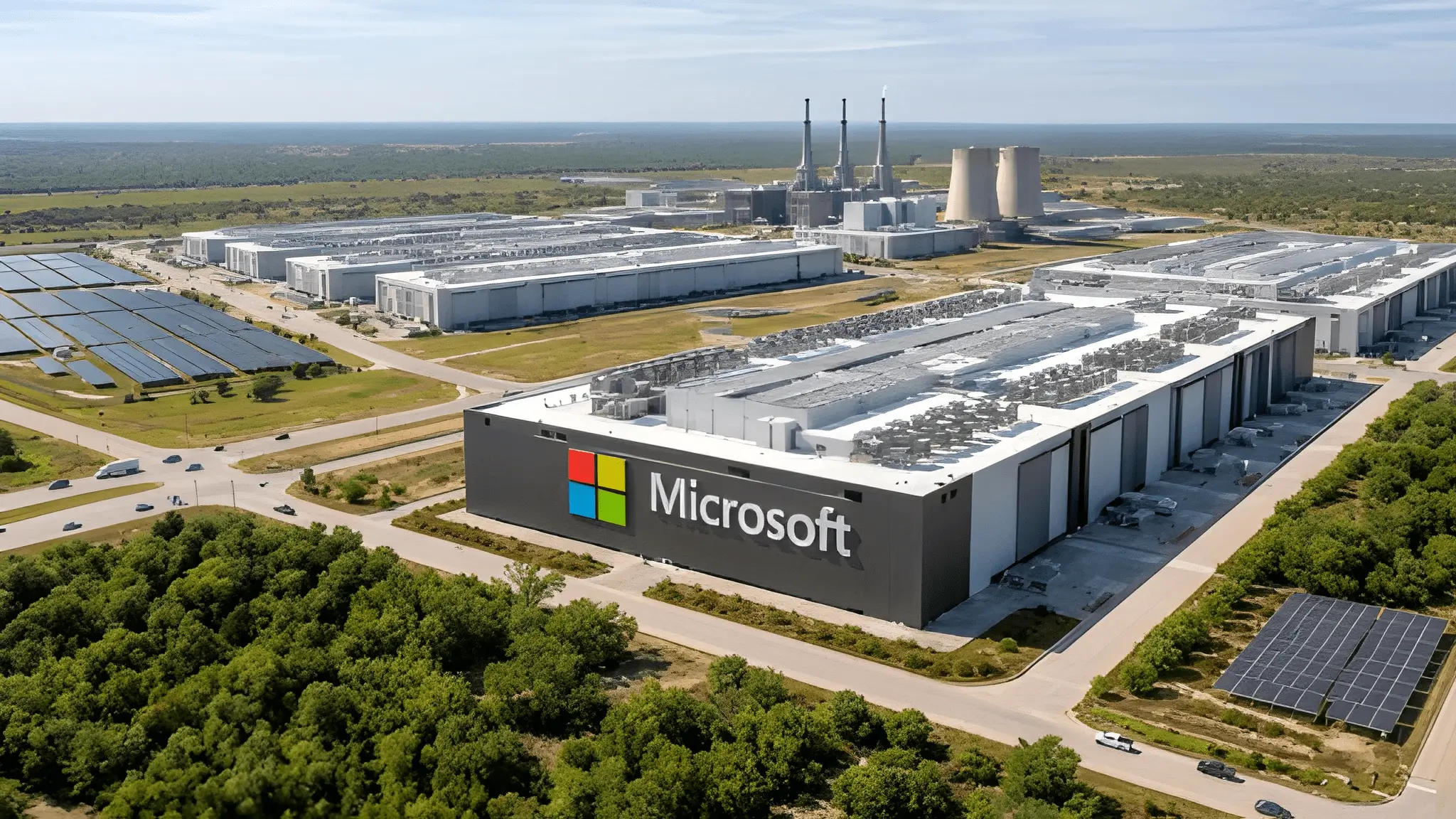
Microsoft is taking over a major data centre construction project in Texas after OpenAI declined to pursue further expansion, marking a notable shift in how both companies are scaling artificial intelligence infrastructure.

The move places the two companies side by side within one of the largest AI computing hubs in the United States, located in Abilene. Data centre developer Crusoe confirmed it is now working with Microsoft to construct two new “AI factory” buildings alongside an on-site power plant.
These new facilities will sit adjacent to an already massive campus being developed for OpenAI and Oracle, reinforcing Abilene’s emergence as a critical node in the global AI infrastructure race.
Stargate Vision Meets Strategic Divergence
OpenAI’s existing project forms the backbone of its broader Stargate initiative, a flagship AI infrastructure push that drew national attention when Donald Trump highlighted it shortly after his inauguration last year as a signal of confidence in U.S. technological leadership.

However, OpenAI has stepped back from further expansion at the site. “Our flagship Stargate site is one of the largest AI data center campuses in the United States,” said Sachin Katti, OpenAI’s head of compute infrastructure, in a post on X. “We considered expanding it further, but ultimately chose to put that additional capacity in other locations.”
Katti added that OpenAI currently has more than half a dozen AI infrastructure sites under development across the U.S., including a project with Oracle in Wisconsin.
From Partnership to Parallel AI Scaling
Microsoft and OpenAI once operated under a tightly coupled cloud relationship, with Microsoft serving as the exclusive cloud provider and maintaining an estimated 27% stake in the company.
However, both firms are now pursuing increasingly independent AI strategies even as they continue to build on the same physical land. This geographic overlap paired with strategic divergence highlights a broader industry trend: hyperscalers and AI labs are decoupling infrastructure dependencies while maintaining selective alignment.
Meanwhile, Crusoe has already completed two buildings for OpenAI and Oracle, with six additional facilities expected to be delivered by the end of the year. These developments continue to supply the compute backbone required to train and deploy systems like ChatGPT.
Microsoft’s expansion will bring the total number of data centre buildings at the site to 10, collectively targeting an extraordinary 2.1 gigawatts of computing capacity. The scale transforms what was once mesquite shrubland into a dense industrial AI corridor. Crucially, the project includes a new power plant capable of generating 900 megawatts.
Crusoe co-founder and CEO Chase Lochmiller said in a written statement that the facility will “continue building the industrial foundation for American AI at a velocity the industry has never seen.”
This new capacity significantly exceeds the existing 350-megawatt gas-fired plant supporting the OpenAI and Oracle operations. That facility primarily acts as backup power, with the main supply drawn from the regional grid, including nearby wind energy sources.
Energy Trade-Offs Reshape AI Infrastructure Economics
The rapid scaling of AI infrastructure continues to complicate environmental commitments across the technology sector. Data centres remain energy-intensive, with fossil fuels still playing a central role in ensuring reliability and uptime.
“We’re burning gas to run this data center,” OpenAI CEO Sam Altman said while visiting Abilene last year, adding that “in the long trajectory of Stargate” the hope is to rely on many other power sources. Nevertheless, the immediate reality reflects a trade-off between speed and sustainability, a tension that increasingly defines the AI infrastructure buildout globally.
A New Phase in the AI Infrastructure Race
The Abilene development signals more than a project handoff; it reflects a structural shift in how leading AI players deploy capital, secure energy, and control compute.
Moreover, Microsoft’s entry into the expansion underscores its intent to deepen vertical integration across AI infrastructure. However, OpenAI’s geographic diversification strategy suggests a parallel effort to reduce concentration risk and optimize resource distribution.
Therefore, the Texas AI expansion stands as both a collaboration and a quiet decoupling of a dual dynamic that may define the next phase of hyperscale AI competition.












