
NVIDIA H200 shipments delayed to Q3  · BREAKING: Microsoft confirms 3GW data centre expansion in Asia-Pacific ·  AWS announces new sovereign cloud regions in India and UAE  · Arm-based servers now 24% of hyperscale deployments ·  EU AI Act enforcement enters phase two  · Global data centre investment hits $612B in 2026 ·  TSMC Arizona yields improve to 68% on 3nm process  · OpenAI valuation reaches $400B after latest funding round ·  NVIDIA H200 shipments delayed to Q3  · BREAKING: Microsoft confirms 3GW data centre expansion in Asia-Pacific ·  AWS announces new sovereign cloud regions in India and UAE  · Arm-based servers now 24% of hyperscale deployments ·  EU AI Act enforcement enters phase two  · Global data centre investment hits $612B in 2026

Direct-to-Chip Cooling Is No Longer Optional

The data center cooling conversation has been heading in one direction for several years. Air cooling, the default for most

Share
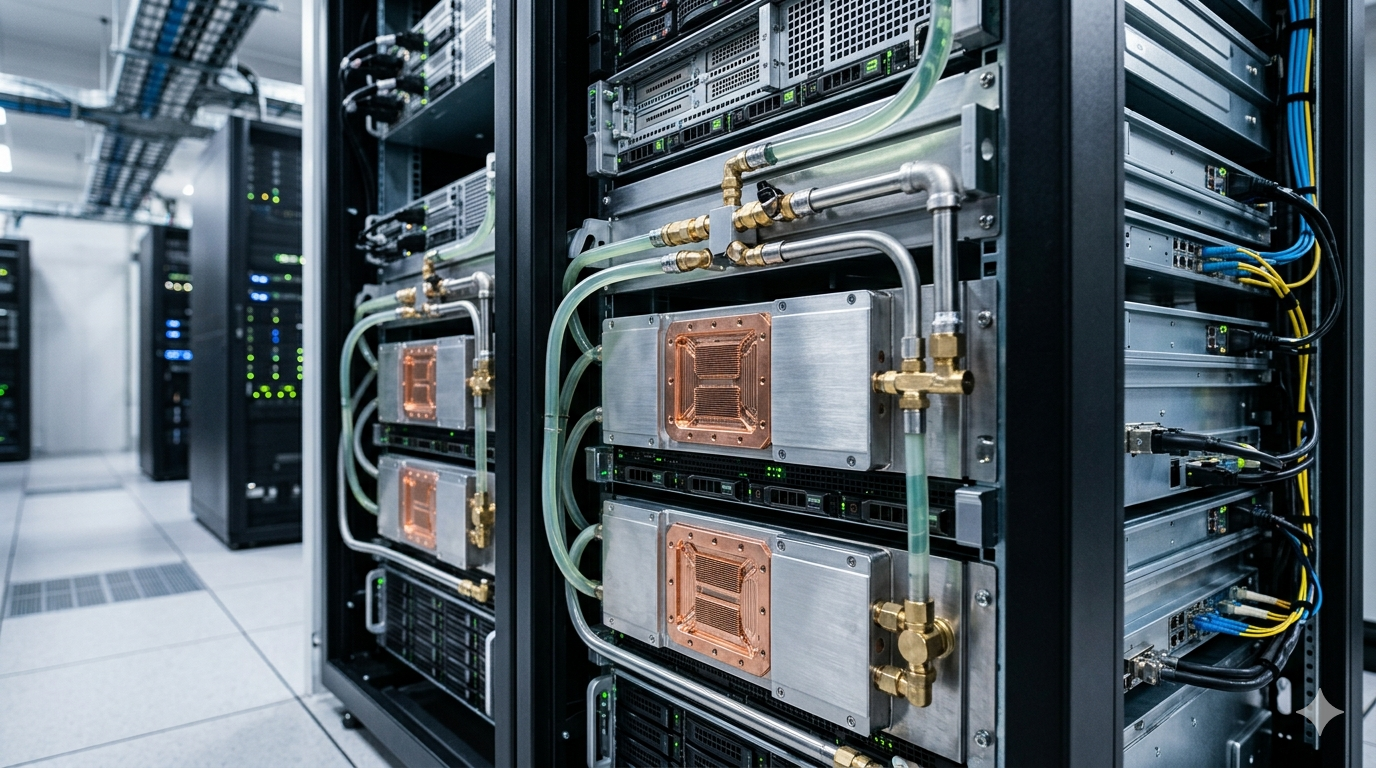
Direct to chip cooling AI data center cold plate liquid cooling GPU rack 2026

The data center cooling conversation has been heading in one direction for several years. Air cooling, the default for most of the industry’s history, is retreating from the frontier of AI infrastructure deployment. The question was never whether liquid cooling would become standard. It was always when. In 2026, the when has arrived. Liquid-cooled server racks will account for nearly half of all new deployments this year, and for facilities building around the latest AI accelerators, liquid cooling is not a premium option. It is a technical requirement.

The shift is not driven by efficiency preference. It is driven by physics. NVIDIA’s GB300 chips carry a thermal design power exceeding 1,400 watts per chip. At those heat flux densities, air cooling cannot remove heat from the silicon fast enough to prevent throttling. Direct-to-chip liquid cooling, which circulates coolant through cold plates mounted directly on the processor, is the only approach that handles those loads reliably at scale. Facilities that cannot support direct-to-chip cooling cannot run the latest generation of AI accelerators at rated performance.

Why Direct-to-Chip Is Different From Facility-Level Cooling

Cold plates and immersion represent fundamentally different approaches to removing heat from silicon at extreme density. Direct-to-chip cold plate cooling sits between conventional rear-door heat exchangers and full immersion in terms of engineering complexity, capital cost, and thermal performance. Most operators are adopting it for current AI hardware because it delivers the performance required without the full infrastructure overhaul that immersion demands.

The key difference between direct-to-chip and facility-level approaches is where the thermal work happens. Air cooling and rear-door heat exchangers manage heat after it leaves the chip and enters the rack airflow. Direct-to-chip cooling intercepts heat at the source, before it affects ambient rack temperatures. That difference matters at high power densities because engineers cannot manage the heat flux from a 1,400-watt chip effectively once it enters the rack airspace. The thermal gradient from chip to coolant must be minimised at the chip level, and that requires the coolant loop to contact the chip package directly.

What Operators Need to Retrofit and What They Need to Build

The practical challenge for operators managing existing facilities is that direct-to-chip cooling requires infrastructure that air-cooled designs never included. Operators must add coolant distribution units, in-rack plumbing manifolds, leak detection systems, and the secondary plant infrastructure to move heat from the coolant loop to a facility chiller or cooling tower. For facilities that designers never built with these systems in mind, the retrofit complexity is significant and the cost is not trivial.

Cooling the chip itself is an emerging frontier that goes further than current cold plate approaches. For facilities deploying today’s hardware, however, direct-to-chip cold plates are the immediate engineering challenge. Operators who have not yet mapped their facilities for plumbing routes, the structural load of filled coolant manifolds, and the secondary plant capacity needed at scale are building a gap between their infrastructure capabilities and the hardware they will need to deploy within the next 12 to 18 months.

New facilities have the advantage of designing direct-to-chip infrastructure from the outset. Their designers can optimise plumbing routes, floor loading specifications, secondary plant sizing, and facility management systems for liquid cooling as a baseline rather than an addition. Those facilities will serve the full range of current and next-generation AI accelerators without the compromises and costs that retrofitting imposes. The operators who understood three years ago that liquid cooling was the destination and designed accordingly are now the operators whose facilities can host the hardware that everyone else is scrambling to accommodate.

The Maintenance Reality Nobody Discusses Enough

Direct-to-chip cooling introduces maintenance requirements that air-cooled operations never faced. Operations teams must manage coolant chemistry to prevent corrosion, microbial growth, and scaling that reduce heat transfer efficiency and damage components over time. Leaks, however small, create risk in environments where compute hardware represents tens of millions of dollars per rack. The quick-disconnect fittings and manifold systems that make liquid-cooled racks serviceable in production environments minimise leak risk, but they introduce maintenance disciplines that operations teams must develop if they have not previously managed liquid-cooled infrastructure.

The operational learning curve is real. Facilities that invest in training their operations teams now are building a capability advantage over those that will develop it under operational pressure once high-density AI hardware is already deployed. The shift to liquid cooling is not just an infrastructure transition. It is an operational one, and the full cost includes the time and investment required to build the skills that make liquid-cooled infrastructure reliable at scale.

The Standardisation Gap That Is Slowing Adoption

One of the practical barriers to faster direct-to-chip cooling adoption is the absence of a mature standardisation ecosystem. Air-cooled data centers operate with well-established interoperability standards across rack formats, power distribution, and cooling infrastructure. Direct-to-chip liquid cooling is still working through that process. Different server vendors use different cold plate designs, different coolant connection formats, and different manifold specifications. A facility that standardises its liquid cooling infrastructure around one vendor’s ecosystem may face significant rework costs when deploying hardware from a different supplier.

A consortium of data center operators and chip manufacturers finalised a Direct-to-Chip Interoperability Standard in late 2025, aiming to ensure colocation facilities can support liquid cooling manifolds from different vendors without expensive retrofitting. That standard is a meaningful step forward, but adoption across the full range of hardware vendors and facility operators will take time. In the interim, operators deploying direct-to-chip cooling must make careful decisions about which vendor ecosystems their infrastructure is optimised for, knowing those decisions carry lock-in implications that air-cooled infrastructure decisions never created. The facilities that get standardisation right early, building infrastructure that accommodates the evolving hardware ecosystem without major rework, will hold a durable operational advantage as the liquid cooling market matures.


[simple-author-box]

More from AI Infrastructure

Power negotiations often conclude long before operational constraints reveal themselves inside a live facility.

Artificial intelligence infrastructure has compressed deployment timelines to the point where electrical capacity is

Boards increasingly expect organizations to support sustainability reporting with evidence that aligns with governance

COMPUTE WEEKLY

The briefing that 40,000+ tech leaders read every Monday. Sharp, fast, essential.

Great! We’ve received your information.

We couldn’t process your submission. Please retry

Building an AI Startup Without Owning GPUs

Not owning GPUs has become the default, deliberate strategy for building an AI company — not a compromise founders accept reluctantly. H100 rental rates fell 64-75% in fifteen months, a dense ecosystem of neoclouds and inference-as-a-service providers now lets startups skip infrastructure entirely, and credit programs can fund a company’s first year before a founder writes a check
Most Read

Infrastructure planning discussions often prioritize engineering, construction, and utility considerations before examining how end

AI infrastructure deployment schedules depend on coordinated progress across hardware availability, electrical infrastructure, cooling

Artificial intelligence has transformed the economics of digital infrastructure. Every new AI model requires

Data centers do not visibly smoke. They have no smokestacks, no visible exhaust, and

Artificial intelligence has transformed the economics of digital infrastructure. Companies once competed by acquiring

Disruptor Spotlight

Cerebras Systems

The chip that makes Nvidia nervous. Cerebras’ Wafer Scale Engine is rewriting the rules of AI inference at scale.
Faster
0 x
YoY Revenue
0 x
Transistors
0 T
Market Pulse
NVDA
$924.60
-2.11%
MSFT
$421.30
-2.94%
AMZN
$192.80
-4.87%
AMD
$924.60
-2.40%
TSMC
$924.60
-2.32%
Indicative only · Not financial advice
Upcoming Events
SEP
The AI Infrastructure Race (India)
WEBINAR · ONLINE
The AI Infrastructure Race: Won on Power, Land and Trust — Not Capital
MAY
0
AI Infrastructure Summit
DUBAI · IN PERSON
MEA’s premier AI infrastructure event.
JUN
0 0
Compute Forecast Summit
SINGAPORE · IN PERSON
Our flagship APAC event. Early bird open.
Latest Moves
Live
ecolab
Ecolab Deepens Cooling Strategy With $4.75B CoolIT Acquisition
Ecolab is making one of its biggest moves yet into AI infrastructure after completing its $4.75 billion acquisition of liquid cooling specialist CoolIT Systems
Pure DC AVK Europe data center microgrid Dublin 110MW AI infrastructure Ireland 2026
Pure DC and AVK Deploy Europe’s First 110 MW Data Center Microgrid in Dublin
The Pure DC Dublin microgrid has made history as Europe’s first large-scale on-site data center microgrid, launched in partnership with power solutions provider AVK at Pure DC’s campus in Ireland.
Pace Digitek
Pace Digitek Partners With MEGMEET to Expand AI Data Center Power Business
India’s AI infrastructure ecosystem continues to mature as domestic technology manufacturers move beyond traditional telecommunications and industrial markets toward high-growth digital infrastructure opportunities
Follow Compute Forecast
11K followers
1200 followers
Companies to Watch
CW
CoreWeave
Neo Cloud · $19B · IPO Watch
CB
Cerebras Systems
AI Hardware · $4.25B · Pre-IPO
G42
G42
Sovereign AI · Abu Dhabi
H
Humain
Saudi AI · $40B Fund
Latest Podcast
AI Capex, Cloud Margins & the Nuclear Bet
48 MIN · 25 APR 2026

Direct-to-Chip Cooling Is No Longer Optional

The data center cooling conversation has been heading in one direction for several years. Air cooling, the default for most

Share
Direct to chip cooling AI data center cold plate liquid cooling GPU rack 2026
19
847 SHARES

0
SHARES

[simple-author-box]

More from AI Infrastructure

Infrastructure planning discussions often prioritize engineering, construction, and utility considerations before examining how end

AI infrastructure deployment schedules depend on coordinated progress across hardware availability, electrical infrastructure, cooling

Artificial intelligence has transformed the economics of digital infrastructure. Every new AI model requires

Data centers do not visibly smoke. They have no smokestacks, no visible exhaust, and

COMPUTE WEEKLY

The briefing that 40,000+ tech leaders read every Monday. Sharp, fast, essential.

Great! We’ve received your information.

We couldn’t process your submission. Please retry

Global AI Infrastructure Outlook 2026

The briefing that 40,000+ tech leaders read every Monday. Sharp, fast, essential.
Download Free
Most Read

Infrastructure planning discussions often prioritize engineering, construction, and utility considerations before examining how end

AI infrastructure deployment schedules depend on coordinated progress across hardware availability, electrical infrastructure, cooling

Artificial intelligence has transformed the economics of digital infrastructure. Every new AI model requires

Data centers do not visibly smoke. They have no smokestacks, no visible exhaust, and

Artificial intelligence has transformed the economics of digital infrastructure. Companies once competed by acquiring

Disruptor Spotlight

Cerebras Systems

The chip that makes Nvidia nervous. Cerebras’ Wafer Scale Engine is rewriting the rules of AI inference at scale.
Faster
0 x
YoY Revenue
0 x
Transistors
0 T
Market Pulse
NVDA
$924.60
+2.4%
MSFT
$421.30
+1.1%
AMZN
$192.80
-0.6%
NVDA
$924.60
+2.4%
NVDA
$924.60
+2.4%
Indicative only · Not financial advice
Upcoming Events
MAY
0 0
DCD Global — London
LONDON · IN PERSON
World’s largest DC event. CF is media partner.
MAY
0
AI Infrastructure Summit
DUBAI · IN PERSON
MEA’s premier AI infrastructure event.
JUN
0 0

Compute Forecast Summit

SINGAPORE · IN PERSON
Our flagship APAC event. Early bird open.
Latest Moves
  • Live
Sam Altman
OpenAI appoints new Chief Infrastructure Officer to lead $100B DC programme
27 APR · OPENAI
Sam Altman
OpenAI appoints new Chief Infrastructure Officer to lead $100B DC programme
27 APR · OPENAI
Sam Altman
OpenAI appoints new Chief Infrastructure Officer to lead $100B DC programme
27 APR · OPENAI
Follow Compute Forecast
18.4K followers
12.1K followers
9.3K subscribers
41 episodes
Companies to Watch
CW
CoreWeave
Neo Cloud · $19B · IPO Watch
CB
Cerebras Systems
AI Hardware · $4.25B · Pre-IPO
G42
G42
Sovereign AI · Abu Dhabi
CW
Humain
Saudi AI · $40B Fund
Latest Podcast
AI Capex, Cloud Margins & the Nuclear Bet
48 MIN · 25 APR 2026
Scroll to Top








