 Skip to content
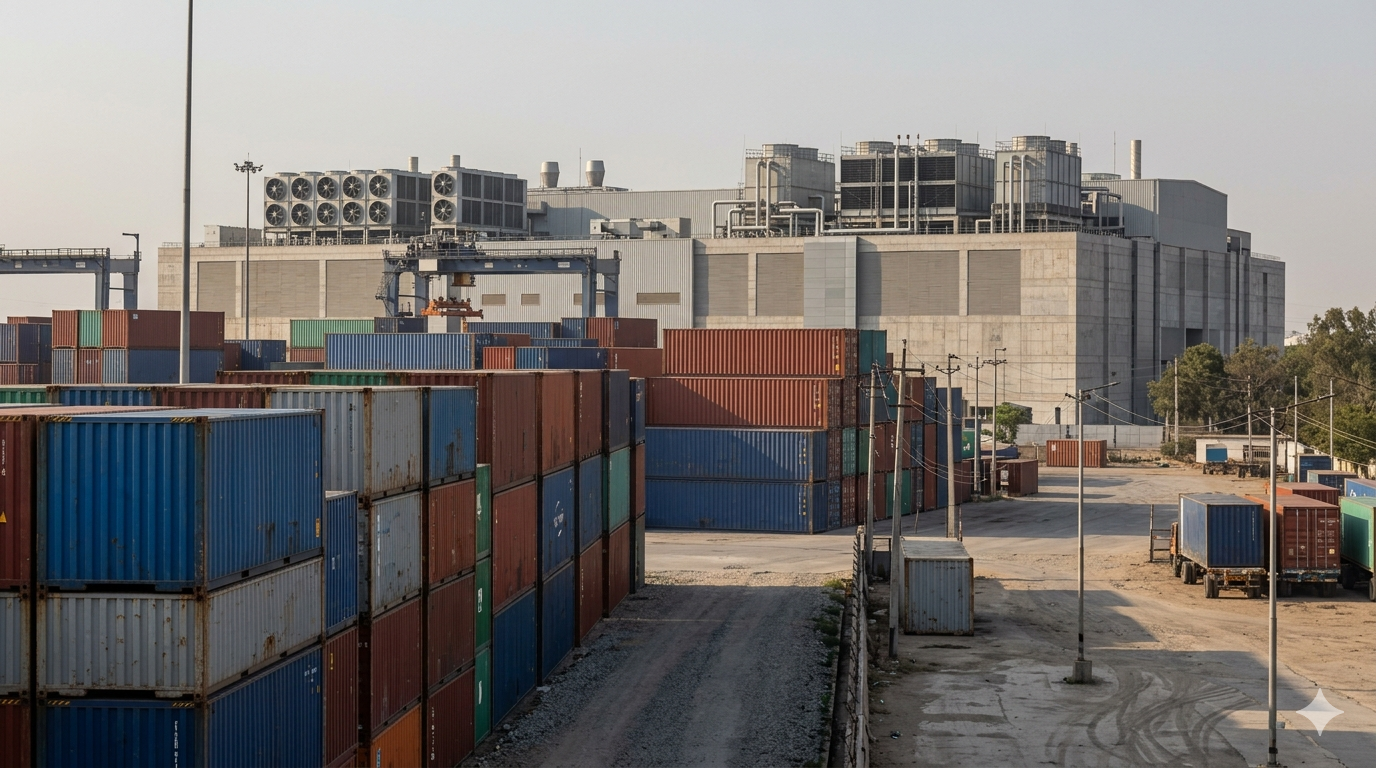
The AI infrastructure buildout has operated for years on an implicit assumption: that the global supply chains delivering its core components would remain open, predictable, and accessible regardless of geopolitical conditions. That assumption was always questionable. In 2026, it is no longer defensible.

Tariffs, export controls, and trade tensions now directly disrupt the physical infrastructure the AI industry depends on. They delay projects, raise construction costs, and force procurement decisions the industry was never designed to handle. Companies building the most consequential compute infrastructure in history are discovering that their supply chains are far more politically exposed than their planning models ever accounted for. They are now quietly passing that discomfort into every timeline and budget across the sector.
The Hardware Dependency the Industry Chose Not to See
Building AI data centers at scale requires transformers, switchgear, cooling systems, server hardware, and networking equipment sourced from a global supply chain where China plays a central and in some categories dominant role. US imports of high-power transformers from China increased from fewer than 1,500 units in 2022 to more than 8,000 through October 2025. China supplies over 40 percent of US battery imports and remains close to 30 percent in some switchgear categories. The electrical equipment that makes AI data centers work is deeply entangled with Chinese manufacturing in ways that years of onshoring rhetoric have not materially changed.
The AI industry knew this. The infrastructure investors who funded data center development knew this. The hyperscalers placing hundreds of billions in capital expenditure commitments knew this. The response, for most of that period, was to treat the geopolitical exposure as a background risk rather than an operational constraint. Procurement teams sourced from wherever supply was available and cost was competitive. Supply chain diversification was a medium-term aspiration rather than an immediate operational priority. The AI race was moving too fast to stop and audit the supply chain it depended on.

What Tariffs Actually Do to Infrastructure Timelines
The practical effect of tariffs on AI infrastructure is not primarily about price. It is about timing. A transformer that takes two to three years to procure from domestic or allied country suppliers under normal conditions takes even longer when tariff uncertainty causes procurement teams to hesitate, when alternative suppliers face sudden surges in orders from buyers trying to reduce China exposure, and when the equipment that does arrive from China carries costs that affect project economics in markets where margins were already tight.
The silent bottleneck in transformer and substation supply chains predates the current tariff environment. Tariffs did not create the shortage. What they do is make the shortage harder to resolve by limiting the pool of suppliers operators can draw from without cost penalties, creating uncertainty that makes long-term procurement commitments harder to justify, and adding an additional layer of unpredictability to project timelines that were already constrained. Nearly half of US data center projects planned for 2026 face delays. Electrical equipment availability is a primary driver of those delays. Tariffs are a factor in that availability, and their effect compounds the existing supply chain constraints rather than operating independently of them.
The Contradiction at the Heart of US AI Policy
There is a genuine contradiction running through US AI infrastructure policy that the tariff issue makes visible. The US government has identified AI infrastructure as a national security and economic competitiveness priority. It wants AI data centers built faster, at greater scale, and with more domestic control. At the same time, the tariff policies designed to reduce Chinese economic influence are raising costs and extending timelines for the electrical equipment those data centers require. The goal of building more AI infrastructure faster is in direct tension with trade policies that constrain the supply chains the buildout depends on.
The administration has recognised parts of this tension, carving out semiconductor and advanced chip imports from some tariff measures because the national security logic of maintaining chip supply access outweighs the revenue and political logic of tariffing them. The same logic applies to the electrical infrastructure layer, but it has received less attention because transformers and switchgear are less visible in the AI narrative than GPUs and data centers. They are, however, just as essential. A data center without powered electrical infrastructure is a building with no compute. Getting that infrastructure delivered on schedule matters as much as the chip supply it enables.
Why the Diversification Response Is Taking Too Long
The standard industry response to supply chain risk is diversification. Build alternative supplier relationships, spread procurement across geographies, reduce single-source dependency. That response is underway in the AI infrastructure supply chain, but it is moving more slowly than the scale of the problem demands. Canada, Mexico, and South Korea have become larger sources of high-power transformers as operators seek to reduce China exposure. Siemens Energy committed $1 billion to expanding US transformer and gas turbine manufacturing. GE Vernova acquired full ownership of Prolec, a transformer company, for $5.3 billion.
These investments are meaningful. They will ease the shortage eventually. The problem is the timeline. New manufacturing capacity takes years to come online. Supplier relationships built under procurement pressure rather than strategic planning are less reliable than those developed over time. And the diversification response is being built on the fly, during an active buildout cycle, against a demand curve that is not waiting for supply chains to catch up. The operators placing transformer orders today for facilities coming online in 2027 and 2028 are doing so in a market that diversification efforts have not yet stabilised. The gap between the pace of supply chain reform and the pace of AI infrastructure demand is real, and it will take several years to close fully.
What the Industry Should Have Done Differently
The honest assessment is that the AI industry’s supply chain exposure to geopolitical risk was foreseeable and the response to it was inadequate. The companies best positioned in the current environment are those that placed transformer and switchgear orders two to three years ahead of need, built supplier relationships across multiple geographies, and treated electrical equipment procurement as a strategic function rather than a procurement afterthought. Those companies represent a minority of the market.
China’s AI race entering a less open phase is one dimension of the geopolitical shift affecting the industry. The supply chain exposure on the infrastructure side is another, and it deserves the same level of strategic attention. The AI buildout has attracted extraordinary capital, engineering talent, and senior leadership focus. It has not attracted proportionate attention to the supply chain resilience that makes deployment possible. That gap is now showing up in delayed projects, rising costs, and procurement decisions being made under pressure that should have been made with planning.
The lesson is not that tariffs are wrong or that China exposure is inherently unmanageable. It is that an industry spending hundreds of billions annually on compute infrastructure should have invested more seriously in understanding and managing the supply chain that compute infrastructure depends on. The tariff environment did not create that vulnerability. It just made it impossible to ignore any longer. The companies that treat this moment as a genuine supply chain reset, rather than a temporary disruption to manage until conditions normalise, are the ones that will be better positioned when the next geopolitical shock arrives. Because in an industry this capital-intensive, building this fast, across this many markets, another shock is not a possibility. It is a certainty.










