Skip to content
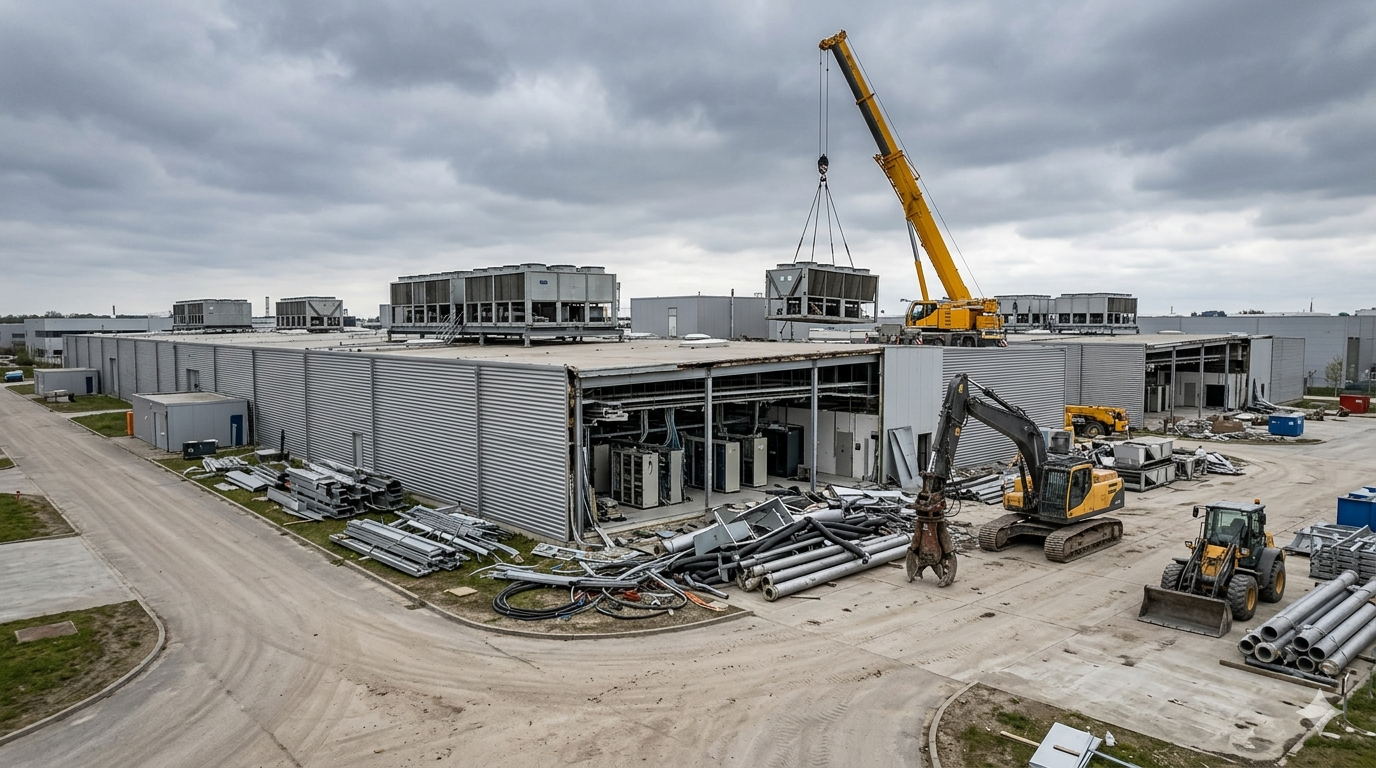
The AI infrastructure buildout has dominated the industry conversation for three years. New campuses, new power agreements, new cooling architectures, new financing vehicles. Every headline points forward. What is not yet receiving equivalent attention is the wave of existing infrastructure that the buildout is rendering obsolete, and the decisions that operators will face as that wave arrives. The data center decommissioning problem is not a future risk. It is a present one that is already showing up in asset valuations, operational budgets, and capital allocation decisions across the sector. Most operators are not ready for it.

The facilities at risk are not old or poorly built. Many were constructed to the highest specifications available at the time of development. The problem is that the specifications available in 2018 or 2020 did not anticipate the power density, the cooling requirements, or the structural loading that current and next-generation AI hardware demands. A facility designed for 10 kilowatts per rack cannot run Blackwell GPU clusters at 120 kilowatts per rack without fundamental redesign. The choice between investing in that redesign, repurposing the facility for workloads it can actually support, or decommissioning it entirely is a decision that thousands of operators are approaching faster than their planning cycles anticipated.
Why the Timeline Is Compressed
The hardware generation cycle in AI compute is the primary driver of the decommissioning timeline. Each GPU generation delivers substantially more compute per rack but at substantially higher power density. The move from A100 to H100 pushed rack power requirements significantly. The move from H100 to Blackwell pushed them further. Vera Rubin, arriving in the second half of 2026, will push them further still. Operators who built or leased facilities to support one hardware generation are discovering that the next generation requires infrastructure their facilities cannot provide.
The compression of this timeline is distinctive. Conventional data center infrastructure has historically depreciated over 15 to 20 years, with meaningful revenue generation throughout that period. The AI hardware cycle runs at 18 to 24 months. A facility built around A100 specifications in 2021 is already behind the current hardware generation by two full cycles. Its ability to generate competitive revenue from AI training workloads is already compromised. Its operators face the decommissioning question sooner than any conventional depreciation model would suggest.

Why Each Hardware Generation Shortens the Asset Lifecycle
The time-to-power crisis constrains AI infrastructure expansion in ways that interact directly with the decommissioning question. Grid connections take three to five years to secure in major US markets. Operators with existing grid connections, even at sites with obsolete building specifications, hold an asset that new development cannot easily replicate. The question for these operators is whether the value of their grid connection justifies the cost of upgrading the facility around it, or whether the economics favour a different path.
The Three-Way Decision Every Operator Now Faces
The operator facing an obsolete or underperforming AI data center asset faces three broad options: retrofit the facility to current specifications, repurpose it for workloads it can support, or decommission it and exit the asset. Each path carries a distinct economics profile, a distinct timeline, and a distinct set of risks that the AI infrastructure market has not yet fully priced.
Retrofit is the most capital-intensive option but preserves the most value from the existing asset. A well-located site with a secured grid connection and established relationships with local utilities represents years of permitting work and infrastructure development that cannot be quickly replicated. The retrofit challenge of converting air-cooled facilities to liquid cooling establishes that retrofit is technically achievable across most facility types but carries significant cost and operational complexity. Floor loading reinforcement, power delivery upgrades, cooling infrastructure replacement, and structural modifications to accommodate liquid cooling distribution can collectively cost as much as building a new facility of equivalent capacity, without the benefit of a clean design that optimises for current hardware requirements.
Why Repurposing Is Often the Most Overlooked Option
Repurposing preserves revenue from the asset without the full capital commitment of a retrofit to AI specifications. A facility that cannot support 120 kilowatt GPU racks can still serve enterprise cloud workloads, backup and archive storage, network infrastructure, and lower-density compute applications that do not require AI-grade power density. The revenue per square metre from these workloads is lower than from AI workloads, but it is real revenue against a fixed cost base. Operators who repurpose strategically can extend the useful life of their assets while they evaluate whether market conditions justify a full retrofit investment.
Decommissioning is the cleanest exit but carries the highest immediate costs and the most complex logistics. A large data center contains significant quantities of hazardous materials, including lead acid batteries in UPS systems, refrigerants in cooling equipment, and legacy electrical components that require specialised handling. The decommissioning process generates substantial quantities of electronic waste, much of which contains recoverable metals that have value if processed correctly. Managing that process efficiently and in compliance with evolving environmental regulations is a capability that most operators have not built because they have not previously needed it at scale.
The Economics of Retrofit at Current Prices
The retrofit economics depend heavily on three variables: the cost of the retrofit itself, the revenue premium that AI workloads generate over alternative uses, and the opportunity cost of the capital relative to building new. Each of these variables is moving in directions that complicate the retrofit case.
Retrofit costs have risen sharply as supply chain constraints have pushed up the cost of electrical equipment, liquid cooling components, and specialist construction labour. The same tariff pressures on Chinese electrical equipment that are constraining new data center development also apply to retrofit projects. A facility owner who budgeted a retrofit at 2023 cost estimates is discovering that current market costs are 20 to 40 percent higher depending on the equipment categories involved.
Retrofitting liquid cooling inside existing data centers requires not just the cooling hardware itself but substantial structural and mechanical engineering work to integrate it into buildings not designed for it. The manifold routing, the structural penetrations for coolant distribution, the condensate management systems, and the electrical modifications required to support higher-density hardware all add cost that does not appear in simple equipment pricing. Operators who have completed retrofits consistently report that the actual cost exceeded initial estimates by meaningful margins.
Why Opportunity Cost Is the Most Underweighted Variable
The revenue premium for AI workloads is real but variable. Hyperscaler AI training workloads command premium pricing precisely because the infrastructure required to support them is constrained. As new supply comes online and the market for AI compute capacity becomes more competitive, that premium will compress. An operator making a large retrofit investment at 2026 costs is betting that the revenue premium will persist long enough to justify the capital deployment.
Opportunity cost is the factor most often underweighted in retrofit analyses. Capital deployed in a facility retrofit is capital not deployed in new development, new hardware procurement, or other uses that might generate better risk-adjusted returns. Data center expansion is no longer a real estate problem but an infrastructure and power problem. The operators with the strongest competitive positions are those who have secured power capacity, not those who have the most square footage. A retrofit that improves the density of an existing facility without addressing its power access position may improve the asset’s technical specifications without improving its competitive position in the market for AI workloads.
The Hardware Lifecycle Dimension
The decommissioning wave is not limited to facilities. The hardware inside those facilities faces its own obsolescence cycle that operators are managing with varying degrees of success. A GPU cluster deployed in 2022 for AI training has been through multiple model generation transitions since then. The economic case for continuing to operate that hardware depends on whether the workloads it can run efficiently still generate revenue that justifies the power cost and operational overhead of maintaining it.
The inference market creates a partial reprieve for older hardware. Training frontier models requires the most current generation of AI accelerators to be economically viable. Inference, by contrast, can run profitably on hardware that is one or two generations behind the frontier, because the revenue per inference token is sufficient to cover the higher power cost per token that older hardware generates. Operators who can shift older hardware from training to inference extend its revenue-generating life and defer the hardware decommissioning decision.
Why the Inference Reprieve Has a Hard Limit
As newer hardware generations arrive, each offering substantially better inference efficiency per watt than its predecessor, the power cost disadvantage of running older hardware increases. A cluster that was marginally viable for inference in 2025 may be clearly uneconomic for inference in 2027 as Vera Rubin-era hardware drives down the cost per inference token for operators running current hardware. The reprieve extends the hardware lifecycle but does not eliminate the eventual decommissioning endpoint.
Hardware decommissioning at AI scale introduces logistics challenges that the industry has not previously encountered. A hyperscale GPU cluster contains thousands of individual accelerator cards, each containing recoverable metals including gold, silver, copper, and rare earth elements. The secondary market for used AI accelerators is active and growing, but it is not yet sufficiently mature to absorb the volumes that large-scale hardware refreshes will generate. Operators who plan hardware transitions without a clear secondary market strategy will either accept lower recovery values or face extended disposition timelines that delay capital redeployment.
The Environmental Accounting That Nobody Has Done
The environmental cost of the decommissioning wave represents an under-examined dimension of the AI infrastructure buildout’s sustainability profile. The industry has invested substantially in measuring and reducing the operational carbon footprint of data centers, including through renewable energy procurement, efficiency improvements, and cooling technology transitions. The embodied carbon in existing infrastructure and the environmental cost of decommissioning it receive far less attention.
Manufacturing a large power transformer embeds substantial carbon in the steel, copper, and insulation materials it contains. Disposing of that transformer at end of life generates waste streams that have to be managed. The same applies to UPS batteries, cooling equipment, structural steel, and the thousands of tonnes of concrete in a large data center facility. When the AI hardware cycle forces facilities into early obsolescence, it accelerates the realisation of those embodied carbon costs and generates decommissioning waste streams earlier than any conventional infrastructure model anticipated.
Why Embodied Carbon Changes the Decommissioning Cost Model
The regulatory environment for data center decommissioning is evolving. Several European jurisdictions are developing extended producer responsibility frameworks that will require facility operators to account for end-of-life environmental costs when making development decisions. The US regulatory trajectory is less advanced but moving in a similar direction as the scale of AI infrastructure decommissioning becomes more visible. Operators who have not built decommissioning cost estimates into their facility economics are carrying an unquantified liability that will eventually become concrete.
Who Manages This Best
The operators who navigate the decommissioning wave most effectively will be those who treat it as a planning problem rather than an emergency. The facilities approaching obsolescence are knowable. The hardware refresh cycles are predictable. The cost trajectories for retrofit, repurpose, and decommission are modelable with reasonable assumptions. Operators who build these scenarios into their capital planning now, rather than confronting them as crises when individual assets reach decision points, will have more options and better economics than those who do not.
The most sophisticated operators are already incorporating decommissioning planning into their asset lifecycle models. They identify facilities with sufficient grid access and locational value for retrofit investment, repurpose suitable sites for lower-density workloads, and place remaining assets on managed wind-down timelines to maximise recovery value from hardware, equipment, and land.
Why Asset-Level Analysis Beats Portfolio-Level Rules
That tiered approach reflects the reality that no single answer applies to all assets. The right decision depends on the specific combination of location, grid access, structural characteristics, lease terms, and market positioning of each individual facility. The operators who lack this analytical capability are the ones most likely to make expensive decisions under time pressure. The decommissioning wave will not wait for planning cycles to catch up. It is arriving on the timeline that the AI hardware generation cycle dictates, and that timeline is not negotiating with anyone’s budget calendar.
The Value Hidden in the Problem
There is a dimension of the decommissioning wave that represents genuine opportunity rather than pure cost. Facilities that cannot economically support high-density AI workloads still contain real assets: grid connections, real estate, cooling infrastructure, and power delivery equipment that have value to buyers with different use cases and economics. The secondary market for data center assets is developing rapidly, and buyers who can operate profitably at lower density points are actively seeking assets that AI operators are exiting.
The grid connection often represents the most valuable component. In markets with multi-year connection timelines, operators transfer or reuse existing connections from retired AI facilities for new development on the same site. Operators who prioritise the grid connection when decommissioning assets maintain a stronger position than those who treat the asset as a disposal cost.
Why the Grid Connection Is the Most Valuable Component
The decommissioning wave is also driving the development of specialist service providers who can manage the logistics, environmental compliance, hardware disposition, and facility preparation aspects of large-scale data center retirements more efficiently than individual operators can manage them internally. That ecosystem is still early but growing. Operators who engage it proactively will achieve better outcomes than those who attempt to manage complex decommissioning projects with internal teams that have not previously done them at AI infrastructure scale.
What the Market Has Not Priced
Private capital markets have absorbed the AI infrastructure buildout narrative with enthusiasm. Valuations of data center assets have risen sharply, financing has been abundant, and investor appetite for exposure to the AI compute supercycle has been strong. What the market has not yet fully priced is the decommissioning liability embedded in the asset base.
A portfolio of data center assets valued on the assumption of continued high utilisation at AI workload pricing carries a different risk profile if a meaningful fraction of those assets face obsolescence before their financing matures. The private equity funds, REITs, and infrastructure vehicles that have accumulated data center exposure over the past three years are beginning to encounter this question in their portfolio reviews. Some are discovering it in assets they acquired at peak valuations with assumptions about AI workload revenue that are harder to sustain as the hardware generation cycle advances.
Why Valuation Divergence Is Widening Across the Asset Base
The valuation gap between assets that can support current-generation AI hardware and assets that cannot is widening. Well-located facilities with secured high-voltage grid connections, structural specifications that accommodate high-density cooling, and floor loading that supports 120 kilowatts per rack or above are commanding significant premiums. Facilities that lack one or more of these characteristics are trading at discounts that reflect the retrofit cost required to close the gap, or the lower revenue ceiling of the workloads they can support without retrofit. That valuation divergence is a market signal that the decommissioning and upgrade cycle is real and already underway.
The Workforce Dimension
The decommissioning wave carries a workforce implication that receives little attention. Building and operating data centers employs significant numbers of skilled workers in construction, electrical engineering, mechanical maintenance, and facilities management. Decommissioning those facilities at scale requires different skills in different proportions: environmental compliance specialists, hazardous material handlers, secondary market brokers for equipment disposition, and demolition engineers for structural elements.
The workforce transition from construction-era skills to decommissioning-era skills is not automatic. Communities that have built local employment bases around data center construction and operation will experience a different economic impact from the decommissioning wave than from the buildout wave. Policymakers who are currently focused on the job creation aspects of AI infrastructure investment are not yet adequately focused on the workforce planning implications of the decommissioning cycle that follows.
Why Decommissioning Skills Are Not Construction Skills
Training programs that prepare workers for data center construction and operation are well established. Training programs that prepare workers for data center decommissioning at the scale that the AI hardware cycle will generate are not. Addressing that gap requires lead time that the current policy environment is not providing. The decommissioning wave will not pause while workforce development programs catch up.
The Regulatory Gap That Will Close
The regulatory framework for data center decommissioning in most markets is inadequate for the scale and pace of the wave that is approaching. Environmental permits, waste management regulations, and end-of-life equipment disposal rules were written for an industry that retired facilities over decades, not years. The AI hardware cycle compresses that timeline in ways that the existing regulatory framework did not anticipate.
Several specific regulatory gaps create risk for operators planning decommissioning. Refrigerant disposal regulations apply to cooling equipment removal, but the compliance pathway for large-scale simultaneous removal of cooling systems across multiple facilities has not been tested at the volumes that coordinated decommissioning programmes will generate. Battery disposal regulations for UPS systems carry cost and logistics requirements that scale poorly when applied to the lead acid battery banks in facilities of 50 megawatts and above.
Why Extended Producer Responsibility Frameworks Change the Cost Model
The extended producer responsibility frameworks developing in Europe will eventually apply to data center infrastructure at end of life. Operators who have not modelled the cost implications of those frameworks in their asset economics carry unquantified liability that will crystallise as the regulatory environment tightens. Getting ahead of that tightening, rather than reacting to it, is the posture that sophisticated operators should be taking now.
Building the Decommissioning Capability
Most data center operators have never decommissioned a facility at the scale that the AI hardware cycle will require. The operational muscle for large-scale decommissioning does not exist in most organisations because it has not been needed. Building that capability requires investment in processes, partnerships, and expertise that operators need to make before the decommissioning decisions arrive, not after.
The process dimension involves developing internal frameworks for asset lifecycle assessment that can systematically evaluate each facility against the criteria that determine its retrofit, repurpose, or decommission trajectory. Those frameworks need to incorporate hardware generation roadmaps, power infrastructure assessments, structural specifications, market positioning, and financial modelling into a coherent decision support tool. Building that tool takes time and analytical investment that many operators have not yet committed.
The partnership dimension involves establishing relationships with the specialist service providers who can execute decommissioning efficiently: environmental compliance firms, equipment remarketing specialists, construction contractors experienced in facility demolition, and secondary market brokers for data center assets. These relationships are more effective when established proactively rather than reactively.
Why Proactive Partnerships Beat Reactive Procurement
Service providers approached with a planned, well-structured decommissioning programme offer better terms and timelines than those approached with an urgent requirement to dispose of an asset on short notice. The expertise dimension involves ensuring that asset management and capital planning teams have the technical and financial literacy to evaluate decommissioning decisions accurately. This means understanding the technical specifications that determine AI workload compatibility, the retrofit cost estimation methodology for different facility types, and the secondary market dynamics that determine recovery value. These are not skills that conventional real estate or facilities management training provides. Operators who invest in building this capability now are positioning themselves to manage the decommissioning wave as a planned business process rather than a series of emergency responses.
The Secondary Market That Will Define Recovery Value
The secondary market for data center assets, hardware, and equipment is one of the most important and least understood factors in the decommissioning economics equation. Recovery value from a decommissioned facility depends heavily on the depth and efficiency of the markets for what comes out of it, and those markets are in varying stages of maturity.
The hardware secondary market for AI accelerators is active and growing. Used H100 GPUs trade at prices that reflect their inference utility, and operators who plan hardware disposition carefully can recover meaningful value from clusters being retired from training service. However, the market has not been tested at the volumes that coordinated large-scale hardware refreshes will generate. When multiple large operators simultaneously retire A100 or H100 clusters in favour of Blackwell or Vera Rubin hardware, the secondary market supply surge will compress prices. Operators who time their dispositions strategically, bringing hardware to market before the supply surge rather than during it, will achieve better recovery values.
The infrastructure equipment secondary market is less developed. Large power transformers, medium-voltage switchgear, UPS systems, and cooling equipment from decommissioned facilities represent real value, but the market for used data center electrical equipment is fragmented and inefficient. Specialist remarketing firms are developing capabilities in this space, but the matching of sellers with buyers at scale requires market infrastructure that is still being built.
Why Timing the Market Matters as Much as Executing the Sale
The land and building secondary market depends heavily on location and the specific characteristics of each facility. A well-located site with a secured grid connection will attract buyers even if the building specifications are obsolete for AI workloads, because the land and the connection have value for new development. A site with constraints on power access, water availability, or connectivity may have limited secondary market value regardless of the building quality.
The most important insight about the secondary market is that it rewards early movers. Operators who bring assets to market before the decommissioning wave fully arrives will face less competition from other sellers and achieve better prices than those who wait. The calculus that makes a decommissioning decision feel premature today is the same calculus that makes it optimal from a recovery value perspective. Operators who understand that they are racing against a supply curve, not just making an isolated asset decision, will time their dispositions more effectively.
The decommissioning wave is one of the defining infrastructure management challenges of the AI era. It arrives without precedent, at a speed the industry has not previously encountered, with financial, environmental, and operational dimensions that intersect in complex ways. The operators who engage with it clearly, plan for it systematically, and build the capabilities to manage it effectively will find that it is navigable. Those who do not will find it considerably more costly than it needed to be.