
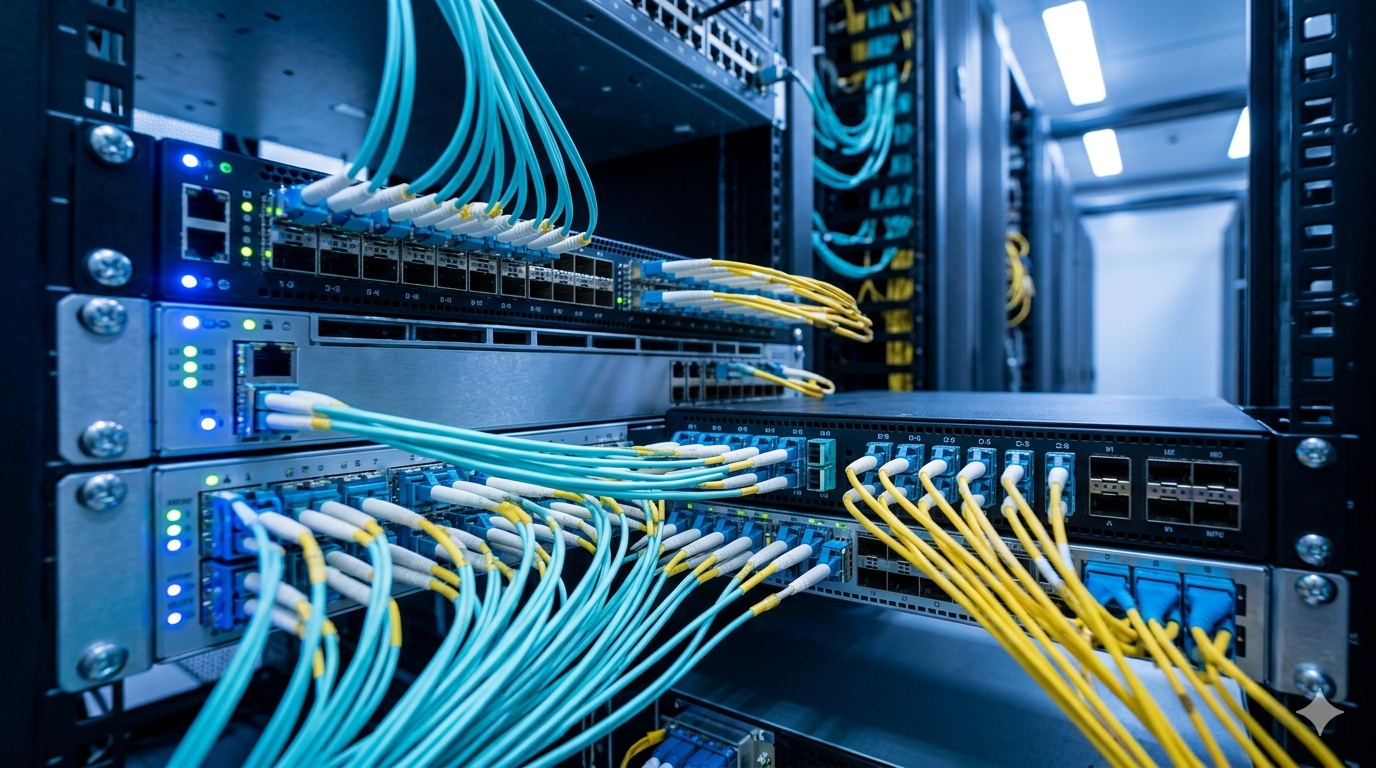
The AI infrastructure conversation in 2026 focuses on GPU generations, power density, and cooling architectures. Those priorities make sense. However, a networking transition is reshaping how organisations build and operate AI clusters, and it is not receiving the attention it deserves. Co-packaged optics, the integration of optical transceivers directly onto switch ASICs rather than in separate pluggable modules, is moving from research and early deployment into the mainstream product roadmaps of every major networking vendor. When it arrives at scale, it will change the cost structure, power profile, and physical design of AI data centers in ways that infrastructure planners are not yet accounting for.

Understanding why co-packaged optics matters requires understanding what the current pluggable transceiver approach costs. Every switch in a modern AI cluster connects to other switches and servers through pluggable optical transceivers that convert electrical signals to light for transmission and back to electrical for processing. Those transceivers consume significant power, generate heat that must be managed, take up physical port space on the switch, and introduce conversion losses that degrade signal integrity at the highest bandwidths. At the rack and cluster scale of today’s AI infrastructure, the aggregate cost of those conversion steps, in power, heat, and space, is substantial.
What Co-Packaged Optics Actually Changes
Co-packaged optics moves the optical engine from a separate pluggable module into the same package as the switch ASIC, eliminating the electrical connection between the switch chip and the transceiver. That elimination removes the primary source of signal degradation at high speeds, reduces the power consumed by the electrical-to-optical conversion process, and frees up the physical port real estate that pluggable transceivers currently occupy. Nvidia’s Quantum-X InfiniBand and Spectrum-X Ethernet photonics platforms, targeting commercial availability in 2026, are the most prominent current examples of co-packaged optics moving into production AI networking products.
The power reduction numbers are significant. Nvidia has stated that its co-packaged optics platforms reduce power consumption by up to 3.5 times compared to equivalent pluggable transceiver configurations. For an AI cluster consuming hundreds of megawatts, a 3.5 times reduction in networking power is not a marginal efficiency improvement. It is a material change in the facility-level power budget that affects how much compute can be delivered per megawatt of available capacity. Beyond GPUs, the hidden architecture powering the AI revolution established that the networking layer is as consequential as the compute layer in AI infrastructure design. Co-packaged optics is the most significant networking layer development since high-radix InfiniBand switches enabled the current generation of large-scale GPU clusters.

Why Bandwidth Scaling Demanded This Transition
The underlying driver of co-packaged optics adoption is a bandwidth scaling problem that pluggable transceivers cannot solve at the speeds AI networking requires. Each generation of AI accelerators demands more inter-node bandwidth than the previous one. The interconnect fabric connecting GPU nodes in a training cluster needs to scale bandwidth in proportion with the compute it serves, or the faster GPUs spend increasing fractions of their time waiting for data rather than computing. Pluggable transceivers face fundamental physical limits at the highest bandwidths because the electrical connection between the switch ASIC and the transceiver module degrades signal integrity as speeds increase. Co-packaged optics eliminates that electrical connection and enables the switch ASIC to drive optical signals directly, removing the bandwidth ceiling that pluggable transceivers impose.
What This Means for AI Cluster Design
The infrastructure implications of co-packaged optics at scale extend beyond the networking layer itself. Lower networking power consumption changes the cooling load distribution within the data center. Current AI cluster designs allocate significant cooling capacity to the networking infrastructure, because pluggable transceivers generate substantial heat that must be removed. Co-packaged optics reduces that heat load, which changes the cooling architecture requirements for the networking portions of the facility. The background giants and how AI clusters power intelligence described the hidden infrastructure complexity of large GPU clusters. The networking cooling load is one of the less visible components of that complexity, and co-packaged optics meaningfully reduces it.
The physical design of switches also changes with co-packaged optics. Pluggable transceivers occupy front-panel port real estate that limits how many ports a switch can offer within a given physical form factor. Co-packaged optics moves the optical engines inside the switch package, freeing front-panel space for more ports or enabling higher port-count switches in the same physical footprint. For AI cluster designers aiming to maximise the number of GPU nodes connected with minimal switch hops, higher port-count switches directly improve cluster topology options and reduce the number of switching layers needed to connect a given number of nodes.
Why the Transition Creates Operational Challenges
Co-packaged optics also introduces operational changes that infrastructure teams need to plan for. Pluggable transceivers can be replaced individually when they fail, which simplifies maintenance in deployed clusters. Co-packaged optics integrates the optical engine with the switch ASIC, which means that an optical failure potentially requires replacing the entire switch rather than just the transceiver. That changes the sparing strategy, the maintenance procedures, and the failure recovery economics for AI cluster networking infrastructure. AI density versus infrastructure reality and where systems break highlighted the mismatch between infrastructure planning assumptions and operational reality in high-density AI deployments. Co-packaged optics is another dimension of that mismatch for teams that plan maintenance procedures based on the pluggable transceiver model.
When Infrastructure Planners Need to Start Accounting for This
Nvidia has targeted commercial availability for Quantum-X InfiniBand switches with co-packaged optics in early 2026 and Spectrum-X Ethernet switches in the second half of 2026. Those timelines put co-packaged optics in active procurement consideration for any AI cluster build or expansion planned for 2026 and 2027. Infrastructure teams designing facilities today for next-generation GPU deployments need to account for the power and cooling profile of co-packaged optics switches rather than the pluggable transceiver profile they have designed around historically. The difference is large enough to affect facility power budgets, cooling system sizing, and the compute density that a given power envelope can support.
Corning’s AI network density breakthroughs and Marvell’s expansion of AI data center interconnect technology reflect the broader industry movement toward higher-density, lower-power optical networking that co-packaged optics represents. The vendors building AI networking infrastructure are converging on this approach because the alternative, continuing to scale pluggable transceivers to higher bandwidths, is approaching physical limits. Infrastructure planners who understand this transition early will design facilities that are compatible with the networking technology their GPU investments will require. Those who design around the pluggable transceiver assumptions of the current generation will face retrofitting decisions when co-packaged optics becomes the default in the hardware they are procuring.











