
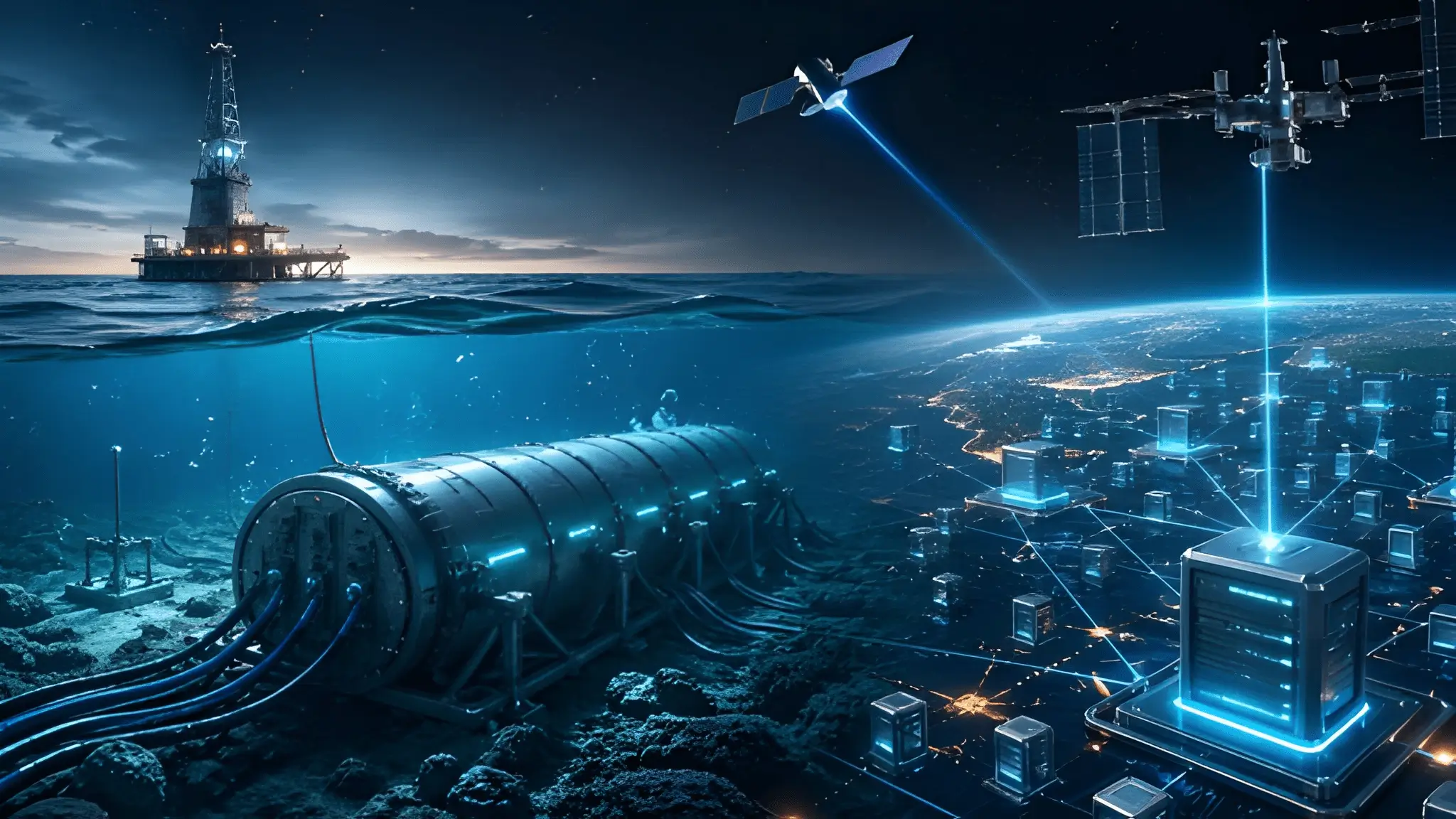
The infrastructure conversation has expanded from scale to include placement, and that added dimension introduces a more difficult question than capacity alone ever did. Engineers and strategists no longer debate whether compute will grow, because demand across AI, simulation, and real-time analytics workloads continues to accelerate and, in several segments, is approaching or exceeding earlier projections. The real tension now exists in deciding where that compute should physically reside when constraints evolve faster than architectures. Ocean floors promise cooling efficiency, orbital platforms suggest geographic independence, and edge networks claim proximity advantages. Each of these environments appears to solve a bottleneck that centralized data centers struggle to address at scale. However, infrastructure does not operate in isolation, and every new layer introduces operational friction that reshapes the problem instead of eliminating it.

The narrative surrounding these emerging environments often simplifies trade-offs into headline advantages, which distorts how systems behave under sustained load. Thermal efficiency in subsea deployments looks compelling until maintenance cycles and cable dependencies enter the equation. Orbital compute appears limitless until launch costs, radiation exposure, and latency boundaries impose hard ceilings. Edge computing presents itself as lightweight distribution, yet aggregate density across thousands of nodes increases total infrastructure burden rather than reducing it. These realities do not invalidate innovation across these layers, but they demand a system-level understanding that moves beyond isolated metrics. Infrastructure strategy now requires balancing competing constraints rather than optimizing a single variable.
Three Frontiers, One Problem: Compute Still Has to Live Somewhere
Every compute environment, regardless of abstraction, ultimately anchors itself in physical systems that obey energy, material, and spatial constraints. Ocean deployments rely on pressure-resistant enclosures, subsea cabling, and coastal integration points that tether them to terrestrial grids. Orbital systems depend on launch vehicles, station-keeping mechanisms, and ground communication networks that reintroduce Earth-based dependencies. Edge environments distribute compute closer to users, yet they require localized power, cooling, and connectivity infrastructure that scales horizontally. None of these layers escapes the requirement for physical hosting, even if the perception suggests otherwise. Constraints do not disappear when infrastructure shifts location, they redistribute across different domains. This redistribution often introduces new bottlenecks that remain less visible during early deployment phases.
The illusion of abstraction often leads stakeholders to underestimate the persistence of physical limitations across these environments. Subsea deployments still depend on energy delivery from land-based grids, which introduces vulnerability to coastal disruptions and regulatory frameworks. Orbital compute requires continuous telemetry, which depends on ground stations that limit operational independence. Edge nodes rely on distributed power networks that vary significantly in reliability across regions. These dependencies create interconnected risk profiles that extend beyond the immediate environment of the compute layer. Infrastructure resilience therefore becomes a function of the weakest link across all supporting systems. The problem of “where compute lives” evolves into a question of how interconnected systems sustain it under variable conditions.

Subsea Isn’t Passive: Cooling Efficiency Comes with Operational Complexity
Subsea data centers leverage the thermal properties of ocean water to dissipate heat more efficiently than traditional air-cooled systems. This advantage reduces energy consumption associated with cooling, which directly impacts operational expenditure in high-density workloads. However, the same environment that enables thermal efficiency introduces challenges in accessibility, maintenance, and repair cycles. Hardware failures underwater require specialized retrieval operations that increase downtime compared to terrestrial facilities. Deployment itself demands precise engineering to ensure structural integrity under pressure and long-term corrosion resistance. These complexities shift cost structures from energy consumption to lifecycle management and logistics.
The sealed and long-duration design of subsea infrastructure limits flexibility in scaling and upgrading systems once deployed without physical retrieval. Unlike modular land-based data centers, subsea units cannot be easily expanded or reconfigured without significant intervention. Network connectivity relies heavily on submarine cables, which represent critical points of failure and geopolitical sensitivity. Maintenance schedules must account for environmental factors such as marine growth and sediment accumulation that impact system performance over time. Additionally, regulatory frameworks governing ocean deployments vary across jurisdictions, complicating large-scale adoption. These factors transform subsea computing into a highly specialized solution rather than a universally scalable model.
Orbit Isn’t Infinite: The Physics, Cost, and Fragility of Space Compute
Orbital computing introduces a fundamentally different set of constraints driven by physics rather than geography. Launching infrastructure into space requires significant capital investment, with costs influenced by payload weight, frequency of launches, and mission duration. Once deployed, systems must operate within strict power budgets, often relying on solar energy and limited storage capacity. Radiation exposure presents a persistent threat to hardware reliability, necessitating specialized shielding and redundancy mechanisms. Communication latency, while reduced compared to deep-space systems, still exceeds terrestrial and edge-based alternatives for many applications. These limitations constrain the types of workloads that can realistically operate in orbit.
The fragility of orbital systems becomes more apparent when considering collision risks and debris accumulation in low Earth orbit. Space traffic has increased significantly, raising the probability of interference that could disrupt compute operations. Maintenance in orbit remains highly complex, often requiring robotic intervention or human missions that add to operational costs. Data transmission depends on ground stations, which reintroduces dependency on terrestrial infrastructure despite the perceived independence of space-based systems. Economic models for orbital compute remain uncertain, as revenue generation must offset both deployment and maintenance expenses. These constraints limit orbit to niche applications where its unique advantages justify the trade-offs.
Edge Isn’t Lightweight Anymore: The Hidden Density Problem
Edge computing emerged as a response to latency-sensitive applications, placing compute resources closer to end users and data sources. This approach reduces round-trip times and enables real-time processing for use cases such as autonomous systems and industrial automation. However, distributing compute across numerous edge nodes increases the total volume of infrastructure required to support these deployments. Each node requires its own power supply, cooling solution, and network connectivity, which collectively amplify resource consumption. The cumulative effect of thousands of distributed nodes can increase the overall infrastructure footprint in certain architectures, particularly where resource duplication and redundancy are required. This shift challenges the assumption that edge computing inherently reduces infrastructure burden.
Managing distributed infrastructure introduces operational complexity that scales with the number of deployed nodes. Monitoring, maintenance, and security must be coordinated across geographically dispersed locations, which increases management overhead. Edge environments often operate in less controlled conditions compared to traditional data centers, exposing systems to temperature fluctuations and physical risks. Standardization becomes difficult when deployments span diverse environments with varying requirements. Additionally, energy efficiency gains at individual nodes may not translate into system-wide savings when aggregated. These challenges position edge computing as an essential but resource-intensive layer within the broader infrastructure ecosystem.
Comparing subsea, orbital, and edge environments reveals a consistent pattern where each solution addresses a specific constraint while introducing additional challenges. Subsea deployments optimize cooling but complicate maintenance and scalability. Orbital systems offer geographic flexibility but face economic and physical limitations that restrict widespread adoption. Edge computing reduces latency but increases overall infrastructure density and management complexity. These trade-offs do not indicate failure, but they highlight the multidimensional nature of infrastructure design. Decision-making must therefore consider energy, latency, cost, and governance simultaneously rather than prioritizing a single metric.
System architects increasingly adopt hybrid approaches that combine multiple layers to balance these competing constraints. Workloads are distributed based on performance requirements, regulatory considerations, and cost efficiency. For instance, latency-sensitive applications may operate at the edge, while high-density compute tasks remain in centralized or specialized environments. Subsea and orbital layers may support niche use cases where their unique advantages align with specific operational needs. This orchestration requires advanced coordination mechanisms that ensure seamless integration across layers. Infrastructure strategy evolves from selecting a single environment to designing an interconnected ecosystem.
No Winners, Only Architecture Decisions
The question of which layer “wins” becomes irrelevant when examined through the lens of system-level performance and sustainability. Each environment contributes distinct capabilities that address specific challenges within the broader infrastructure landscape. Ocean, orbit, and edge do not compete in isolation, because their value emerges when integrated into a cohesive architecture. The future of compute infrastructure depends on orchestrating these layers to optimize performance across multiple dimensions. Decision-makers must evaluate trade-offs continuously as technology and demand evolve. The outcome is not a single dominant layer, but a dynamic balance shaped by context and constraints.











