 Skip to content
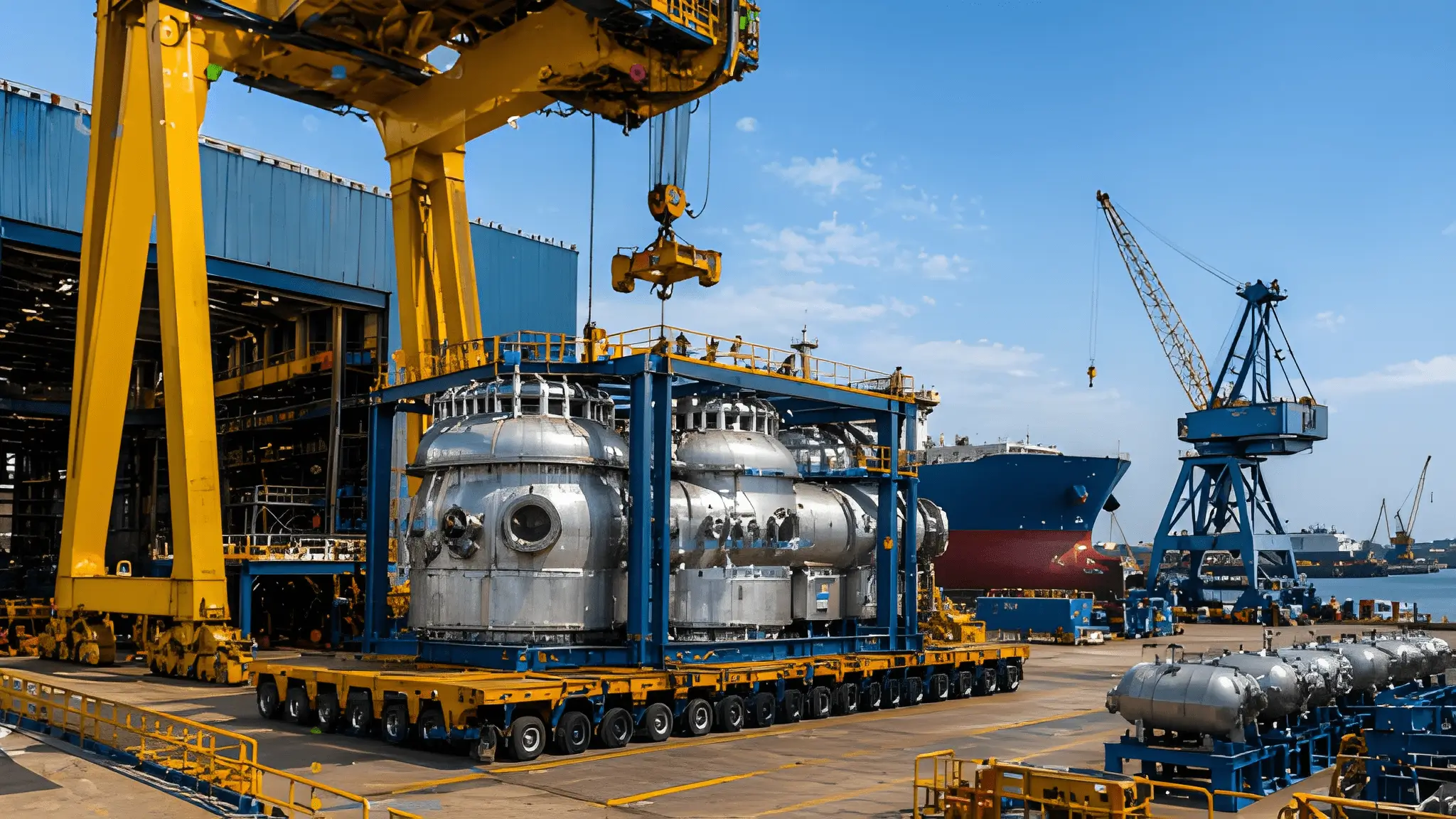
Blue Energy has raised $380 million to advance a shipyard-based model for building grid-scale nuclear reactors, positioning itself at the center of a shifting energy calculus shaped by artificial intelligence workloads and electrification demand. The funding arrives as utilities and hyperscale technology operators reassess nuclear power’s role in stabilizing long-term supply, particularly after recent U.S. reactor projects faced cost overruns and extended delays.

The company shifts away from on-site megaproject builds. It uses modular fabrication in shipyards instead. Standardized processes and repeatable engineering reduce execution risk. This move positions nuclear as an industrial product, not a one-off infrastructure gamble.
“This funding marks an important step in Blue Energy’s mission to make new nuclear more deployable, predictable, and financeable,” said Blue Energy CEO and Co-Founder Jake Jurewicz. “Blue Energy is poised to deliver a significantly de-risked product and finally attract the private capital that nuclear deployment has historically struggled to secure. And for the first time, a nuclear project is designed so that it doesn’t need to rely primarily on taxpayer dollars and ratepayers to backstop risk. By combining offsite prefabrication, standardized plant delivery and a disciplined development model, we believe Blue Energy can reduce cost and compress timelines with the goal of making nuclear power competitive with fossil fuel and renewables – all without sacrificing safety. Blue Energy is developing a nuclear power product designed to scale at a time when the world needs it most.”
Manufacturing Model Targets Cost and Timeline Compression
Blue Energy builds its strategy around prefabricated modular reactors. It assembles systems offsite and delivers them under fixed-price contracts. This approach directly tackles the industry’s biggest issue: unpredictable cost and timelines.

The company will begin construction in Texas in Q3 2026. The project targets up to 1.5 gigawatts of capacity. That output matches the rising demand from AI data centers and industrial workloads, which already strain grid capacity.
Blue Energy structures projects around predictable financing and standardized deployment. This approach unlocks private capital that nuclear has long failed to attract. However, execution discipline will determine success, especially across multiple builds.
Private Capital Bets on Nuclear’s Industrial Reset
The funding round reflects growing investor conviction that nuclear power can transition from a policy-dependent sector into a market-driven infrastructure class. Backers argue that demand signals from compute-heavy industries are reshaping the economics of baseload power.
“VXI is proud to partner with Blue Energy as the company unlocks the largest underutilized resource civilization has: nuclear power,” said Orin Hoffman, Managing Director of VXI Capital and Board Director at Blue Energy. “By delivering abundant, affordable nuclear power Blue Energy is perfectly positioned to meet rapidly increasing near-term energy demand from data centers and advanced manufacturing. Our investment reflects our confidence that, by building the world’s first project-financed nuclear power plant, Blue Energy will rewrite the playbook for nuclear power’s next era.”
The company plans to start construction of its first project in Texas in the third quarter of 2026, targeting up to 1.5 gigawatts of capacity. That output aligns with the accelerating power requirements of large-scale AI data centers and energy-intensive industrial operations, sectors that increasingly face grid constraints.
“The Blue Energy team has made remarkable progress de-risking the single hardest problem in nuclear, the cost structure that makes it project-financeable,” said Michael Kearney, General Partner at Engine Ventures and Board Director at Blue Energy. “Their manufacturing and development approach is what finally positions nuclear to run down the cost curve necessary for rapid deployment to meet this moment of demand growth, and we couldn’t be more excited to back them on that path.”
Regulatory Shift Enables Phased Nuclear Deployment
The U.S. Nuclear Regulatory Commission approved Blue Energy’s phased construction model. The company will first run turbines on natural gas, then switch them to nuclear generation.
This approach generates early revenue and lowers financial risk during development. It also sets a precedent for faster nuclear deployment in the U.S. Moreover, the model reflects current grid conditions. Power demand rises faster than nuclear build timelines. Developers can now bridge that gap with interim generation.
Compute Demand Forces Energy Infrastructure Rethink
The timing of Blue Energy’s expansion underscores a deeper structural shift: compute infrastructure now dictates energy strategy. AI data centers require continuous, high-density power, pushing utilities to secure stable baseload generation that renewables alone cannot guarantee.
Consequently, nuclear power is re-entering strategic discussions not as a legacy technology but as a necessary complement to intermittent energy sources. Blue Energy’s shipyard model attempts to resolve the economic barriers that previously limited adoption.
The company’s success will hinge on whether it can deliver repeatable builds at scale while maintaining cost discipline. If achieved, the implications extend beyond nuclear, potentially redefining how large-scale energy infrastructure is financed, constructed and deployed in the era of exponential compute growth.












