 Skip to content
The Middle East is rapidly repositioning itself as a critical hub for next-generation data infrastructure, as artificial intelligence workloads push operators beyond conventional design limits. Industry leaders now view the region not just as an emerging market, but as a proving ground for high-density, AI-native deployments.

Speaking on the transformation, Milan Radia, CEO of Connected Compute and partner at Taranis Capital, outlined how hyperscale demand is forcing a structural rethink of how data centres are built and operated. In conversation with Mark Walker, Radia pointed to a decisive break from legacy infrastructure models.
Data centres once functioned largely as “powered shells,” offering space and electricity with limited engineering complexity. That model is fading. Operators now design facilities around extreme compute density, driven by advanced AI hardware.
Radia highlighted that rack-level power requirements have escalated sharply. Earlier deployments operated at relatively low densities, but next-generation chips, such as those from Nvidia are redefining the baseline. The GB300 class systems now demand up to 150kW per rack, fundamentally altering thermal and electrical design assumptions.

This escalation is not incremental. It is architectural.
Sovereignty Drives On-Soil Infrastructure Expansion
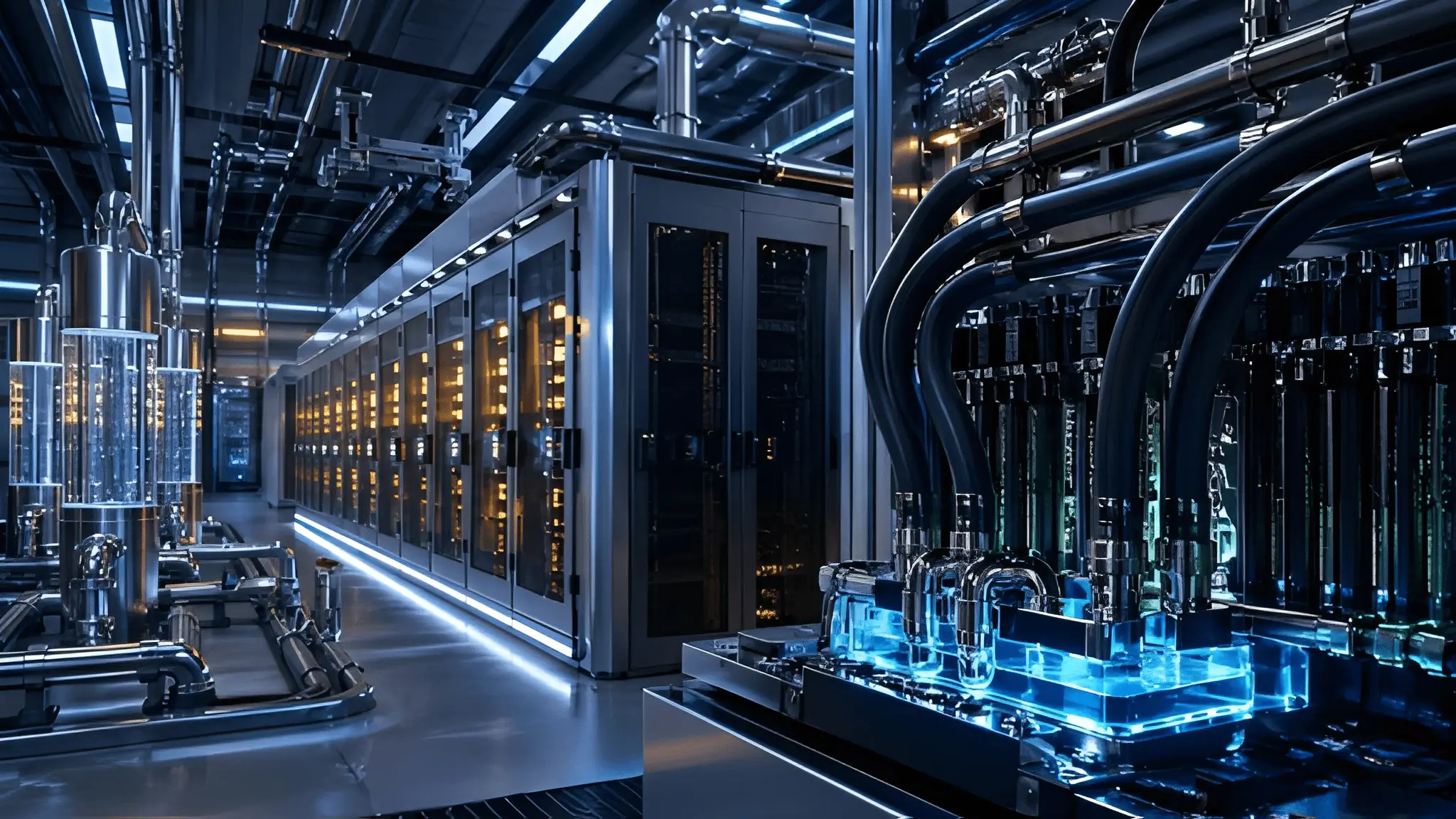
Air cooling no longer meets the thermal demands of AI-scale compute. As a result, liquid cooling has shifted from optional enhancement to operational necessity.
“Liquid is a much better conductor of heat,” Radia noted, adding that the shift from air-cooling to direct-to-chip liquid cooling is now a necessity for modern AI factories.
Direct-to-chip systems allow operators to extract heat more efficiently, maintain performance stability, and support sustained high workloads. However, this transition introduces a clear divide: facilities that cannot retrofit risk falling behind. Legacy infrastructure faces a narrowing window for adaptation. Operators must either upgrade aggressively or accept declining relevance in AI-driven markets.
Governments across the region are accelerating investments in domestic data capacity. Both the United Arab Emirates and Saudi Arabia are prioritising “on-soil” deployments to ensure control over sensitive data.
Radia pointed out that proprietary AI models increasingly underpin government and enterprise systems. These models require secure, localised infrastructure to manage confidential datasets and comply with regulatory frameworks.
The shift reflects more than compliance. It signals a strategic move to anchor AI capabilities within national borders. AI infrastructure demand is no longer dominated by model training alone. Operators now prioritise inferencing workloads, where systems deliver real-time outputs to end users. Applications such as Gemini depend on low-latency environments to function effectively. This requirement is pushing data centre design toward distributed architectures that place compute closer to users.
As a result, proximity has become as important as power.
Capital, GPUs, and Regional Momentum
The Middle East’s rise is also tied to strong capital inflows and access to advanced compute hardware. Strategic agreements and government-backed initiatives are accelerating deployment timelines.
Entities such as IHC are supporting large-scale infrastructure builds, enabling rapid scaling of AI-ready facilities. Availability of high-performance GPUs further strengthens the region’s position in the global compute race. Moreover, connectivity advantages and reliable energy supply continue to attract hyperscale interest.
The next phase of data centre growth will not reward scale alone. Operators must align infrastructure with the specific demands of AI workloads, density, cooling, and latency. Radia concluded that while the demand for capacity is vast, the winners will be those building distributed, high-density hubs that can handle the specific latency needs of the next generation of software.
The Middle East now stands at the intersection of capital, policy, and technology. Its ability to execute on this convergence will determine whether it leads or follows in the AI infrastructure era.












