 Skip to content
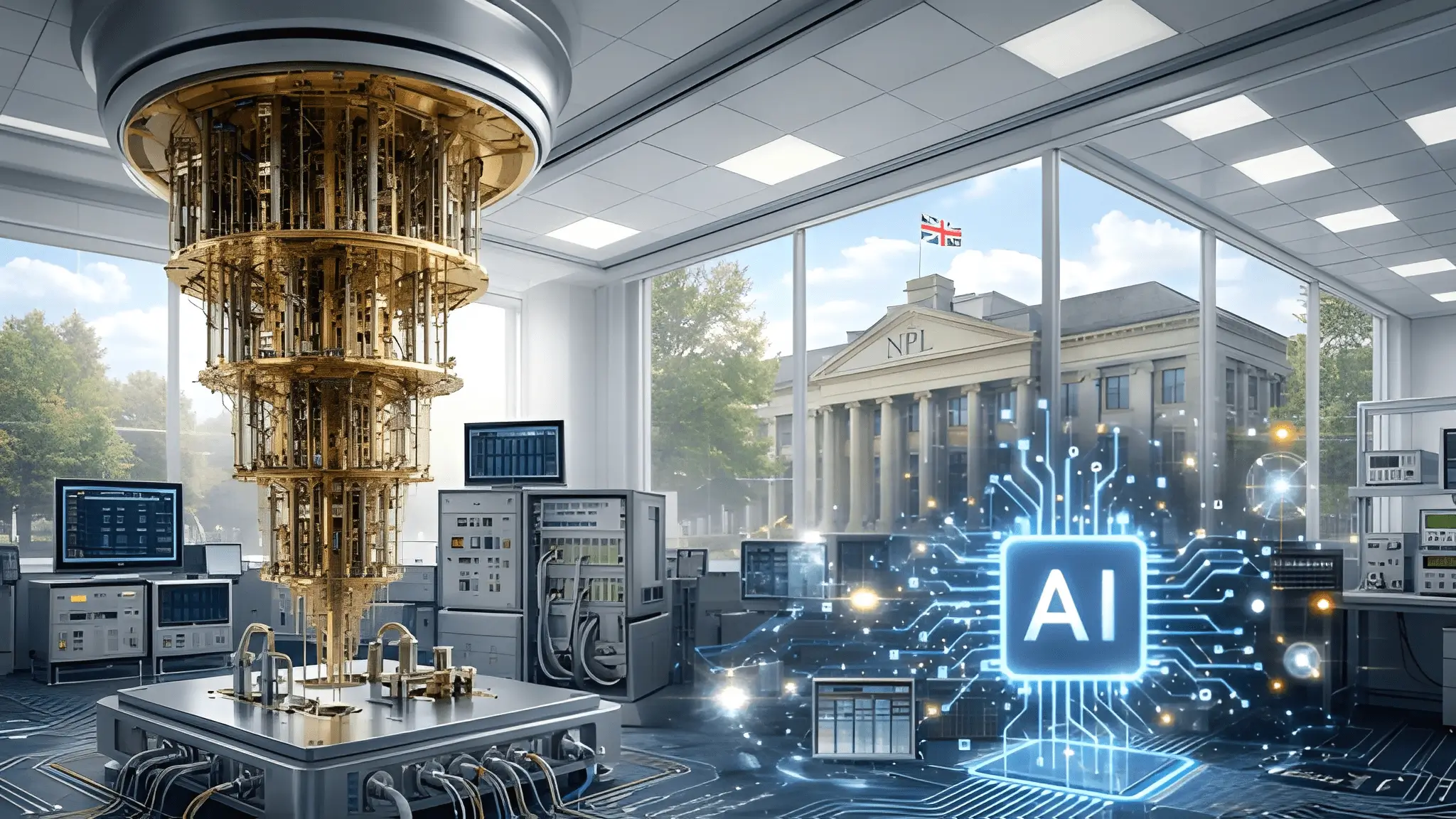
The UK’s National Physical Laboratory (NPL) has introduced NVIDIA Ising AI into its quantum measurement stack, marking a strategic shift in how calibration workflows scale alongside emerging quantum systems. The move positions AI not as an auxiliary tool, but as a foundational layer in the transition from experimental quantum devices to commercially viable infrastructure.

At the core of the deployment lies the integration of NVIDIA Ising capabilities within NPL’s existing quantum measurement environment. The initiative reflects a broader institutional mandate: as the UK’s national metrology authority, NPL defines and maintains precision standards critical to next-generation technologies. Within its Institute for Quantum Standards and Technology, research programs increasingly center on improving how quantum systems are measured, calibrated, and benchmarked under real-world conditions.
Automating Qubit Stability and Calibration Complexity
Quantum computing continues to confront a persistent constraint: qubit instability. These fundamental units of quantum information remain highly sensitive to environmental noise, thermal fluctuations, and device-level imperfections. As system scale increases, maintaining consistent qubit behavior becomes exponentially more complex.
NPL’s adoption of NVIDIA Ising AI directly addresses this operational bottleneck. Calibration, traditionally dependent on expert-led manual intervention, is now being embedded into automated pipelines powered by machine learning. This transition reduces the need for continuous human oversight while introducing greater consistency across measurement cycles.

Qubit performance hinges on coherence metrics, particularly the relaxation time known as T1. This parameter determines how long a qubit remains in an excited state before returning to its ground state. However, T1 is not constant; it fluctuates over time due to both internal system dynamics and external disturbances.
Historically, tracking these fluctuations required repeated manual validation. With NVIDIA Ising Calibration, NPL has demonstrated that such monitoring can be automated. The system uses a trained vision-language model to evaluate whether qubit coherence remains stable and to classify instability patterns, including abrupt shifts and gradual degradation.
AI-Driven Insight Expands Quantum System Visibility
This capability changes the calibration paradigm. Instead of reactive adjustments, researchers gain proactive insight into system behavior. Performance anomalies can be identified faster, while corrective strategies can be implemented with greater precision.
Alongside the deployment, NPL has collaborated on a benchmarking suite designed to evaluate AI-driven calibration methods. Within this framework, qubit coherence stability serves as a primary test case, enabling comparative analysis across different machine learning approaches.
The benchmarking initiative builds on earlier research demonstrating that machine learning can accelerate quantum device characterisation. More importantly, it extends beyond efficiency gains. AI-driven calibration introduces deeper visibility into the physical mechanisms that generate noise within quantum systems, offering a pathway to more stable and predictable hardware performance.
Standardisation Push Aligns With UK Quantum Strategy
NPL’s collaboration forms part of a wider effort to establish independent and transparent benchmarking standards for quantum technologies. As investment in quantum computing accelerates, the absence of reliable evaluation metrics has emerged as a critical barrier to commercial adoption.
By embedding NVIDIA Ising into its calibration infrastructure, NPL contributes to the development of standardized performance frameworks that can guide both public and private sector decision-making. These frameworks aim to bring clarity to system capabilities, enabling more informed capital allocation and technology roadmapping.
The initiative aligns with the UK’s National Quantum Technologies Programme, which prioritizes the advancement of scalable and commercially viable quantum systems. Measurement integrity and reproducibility are central to this agenda, positioning calibration as a strategic layer rather than a technical afterthought.
However, the implications extend beyond national strategy. As quantum systems move toward larger qubit counts and more complex architectures, calibration efficiency will define operational feasibility. AI-driven approaches, such as those enabled by NVIDIA Ising, signal a shift toward autonomous infrastructure capable of managing its own stability constraints.
Strategic Implications for Quantum Commercialisation
The integration of AI into quantum calibration marks a turning point in how the industry approaches scalability. NPL’s deployment illustrates that progress in quantum computing is no longer limited to hardware breakthroughs alone; it increasingly depends on the intelligence embedded within supporting systems.
As a result, calibration evolves from a maintenance function into a strategic enabler of performance. AI-driven measurement frameworks not only reduce operational friction but also establish the reliability required for enterprise adoption.
The trajectory is clear: quantum computing will scale only as fast as its ability to measure, validate, and stabilize itself. NPL’s move positions the UK at the forefront of this transition, where AI and metrology converge to define the next phase of compute infrastructure.










