
The Cost Line Nobody Sees on the Budget Sheet
Most AI leaders can identify the price of GPUs, cloud contracts, model licenses, and engineering talent within minutes. Financial reviews routinely track utilization, storage growth, token consumption, and infrastructure depreciation with impressive precision. Yet one cost category often remains buried inside broader operational metrics, where it escapes scrutiny despite influencing nearly every deployment decision. The issue does not originate from a lack of generating capacity or insufficient compute procurement. Instead, it emerges from the interaction between highly dynamic AI workloads and electrical systems designed around assumptions of relatively stable consumption patterns. As AI inference increasingly becomes the dominant workload across modern data center environments, power behavior itself becomes an operational variable rather than a background utility consideration.

Many organizations encounter this challenge through infrastructure overprovisioning, capacity-planning complexity, and performance variability that can be difficult to attribute to a single operational factor. Product teams frequently attribute the resulting inefficiencies to software architecture, orchestration complexity, or model design decisions. Infrastructure teams often respond by adding reserve capacity because reserve capacity appears easier to justify than diagnosing transient behavior across the electrical stack. The result creates a compounding cycle where technical teams absorb costs without identifying the originating source.Some infrastructure efficiency challenges originate from the interaction between workload behavior and the power environment supporting the workload. As AI infrastructure expands rapidly across hyperscale and enterprise deployments, understanding this relationship becomes increasingly important for maintaining development velocity.
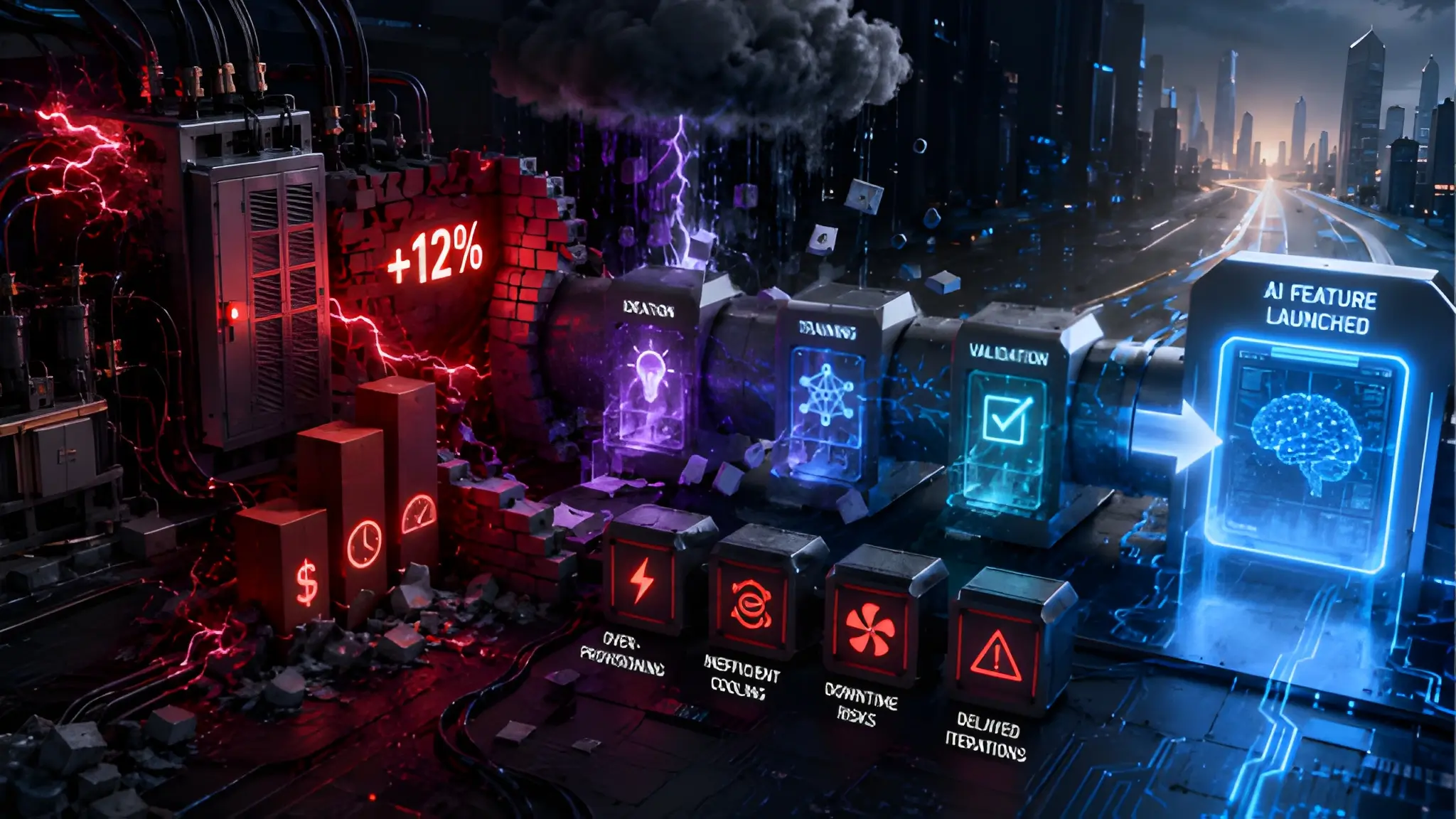
The 12% You Didn’t Model: Where Iteration Bills Hide in Your Waveform
AI development rarely progresses through a single training run followed by immediate production deployment. Teams repeatedly retrain models, execute fine-tuning cycles, perform evaluation passes, conduct safety testing, and launch multiple A/B experiments before approving a release candidate. Every iteration introduces a unique power profile driven by GPU synchronization, memory access patterns, communication overhead, and workload scaling behavior. Highly variable workload behavior can create planning and infrastructure-management challenges even when hardware resources appear adequately provisioned. Infrastructure operators commonly maintain reserve capacity and operational headroom to preserve reliability under changing workload conditions. These operational practices can influence how efficiently available infrastructure resources are utilized.
Waveform behavior matters because modern AI workloads do not consume energy at a constant rate. Large clusters can experience rapid ramps, synchronized demand spikes, and temporary valleys as distributed jobs transition between computational stages. These fluctuations require power delivery and cooling systems to accommodate changing demand patterns that are not fully reflected by steady-state utilization measurements. Research examining AI workload power profiles demonstrates that high-resolution workload measurements reveal substantial temporal variability that traditional planning assumptions often overlook. Accommodating highly variable demand often requires additional infrastructure planning, capacity management, and operational flexibility. Rather, the associated infrastructure requirements become part of the overall cost structure supporting model development and deployment activities.

Milliseconds That Kill Sprints: How Inference Jitter Becomes Roadmap Debt
Engineering organizations usually measure release velocity through deployment frequency, lead time, rollback rates, and incident recovery performance. Those indicators appear disconnected from electrical infrastructure at first glance. However, inference environments increasingly depend on tightly coordinated hardware systems that operate near utilization thresholds in pursuit of efficiency. Even short-duration transients can introduce latency variation that affects workload scheduling, queue management, and service responsiveness. Short-duration performance variations may not trigger outages, yet they can affect consistency across latency-sensitive production environments.Maintaining consistent performance across distributed environments often requires additional engineering effort and operational oversight.
Mixture-of-experts architectures, retrieval-augmented systems, and multimodal inference pipelines amplify this challenge because demand no longer scales linearly with user activity. Certain requests activate substantially larger compute pathways than others, creating bursts that infrastructure planners cannot accurately forecast using average utilization metrics alone. Product and infrastructure teams commonly expand validation and monitoring efforts when evaluating performance-sensitive production environments. Infrastructure teams often maintain operational headroom to support reliability objectives under changing workload conditions.
These operational measures require additional planning, monitoring, and resource management activities. As AI systems grow more complex, infrastructure management becomes an increasingly important consideration within broader technology planning and delivery processes.
Your Buffering Gap Is a Budget Gap: Supercaps vs. the ‘Wait-and-See’ Tax
Power buffering decisions often receive less strategic attention than compute procurement decisions despite influencing workload stability at a fundamental level. Many facilities continue to evaluate energy storage primarily through the lens of outage duration, resilience targets, and backup runtime requirements. That perspective remains important for business continuity, but AI environments introduce a different operational challenge measured in milliseconds rather than minutes. Training clusters and inference fleets generate abrupt load transitions that conventional battery systems were not originally optimized to address. Batteries perform exceptionally well when supplying sustained energy over longer intervals, yet transient events require extremely rapid response characteristics. As a result, organizations that rely exclusively on traditional buffering approaches may leave a performance gap between workload behavior and infrastructure response capability.
Supercapacitors occupy a different position within the energy-storage spectrum because they specialize in rapid charge and discharge cycles rather than extended duration support. Their value emerges when infrastructure operators need to absorb sudden fluctuations before those fluctuations propagate through the broader electrical environment. AI workloads frequently exhibit rapid changes in power demand that align with use cases commonly discussed in transient-response and power-buffering research. Organizations commonly use reserve capacity, operational headroom, and infrastructure redundancy to support reliability objectives under variable demand conditions. These approaches require additional infrastructure resources and operational planning that become part of ongoing facility management practices. The resulting infrastructure requirements can influence the overall economics of application development and deployment activities.
When “Predictive” Isn’t Predictable: EMS Blind Spots That Break ROI
Energy management systems have become significantly more sophisticated during the past decade. Operators now benefit from extensive telemetry, forecasting engines, automated controls, and workload-aware optimization frameworks that were unavailable in earlier generations of infrastructure. These platforms perform effectively when historical behavior provides a reliable foundation for future projections. Traditional enterprise applications, cloud services, and many transactional workloads fit that assumption reasonably well because their demand patterns evolve within relatively predictable ranges. Modern AI environments increasingly challenge those assumptions because workload characteristics can change dramatically between training cycles, inference stages, and model architectures. Consequently, prediction accuracy becomes harder to maintain even as monitoring visibility continues to improve.
Video generation models, diffusion-based systems, and large-scale multimodal workloads demonstrate why historical averages often provide an incomplete picture of future demand. These workloads can produce highly variable utilization patterns depending on prompt complexity, model routing decisions, concurrency levels, and inference pathways. EMS platforms frequently optimize around aggregate trends because aggregate trends remain easier to forecast than high-frequency transient behavior. Differences between forecasted and observed workload behavior can affect capacity-planning assumptions and infrastructure-management decisions. Infrastructure teams often maintain additional reliability margins when managing environments characterized by uncertain or rapidly changing demand patterns. Meanwhile, the associated infrastructure costs are frequently distributed across multiple operational and technology budgets.
Procurement’s Phantom Clause: The Frequency-Domain SLA Your Vendor Won’t Pitch
Infrastructure procurement discussions typically revolve around familiar metrics such as megawatts, uptime guarantees, power usage effectiveness, availability commitments, and expansion capacity. These measurements remain important because they establish the baseline operating conditions required for reliable facility performance. However, AI workloads increasingly expose limitations in contracts that focus exclusively on aggregate capacity rather than dynamic behavior. A facility may satisfy every contractual power obligation while still exhibiting characteristics that reduce workload efficiency under highly variable demand conditions. Procurement discussions have traditionally focused on capacity, reliability, and availability metrics, while dynamic electrical-performance characteristics have received less attention in many commercial frameworks. That gap creates a situation where infrastructure appears compliant on paper while introducing hidden operational friction in practice.
Frequency-domain behavior influences how infrastructure responds to rapidly changing loads generated by modern AI clusters. When vendors provide only steady-state performance guarantees, operators receive limited visibility into how systems behave during abrupt workload transitions. Engineering teams subsequently discover performance limitations after deployment, when modifying the infrastructure becomes substantially more expensive than addressing requirements during procurement. Including dynamic performance specifications within service-level agreements can provide greater visibility into how infrastructure responds under changing workload conditions. Such requirements do not replace traditional reliability metrics, but they complement them by reflecting the realities of contemporary AI environments. Procurement strategies that incorporate workload characteristics can support more informed infrastructure evaluation and planning decisions.
Stop Paying the Tax: Turning Waveforms Into a Launch Advantage
Organizations often pursue AI optimization through model compression, software acceleration, orchestration improvements, and hardware upgrades. Those initiatives remain valuable because they address important contributors to overall performance and cost efficiency. Yet infrastructure predictability increasingly deserves equal attention because it influences how effectively every other optimization delivers value. Infrastructure designs that account for workload behavior can support more effective capacity planning and operational management. Improved operational visibility can help teams make more informed decisions about infrastructure management and resource allocation. Infrastructure performance remains an important factor influencing the efficiency of AI development environments.
The most effective approach begins with measuring workload shape rather than focusing exclusively on average consumption metrics. High-resolution visibility into ramp rates, transient events, synchronization patterns, and demand variability provides a clearer understanding of how AI systems interact with supporting infrastructure. Dynamic buffering technologies, transient-response capabilities, and workload-aware power architectures are among the approaches being explored to manage highly variable power-demand patterns. Infrastructure planning increasingly considers both capacity requirements and workload variability as AI deployments expand. Consistent infrastructure performance remains an important objective for organizations conducting experimentation, validation, and deployment activities. Understanding workload-driven power behavior can contribute to broader infrastructure planning and operational decision-making efforts.











