
NVIDIA H200 shipments delayed to Q3  · BREAKING: Microsoft confirms 3GW data centre expansion in Asia-Pacific ·  AWS announces new sovereign cloud regions in India and UAE  · Arm-based servers now 24% of hyperscale deployments ·  EU AI Act enforcement enters phase two  · Global data centre investment hits $612B in 2026 ·  TSMC Arizona yields improve to 68% on 3nm process  · OpenAI valuation reaches $400B after latest funding round ·  NVIDIA H200 shipments delayed to Q3  · BREAKING: Microsoft confirms 3GW data centre expansion in Asia-Pacific ·  AWS announces new sovereign cloud regions in India and UAE  · Arm-based servers now 24% of hyperscale deployments ·  EU AI Act enforcement enters phase two  · Global data centre investment hits $612B in 2026

GM Targets AI Data Center Power With Sodium Batteries

General Motors is accelerating its push beyond electric vehicles, unveiling a broad energy-storage strategy that places the automaker at the

Share
GM Energy Storage

General Motors is accelerating its push beyond electric vehicles, unveiling a broad energy-storage strategy that places the automaker at the center of two fast-growing markets: AI data center power infrastructure and grid-scale energy storage. The company announced a series of partnerships and technology initiatives aimed at commercializing new battery chemistries, repurposing existing battery assets, and creating long-term opportunities in stationary power systems.

The move reflects a wider shift among automotive manufacturers seeking new revenue streams from battery technologies originally developed for electric vehicles. As AI-driven power demand rises and utilities seek additional storage capacity, battery makers and automakers increasingly view stationary energy storage as a major growth market. GM’s latest strategy combines new battery development, manufacturing partnerships, and second-life battery deployments, creating a diversified approach to serving both industrial customers and power-hungry digital infrastructure operators.

GM and Peak Energy Develop Sodium-Ion Batteries for Grid Deployments

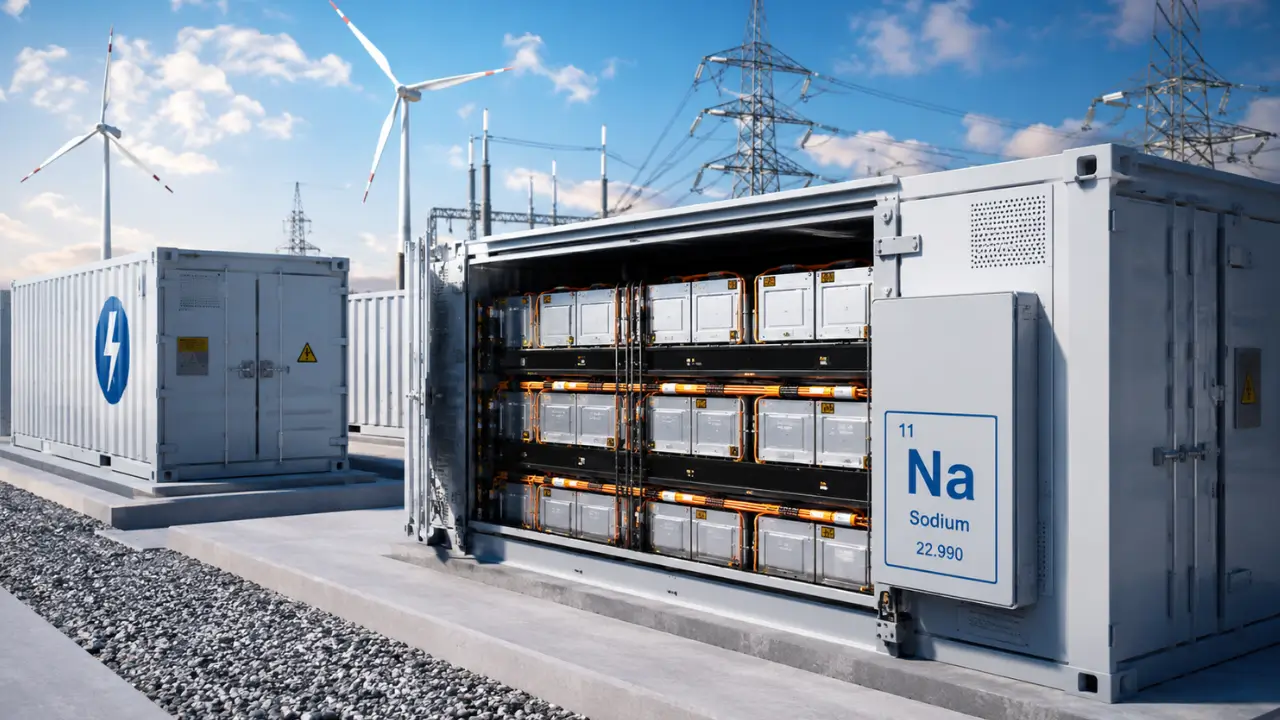
The centerpiece of GM’s announcement is a partnership with energy-storage startup Peak Energy to develop sodium-ion batteries specifically for grid-scale applications. The initiative marks one of the most significant sodium-ion battery programs announced by a major automaker outside China. Unlike traditional lithium-ion batteries, sodium-ion technology relies on more abundant and lower-cost materials. Industry advocates believe the chemistry can deliver longer operational lifespans while reducing safety concerns associated with thermal events. The tradeoff remains lower energy density, requiring larger battery systems to store equivalent amounts of electricity.

“The way we’re getting into the market is the easy way, through ESS,” Kurt Kelty, vice president of battery and sustainability at GM, told TechCrunch. “The performance characteristics are just what is needed in that market.” GM has not disclosed the financial commitment attached to the project. However, the automaker previously committed approximately $900 million toward commercializing next-generation battery technologies, including investments in advanced battery development facilities.

Simplified Battery Systems Could Reduce Long-Term Costs

Peak Energy has already designed energy-storage systems around the unique operating characteristics of sodium-ion batteries. Because the chemistry presents a lower overheating risk than conventional lithium-ion systems, the company has engineered products that eliminate several traditional support components. The design removes cooling and fire-suppression systems that often contribute significantly to installation and maintenance costs. As a result, developers may achieve lower upfront capital expenditures while also reducing operational complexity over the life of the asset.

“This is the manifestation of the hardest part to engineer is no part at all,” he said. “Eliminate the part, eliminate the problem.” GM intends to manufacture sodium-ion cells and supply them to Peak Energy, which will integrate the batteries into commercial storage products. Commercial deployment remains several years away, though, as the technology progresses through development and validation stages.

The first sodium-ion cells developed under GM’s program are expected to enter trial production in 2028 at the company’s Battery Cell Development Center. The facility forms a key part of GM’s broader effort to accelerate battery innovation and shorten commercialization timelines. Company executives believe the center can reduce development cycles by roughly a year, helping move emerging battery technologies from laboratory testing to commercial deployment more efficiently. Faster development could also lower costs associated with scaling new chemistries for industrial applications. Until sodium-ion production reaches commercial readiness, GM plans to support the energy-storage market through lithium iron phosphate (LFP) battery cells supplied through its existing relationship with LG Energy Solution. The two companies already collaborate through their battery manufacturing partnership supporting GM’s electric vehicle programs.

AI Data Centers Drive New Demand for Stationary Storage

The expansion arrives as AI infrastructure creates unprecedented demand for reliable power systems. Data centers increasingly require energy-storage assets to manage power fluctuations, improve uptime, and support growing computational workloads driven by graphics processing units. Consequently, battery technologies once reserved for transportation are becoming critical components of digital infrastructure. Developers are searching for solutions that can stabilize power delivery while reducing strain on local electrical grids.

GM’s energy-storage ambitions position the company to participate directly in this emerging market, where demand growth continues to outpace many traditional industrial sectors. Alongside its sodium-ion initiative, GM also announced an expanded relationship with Redwood Materials, the battery recycling and energy-storage company founded by former Tesla executive J.B. Straubel.

The companies already maintain an established supply chain relationship. Redwood purchases manufacturing scrap from GM battery facilities and receives used battery packs from the automaker’s electric vehicle fleet. GM currently has approximately 10,000 battery packs moving through that pipeline.Redwood has demonstrated the commercial potential of second-life batteries through a 12-megawatt, 63-megawatt-hour microgrid operating at a Crusoe data center in Sparks, Nevada. The project uses retired EV battery packs to support data center operations while extending battery value beyond automotive applications.


[simple-author-box]

More from AI Infrastructure

CtrlS draws fresh backing for its next build-out CtrlS Datacenters has secured ₹250 crore

Terranova has begun construction on Campus Campinas, a major hyperscale development outside São Paulo

Starcloud has raised $250 million in a Series A extension, giving the space-computing startup

COMPUTE WEEKLY

The briefing that 40,000+ tech leaders read every Monday. Sharp, fast, essential.

Great! We’ve received your information.

Building an AI Startup Without Owning GPUs

Not owning GPUs has become the default, deliberate strategy for building an AI company — not a compromise founders accept reluctantly. H100 rental rates fell 64-75% in fifteen months, a dense ecosystem of neoclouds and inference-as-a-service providers now lets startups skip infrastructure entirely, and credit programs can fund a company’s first year before a founder writes a check
Most Read

Demand is broadening across enterprise workloads APAC’s infrastructure story is changing in ways that

AI infrastructure decisions increasingly influence what enterprises can build, test, and deliver. They also

Why Infrastructure Planning Now Starts With Availability A data center project can have a

A property can look enormous from the site entrance and still offer almost no

As rack power rises toward the megawatt range, the physical footprint of power-delivery equipment

Disruptor Spotlight

Cerebras Systems

The chip that makes Nvidia nervous. Cerebras’ Wafer Scale Engine is rewriting the rules of AI inference at scale.
Faster
0 x
YoY Revenue
0 x
Transistors
0 T
Market Pulse
MSFT
+1.02%
NVDA
+0.66%
AMZN
-0.078%
AMD
-6.95%
TSMC
-2.98%
Indicative only · Not financial advice
Upcoming Events
SEP
The AI Infrastructure Race (India)
WEBINAR · ONLINE
The AI Infrastructure Race: Won on Power, Land and Trust — Not Capital
MAY
0
AI Infrastructure Summit
DUBAI · IN PERSON
MEA’s premier AI infrastructure event.
JUN
0 0
Compute Forecast Summit
SINGAPORE · IN PERSON
Our flagship APAC event. Early bird open.
Latest Moves
Live
ecolab
Ecolab Deepens Cooling Strategy With $4.75B CoolIT Acquisition
Ecolab is making one of its biggest moves yet into AI infrastructure after completing its $4.75 billion acquisition of liquid cooling specialist CoolIT Systems
Pure DC AVK Europe data center microgrid Dublin 110MW AI infrastructure Ireland 2026
Pure DC and AVK Deploy Europe’s First 110 MW Data Center Microgrid in Dublin
The Pure DC Dublin microgrid has made history as Europe’s first large-scale on-site data center microgrid, launched in partnership with power solutions provider AVK at Pure DC’s campus in Ireland.
Pace Digitek
Pace Digitek Partners With MEGMEET to Expand AI Data Center Power Business
India’s AI infrastructure ecosystem continues to mature as domestic technology manufacturers move beyond traditional telecommunications and industrial markets toward high-growth digital infrastructure opportunities
Follow Compute Forecast
11K followers
1200 followers
Companies to Watch
CW
CoreWeave
Neo Cloud · $19B · IPO Watch
CB
Cerebras Systems
AI Hardware · $4.25B · Pre-IPO
G42
G42
Sovereign AI · Abu Dhabi
H
Humain
Saudi AI · $40B Fund
Latest Podcast
AI Capex, Cloud Margins & the Nuclear Bet
48 MIN · 25 APR 2026

GM Targets AI Data Center Power With Sodium Batteries

General Motors is accelerating its push beyond electric vehicles, unveiling a broad energy-storage strategy that places the automaker at the

Share
GM Energy Storage
32
847 SHARES

0
SHARES

[simple-author-box]

More from AI Infrastructure

Demand is broadening across enterprise workloads APAC’s infrastructure story is changing in ways that

AI infrastructure decisions increasingly influence what enterprises can build, test, and deliver. They also

Why Infrastructure Planning Now Starts With Availability A data center project can have a

A property can look enormous from the site entrance and still offer almost no

COMPUTE WEEKLY

The briefing that 40,000+ tech leaders read every Monday. Sharp, fast, essential.

Great! We’ve received your information.

Global AI Infrastructure Outlook 2026

The briefing that 40,000+ tech leaders read every Monday. Sharp, fast, essential.
Download Free
Most Read

Demand is broadening across enterprise workloads APAC’s infrastructure story is changing in ways that

AI infrastructure decisions increasingly influence what enterprises can build, test, and deliver. They also

Why Infrastructure Planning Now Starts With Availability A data center project can have a

A property can look enormous from the site entrance and still offer almost no

As rack power rises toward the megawatt range, the physical footprint of power-delivery equipment

Disruptor Spotlight

Cerebras Systems

The chip that makes Nvidia nervous. Cerebras’ Wafer Scale Engine is rewriting the rules of AI inference at scale.
Faster
0 x
YoY Revenue
0 x
Transistors
0 T
Market Pulse
NVDA
$924.60
+2.4%
MSFT
$421.30
+1.1%
AMZN
$192.80
-0.6%
NVDA
$924.60
+2.4%
NVDA
$924.60
+2.4%
Indicative only · Not financial advice
Upcoming Events
MAY
0 0
DCD Global — London
LONDON · IN PERSON
World’s largest DC event. CF is media partner.
MAY
0
AI Infrastructure Summit
DUBAI · IN PERSON
MEA’s premier AI infrastructure event.
JUN
0 0

Compute Forecast Summit

SINGAPORE · IN PERSON
Our flagship APAC event. Early bird open.
Latest Moves
  • Live
Sam Altman
OpenAI appoints new Chief Infrastructure Officer to lead $100B DC programme
27 APR · OPENAI
Sam Altman
OpenAI appoints new Chief Infrastructure Officer to lead $100B DC programme
27 APR · OPENAI
Sam Altman
OpenAI appoints new Chief Infrastructure Officer to lead $100B DC programme
27 APR · OPENAI
Follow Compute Forecast
18.4K followers
12.1K followers
9.3K subscribers
41 episodes
Companies to Watch
CW
CoreWeave
Neo Cloud · $19B · IPO Watch
CB
Cerebras Systems
AI Hardware · $4.25B · Pre-IPO
G42
G42
Sovereign AI · Abu Dhabi
CW
Humain
Saudi AI · $40B Fund
Latest Podcast
AI Capex, Cloud Margins & the Nuclear Bet
48 MIN · 25 APR 2026
Scroll to Top








