...
NVIDIA H200 shipments delayed to Q3  · BREAKING: Microsoft confirms 3GW data centre expansion in Asia-Pacific ·  AWS announces new sovereign cloud regions in India and UAE  · Arm-based servers now 24% of hyperscale deployments ·  EU AI Act enforcement enters phase two  · Global data centre investment hits $612B in 2026 ·  TSMC Arizona yields improve to 68% on 3nm process  · OpenAI valuation reaches $400B after latest funding round ·  NVIDIA H200 shipments delayed to Q3  · BREAKING: Microsoft confirms 3GW data centre expansion in Asia-Pacific ·  AWS announces new sovereign cloud regions in India and UAE  · Arm-based servers now 24% of hyperscale deployments ·  EU AI Act enforcement enters phase two  · Global data centre investment hits $612B in 2026

Google Unveils Brazos to Extend Liquid Cooling Without Data Center Rebuilds

Google has introduced Brazos, a rack-mounted liquid cooling platform designed to help data center operators support increasingly power-hungry artificial intelligence

Share
Google Brazos

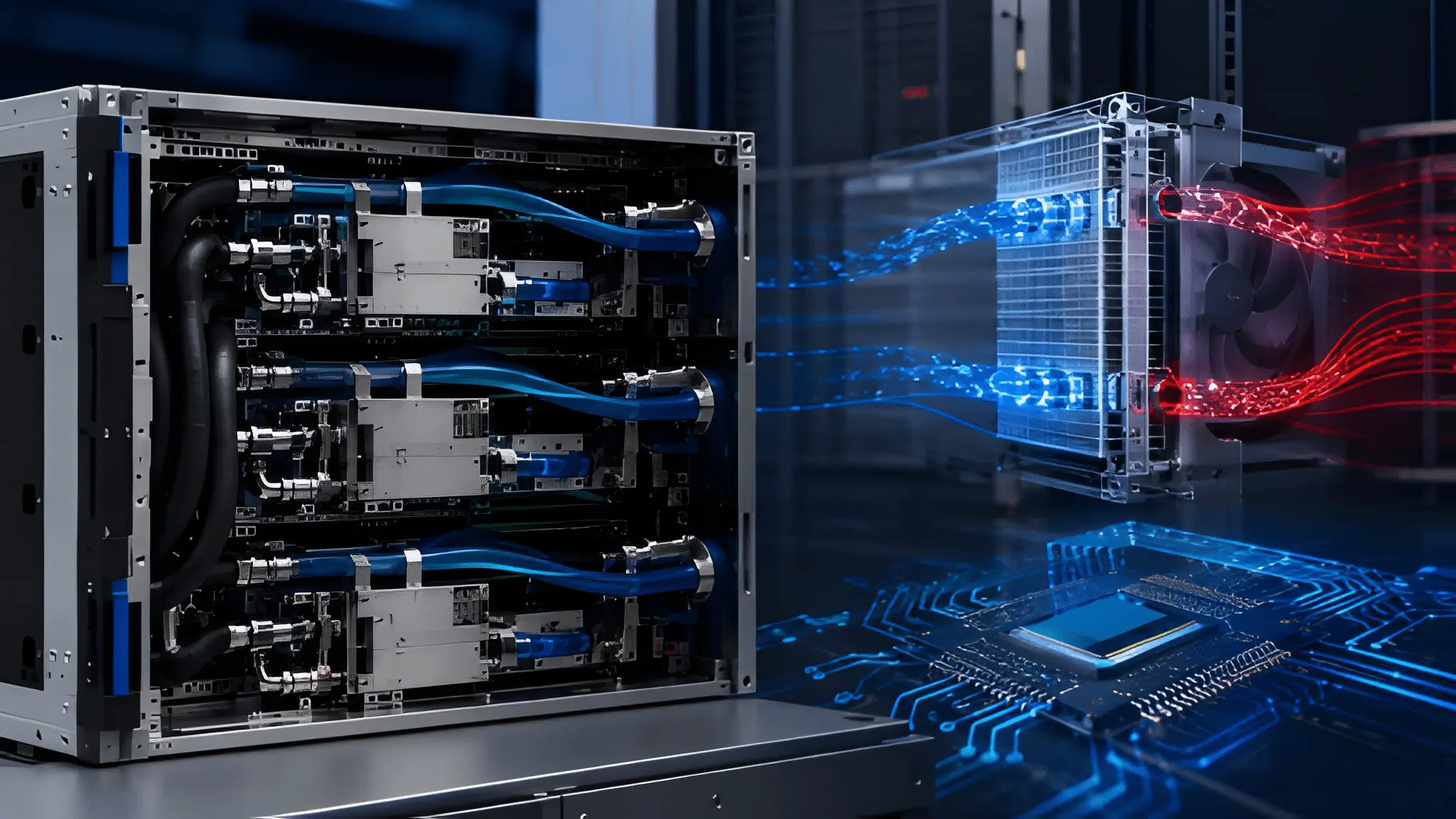
Google has introduced Brazos, a rack-mounted liquid cooling platform designed to help data center operators support increasingly power-hungry artificial intelligence and high-performance computing infrastructure without undertaking costly facility overhauls.

The launch comes as AI hardware power consumption continues to climb across the industry. According to Google, next-generation AI and HPC processors now regularly exceed 1,000 watts of thermal design power, creating thermal management challenges that traditional air-cooling systems struggle to address. As rack densities increase, operators face mounting pressure to deploy more efficient cooling technologies while preserving existing infrastructure investments. The challenge has become especially acute as enterprises and cloud providers race to scale AI capacity.

Brazos aims to bridge that gap by enabling liquid-cooled IT equipment to operate within facilities originally designed for air-cooled deployments. Instead of requiring large-scale mechanical retrofits, the platform allows operators to introduce liquid cooling incrementally at the rack level. That approach could prove attractive for organizations seeking to expand AI capabilities without disrupting active data center environments. The strategy also reflects a broader industry shift toward modular infrastructure modernization.

Google Positions Brazos as a Retrofit-Friendly Cooling Solution

At its core, Brazos operates as a closed-loop liquid-to-air cooling system. The platform captures heat directly from computing components through liquid cooling and subsequently transfers that heat into the facility’s hot aisle using liquid-to-air heat exchangers. This design avoids direct dependence on building water infrastructure while maintaining thermal efficiency for high-density workloads. As a result, operators gain a pathway to support advanced AI hardware inside legacy facilities.

Google said the system separates the internal IT liquid loop from the data center’s facility water supply. This architecture allows deployments to occur one rack at a time rather than requiring facility-wide modifications. For operators managing mixed environments, that flexibility could simplify migration strategies and reduce implementation risks. It also creates opportunities for phased infrastructure upgrades aligned with AI capacity growth.

The company designed Brazos to support organizations facing space, budget, and operational constraints. Rather than replacing entire cooling ecosystems, operators can selectively deploy liquid cooling where thermal demands justify the investment. This modular model aligns with growing industry demand for scalable infrastructure solutions capable of adapting to rapidly changing AI hardware requirements. Consequently, data center operators may find it easier to balance performance growth against capital expenditures.

Technical Design Supports High-Density AI Deployments

Brazos includes three cooling units alongside integrated rack manifolds. Each modular chassis occupies 11 Open Units of rack space and supports Open Compute Project ORv3 rack standards. The platform delivers a nominal thermal load capacity of 60 kilowatts per rack when configured across three modular units. Those specifications position the system for deployments involving modern AI accelerators and advanced HPC infrastructure.

The cooling platform supports operation using either deionized water or a 25% propylene glycol mixture. Google designed the system to run on 40 to 60-volt DC power inputs while incorporating multiple operational safeguards. These include leak detection capabilities, pressure relief valves, local monitoring functions, and remote management through Modbus over TCP. Together, those features aim to enhance reliability and operational visibility within high-density computing environments.

The growing adoption of liquid cooling technologies reflects broader changes occurring across the AI infrastructure market. As processor power densities rise, thermal management increasingly influences facility design decisions, deployment timelines, and operational efficiency. Cooling systems that can integrate into existing environments are attracting attention from operators seeking to accelerate AI deployment schedules. Brazos enters the market at a time when many organizations are evaluating how best to accommodate next-generation compute platforms.

Open Availability Signals Broader Industry Ambitions

Google said Brazos is now generally available, with manufacturing suppliers prepared to bring the design to market for broader industry adoption. The move signals the company’s intention to extend the platform beyond internal infrastructure and contribute to wider ecosystem development. By enabling external manufacturing, Google is positioning Brazos as a scalable solution for operators confronting AI-driven thermal challenges.

The company also plans to open source the platform’s technical specifications, design principles, and visual assets through industry forums in the coming months. That decision aligns with growing collaboration across the data center sector as operators, equipment vendors, and hyperscalers work to establish common approaches for high-density AI deployments. Open specifications could help accelerate adoption and interoperability across the industry. The initiative also reinforces the increasing role of shared engineering frameworks in shaping the next generation of AI infrastructure.

AI Cooling Becomes the Next Data Center Battleground

The launch of Brazos highlights a growing reality across digital infrastructure markets: cooling has become as strategically important as compute itself. While AI innovation continues to push processor performance higher, thermal constraints increasingly determine how quickly new capacity can be deployed. Solutions that extend the life of existing facilities while enabling higher-density computing are likely to play a central role in future infrastructure strategies. Google’s latest move underscores how the competition to support AI growth is now expanding well beyond chips and into the physical foundations of the data center.


[simple-author-box]

More from AI Infrastructure

Goodman Secures Major Hyperscaler Commitment Goodman Group has signed a 20-year lease with an

Dell’Oro Group expects the global data center physical infrastructure market to reach $120 billion

Micron Technology is committing $10 billion to a new research organization designed to tackle

COMPUTE WEEKLY

The briefing that 40,000+ tech leaders read every Monday. Sharp, fast, essential.

Great! We’ve received your information.

Building an AI Startup Without Owning GPUs

Not owning GPUs has become the default, deliberate strategy for building an AI company — not a compromise founders accept reluctantly. H100 rental rates fell 64-75% in fifteen months, a dense ecosystem of neoclouds and inference-as-a-service providers now lets startups skip infrastructure entirely, and credit programs can fund a company’s first year before a founder writes a check
Most Read

Demand is broadening across enterprise workloads APAC’s infrastructure story is changing in ways that

AI infrastructure decisions increasingly influence what enterprises can build, test, and deliver. They also

Why Infrastructure Planning Now Starts With Availability A data center project can have a

A property can look enormous from the site entrance and still offer almost no

As rack power rises toward the megawatt range, the physical footprint of power-delivery equipment

Disruptor Spotlight

Cerebras Systems

The chip that makes Nvidia nervous. Cerebras’ Wafer Scale Engine is rewriting the rules of AI inference at scale.
Faster
0 x
YoY Revenue
0 x
Transistors
0 T
Market Pulse
MSFT
+1.02%
NVDA
+0.66%
AMZN
-0.078%
AMD
-6.95%
TSMC
-2.98%
Indicative only · Not financial advice
Upcoming Events
SEP
The AI Infrastructure Race (India)
WEBINAR · ONLINE
The AI Infrastructure Race: Won on Power, Land and Trust — Not Capital
MAY
0
AI Infrastructure Summit
DUBAI · IN PERSON
MEA’s premier AI infrastructure event.
JUN
0 0
Compute Forecast Summit
SINGAPORE · IN PERSON
Our flagship APAC event. Early bird open.
Latest Moves
Live
ecolab
Ecolab Deepens Cooling Strategy With $4.75B CoolIT Acquisition
Ecolab is making one of its biggest moves yet into AI infrastructure after completing its $4.75 billion acquisition of liquid cooling specialist CoolIT Systems
Pure DC AVK Europe data center microgrid Dublin 110MW AI infrastructure Ireland 2026
Pure DC and AVK Deploy Europe’s First 110 MW Data Center Microgrid in Dublin
The Pure DC Dublin microgrid has made history as Europe’s first large-scale on-site data center microgrid, launched in partnership with power solutions provider AVK at Pure DC’s campus in Ireland.
Pace Digitek
Pace Digitek Partners With MEGMEET to Expand AI Data Center Power Business
India’s AI infrastructure ecosystem continues to mature as domestic technology manufacturers move beyond traditional telecommunications and industrial markets toward high-growth digital infrastructure opportunities
Follow Compute Forecast
11K followers
1200 followers
Companies to Watch
CW
CoreWeave
Neo Cloud · $19B · IPO Watch
CB
Cerebras Systems
AI Hardware · $4.25B · Pre-IPO
G42
G42
Sovereign AI · Abu Dhabi
H
Humain
Saudi AI · $40B Fund
Latest Podcast
AI Capex, Cloud Margins & the Nuclear Bet
48 MIN · 25 APR 2026

Google Unveils Brazos to Extend Liquid Cooling Without Data Center Rebuilds

Google has introduced Brazos, a rack-mounted liquid cooling platform designed to help data center operators support increasingly power-hungry artificial intelligence

Share
Google Brazos
66
847 SHARES

0
SHARES

[simple-author-box]

More from AI Infrastructure

Demand is broadening across enterprise workloads APAC’s infrastructure story is changing in ways that

AI infrastructure decisions increasingly influence what enterprises can build, test, and deliver. They also

Why Infrastructure Planning Now Starts With Availability A data center project can have a

A property can look enormous from the site entrance and still offer almost no

COMPUTE WEEKLY

The briefing that 40,000+ tech leaders read every Monday. Sharp, fast, essential.

Great! We’ve received your information.

Global AI Infrastructure Outlook 2026

The briefing that 40,000+ tech leaders read every Monday. Sharp, fast, essential.
Download Free
Most Read

Demand is broadening across enterprise workloads APAC’s infrastructure story is changing in ways that

AI infrastructure decisions increasingly influence what enterprises can build, test, and deliver. They also

Why Infrastructure Planning Now Starts With Availability A data center project can have a

A property can look enormous from the site entrance and still offer almost no

As rack power rises toward the megawatt range, the physical footprint of power-delivery equipment

Disruptor Spotlight

Cerebras Systems

The chip that makes Nvidia nervous. Cerebras’ Wafer Scale Engine is rewriting the rules of AI inference at scale.
Faster
0 x
YoY Revenue
0 x
Transistors
0 T
Market Pulse
NVDA
$924.60
+2.4%
MSFT
$421.30
+1.1%
AMZN
$192.80
-0.6%
NVDA
$924.60
+2.4%
NVDA
$924.60
+2.4%
Indicative only · Not financial advice
Upcoming Events
MAY
0 0
DCD Global — London
LONDON · IN PERSON
World’s largest DC event. CF is media partner.
MAY
0
AI Infrastructure Summit
DUBAI · IN PERSON
MEA’s premier AI infrastructure event.
JUN
0 0

Compute Forecast Summit

SINGAPORE · IN PERSON
Our flagship APAC event. Early bird open.
Latest Moves
  • Live
Sam Altman
OpenAI appoints new Chief Infrastructure Officer to lead $100B DC programme
27 APR · OPENAI
Sam Altman
OpenAI appoints new Chief Infrastructure Officer to lead $100B DC programme
27 APR · OPENAI
Sam Altman
OpenAI appoints new Chief Infrastructure Officer to lead $100B DC programme
27 APR · OPENAI
Follow Compute Forecast
18.4K followers
12.1K followers
9.3K subscribers
41 episodes
Companies to Watch
CW
CoreWeave
Neo Cloud · $19B · IPO Watch
CB
Cerebras Systems
AI Hardware · $4.25B · Pre-IPO
G42
G42
Sovereign AI · Abu Dhabi
CW
Humain
Saudi AI · $40B Fund
Latest Podcast
AI Capex, Cloud Margins & the Nuclear Bet
48 MIN · 25 APR 2026
Scroll to Top
Seraphinite AcceleratorOptimized by Seraphinite Accelerator
Turns on site high speed to be attractive for people and search engines.