 Skip to content
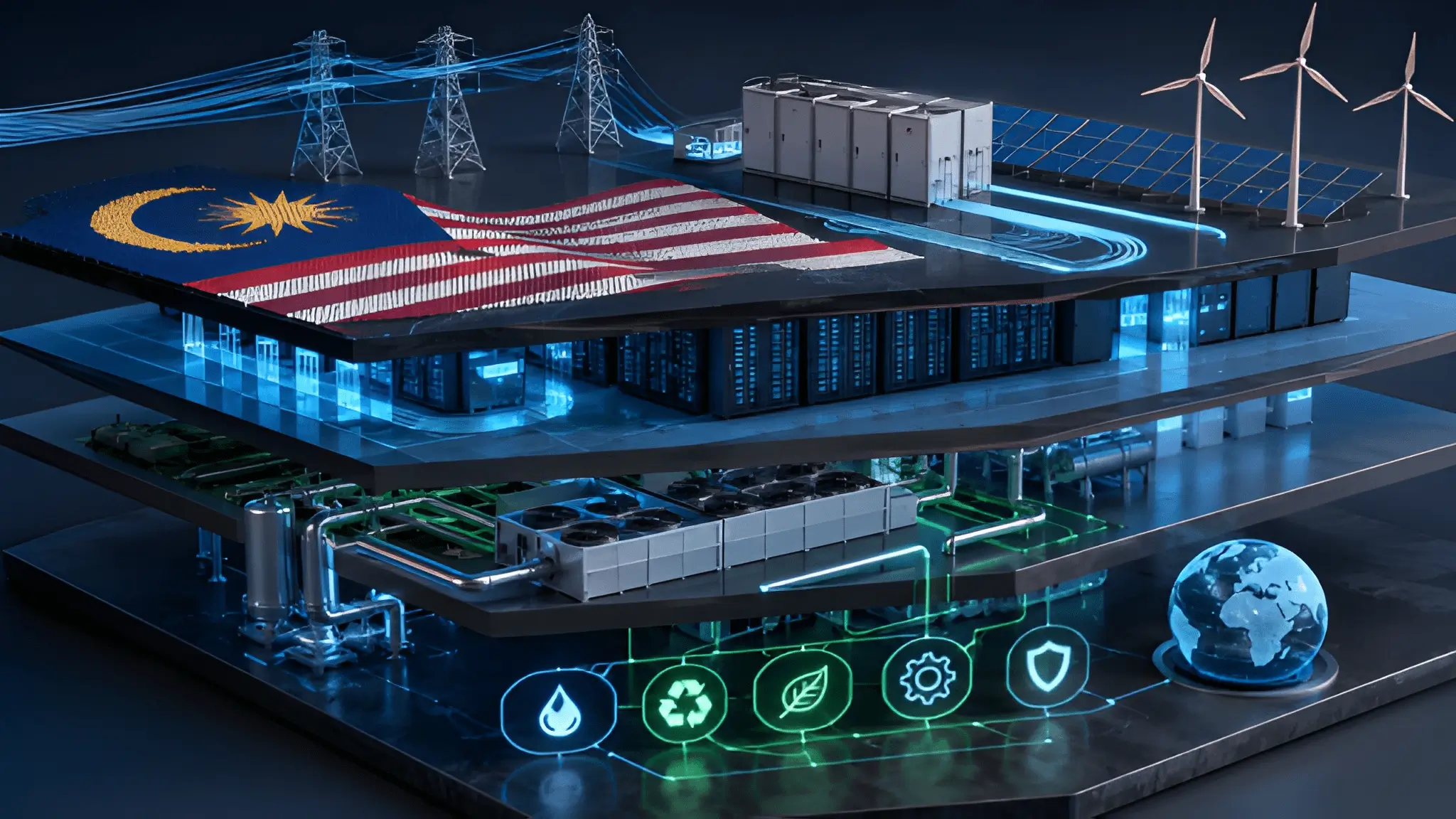
Malaysia’s data center sector is discovering that environmental performance rarely improves through a single technological leap. Instead, operators are increasingly combining a series of targeted upgrades across cooling, water management, energy sourcing and backup power systems to reduce resource consumption while supporting the rapid expansion of artificial intelligence infrastructure. As hyperscale campuses continue to spread across Johor, Cyberjaya and emerging digital corridors, developers are balancing growing computing requirements against tighter expectations around efficiency and resource stewardship. The industry’s approach reflects a broader recognition that sustainability in digital infrastructure requires continuous optimisation rather than dependence on a breakthrough solution. Industry participants interviewed for the report described a preference for deploying multiple incremental improvements across cooling, water and energy systems rather than waiting for a single transformative technology. That philosophy is shaping investment decisions across both existing facilities and new developments entering the Malaysian market.

According to OpenDC Sdn Bhd Managing Director Wong Weng Yew, progress is emerging through a collection of smaller innovations that collectively deliver meaningful environmental benefits. “There has not been one major breakthrough that changes the whole thing. What I am seeing right now is a number of minor breakthroughs that together will be very significant,” Wong tells ESG. He points to advancements in water conservation technologies that are helping operators significantly reduce consumption while maintaining operational performance. “In terms of water conservation, there have been technologies evolving that can help to reduce water utilisation by up to 50%, 60%. So that is something I am happy to see the industry moving forward with.” Such developments come as AI infrastructure deployment increases attention on the long-term energy and water requirements associated with data center growth.
Advanced Cooling Technologies Move Into the Mainstream
Cooling infrastructure is a major focus of technology upgrades across Malaysia’s data center industry, according to the operators and vendors cited in the report. Facilities that once relied on traditional air-conditioning systems are now moving toward increasingly sophisticated thermal management architectures capable of supporting higher-density computing environments. OpenDC’s operational history illustrates how quickly cooling technologies have evolved during the past decade. Its first data hall, commissioned in 2015, relied on air-cooling systems similar in concept to conventional split-unit designs. Subsequent upgrades introduced chilled-water systems followed by fan-wall cooling technologies that now form the backbone of most of the company’s facilities. Each stage delivered incremental efficiency improvements while preparing infrastructure for future computing requirements.
The next phase centers on direct-to-chip liquid cooling, a technology designed to manage the intense heat generated by AI processors and graphics processing units. Instead of cooling the surrounding air, liquid circulates directly through heat sinks attached to critical computing components, removing heat more efficiently and reducing energy consumption associated with traditional cooling methods. OpenDC is rapidly expanding deployment of the technology across its portfolio. “By year’s end, more than 70% of our capacity will be cooled down using this technology,” Wong says. The transition reflects a broader industry shift as operators prepare for workloads that increasingly exceed the thermal limits of conventional air-cooled environments. Direct-to-chip liquid cooling is increasingly being deployed by operators seeking to support higher-density AI workloads.
Benchmark to the Liquid Cooling Technologies
Beyond direct-to-chip systems, operators continue to evaluate immersion cooling technologies that submerge server hardware in dielectric fluids. The approach offers the potential to drive power usage effectiveness levels close to 1.0, a benchmark long considered difficult to achieve at scale. However, commercial adoption remains limited because the economics remain challenging for many operators. Specialised fluids, customised infrastructure requirements and a shortage of trained personnel continue to create barriers to wider deployment. For many companies, the decision ultimately hinges on whether marginal efficiency gains justify substantial additional investment. As a result, operators cited in the report continue to deploy direct-to-chip liquid cooling more widely while evaluating immersion cooling for specific use cases.
Water Conservation Is Emerging as a Strategic Priority
Water management is receiving greater attention from operators as data center development expands across Malaysia. While energy consumption often dominates discussions around digital infrastructure sustainability, operators are paying closer attention to how cooling systems affect long-term water demand. OpenDC is evaluating alternative technologies designed to minimise dependence on evaporative cooling processes. Among those options are eco-chillers configured for dry-site environments, where heat rejection occurs through closed-loop systems that do not require ongoing water consumption. Such systems offer a potential pathway for reducing exposure to future water constraints while maintaining operational resilience. The strategy reflects efforts by operators to evaluate long-term resource requirements as data center capacity continues to expand.

Wong mentioned; “Most of our data centres do not have a water issue, but we are always looking into newer solutions, because eventually, water will be exhausted as the data centre industry grows.” That long-term perspective is gaining relevance as operators plan facilities that can operate for decades. They now evaluate water consumption alongside power, connectivity and other infrastructure requirements when selecting cooling technologies. Consequently, many operators consider water efficiency much earlier in the development process. Their decisions show that sustainability metrics now play a larger role in digital infrastructure planning.
AI Infrastructure Is Redefining Facility Design Requirements
The rise of artificial intelligence workloads is accelerating changes across the entire data center ecosystem. Facilities designed only a few years ago often face new performance requirements that exceed original planning assumptions. Vertiv Malaysia director of sales management and country head CK Wong says many facilities constructed during 2023 and 2024 were designed for rack densities ranging between 10kW and 20kW. Those specifications increasingly fall short of what AI applications demand today. As a result, operators are exploring retrofit strategies that allow infrastructure upgrades without disrupting ongoing operations. The challenge, according to infrastructure vendors, is accommodating higher-density computing requirements while enabling future technology upgrades.
Wong also views Johor’s evolving approval framework as evidence of a more mature market. Authorities are increasingly evaluating projects through a broader lens that includes water-use effectiveness and renewable-energy integration alongside traditional considerations such as power availability and network connectivity. He notes that concerns regarding condensation in tropical climates are often overstated. “Liquid cooling systems typically operate at relatively higher temperatures, which significantly reduce the likelihood of condensation forming at the chip or cooling interface.” The greater challenge, he argues, involves workforce development. “AI infrastructure is no longer purely electrical, it is electro-mechanical. Teams must build fluency in thermal and fluid management alongside power systems expertise.” Wong said operational teams increasingly need expertise in thermal and fluid management alongside traditional power systems knowledge.
Johor Demonstrates How Multiple Sustainability Measures Can Work Together
Several large-scale developments in Johor are combining multiple environmental initiatives within a single project, reflecting the layered sustainability strategies described by industry participants. Among them is a facility operated by Computility Technology Sdn Bhd, the Malaysian subsidiary of China-headquartered ZData Group. Director Yeo Yong Hwang oversees what is currently Malaysia’s only hyperscale facility with provisional GreenRE Platinum certification, which GreenRE granted earlier this year. The RM8 billion development spans 38 acres in Gelang Patah and incorporates a range of technologies intended to reduce resource consumption. Rather than relying on one sustainability measure, the project integrates several complementary systems that improve overall environmental performance. The facility combines water, cooling and renewable-energy initiatives within a single development strategy.
A central feature of the development is its water strategy. The facility will operate entirely on reclaimed water from two treatment plants next to an Indah Water site. “ZData integrated a more water-efficient design in its facilities, incorporated to almost 87% of its liquid cooling system,” Yeo says. Rainwater harvesting systems provide additional support for cooling operations, creating a diversified approach to water management. Meanwhile, the company is expanding renewable-energy procurement through the Corporate Renewable Energy Supply Scheme. Current plans target approximately 630,000 megawatt-hours of solar power generation annually beginning in 2028. Together, these initiatives show how operators can integrate water and energy strategies within a single sustainability framework.
Renewable Fuels Expand the Sustainability Toolkit
Backup power systems represent another area where operators are pursuing emissions reductions without compromising reliability. Historically, diesel generators have served as the primary safeguard against grid disruptions across the data center industry. However, companies are now testing alternatives capable of lowering emissions while preserving operational resilience. On May 12, Bridge Data Centres completed an Asia-Pacific pilot programme involving hydrotreated vegetable oil in partnership with EcoCeres. EcoCeres manufactures the fuel from waste-based feedstocks, and operators can use it as a direct replacement for conventional diesel without modifying existing engines. Such compatibility makes it an attractive option for operators seeking near-term emissions reductions.
“Sustainability is core to BDC’s strategy. As AI workloads continue to scale across the region, we are committed to advancing innovative clean energy solutions that reduce our carbon footprint while meeting the performance and reliability requirements of our hyperscale customers,” says BDC CEO Eric Fan. EcoCeres CEO Matti Lievonen says the project demonstrates the practical viability of renewable fuels within mission-critical infrastructure. “By proving that waste-based renewable fuels can meet stringent reliability and performance requirements in existing diesel backup systems, this pilot offers a practical way for operators to significantly reduce emissions while maintaining the highest standards of reliability.” BDC intends to expand the use of hydrotreated vegetable oil across its regional operations. The company is also exploring longer-term opportunities including floating hydrogen power concepts and assessments of nuclear energy for future AI-related demand.
Capacity Growth Brings New Questions Around Energy Demand
Despite growing momentum around sustainability initiatives, the scale of Malaysia’s data center expansion continues to raise questions about long-term resource requirements. None of the technologies currently being deployed can fully offset the increasing demand for electricity and water associated with AI infrastructure. As workloads become more computationally intensive, facilities require greater power density and more advanced cooling systems. Industry participants expect growing interest in on-site generation technologies including gas turbines and integrated solar-plus-storage systems. These approaches could provide operators with greater control over reliability while helping manage long-term energy costs. Nevertheless, the national grid is expected to remain the foundation of Malaysia’s digital infrastructure ecosystem.
“The grid will remain central. However, selective energy autonomy, especially in Johor and Cyberjaya, will likely increase for operators seeking greater control over reliability and long-term cost stability,” Wong says. At the national level, policymakers are already confronting the implications of rapid growth. Speaking at the Datacentre and Cloud Infrastructure Expo in May, Minister of Investment, Trade and Industry Datuk Seri Johari Abdul Ghani said Malaysia’s data center industry could require as much as 8.3GW of energy by 2040. Current demand, however, remains substantially below approved capacity levels, creating concerns about what he described as “phantom demand.” Authorities are evaluating stricter approval requirements linked to committed customers while considering penalties for unused capacity. At the same time, operators continue to push for more competitive renewable-energy pricing as sustainability targets become increasingly intertwined with commercial performance.












