
AI’s Growth Is Creating a Cooling Problem
Artificial intelligence has triggered one of the largest infrastructure expansions in modern technology history. Hyperscalers, cloud providers, and enterprise operators are investing billions of dollars into new data centers to support increasingly powerful AI models. While much attention focuses on GPUs and computing capacity, another challenge is emerging behind the scenes. Cooling systems consume a significant portion of the electricity required to operate AI infrastructure. As AI clusters become denser and more power-hungry, cooling is rapidly becoming one of the industry’s most important engineering constraints. The next breakthrough in AI infrastructure may not come from processors alone but from how efficiently those processors can be cooled.

Industry forecasts suggest data centers could account for between 9% and 17% of total U.S. electricity consumption by the end of the decade. A substantial share of that energy is used solely to remove heat from servers and accelerators. Traditional cooling methods were designed for an era when computing density was significantly lower than today. Modern AI facilities operate under very different conditions, with thousands of GPUs generating concentrated heat loads around the clock. Consequently, cooling has evolved from an operational necessity into a strategic component of AI infrastructure design. Operators increasingly view thermal management as a direct contributor to performance, efficiency, and long-term sustainability.
A Nuclear Engineering Approach to Data Center Cooling
Founders believes the answer may lie in a field far removed from conventional data center design. The startup was founded by Reza Azizian, a former MIT nuclear engineering postdoctoral researcher, and Matteo Bucci, an associate professor in MIT’s Department of Nuclear Science and Engineering. Before entering the AI infrastructure market, both researchers spent years studying heat transfer in nuclear reactors. Their work focused on maximizing energy extraction by improving the efficiency of thermal systems. Eventually, they recognized that many of the same principles could address growing challenges inside modern data centers. That realization became the foundation for Ferveret’s cooling platform.
Nuclear reactors and AI servers appear to operate in entirely different worlds. Yet both environments face a common problem: moving large amounts of heat away from critical components efficiently. In nuclear power generation, improved heat transfer directly affects operational performance and economic output. Similar dynamics increasingly apply to AI infrastructure. Every watt used for cooling represents energy that cannot be used for computation. Therefore, more efficient heat removal can improve both infrastructure economics and computational productivity. Ferveret’s founders saw an opportunity to transfer decades of thermal engineering knowledge from the nuclear sector into digital infrastructure.

Why Liquid Is Replacing Air
For decades, air cooling remained the dominant approach in data centers. Large fans circulated cool air through server halls while removing heat generated by processors and storage equipment. That model worked effectively when rack densities remained relatively modest. AI workloads have changed the equation. Modern accelerators consume far more power and generate substantially more heat than traditional enterprise computing systems. As rack densities continue to rise, air becomes increasingly inefficient as a heat-transfer medium. This limitation is accelerating industry adoption of liquid cooling technologies.
Liquid absorbs and transfers heat far more efficiently than air. This characteristic allows operators to remove larger thermal loads while consuming less energy. Many AI facilities now deploy direct-to-chip liquid cooling systems that circulate coolant directly across high-performance processors. Others are experimenting with immersion cooling, which submerges hardware in specialized fluids. The objective remains the same: maximize performance while minimizing energy consumption. However, existing liquid-cooling approaches still face challenges related to complexity, maintenance, and resource usage. Foundersbelieves its technology can address some of those limitations.
The Bubble Technology Behind Adaptive Phase Cooling
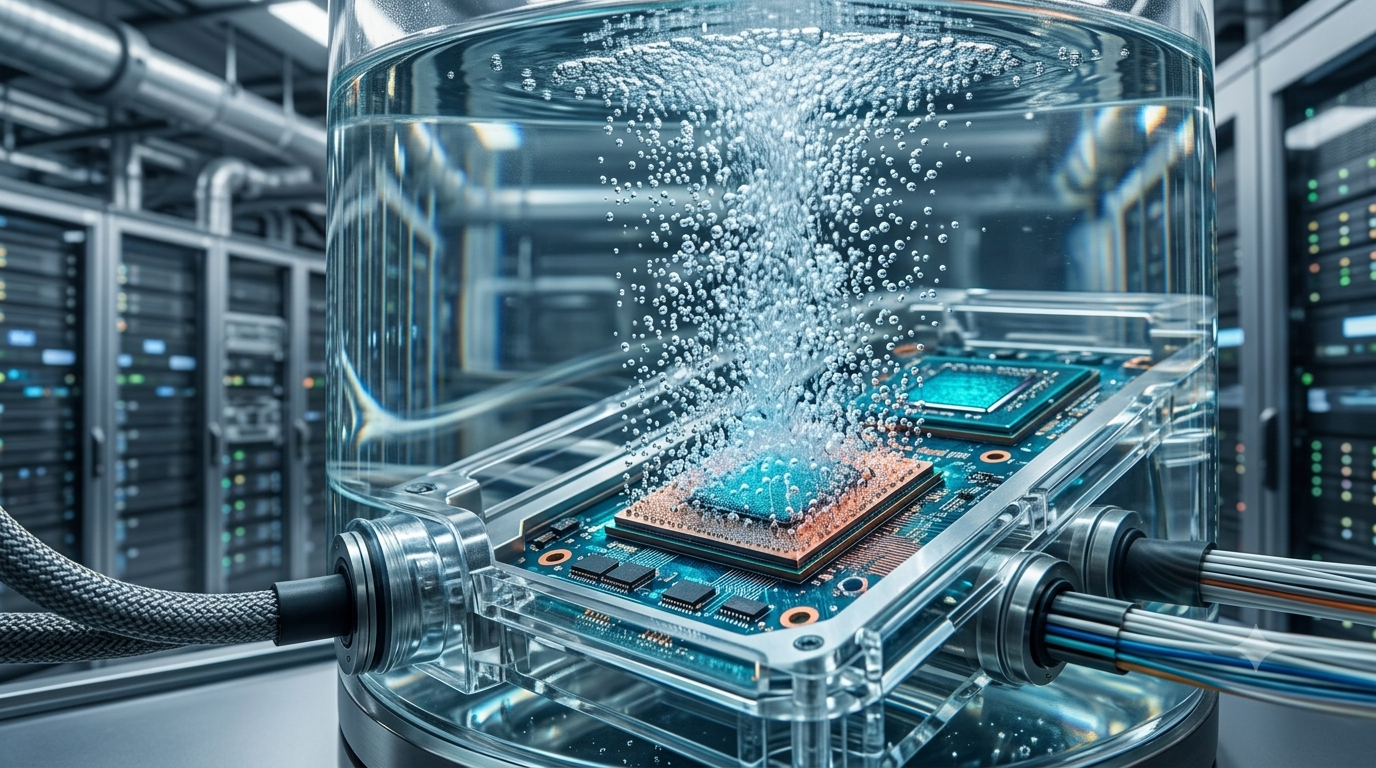
The core of Ferveret’s system is a technology called Adaptive Phase Cooling, or APC. Like many immersion-cooling solutions, APC relies on liquid rather than air to remove heat from computing hardware. What differentiates the system is how it manages boiling at the chip surface. The technology generates extremely small bubbles that detach rapidly and recondense almost immediately within the surrounding liquid. This process accelerates heat transfer while avoiding some of the complexity associated with traditional boiling-based cooling systems. The result is a more efficient thermal cycle that improves cooling performance without increasing operational complexity.
The technology draws inspiration from a nuclear engineering concept known as subcooled boiling. In conventional boiling systems, operators must carefully manage vapor formation, pressure, and fluid recovery. Ferveret’s approach allows bubbles to form and collapse within a tightly controlled environment. Smaller bubbles create more efficient heat exchange while maintaining stable operating conditions. According to the company, the process enables significantly greater thermal performance than many existing liquid-cooling alternatives. This capability becomes increasingly important as AI chips continue pushing the limits of power density.
Another notable aspect of the design is its avoidance of PFAS-based fluids. Several advanced cooling approaches rely on chemicals often referred to as “forever chemicals” because of their environmental persistence. Foundersinstead uses a low-boiling-point liquid that does not contain PFAS compounds. This decision aligns with growing industry efforts to improve sustainability while maintaining performance. As environmental scrutiny of data center operations increases, fluid selection is becoming an increasingly important consideration. Ferveret’s system attempts to balance performance improvements with environmental responsibility.
Efficiency Gains Could Change AI Economics
The startup’s claims extend beyond thermal performance. In collaboration with UCLA’s Intelligent Connectivity Laboratory, Foundersconducted benchmarking studies using NVIDIA H200 GPUs. According to the results, the APC system achieved a 15% improvement in computational efficiency compared with direct-to-chip liquid cooling solutions. The benchmark measured performance in terms of computational output per unit of power consumed. These findings suggest that cooling improvements alone can materially affect AI infrastructure productivity. Such gains become increasingly valuable as operators face growing constraints around power availability. The company argues that the benefits compound when cooling efficiency is combined with facility-level optimization. Ferveret’s control software continuously monitors operating conditions and adjusts power delivery in real time.
By coordinating thermal performance and energy management, the company says operators can generate up to 35% more AI output from the same power allocation. In a market where access to electricity increasingly determines infrastructure growth, extracting more compute from existing power resources represents a significant advantage. The approach aligns closely with industry efforts to maximize performance per watt. Power constraints have become one of the defining challenges of AI infrastructure development. In many regions, obtaining new electricity capacity can take years. Data center operators therefore seek technologies that increase computing output without requiring additional power contracts. Cooling innovations now influence infrastructure economics in ways that were rarely considered a decade ago. Ferveret’s value proposition is built around that reality. The company is positioning thermal efficiency as a direct driver of AI productivity rather than merely an operational concern.
A Water-Free Path for Future Data Centers
Water consumption has become another major concern for the industry. Conventional cooling systems often require significant water resources, particularly in large facilities operating in warm climates. Growing public scrutiny and environmental regulations are forcing operators to reconsider how cooling infrastructure is designed. Several recent innovations focus on reducing or eliminating water consumption entirely. Ferveret’s platform fits within that broader industry movement toward water-efficient infrastructure.
The company’s water-free approach may offer advantages in regions where renewable energy resources are abundant but water availability remains limited. Solar-rich environments frequently face water constraints that complicate large-scale data center development. By removing water requirements from the cooling equation, operators gain greater flexibility when selecting future infrastructure locations. This capability could support data center deployment in parts of the Middle East, Africa, and water-stressed regions of North America. As AI infrastructure expands globally, geographic flexibility may become increasingly valuable.
From Pilot Projects to Commercial Deployment
Startup is already testing its technology with several organizations. The company has announced collaborations involving CleanSpark, FuriosaAI, and Switch, one of the largest data center operators in the United States. These deployments provide opportunities to validate performance outside laboratory environments. Success in commercial settings will ultimately determine whether the technology can scale across the broader industry. Early partnerships suggest operators are actively exploring alternatives to conventional cooling architectures. Interest reflects the growing urgency surrounding thermal management challenges.
The company is also participating in NVIDIA’s Inception startup ecosystem, providing additional visibility within the AI infrastructure market. Founders plans to expand partnerships and continue refining its integrated cooling and software platform. Its modular design may also simplify deployment compared with some immersion-cooling systems that require large infrastructure changes. Operators increasingly prefer solutions that can integrate with existing rack environments rather than requiring complete facility redesigns. This emphasis on deployability may prove as important as the underlying thermal innovation itself.
Cooling May Become the Next AI Infrastructure Battleground
The AI industry often focuses on model performance, chip design, and computing scale. Yet cooling is becoming one of the most influential variables in infrastructure development. Power constraints, water scarcity, and rising rack densities are forcing operators to rethink how facilities are designed and operated. Technologies that improve thermal efficiency can unlock additional compute capacity without expanding energy consumption. As a result, cooling is increasingly viewed as a strategic lever rather than a background utility. Ferveret’s nuclear-inspired approach illustrates how ideas from other industries can reshape AI infrastructure. By applying advanced heat-transfer techniques developed for reactors, the company is targeting one of the fastest-growing challenges in digital infrastructure. Whether its technology achieves large-scale adoption remains uncertain. However, the broader trend is clear. The next phase of AI infrastructure growth will depend not only on more powerful chips but also on smarter ways to manage the heat those chips generate. In that environment, thermal engineering may become one of the industry’s most valuable competitive advantages.











