Skip to content
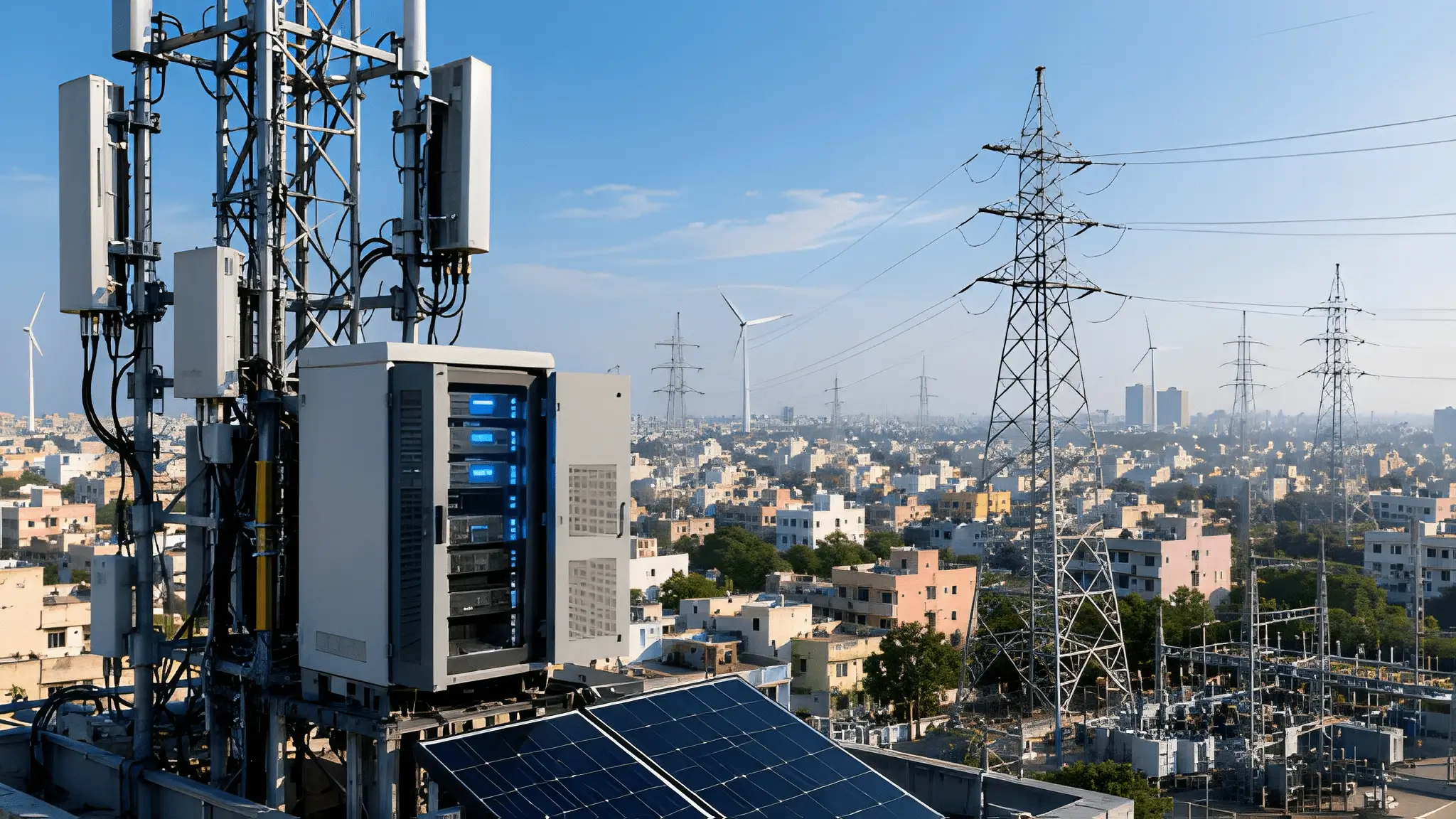
Infrastructure rarely disappears when technology moves on. It often waits for a new workload that can justify its location, power access, and connectivity. Across India, thousands of telecom sites built for an earlier generation of mobile networks now occupy strategic positions inside cities, towns, industrial clusters, and rural corridors. Most discussions around artificial intelligence infrastructure focus on large campuses, GPU clusters, and hyperscale investments. Yet the next phase of deployment may depend just as much on where inference happens as on where models are trained. That distinction places dormant telecom real estate into an entirely different economic category.

India’s digital economy increasingly depends on workloads that require responses in milliseconds rather than minutes. Payment authorization, language translation, agricultural recommendations, fraud detection, video analytics, and customer support systems all generate value when decisions happen close to the user. Moving every request to a centralized facility creates transport overhead that grows as applications become more interactive. Edge inference shifts computation toward the network perimeter and reduces the distance between users and machine intelligence. Existing telecom infrastructure already provides many of the physical ingredients required for that transition. The question is no longer whether distributed AI will emerge, but whether India can deploy it without rebuilding everything from scratch.
From Signal Bars to Inference Zones
Telecom towers were originally optimized for radio coverage, and the characteristics that made them valuable for connectivity include several attributes commonly associated with edge computing deployments, including network access, power availability, and proximity to users. Their locations were selected after years of network planning, demographic analysis, and traffic forecasting. Operators secured rights of way, established utility connections, and integrated these sites into national communications networks. Elevation advantages improved signal propagation, while dense deployment patterns reduced service gaps across populated regions. Those same geographic attributes now create a framework capable of hosting localized computing resources. The asset is not merely the tower structure itself, but the network position that the structure occupies. Large AI facilities remain essential for training and orchestration, but inference operates under a different economic model. Once a model has been trained, performance often depends on how quickly users can access it rather than on the scale of the training cluster. Distributed inference nodes positioned near end users can process requests without forcing every interaction through a distant regional hub. This architecture reduces transport costs, improves responsiveness, and supports workloads that require continuous interaction. Telecom sites already exist within the geographic footprint where demand originates. Consequently, they provide a ready-made foundation for extending computational capacity beyond traditional facilities.
Latency by Pincode: The Bharat Advantage
Artificial intelligence applications increasingly compete on responsiveness rather than raw model size. Users rarely evaluate infrastructure architecture directly, but they notice delays immediately when applications become interactive. Financial transactions, conversational interfaces, recommendation engines, and multilingual assistants all benefit from reduced round-trip times. When requests travel across multiple network layers before reaching a processing endpoint, latency accumulates rapidly. Edge-based inference reduces that travel distance and allows decisions to occur closer to where data originates. The operational benefit becomes especially visible in applications that require continuous user interaction. India presents a distinctive deployment environment because digital demand extends far beyond metropolitan centers. Growth in digital payments, regional language content, agricultural platforms, and mobile-first services increasingly comes from smaller cities and rural districts. Serving these users exclusively from a limited number of centralized facilities introduces performance variability across geographies. Locating inference resources closer to consumption points can help reduce network travel distances and support more consistent application responsiveness across regions. This model supports broader participation in digital services without requiring every interaction to traverse long network paths. As a result, infrastructure design begins to align more closely with population distribution rather than real estate concentration.

The Micro-Site Multiplier Effect
Infrastructure economics often become clearer when viewed as a system rather than as a collection of individual assets. Rail networks derive value from connectivity across thousands of kilometers, not from any single station. Distributed computing follows a similar principle because performance improves when nodes work together across a coordinated architecture. A tower-based inference network gains relevance through geographic coverage, workload distribution, and operational flexibility. Evaluating one location in isolation misses the cumulative effect that emerges when thousands of sites participate in a common platform. The resulting network can serve a wider range of applications than any standalone deployment could support. Traditional infrastructure planning often measures success through the capacity of a single facility. Edge deployments require a different lens because resilience and proximity become equally important metrics. Distributed nodes can help balance localized demand and reduce dependence on a single centralized processing location.
Workloads can move dynamically across regions according to utilization patterns, service requirements, and network conditions. This flexibility improves operational efficiency while creating a more balanced use of computing resources. Network effects therefore become a central component of value creation rather than a secondary benefit. The broader implication is that infrastructure value increasingly comes from coordination rather than concentration. A network of thousands of intelligently managed sites can support use cases that would be difficult to serve from a small number of centralized facilities alone. Orchestration software determines where workloads execute, while the physical network provides geographic reach. This combination transforms existing telecom assets into part of a national digital utility layer. Investments then focus on optimizing the network rather than continuously expanding physical campuses. That shift creates a different framework for evaluating long-term infrastructure returns.
Fiber Was Already There
Connectivity remains one of the most expensive and time-consuming components of digital infrastructure deployment. New facilities often require extensive investment in network access before they can support meaningful workloads. Many telecom operators invested in backhaul modernization during previous network upgrades to support rising mobile data demand and higher-capacity services. Operators expanded fiber connectivity to support rising mobile data consumption and higher-capacity radio technologies. Those investments created a communications fabric that extends deep into urban and semi-urban environments. Infrastructure originally deployed for mobile broadband now provides a foundation for distributed computing coordination. Fiber infrastructure carries strategic value because compute resources become useful only when they can communicate efficiently. Distributed inference nodes require orchestration, monitoring, model updates, telemetry collection, and workload balancing. Reliable backhaul enables these functions without requiring extensive additional connectivity investments. Existing fiber routes therefore reduce one of the major barriers associated with expanding digital infrastructure. Rather than constructing entirely new communication pathways, operators can leverage assets already embedded within the network. This changes the economics of deployment by shifting investment toward compute and software layers.
The Zoning Loophole for Digital Infrastructure
Physical infrastructure faces constraints that extend far beyond technology and capital. Land-use regulations, building permissions, safety requirements, and community acceptance often determine how quickly projects move from planning to deployment. Large digital facilities frequently encounter scrutiny because they require substantial land parcels and extensive utility resources. Telecom towers historically followed a different regulatory path because governments viewed them as communications infrastructure rather than commercial developments. That distinction created deployment flexibility across a wide range of locations. The regulatory classification may now have implications that extend beyond telecommunications. Municipal frameworks generally evolved before distributed artificial intelligence became a meaningful infrastructure category. As a result, many regulations focus on traditional property uses rather than hybrid digital deployments. Existing telecom locations already operate within sites that have established infrastructure access and regulatory approvals. Space constraints, permitting complexity, and community objections can delay entirely new projects. Infrastructure reuse provides a mechanism for introducing computing capacity without triggering every challenge associated with greenfield construction. This dynamic creates an operational advantage that extends beyond pure engineering considerations.
Build the Network, Not the Warehouse
India’s next phase of artificial intelligence infrastructure may depend less on constructing larger facilities and more on distributing intelligence across existing networks. Training environments will continue to require concentrated computing resources, but inference increasingly rewards proximity, responsiveness, and geographic reach. Telecom infrastructure offers a practical mechanism for extending computational capacity closer to users without replicating every element of a traditional development model. Existing locations, connectivity assets, and operational frameworks provide a foundation that already spans much of the country. The opportunity lies in coordinating these assets into a unified service layer. The competitive advantage emerges from orchestration rather than sheer physical scale. The economic implications extend beyond the technology sector itself. Faster digital services improve the effectiveness of financial systems, enterprise software, public services, logistics platforms, and sector-specific applications. Distributed inference can support these outcomes by reducing latency and improving responsiveness across diverse geographies.
The second life of India’s retired telecom footprint is not a story about preserving old assets. It is a story about matching existing infrastructure to emerging computational requirements. Thousands of sites that once carried voice and mobile data traffic can potentially support a distributed layer of intelligent services. Their collective value exceeds the capability of any individual location because the network itself becomes the platform. Success will depend on software orchestration, operational discipline, and economic execution rather than on monument-scale construction. India’s artificial intelligence future may ultimately be shaped by the network it has already built. Infrastructure reuse also encourages more efficient allocation of capital because organizations build upon assets that already exist. This model reflects a broader principle of digital transformation where value increasingly comes from integration rather than replacement. Existing networks can therefore become catalysts for entirely new categories of service delivery.