...
NVIDIA H200 shipments delayed to Q3  · BREAKING: Microsoft confirms 3GW data centre expansion in Asia-Pacific ·  AWS announces new sovereign cloud regions in India and UAE  · Arm-based servers now 24% of hyperscale deployments ·  EU AI Act enforcement enters phase two  · Global data centre investment hits $612B in 2026 ·  TSMC Arizona yields improve to 68% on 3nm process  · OpenAI valuation reaches $400B after latest funding round ·  NVIDIA H200 shipments delayed to Q3  · BREAKING: Microsoft confirms 3GW data centre expansion in Asia-Pacific ·  AWS announces new sovereign cloud regions in India and UAE  · Arm-based servers now 24% of hyperscale deployments ·  EU AI Act enforcement enters phase two  · Global data centre investment hits $612B in 2026

Nvidia’s 45°C Coolant and the End of the Air-Conditioned Data Center

A Temperature That Breaks Intuition Hot tubs run around 38 to 40 degrees Celsius. Nvidia’s newest AI servers run their

Share
coolant data center cooling

A Temperature That Breaks Intuition

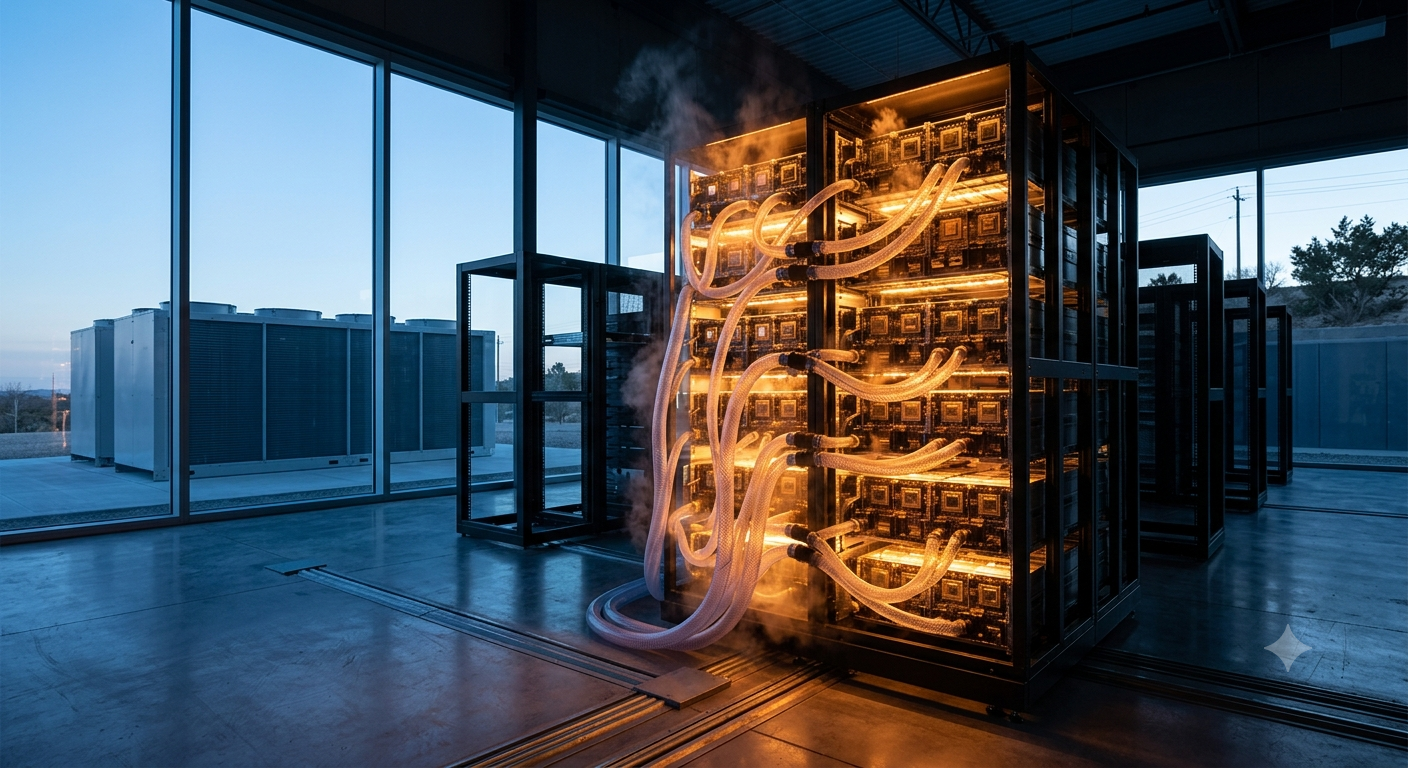
Hot tubs run around 38 to 40 degrees Celsius. Nvidia’s newest AI servers run their cooling liquid even hotter, up to 45 degrees Celsius. That number sounds wrong at first. Hotter coolant should mean worse cooling, not better. The opposite turns out to be true. The coolant itself is unremarkable chemistry. It is a mixture of 75% water and 25% propylene glycol, a formulation similar to antifreeze. What changes everything is the temperature ceiling. The liquid enters at temperatures of up to 113 degrees Fahrenheit and exits at about 131 degrees Fahrenheit, once it absorbs the heat generated by the chips. Heat transfer follows simple physics. Warmer fluids release heat faster into outdoor air. Consequently, the warmer the coolant is when it reaches the outdoor radiator, the easier it becomes for passive cooling to work. That single insight reshapes facility design entirely.

Why Chillers Become Optional

Mechanical chillers exist for one reason. They artificially lower water temperature before it reaches outdoor air. Removing that requirement removes an enormous energy burden. Traditional water-cooling methods, especially those that use chillers, often account for nearly 40% of a data center’s power consumption. That figure explains the urgency behind this shift. Cooling has quietly become one of the most expensive line items in any AI facility. Outdoor dry coolers now handle what chillers once did. At 45C, it is warm enough to reject heat efficiently in the right climate without ever turning on a mechanical chiller. Engineers call this approach dry-cooler-based design. It relies entirely on ambient air, not refrigeration cycles. Nvidia’s own framing reinforces the scale of savings. Industry estimates suggest that increasing chiller temperatures by just 1.8 degrees Fahrenheit can reduce cooling energy costs by four percent. A jump from roughly 24 to 45 degrees Celsius compounds that effect dramatically.

The Geography Problem Nobody Skips

This breakthrough is not universal, however. Climate still governs whether chillers disappear entirely. The system can run without chillers only if outdoor air temperatures stay well below the coolant’s 45-degree limit. Phoenix illustrates the limitation clearly. Nvidia admits that data centers in very hot places like Phoenix, Arizona, may still need chillers during the hottest days of the year. Desert heat simply outpaces even generous coolant tolerances. Even Nvidia’s own engineers acknowledge this nuance. In the right geography, somewhere with reliably cool outdoor air, a liquid-cooled data center can reject its heat through coolant distribution units that capture heat directly at the source. “Right geography” carries real weight in that sentence. Vertiv, a major cooling infrastructure provider, pushed back gently too. Using higher-temperature water does not eliminate the need for heat rejection. While approaches to heat rejection may change, cooling infrastructure is still required. Chillers shrink. They do not vanish everywhere.

Water Savings That Sound Almost Unbelievable

Beyond energy, the water story grabbed even more attention. Conventional cooling-tower-based systems consume roughly 2.6 million gallons of water per megawatt per year, according to the company. That baseline makes any reduction newsworthy. Nvidia’s claim goes further still. Nvidia says the new design can reduce that figure to near zero. Closed-loop circulation explains why. The propylene glycol and water mixture is introduced into the system a single time and kept in circulation indefinitely. Microsoft made a remarkably similar claim around the same moment. Speaking at Microsoft Build 2026, Nadella said the daily water usage over the course of an entire year is roughly equivalent to what a single restaurant would use. Both companies are now racing toward identical messaging. Fairwater backs this up architecturally. Over 90% of the facility’s cooling relies on a closed-loop liquid cooling system that is filled during construction and then continuously recirculates the same water. The remaining cooling load uses outside air, not evaporation.

The Math That Stops at the Wall

Here is where the celebration deserves scrutiny. Both companies measure water at the facility boundary. Nothing upstream gets counted. Critics noticed quickly. Water consumed by power plants supplying the data center’s electricity, which Nvidia does not count in its figures, can double or triple a facility’s total water footprint. That gap is not trivial. It is the entire other half of the equation. Specific numbers make this concrete. For every kilowatt-hour produced, natural gas plants draw down 1.17 liters of water, while coal-fired generation is more demanding still, at 2.2 liters per kilowatt-hour. An AI campus drawing hundreds of megawatts generates enormous indirect consumption. Independent analysis confirms this asymmetry sharply. On-site cooling accounts for only about 4% of the additional water AI will demand through 2050, according to a 2026 analysis by Xylem and Global Water Intelligence. Ninety-six percent sits elsewhere, uncounted by either company’s headline claims.

Drought Maps Make This Personal

Geography turns this abstraction into something tangible. Many AI campuses sit precisely where water already runs short. The scale is striking. Two-thirds of the 809 data centers currently planned across the United States are located on land that has been in drought over the past year. Closed-loop cooling helps less when regional water systems are already strained. Arizona shows this tension sharply. The Bureau of Reclamation declared a Level 1 Shortage Condition on Lake Mead for 2026, requiring Arizona to cut approximately 18% of its annual water apportionment. That is the same desert region drawing major AI investment. Power generation, not server cooling, drives most regional strain. Fossil fuel power plant water demand represents roughly 54% of AI’s total projected water footprint through 2050, entirely unaddressed by closed-loop facility cooling. The chiller disappeared. The bigger draw did not.

The Honest Verdict

None of this makes Nvidia’s engineering hollow. NVIDIA’s water-free cooling is a genuine technical achievement. The engineering checks out. The efficiency gains are real. Removing chillers genuinely cuts both energy and on-site water dramatically. Still, language matters enormously here. Calling a facility “zero water” while ignoring upstream generation misleads the public. Both Nvidia and Microsoft made claims that are accurate yet incomplete simultaneously. Genuine accountability requires full-chain accounting. Operators should disclose generation-source water alongside facility-level figures. Anything less repeats a familiar industry pattern: solving the visible problem, leaving the larger one in shadow. The air-conditioned data center really is ending. Whatever replaces it deserves an honest ledger, not just a warmer thermostat.


[simple-author-box]

More from AI Infrastructure

AI infrastructure has a timing problem that traditional data center planning does not solve

A data center can move from blueprint to construction while still facing significant work

AI infrastructure is entering an uncomfortable phase in which securing more electricity does not

COMPUTE WEEKLY

The briefing that 40,000+ tech leaders read every Monday. Sharp, fast, essential.

Great! We’ve received your information.

Building an AI Startup Without Owning GPUs

Not owning GPUs has become the default, deliberate strategy for building an AI company — not a compromise founders accept reluctantly. H100 rental rates fell 64-75% in fifteen months, a dense ecosystem of neoclouds and inference-as-a-service providers now lets startups skip infrastructure entirely, and credit programs can fund a company’s first year before a founder writes a check
Most Read

Demand is broadening across enterprise workloads APAC’s infrastructure story is changing in ways that

AI infrastructure decisions increasingly influence what enterprises can build, test, and deliver. They also

Why Infrastructure Planning Now Starts With Availability A data center project can have a

A property can look enormous from the site entrance and still offer almost no

As rack power rises toward the megawatt range, the physical footprint of power-delivery equipment

Disruptor Spotlight

Cerebras Systems

The chip that makes Nvidia nervous. Cerebras’ Wafer Scale Engine is rewriting the rules of AI inference at scale.
Faster
0 x
YoY Revenue
0 x
Transistors
0 T
Market Pulse
MSFT
+1.02%
NVDA
+0.66%
AMZN
-0.078%
AMD
-6.95%
TSMC
-2.98%
Indicative only · Not financial advice
Upcoming Events
SEP
The AI Infrastructure Race (India)
WEBINAR · ONLINE
The AI Infrastructure Race: Won on Power, Land and Trust — Not Capital
MAY
0
AI Infrastructure Summit
DUBAI · IN PERSON
MEA’s premier AI infrastructure event.
JUN
0 0
Compute Forecast Summit
SINGAPORE · IN PERSON
Our flagship APAC event. Early bird open.
Latest Moves
Live
ecolab
Ecolab Deepens Cooling Strategy With $4.75B CoolIT Acquisition
Ecolab is making one of its biggest moves yet into AI infrastructure after completing its $4.75 billion acquisition of liquid cooling specialist CoolIT Systems
Pure DC AVK Europe data center microgrid Dublin 110MW AI infrastructure Ireland 2026
Pure DC and AVK Deploy Europe’s First 110 MW Data Center Microgrid in Dublin
The Pure DC Dublin microgrid has made history as Europe’s first large-scale on-site data center microgrid, launched in partnership with power solutions provider AVK at Pure DC’s campus in Ireland.
Pace Digitek
Pace Digitek Partners With MEGMEET to Expand AI Data Center Power Business
India’s AI infrastructure ecosystem continues to mature as domestic technology manufacturers move beyond traditional telecommunications and industrial markets toward high-growth digital infrastructure opportunities
Follow Compute Forecast
11K followers
1200 followers
Companies to Watch
CW
CoreWeave
Neo Cloud · $19B · IPO Watch
CB
Cerebras Systems
AI Hardware · $4.25B · Pre-IPO
G42
G42
Sovereign AI · Abu Dhabi
H
Humain
Saudi AI · $40B Fund
Latest Podcast
AI Capex, Cloud Margins & the Nuclear Bet
48 MIN · 25 APR 2026

Nvidia’s 45°C Coolant and the End of the Air-Conditioned Data Center

A Temperature That Breaks Intuition Hot tubs run around 38 to 40 degrees Celsius. Nvidia’s newest AI servers run their

Share
coolant data center cooling
18
847 SHARES

0
SHARES

[simple-author-box]

More from AI Infrastructure

Demand is broadening across enterprise workloads APAC’s infrastructure story is changing in ways that

AI infrastructure decisions increasingly influence what enterprises can build, test, and deliver. They also

Why Infrastructure Planning Now Starts With Availability A data center project can have a

A property can look enormous from the site entrance and still offer almost no

COMPUTE WEEKLY

The briefing that 40,000+ tech leaders read every Monday. Sharp, fast, essential.

Great! We’ve received your information.

Global AI Infrastructure Outlook 2026

The briefing that 40,000+ tech leaders read every Monday. Sharp, fast, essential.
Download Free
Most Read

Demand is broadening across enterprise workloads APAC’s infrastructure story is changing in ways that

AI infrastructure decisions increasingly influence what enterprises can build, test, and deliver. They also

Why Infrastructure Planning Now Starts With Availability A data center project can have a

A property can look enormous from the site entrance and still offer almost no

As rack power rises toward the megawatt range, the physical footprint of power-delivery equipment

Disruptor Spotlight

Cerebras Systems

The chip that makes Nvidia nervous. Cerebras’ Wafer Scale Engine is rewriting the rules of AI inference at scale.
Faster
0 x
YoY Revenue
0 x
Transistors
0 T
Market Pulse
NVDA
$924.60
+2.4%
MSFT
$421.30
+1.1%
AMZN
$192.80
-0.6%
NVDA
$924.60
+2.4%
NVDA
$924.60
+2.4%
Indicative only · Not financial advice
Upcoming Events
MAY
0 0
DCD Global — London
LONDON · IN PERSON
World’s largest DC event. CF is media partner.
MAY
0
AI Infrastructure Summit
DUBAI · IN PERSON
MEA’s premier AI infrastructure event.
JUN
0 0

Compute Forecast Summit

SINGAPORE · IN PERSON
Our flagship APAC event. Early bird open.
Latest Moves
  • Live
Sam Altman
OpenAI appoints new Chief Infrastructure Officer to lead $100B DC programme
27 APR · OPENAI
Sam Altman
OpenAI appoints new Chief Infrastructure Officer to lead $100B DC programme
27 APR · OPENAI
Sam Altman
OpenAI appoints new Chief Infrastructure Officer to lead $100B DC programme
27 APR · OPENAI
Follow Compute Forecast
18.4K followers
12.1K followers
9.3K subscribers
41 episodes
Companies to Watch
CW
CoreWeave
Neo Cloud · $19B · IPO Watch
CB
Cerebras Systems
AI Hardware · $4.25B · Pre-IPO
G42
G42
Sovereign AI · Abu Dhabi
CW
Humain
Saudi AI · $40B Fund
Latest Podcast
AI Capex, Cloud Margins & the Nuclear Bet
48 MIN · 25 APR 2026
Scroll to Top
Seraphinite AcceleratorOptimized by Seraphinite Accelerator
Turns on site high speed to be attractive for people and search engines.