 Skip to content
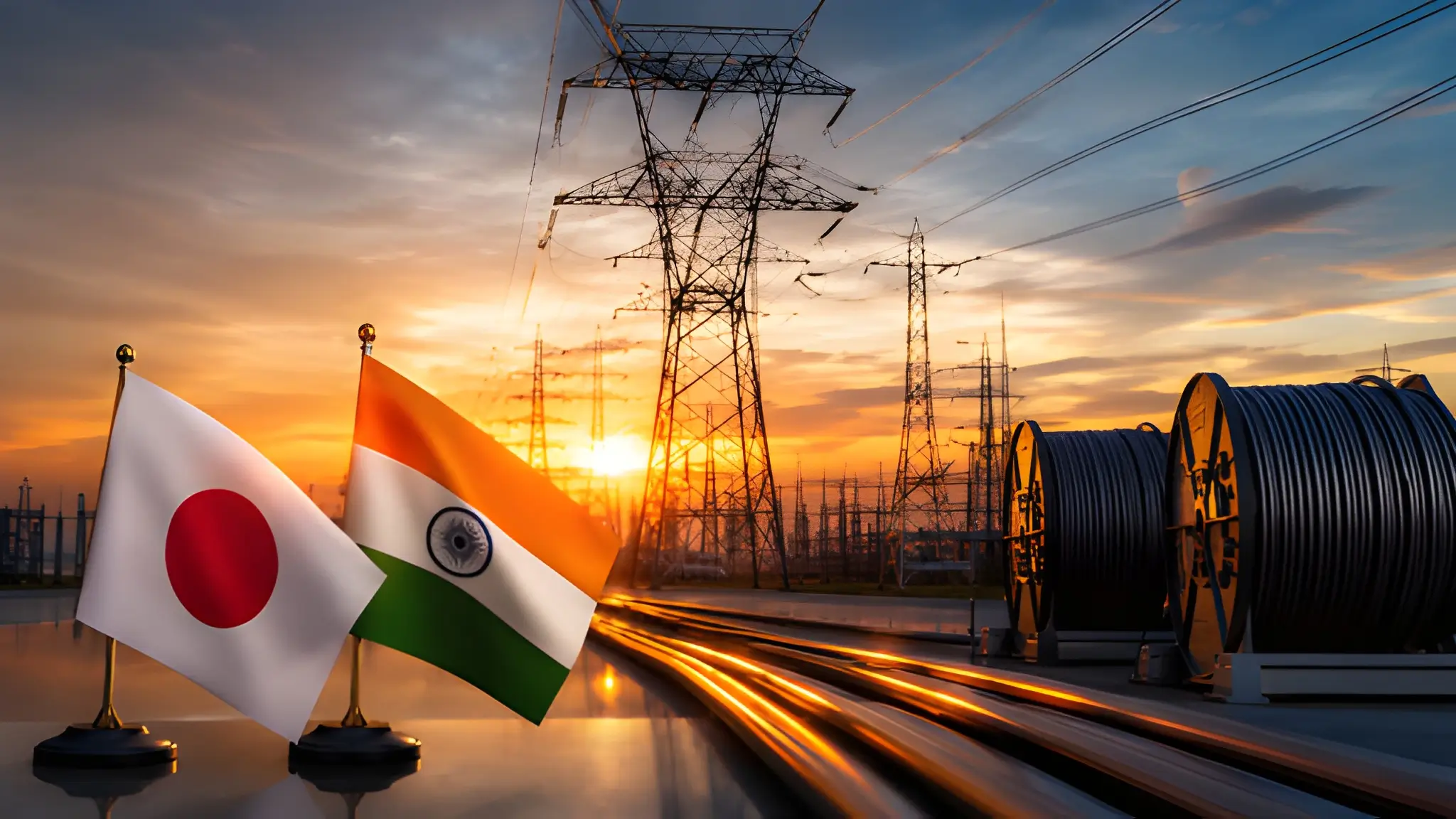
Japan will finance one of India’s largest electricity transmission projects, committing up to 80 billion yen (approximately $492 million) through a new regional energy partnership that strengthens clean energy infrastructure across Asia. The investment launches POWERR Asia, a framework that the Japan Bank for International Cooperation (JBIC) introduced to accelerate strategic energy transition projects and strengthen economic resilience across the Indo-Pacific. The initiative comes as India expands renewable generation capacity and upgrades the transmission networks required to deliver clean electricity nationwide. The 16th India-Japan Annual Summit will spotlight the financing package as both countries expand cooperation beyond conventional infrastructure into energy security, advanced manufacturing, and resilient supply chains. The partnership also signals a broader shift in bilateral ties, with power infrastructure becoming a central pillar of long-term economic cooperation.

POWERR Asia Launches With India’s Major Transmission Corridor
According to Nikkei Asia, Japan Bank for International Cooperation (JBIC), together with Sumitomo Mitsui Banking Corp. (SMBC), Kansai Mirai Bank, and other financial institutions, will arrange the funding package. The project becomes the first investment under the newly launched POWERR Asia initiative, which Japanese Prime Minister Sanae Takaichi proposed to accelerate clean energy infrastructure across the region. Instead of supporting isolated renewable assets, the framework strengthens transmission networks that enable large-scale energy transition. Power Grid Corporation of India is developing the high-voltage direct current (HVDC) transmission system with support from the financing package. The corridor will connect the rapidly expanding renewable energy hub at Khavda in Gujarat with Nagpur in Maharashtra, creating an electricity transmission route spanning roughly 1,200 kilometers. Developers plan to commission the project in 2029, and they currently estimate the total development cost at around 550 billion yen ($3.4 billion).
India’s renewable energy ambitions increasingly depend on transmission capacity as much as generation capacity. Large renewable clusters are often located far from industrial and urban demand centers, making efficient long-distance power delivery essential for grid stability. HVDC technology addresses that challenge by transmitting electricity over extended distances with significantly lower transmission losses than conventional alternating current systems. The Khavda-Nagpur corridor represents another step toward building a nationwide transmission backbone capable of integrating gigawatt-scale renewable generation into India’s national electricity network. Meanwhile, the project is also expected to accelerate wider deployment of HVDC infrastructure throughout the country. According to Nikkei Asia, Hitachi Energy, through its Indian operations and affiliated companies, has already secured transmission and distribution equipment orders connected to the project, reinforcing its position within India’s expanding grid modernization efforts.
India And Japan Expand Cooperation Beyond Electricity Networks
The transmission project forms part of a broader package of agreements expected during the summit between Prime Minister Narendra Modi and Prime Minister Sanae Takaichi. The discussions extend across clean energy, advanced manufacturing, strategic technologies, and economic security, reflecting the expanding scope of the India-Japan partnership. Both governments increasingly view infrastructure collaboration as a long-term strategic asset rather than solely an investment opportunity. According to Nikkei Asia, the two countries are expected to introduce new measures supporting the production of green hydrogen and renewable ammonia in India. These initiatives align with shared efforts to reduce reliance on imported fossil fuels while advancing industrial decarbonization across key sectors.
The summit is also expected to produce a Joint Declaration on Economic Security Cooperation, covering semiconductors, pharmaceuticals, and resilient supply chains that have become increasingly important amid shifting global trade dynamics. Ahead of the summit, Modi said on X that he looked forward to “wide-ranging talks” that would further strengthen the India-Japan Special Strategic and Global Partnership while advancing “peace, stability and prosperity across the Indo-Pacific.” The statement underscores the growing geopolitical dimension of infrastructure cooperation as both countries deepen coordination across multiple strategic sectors.
Japanese Investment Signals Long-Term Confidence In India’s Energy Transition
Beyond government-backed financing, Japanese private companies are reportedly preparing to announce nearly $12.5 billion in investments through approximately 120 cooperation agreements linked to the summit, according to Japanese media reports cited by Nikkei Asia. Those investments span multiple industries and indicate growing corporate confidence in India’s long-term industrial and infrastructure expansion. Consequently, energy transmission projects are increasingly becoming catalysts for wider investment across manufacturing, technology, and supply chains. India currently imports nearly 90% of its crude oil requirements, making energy diversification an increasingly important national priority. Strengthening long-distance electricity transmission supports greater integration of domestic renewable resources while reducing dependence on imported fuels over time. For Japan, supporting India’s evolving power infrastructure also strengthens the resilience of one of its most important strategic partners across the Indo-Pacific, where energy security and economic competitiveness are becoming closely interconnected.













