 Skip to content
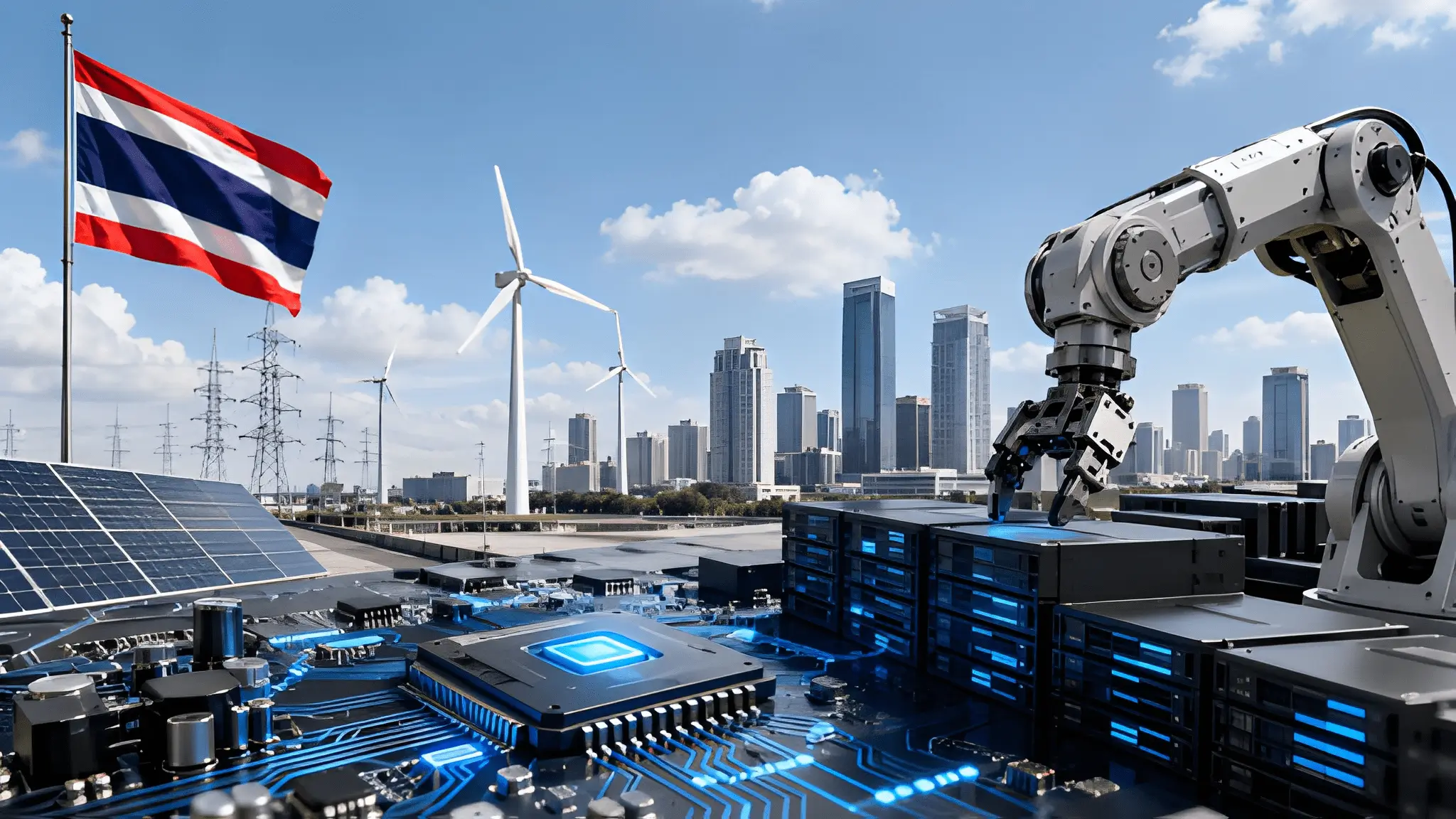
Thailand is moving beyond investment incentives and into infrastructure planning as it positions itself for the next phase of the AI economy. The country has approved US$1.99 billion (66.3 billion baht) in new investments spanning artificial intelligence, advanced electronics, clean energy, and data center infrastructure, reinforcing its ambition to become a regional technology manufacturing and AI infrastructure hub. The latest approvals, announced by the Thailand Board of Investment (BOI), bring together capital commitments from leading Japanese, South Korean, Taiwanese, and domestic companies. Rather than focusing only on attracting capital, the government is simultaneously redesigning the regulatory framework needed to support power-intensive AI infrastructure. That dual approach reflects a broader shift in how countries now compete for hyperscale digital infrastructure. As AI deployments become larger and more energy intensive, governments increasingly need to coordinate electricity, sustainability, manufacturing, and permitting under a single investment strategy.

Thailand Restructures Data Center Energy Governance
One of the most significant developments accompanying the investment approvals is the restructuring of Thailand’s specialized energy oversight panel. The BOI has expanded the committee’s mandate and renamed it the Subcommittee on Energy Management for Data Center Investment and Project Screening, placing it under the leadership of the Minister of Energy. The committee will serve as a centralized review mechanism for future data center proposals. It will examine electricity consumption, environmental impact, water requirements, and clean energy sourcing before projects become eligible for government tax incentives. This effectively places resource planning ahead of fiscal incentives, creating a regulatory checkpoint designed for the realities of hyperscale infrastructure development.
For larger facilities, the government has also introduced a seven-point energy strategy intended to accelerate deployment while maintaining long-term resource stability. The framework includes dedicated electricity tariff structures for data centers, alignment of renewable energy targets with Thailand’s national Power Development Plan, and mechanisms allowing companies to procure renewable electricity through Direct Power Purchase Agreements (PPAs). The roadmap also introduces electricity usage guarantee rules, evaluates direct high-voltage transmission options for hyperscale operators, accelerates national grid investments, and maps regional water and electricity availability to improve future site selection decisions. Consequently, infrastructure planning is becoming a core component of Thailand’s investment policy rather than an afterthought.
Government Links AI Growth With Long-Term Infrastructure Planning
The BOI says the latest measures aim to create confidence among global technology investors while ensuring future infrastructure remains sustainable as AI demand continues to rise. Narit Therdsteerasukdi, Secretary General of the BOI, stated, “We are building the infrastructure needed for the next wave of future-industry investment. The government is aligning resource management with its green transition goals to ensure long-term operational security and give global investors confidence.” He added that by locating key parts of the AI and advanced electronics value chain in Thailand, the economy is directly connecting to the core of next-generation global technology. The comments highlight a strategy extending beyond individual investment announcements. Thailand is positioning itself to host both AI manufacturing capacity and the digital infrastructure required to operate future AI workloads. That combination could strengthen the country’s role within Asia’s expanding semiconductor and cloud infrastructure supply chain.

Among the largest approved projects is an investment by Datasection (Thailand) Co., Ltd., the local subsidiary of Japan’s Datasection Inc. The company will invest US$235.2 million (7.8 billion baht) to establish high-performance Graphics Processing Unit (GPU) server infrastructure across Bangkok and Pathum Thani. The GPU server deployment will provide computing infrastructure for AI applications, enterprise workloads, and regional digital services. As organizations increasingly require dedicated AI compute capacity, GPU-focused facilities have become one of the fastest-growing segments within the broader data center industry. The project also signals Thailand’s intent to compete for AI infrastructure deployments instead of serving solely as a manufacturing location.
Electronics Manufacturing Expands Around AI Supply Chains
Several approved investments strengthen Thailand’s position in the advanced electronics ecosystem supporting AI servers and high-performance computing hardware. South Korea’s Doosan Electro-Materials (Thailand) Co., Ltd. will invest US$180.2 million (6 billion baht) in Samut Prakan to manufacture copper-clad laminate (CCL) and prepreg materials. Taiwan Union Technology (Thailand) Co., Ltd. will invest US$189.2 million (6.3 billion baht) in Chonburi to manufacture similar materials specifically designed for AI servers and data center equipment.
These components form essential layers within printed circuit boards, making them critical to modern computing systems. Meanwhile, Fulltech Fiber Glass (Thailand) Co., Ltd. will invest US$99.4 million (3.3 billion baht) in Chachoengsao to manufacture specialized glass fiber fabric used in PCB production. Together, these projects expand domestic manufacturing capacity across multiple stages of AI hardware production. Rather than relying entirely on imported materials, Thailand is building a more localized supply chain capable of supporting future electronics demand generated by AI infrastructure.
Clean Energy Investment Supports Future Data Center Demand
The investment package also includes new renewable energy capacity intended to support industrial electricity demand. Lomrak Green Energy Co., Ltd. plans to invest US$168.7 million (5.6 billion baht) in two wind power projects located in Lopburi province. The facilities will deliver a combined generating capacity of 120 megawatts to Thailand’s national electricity grid. The additional renewable generation is expected to support electricity-intensive industries, including future data center developments that increasingly require access to cleaner power sources.
The investment approvals were finalized during a BOI meeting chaired by Ekniti Nitithanprapas, Deputy Prime Minister and Minister of Finance. Collectively, the approved projects demonstrate how Thailand is aligning industrial manufacturing, AI infrastructure, energy planning, and regulatory modernization into a single national investment strategy. For hyperscale operators evaluating future expansion across Southeast Asia, that level of coordination may prove as important as the capital incentives themselves.












